
Please Choose Your Language
Views: 222 Author: XS Traffic Facilities Publish Time: 2026-06-08 Origin: Site


Content Menu
● What Are Portable Temporary LED Signs?
● What Are Permanent Concrete-mounted Signs?
● Market Context: Why This Choice Matters Now
● Key Functional Differences: Portable vs. Permanent
>> Visibility and message impact
● Compliance, Safety, and Standards
● Cost and Lifecycle Economics
● Typical Application Scenarios (With Expert Guidance)
>> When to choose portable temporary LED signs
>> When to choose permanent concrete-mounted signs
● Technical and Design Considerations
>> Structural and installation aspects
>> Optical performance and LED technology
● New Insight: Hybrid Deployment Strategy for Agencies
● Practical Selection Framework (Step-by-step)
● Comparison Table: Portable vs. Permanent
● How Shenzhen Xingsheng Can Position Its OEM/ODM Services
● Action-oriented Recommendations (CTA)
● FAQs
>> 1. Are portable temporary LED signs as safe as permanent concrete-mounted signs?
>> 2. How long can a portable temporary LED sign stay in one place?
>> 3. Can permanent concrete-mounted signs be upgraded to LED later?
>> 4. Which option is more cost-effective for large construction contractors?
>> 5. Do both types of signs support integration with smart traffic systems?
Portable temporary LED signs and permanent concrete-mounted signs each play a critical role in modern traffic safety, but they serve very different strategic needs for road authorities, contractors, and facility operators. Understanding how they compare in cost, compliance, visibility, and lifecycle performance is essential before making a long-term investment.
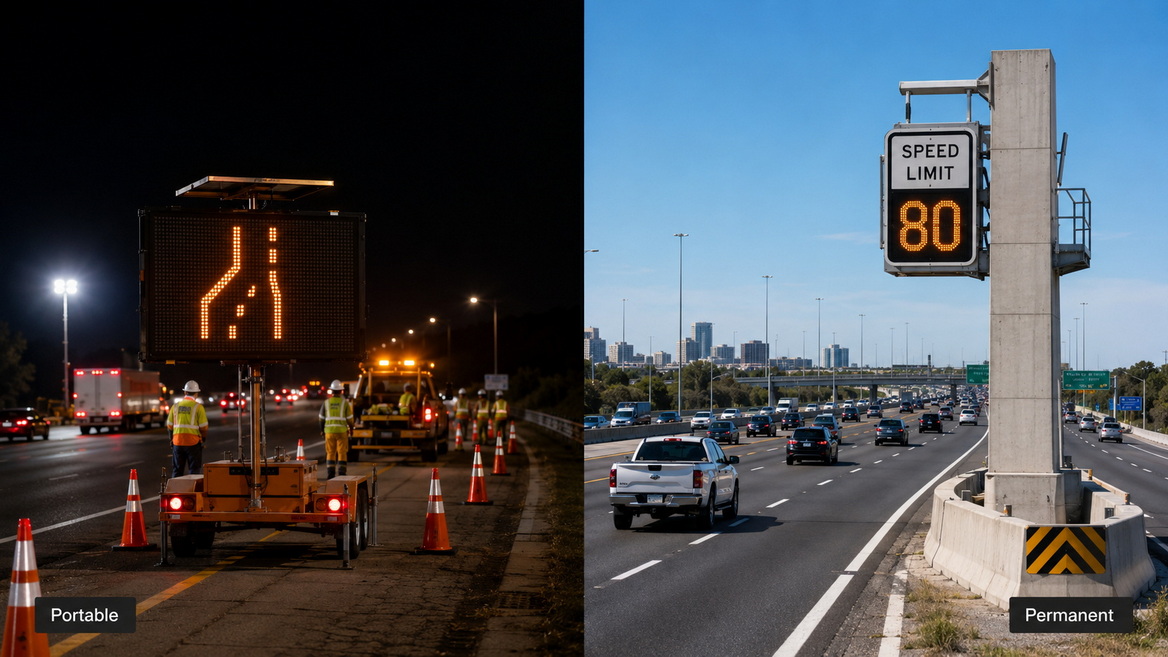
Portable temporary LED signs are movable, self-contained traffic control devices used for short- to medium-term applications such as construction zones, maintenance work, events, or temporary lane closures. They are typically mounted on trailers or foldable stands, powered by batteries and/or solar panels, and equipped with programmable LED displays.
From a field-operations perspective, these signs are designed for rapid deployment and relocation without civil works, making them ideal when road conditions are changing frequently. For a manufacturer like Shenzhen Xingsheng Traffic Facilities Co., Ltd., this category often includes portable LED speed signs, lane control signs, and temporary warning signs tailored to contractors and highway agencies.
Typical use cases:
- Road construction and maintenance work zones
- Temporary detours and lane closures
- Event traffic management (stadiums, festivals, exhibitions)
- Short-term speed control and enforcement support
- Emergency incident response and disaster diversion
Permanent concrete-mounted signs are fixed, long-term traffic signs installed on poles or gantries that are anchored in concrete foundations. They are intended to function for many years in the same location and usually form part of the core traffic control infrastructure of highways, urban streets, toll stations, and parking facilities.
These signs can be traditional retroreflective panels, LED-enhanced signs, or full LED variable message signs mounted on permanent structures. Because they are structural installations, they must meet strict standards for mounting height, wind resistance, crashworthiness, and durability under local regulations such as MUTCD in the U. S. or equivalent standards in other markets.
Typical use cases:
- Regulatory signs (speed limit, stop, yield, lane use)
- Directional and guide signs on highways and interchanges
- Toll lane control and fee information
- Parking guidance and static wayfinding
- Long-term school zone, pedestrian crossing, and warning signs
The global LED traffic signs and signals market is projected to grow steadily, reaching around USD 1.43 billion by 2033 with a CAGR of about 3.5% from 2025 to 2033. This growth is driven by urbanization, smart city projects, and safety regulations that favor LED-based solutions over traditional reflective-only signs.
For B2B buyers—from government agencies and EPC contractors to parking operators—choosing between portable temporary LED signs and permanent concrete-mounted installations is no longer a purely tactical decision; it affects lifecycle cost, compliance, and digital integration across projects. A Chinese OEM/ODM traffic sign manufacturer can add value by advising on system-level planning rather than only supplying hardware.
Portable temporary LED signs:
- High flexibility: Can be moved between sites in hours or even minutes.
- Minimal civil works: Usually no concrete foundation required; ballasted with sandbags or integrated trailer ballast.
- Ideal where traffic patterns or work zones change frequently (e. g., phased construction).
Permanent concrete-mounted signs:
- Low flexibility: Relocation requires new foundations, roadwork, and permits.
- Significant initial civil works: Excavation, rebar, concrete curing, and inspections.
- Optimal when the message and location will remain stable for many years.
Portable temporary LED signs:
- High-intensity LED displays provide strong visibility in low-light or adverse weather conditions.
- Programmable messages allow dynamic warnings (e. g., "Road Work Ahead", "Lane Closed", "Accident Ahead").
- Often mounted lower than permanent signs, so placement must follow guidelines to avoid driver blind spots.
Permanent concrete-mounted signs:
- Can combine retroreflective sheeting with LED enhancements for 24/7 visibility.
- Higher mounting height improves long-distance readability, especially at high speeds.
- Ideal for consistent, repetitive messages (speed limit, direction, toll info) that drivers learn to trust over time.
Both portable and permanent traffic signs must comply with national and regional standards such as the Manual on Uniform Traffic Control Devices (MUTCD) in the U. S. or similar rules elsewhere. Non-compliance can expose road authorities and contractors to liability in the event of accidents.
Portable temporary LED signs:
- Governed by temporary traffic control standards (e. g., MUTCD Part 6) covering work zone devices.
- Requirements include minimum sign sizes, lettering heights, mounting heights, and crashworthy supports.
- Placement distances must be adapted to vehicle speed, typically 4–12 times the speed limit in multiples, depending on urban vs. rural roads.
Permanent concrete-mounted signs:
- Must meet structural and safety standards for foundations, breakaway supports, and wind loading.
- Large signs exceeding 50 square feet need minimum clearances and specifically engineered posts.
- Long-term durability and reflectivity performance are audited across the sign's service life.
For an OEM/ODM manufacturer, demonstrating expertise in these standard frameworks—through documentation, testing reports, and design guidance—strengthens E-E-A-T and builds trust with international buyers.
From a procurement standpoint, buyers should evaluate total cost of ownership, not just the initial purchase price.
Portable temporary LED signs:
- Higher unit price than simple static panels, but can be reused across many short-term projects.
- Cost-effective for contractors working on multiple roadwork or maintenance contracts each year.
- Operating costs include energy (often mitigated by solar), periodic battery replacement, and occasional LED module service.
Permanent concrete-mounted signs:
- Higher upfront cost due to foundations, structural supports, installation labor, and traffic control during works.
- Very low per-year cost when amortized over a long lifespan (often 10–15 years or more with quality materials).
- Suitable for public owners who budget for long-term capital investments rather than temporary rental-like assets.
As a rule of thumb, portable temporary LED signs make financial sense where the same device can be utilized across numerous projects, while permanent concrete-mounted signs are justified for stable, high-traffic locations that demand enduring infrastructure.
From the viewpoint of an experienced traffic engineer or contractor, portable signs are the best choice when:
- Project duration is less than a few months, or the work zone shifts frequently.
- You need dynamic messaging to respond to incidents, weather, or daily lane changes.
- The road authority prefers minimal permanent visual clutter once works are completed.
Concrete example: A highway resurfacing project progressing 2–3 km per week can redeploy the same fleet of portable LED signs along the corridor as work advances, avoiding repeated installation of permanent posts that would later be removed.
Permanent concrete-mounted signs are preferred when:
- The road geometry and traffic patterns are stable over years (new interchanges, toll plazas, main parking entrances).
- Messages must be always visible and consistent, such as speed limits, exit information, or permanent lane allocations.
- The site is part of a strategic road network or long-term smart corridor plan.
Concrete example: A new toll station with multiple dedicated lanes (electronic, cash, trucks, buses) requires clearly mounted overhead lane control signs fixed in concrete foundations to ensure alignment and visibility at highway speeds.
Portable temporary LED signs:
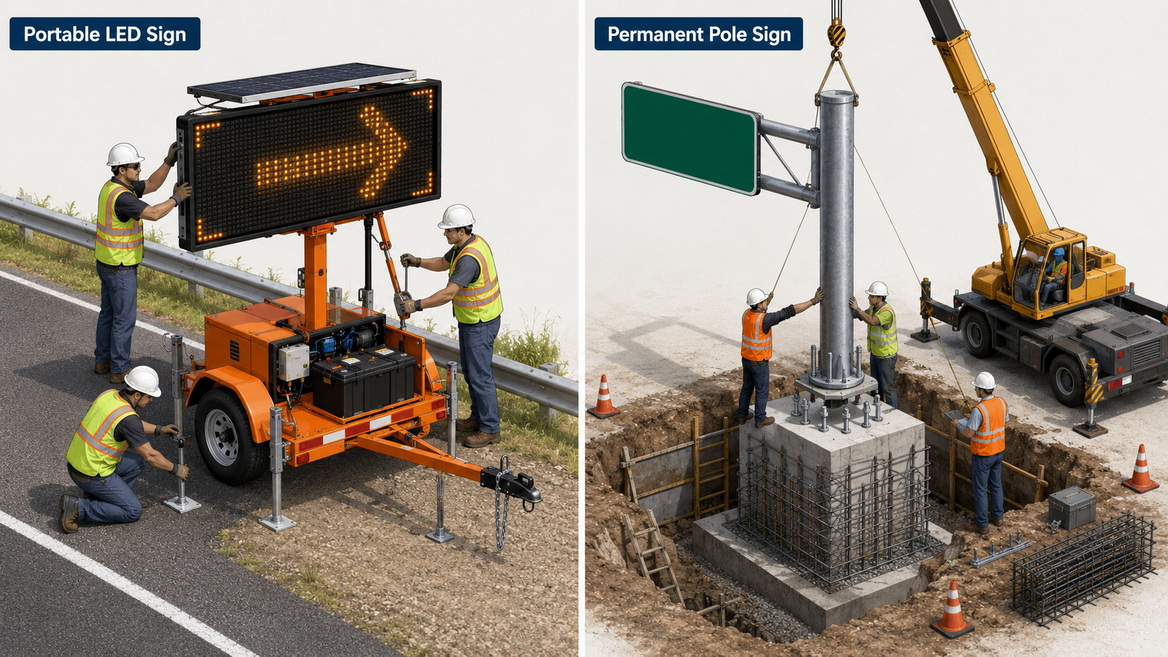
- Trailer-mounted or foldable tripod frames with integrated ballast.
- Quick setup using manual or electric mast raising.
- Must still follow minimum mounting heights (e. g., at least 1 foot above the traveled way for some portable supports) and be crashworthy.
Permanent concrete-mounted signs:
- Require geotechnical assessment, rebar cage design, and correctly dimensioned concrete footings.
- Installed using cranes or specialized lifting equipment for large overhead structures.
- Must consider wind load, vehicle impact, and long-term fatigue.
Both categories benefit from the industry shift to LED technologies:
- LEDs enable high brightness with lower power consumption, supporting solar and battery systems for portable units.
- LED-enhanced signs combine reflective backgrounds with flashing or steady LEDs around the border or symbol area to increase conspicuity.
- For permanent installations, full-matrix LED variable message signs can display complex graphics and multi-line text.
Shenzhen Xingsheng Traffic Facilities Co., Ltd. can leverage this by offering configurable luminance levels, viewing angles, and dimming curves that match local standards and customer expectations.
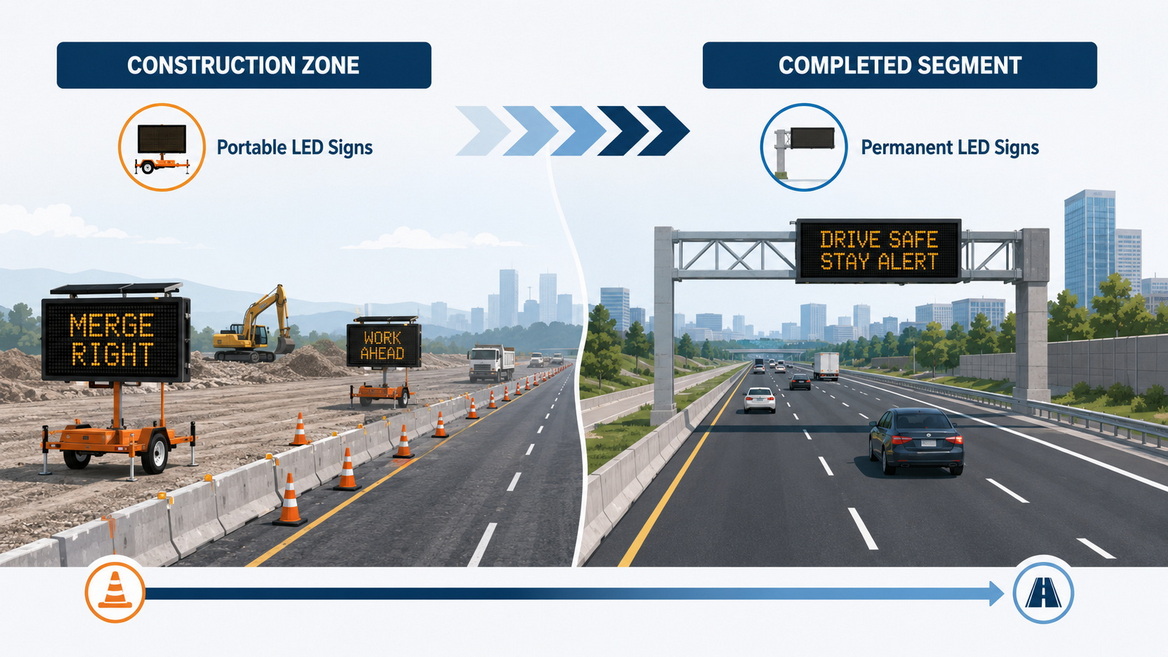
An increasingly popular best practice is to design a hybrid deployment strategy that combines portable temporary LED signs with permanent concrete-mounted installations over the project lifecycle.
In this model:
- Portable temporary LED signs are deployed in early project stages for construction and traffic shifts, providing flexible control and real-time messaging.
- As the road layout stabilizes, permanent concrete-mounted signs are installed to define the final traffic regime.
- Portable units are then redeployed to the next project, improving asset utilization.
From a B2B perspective, this creates an opportunity for manufacturers to offer bundled solutions—for example, a full package of permanent LED traffic signs plus a dedicated fleet of portable work-zone signs, all integrated with similar controller platforms and remote monitoring.
For decision-makers in governments, EPC contractors, or facility operations, the following 5-step framework can be applied:
1. Define time horizon
- Less than 6–12 months and shifting work zones: prioritize portable temporary LED signs.
- More than several years in a fixed layout: prioritize permanent concrete-mounted signs.
2. Analyze traffic speed and volume
- High-speed, high-volume corridors benefit from higher-mounted permanent signs with strong structural design.
- Lower-speed or temporary zones can rely more on well-positioned portable LED signs.
3. Assess message stability vs. variability
- If messages change frequently (e. g., lane changes, incidents, weather alerts), portable or permanent full-matrix LED signs are needed.
- If messages are stable (e. g., speed limit, directional signs), permanent static or LED-enhanced signs are often more economical.
4. Evaluate regulatory and permitting constraints
- Confirm standards, approvals, and inspection processes for foundations, structural supports, and work-zone devices.
- Coordinate with local authorities on allowed portable sign placement and duration.
5. Estimate lifecycle cost and asset utilization
- Model equipment reuse across projects for portable signs.
- Consider long-term maintenance, energy efficiency, and replacement cycles for permanent installations.
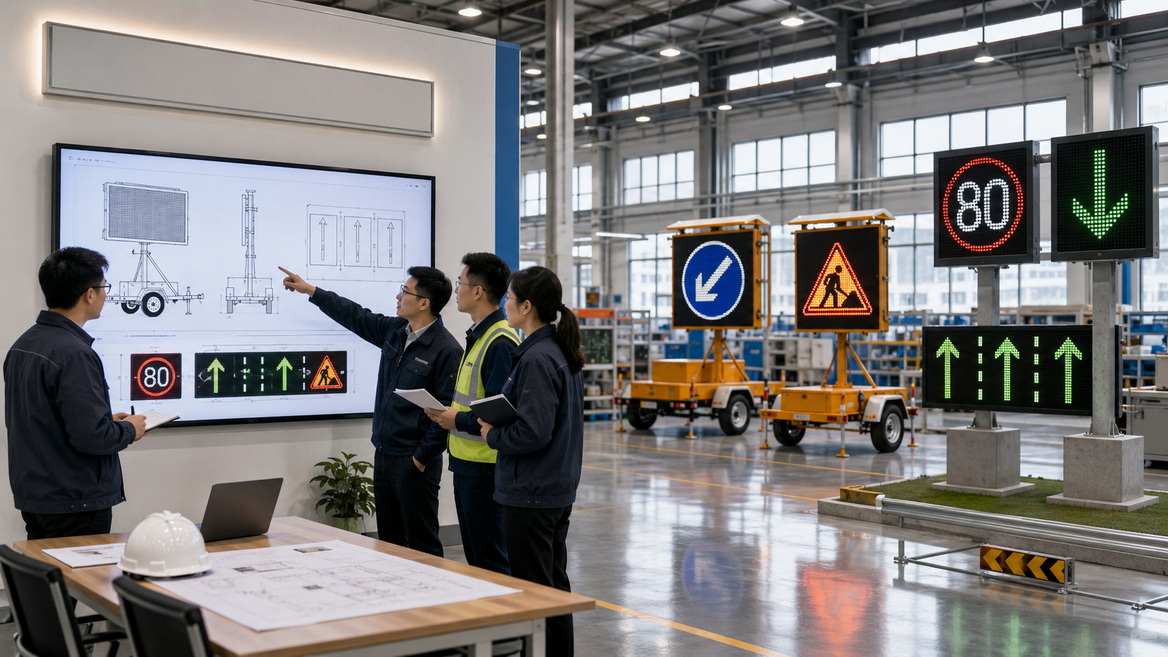
As a Chinese manufacturer specializing in LED traffic signs and broader traffic safety solutions, Shenzhen Xingsheng Traffic Facilities Co., Ltd. can strengthen its position by:
- Offering customized OEM and ODM solutions for both portable temporary LED signs and permanent concrete-mounted signs, including tailored housing, controllers, and communication protocols.
- Providing engineering support documentation referencing international standards and best practices for work-zone and permanent traffic control.
- Supplying matched portfolios for highways, toll stations, and parking facilities, ensuring consistent design language and simplified maintenance.
By combining product manufacturing experience with consultative support, the company can move from being a component supplier to a full traffic safety solutions partner for global B2B clients.
If you are planning or tendering a new traffic project, consider taking these next steps:
- Map your network into temporary vs. permanent signing needs over a 5–10 year horizon.
- Identify key corridors, toll plazas, and parking facilities where permanent concrete-mounted LED signs will deliver the most value.
- Define how many portable temporary LED signs you need to support annual construction, maintenance, and emergency operations.
Shenzhen Xingsheng Traffic Facilities Co., Ltd. can work with your engineering and procurement teams to design a balanced portfolio of portable and permanent LED traffic signs, optimized for your standards, budgets, and project timelines. To discuss specifications, drawings, or OEM/ODM cooperation, you can contact the company's sales team and request tailored proposals based on your road network and regulatory framework.
When properly designed and installed according to work-zone standards, portable temporary LED signs can provide safety levels comparable to permanent signs for their intended use duration. However, they are not intended to replace permanent infrastructure in locations requiring long-term, high-speed guidance.
Work-zone guidelines typically differentiate between short-term (days) and intermediate-term (weeks to months) deployments, and portable signs can be used for both as long as they remain structurally secure and compliant. For multi-year applications, authorities usually prefer permanent installations.
Yes, many existing poles and concrete foundations can support replacement panels or LED-enhanced retrofits, provided they still meet structural and wind-loading requirements. An engineering review is recommended before upgrading.
For contractors managing ongoing projects across a region, investing in a fleet of portable temporary LED signs is often more cost-effective due to high asset reuse and avoided foundation works. Permanent signs make more sense when the contractor is also responsible for long-term operations or concession projects.
Yes, both portable and permanent LED signs can integrate with intelligent transportation systems via wired or wireless communication, allowing remote control and monitoring. Permanent systems tend to have more robust, fixed networking, while portable signs often rely on cellular or temporary communications.
1. WorkSafe TCI – "Temporary Construction Signs vs. Permanent Road Signs: Compliance Differences Explained" (2026) – https://worksafetci.com/2026/01/temporary-construction-signs-vs-permanent-road-signs-compliance-differences-explained/
2. Weekly Safety – "Work Zone Temporary Traffic Control Sign Requirements" (2020) – https://weeklysafety.com/blog/work-zone-temporary-traffic-control-signs
3. Business Research Insights – "LED Traffic Signs and Signals Market Size, Share" (2025) – https://www.businessresearchinsights.com/market-reports/led-traffic-signs-and-signals-market-106927
4. LED Lighting Solutions – "Traffic Signs and Lights" – https://ledlighting-solutions.com/traffic-signs.html
5. Outdoor Signs America – "Portable LED Signs vs. Permanent Signage: Which Is Right for Your Business?" (2025) – https://outdoorsignsamerica.com/blog/portable-led-signs-vs-permanent-signage-which-is-right-for-your-business-/
6. Front Signs – "The Difference Between Road Signs Around The World" (2025) – https://www.frontsigns.com/blog/the-difference-of-world-traffic-signs/
7. Shenzhen Sihanming Technology – OEM/ODM Service Overview – http://www.szshlink.com/en/service.html
8. E-Caretalk – "Comprehensive ODM/OEM Services" – http://www.e-caretalk.com/odm/


