
Please Choose Your Language
Views: 222 Author: XS Traffic Facilities Publish Time: 2026-06-04 Origin: Site


Content Menu
● Introduction: Why Heat Dissipation Matters in LED Signs
● How Heat Affects LED Traffic Signs
>> Thermal Stress on LEDs and Electronics
>> Performance, Lifetime, and Warranty Impact
● Overview: Active Fan Cooling vs. Passive Heat Sinks
>> Key Differences at a Glance
● How Active Fan Cooling Works in LED Signs
>> Advantages of Active Fan Cooling
>> Limitations in Outdoor Traffic Applications
● How Passive Heat Sinks Work in LED Signs
>> Advantages of Passive Heat Sinks
● Real‑World Use Cases: When Each Approach Works Best
>> Active Fans: Narrow‑Space, High‑Power Installations
>> Passive Heat Sinks: Standard for Outdoor Traffic Signs
● Expert View: How Professional Buyers Should Evaluate Thermal Design
● OEM/ODM Perspective: Designing Better Passive‑Cooled LED Signs
● Implementation Steps: How to Choose and Specify the Right Cooling Strategy
● Recommended CTA for B2B Buyers
● FAQs: Heat Dissipation in LED Traffic Signs
>> 1. Why is heat dissipation so important in LED traffic signs?
>> 2. Are active fans ever the best choice for LED signs?
>> 3. Do passive heat sinks work in very hot climates?
>> 4. How often do cooling components need maintenance?
>> 5. What should I ask my supplier about thermal design?
Heat dissipation is one of the most critical design decisions in modern LED traffic signs, and choosing between active fans and passive heat sinks directly affects reliability, lifetime, and total cost of ownership for B2B buyers in traffic safety projects.
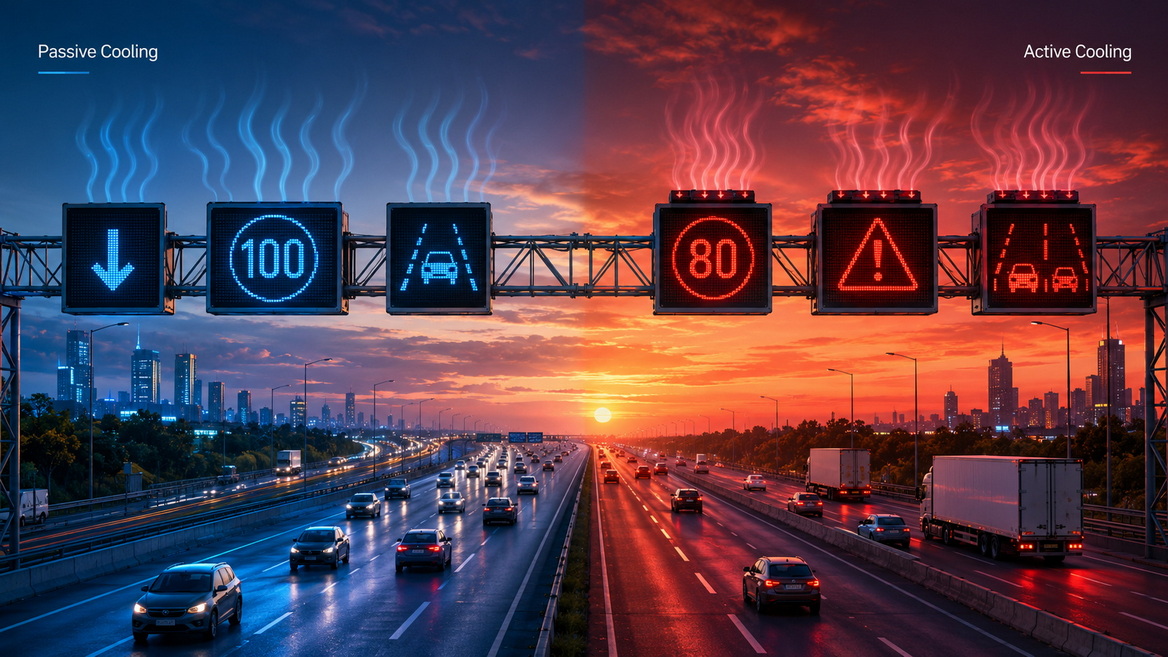
High‑brightness LED traffic signs for highways, toll stations, and parking facilities run for long hours in harsh outdoor environments, often under direct sunlight. Effective thermal management protects LED chips, power supplies, and control boards from overheating, which can otherwise cause color shift, dimming, flicker, or outright failure.
For manufacturers like Shenzhen Xingsheng Traffic Facilities Co., Ltd., which provide OEM/ODM LED traffic signs, the choice between active fan cooling and passive heat sinks is a core engineering and marketing differentiator. Well‑designed heat dissipation lets you offer longer warranties, lower maintenance, and more stable performance that appeal to infrastructure owners and EPC contractors.
When LED junction temperature increases, luminous flux drops and the phosphor material ages faster. This impacts legibility of speed limits, lane control arrows, and variable message signs.
Key risks of poor heat dissipation in LED signs:
- Faster lumen depreciation and color shift
- Shorter driver power supply lifetime
- Premature failure of control PCB and communication modules
- Higher risk of system shutdown in heat waves
In traffic applications, reduced brightness or sign blackout is a serious safety hazard and can lead to regulatory penalties or contract disputes for operators.
Many LED components are rated based on \(L_{70}\) (time to 70% of initial brightness). Elevated operating temperature can cut this lifetime significantly, sometimes by half, depending on the degree of overheating.
For traffic engineering stakeholders, this translates into:
- More frequent sign replacements
- Higher bucket‑truck maintenance costs
- Service disruptions in toll stations and tunnels
This is why heat dissipation strategy is not just a technical detail; it is a business and safety decision that directly impacts project ROI.
Before going into details, here is a practical comparison tailored to LED traffic sign applications.
| Dimension | Active Fan Cooling | Passive Heat Sinks |
|---|---|---|
| Cooling mechanism | Forced air via fans over components | Natural convection via fins and mass |
| Moving parts | Yes, rotating fan blades and bearings | No moving parts |
| Cooling capacity | High, good for tight or hot environments | Moderate, depends on surface and airflow |
| Reliability | Lower, fans can fail mechanically | Higher, minimal failure modes |
| Maintenance | Requires periodic inspection and cleaning | Very low, mainly surface cleaning |
| Noise | Audible fan noise in quiet environments | Silent operation |
| Initial cost | Higher due to fans and control circuitry | Often lower bill of materials |
| Lifetime cost | Higher due to replacement and labor | Lower, especially in remote sites |
| Typical use cases | Indoor displays, compact enclosures | Outdoor traffic signs, highway gantries |
This table reflects common industry practice observed in LED display and electronics cooling literature, adapted to traffic signage scenarios.
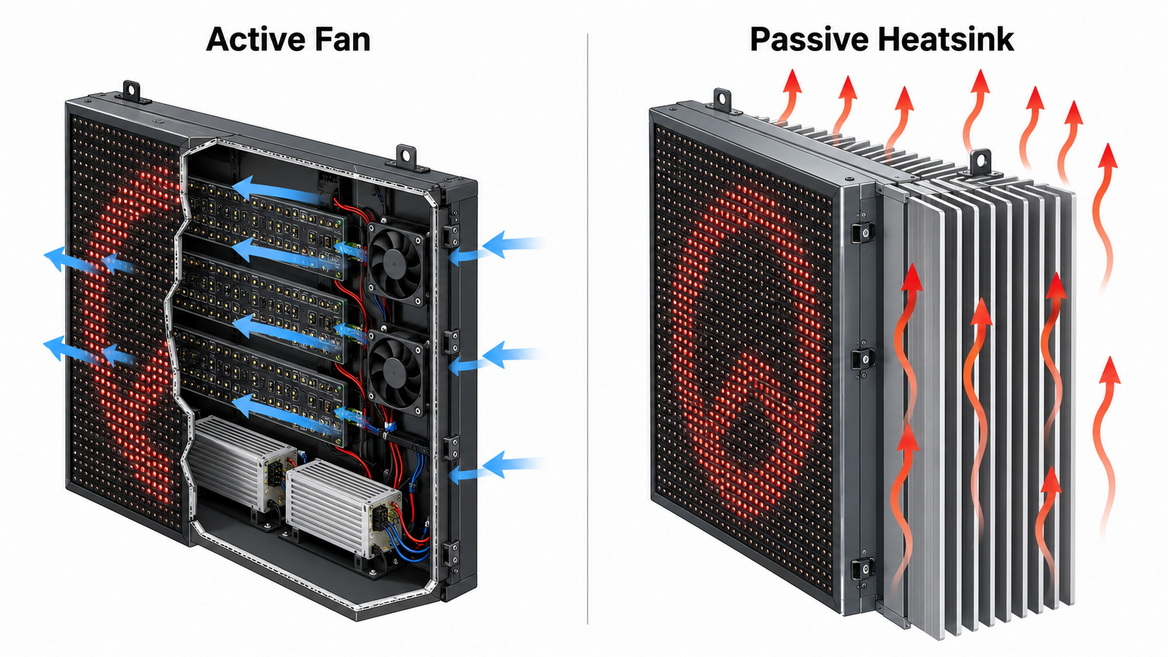
Active cooling uses one or more DC fans to force air over hot components such as LED modules, drivers, and power supplies. By increasing airspeed, it improves convective heat transfer and reduces component temperature.
In LED traffic signs, fans are usually mounted:
- Inside the cabinet roof or side panels
- Close to driver power supplies and LED backplanes
- Sometimes in combination with smaller heat sinks
Fans may run continuously or be controlled by temperature sensors and a small controller to optimize lifetime and noise.
From a practical engineering standpoint, active fans offer three major benefits:
- High thermal performance in compact volumes: Helpful when the sign must be thin or when local regulations limit cabinet size.
- Better control under heat spikes: Fans react quickly to sudden temperature rise during heat waves or full‑brightness operation.
- Potentially lower LED junction temperature, allowing higher drive currents if the design is optimized.
These advantages can be attractive for very high‑density pixel‑pitch displays or complex variable message signs in space‑constrained environments.
However, field experience in outdoor installations shows critical limitations:
- Mechanical failure risk: Bearings and motors wear out; dust and humidity accelerate failure.
- Environmental contamination: In highway environments, fans can pull in dust, insects, and exhaust particulates, which clog filters and reduce airflow.
- Maintenance complexity: Accessing gantry‑mounted or overhead signs to replace a small fan is costly and requires lane closures and traffic management.
From a B2B buyer's perspective (municipalities, toll road operators), this translates into higher long‑term operating costs and more frequent site interventions, which are often more expensive than the sign itself.
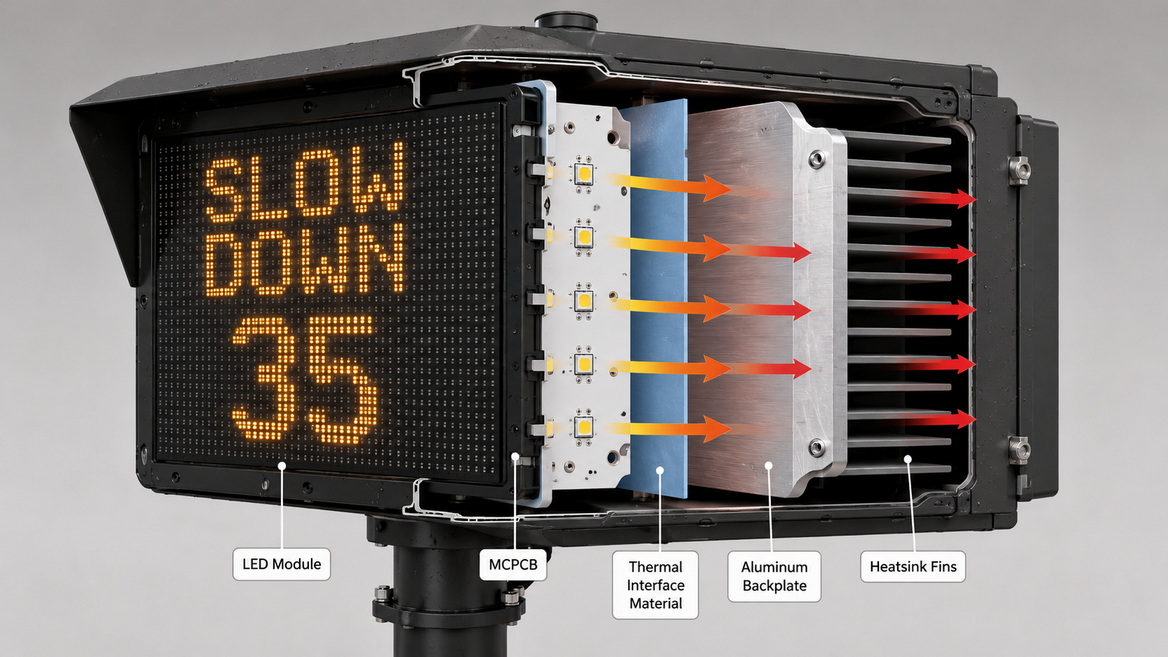
Passive heat sinks rely on natural convection and radiation. Heat from LED modules and drivers is conducted into metal structures with large surface area—typically extruded or cast aluminum fins—then dissipated to ambient air without any moving parts.
In LED traffic signs, passive cooling structures can be:
- Integrated into the LED module backplate
- Designed as external fins on the rear of the sign cabinet
- Combined with high‑conductivity PCB materials and thermal interface materials
For outdoor traffic signs, passive dissipation aligns well with real‑world operating conditions:
- High reliability: No fans, no bearings, no motors; very few failure modes.
- Low maintenance: No fan replacement; occasional cleaning during standard inspection is usually enough.
- Silent operation: Important near residential areas or pedestrian crossings at night.
- Better environmental sealing: No large airflow openings, easier to maintain good IP rating against dust and water.
These factors make passive systems particularly suitable for long‑span highway gantries, tunnels, and remote mountain roads where maintenance access is difficult.
Passive systems are not "free"; they require careful design:
- Larger surface area: Often leads to a thicker or heavier cabinet compared to fan‑cooled alternatives.
- Material selection: Aluminum alloys, fin geometry, and surface treatment must be optimized to maximize heat transfer.
- Thermal path engineering: From LED junction to heat sink base, each interface (solder, PCB, thermal pad) must be minimized and controlled.
A manufacturer with strong mechanical and thermal design capability can turn these constraints into a competitive advantage by offering thinner, lighter passive designs without compromising temperature performance.
Active fans may still be justified in some traffic‑related contexts:
- Very thin, high‑resolution LED display walls in tunnels where space is extremely limited
- Retrofit projects where existing steel structures cannot support heavier passive heat sinks
- Combined indoor/outdoor control rooms displaying traffic information with high pixel density
In these niches, the buyer often prioritizes compactness and high brightness, and accepts higher maintenance overhead.
For classic LED traffic products (speed limit signs, lane control signals, toll price boards, variable message signs, and parking guidance displays) exposed to weather, passive cooling is widely considered best practice due to its robust reliability profile.
Typical advantages for infrastructure owners:
- Longer unattended operation between service visits
- Lower total cost of ownership over the project lifetime
- Greater resilience to dust, salt fog, and humidity
These real‑world priorities explain why many modern LED traffic signs on highways and urban roads adopt purely passive or hybrid‑passive designs rather than fan‑based systems.
Based on industry experience with LED traffic projects, professional specifiers and procurement teams should evaluate thermal design using a structured checklist:
1. Thermal simulation data
- Request thermal analysis or test reports showing LED junction temperature, driver temperature, and cabinet temperature under worst‑case ambient conditions.
2. Component derating strategy
- Confirm that drivers, power supplies, and LEDs are not operated at their maximum rated temperature.
3. Lifetime and warranty alignment
- Ensure warranty period is supported by realistic thermal assumptions, rather than optimistic lab conditions.
4. Maintenance model
- Ask how many cooling‑related components (fans, filters) are expected to be replaced over a 5–10 year period, and at what approximate cost.
5. Environmental sealing and IP rating
- Verify that thermal design does not compromise ingress protection, especially for roadside installations exposed to heavy rain and dust.
By applying this framework, B2B buyers can look beyond marketing claims and assess whether active or passive cooling aligns better with their operational priorities.
From the perspective of a Chinese OEM/ODM LED traffic sign manufacturer, there are several practical strategies to enhance passive cooling while keeping the product competitive in global tenders:
- Optimize fin geometry and placement on the rear of cabinets to maximize natural airflow paths.
- Use high‑conductivity aluminum substrates (MCPCB) and quality thermal interface materials to reduce thermal resistance from LED to heat sink.
- Design modular LED panels with integrated heat spreaders, allowing easy replacement without thermal performance loss.
- Validate designs through combined high‑temperature, high‑humidity, and power‑cycling tests that simulate real roadside conditions.
These approaches help differentiate your product in RFPs where buyers increasingly ask for detailed reliability and lifetime data rather than just initial price and brightness.
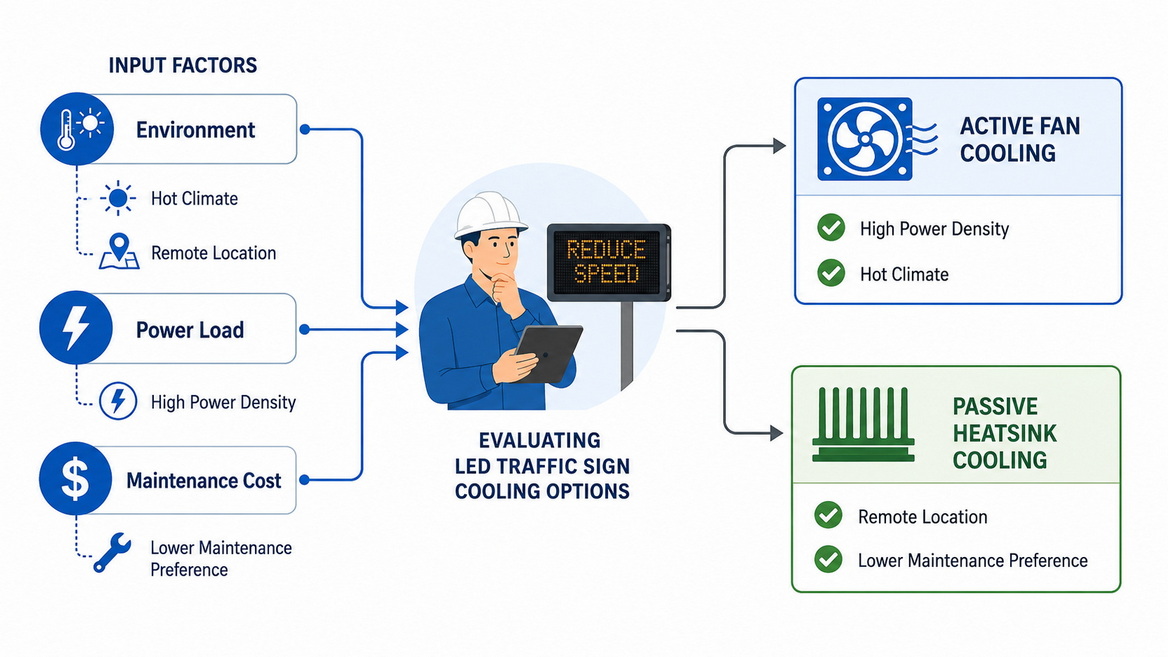
For engineers and procurement teams working on a new traffic project or product line, the following step‑by‑step process can help:
1. Define environmental conditions
- Maximum ambient temperature, solar load, altitude, and pollution level for each deployment region.
2. Estimate thermal load
- Calculate total power consumption of LED modules, drivers, and communication units at maximum brightness.
3. Set target junction temperatures
- Use LED and driver datasheets to define maximum acceptable operating temperatures with safety margin.
4. Compare design options
- Evaluate fan‑cooled and passive designs against thermal targets, cabinet size constraints, and structural limits.
5. Run pilot installations
- Install a limited number of units with temperature sensors and monitor real‑world data through peak summer.
6. Finalize specifications
- Include clear requirements on temperature limits, IP rating, and maintenance expectations in project documents and contracts.
Following these steps ensures that the chosen cooling concept is not just theoretically adequate but proven in the field.
Talk to our engineering team to evaluate the best thermal design for your next LED traffic signage project. Request a free thermal assessment and customized OEM/ODM proposal today.
Heat dissipation directly affects brightness stability, color consistency, and lifetime of LEDs, drivers, and control electronics, which are critical for safe and reliable traffic guidance.
Active fans can be appropriate in compact, high‑power installations where cabinet space is severely limited, but they require more maintenance and carry higher failure risk over time.
Yes, if properly sized and designed with adequate surface area and airflow paths; manufacturers must validate performance through thermal testing under worst‑case ambient conditions.
Fan‑cooled systems may need inspection and cleaning at least annually in dusty environments, while passive systems typically require only surface cleaning during routine sign maintenance.
Request thermal test reports, lifetime assumptions, derating strategy, maintenance plans, and confirmation that the chosen design supports the warranty period under your local climate conditions.


