
Please Choose Your Language
Views: 222 Author: XS Traffic Facilities Publish Time: 2026-06-02 Origin: Site


Content Menu
● What "1000 ft LED Visibility vs. 300 ft Reflective Visibility" Really Means
● Why Visibility Distance Matters for Real‑World Safety
● How Reflective Road Markers Work (≈300 ft Visibility)
● How LED Road Studs Work (≈1000 ft Visibility)
● 1000 ft vs. 300 ft: Where Each Technology Wins
● Field Insights from Drivers and Operators
● When to Choose LED Visibility up to 1000 ft
● Practical Design Steps for Specifying Visibility
● Shenzhen Xingsheng's OEM/ODM Capabilities for LED and Reflective Solutions
● Case‑Style Example: Highway Curve and Toll Plaza Upgrade
● Where to Use Reflective‑Only Solutions
● Call to Action: Design Your Next Visibility Upgrade with Shenzhen Xingsheng
● Frequently Asked Questions (FAQ)
>> 1. Do I need LED studs if I already use reflective markers?
>> 2. Are LED road studs suitable for heavy‑truck traffic?
>> 3. How do LED road studs perform in rain and fog?
>> 4. What is the typical lifetime of solar LED road studs?
>> 5. Can Shenzhen Xingsheng customize road reflectors for my project?
Using LED road studs to extend visibility from 300 ft to 1000 ft can dramatically improve reaction time, cut crash risk, and future‑proof your traffic safety projects. This guide explains the difference between 1000 ft LED visibility and 300 ft reflective visibility from the perspective of a traffic‑safety manufacturer and on‑road users, and shows where Shenzhen Xingsheng's OEM/ODM solutions fit into your strategy.
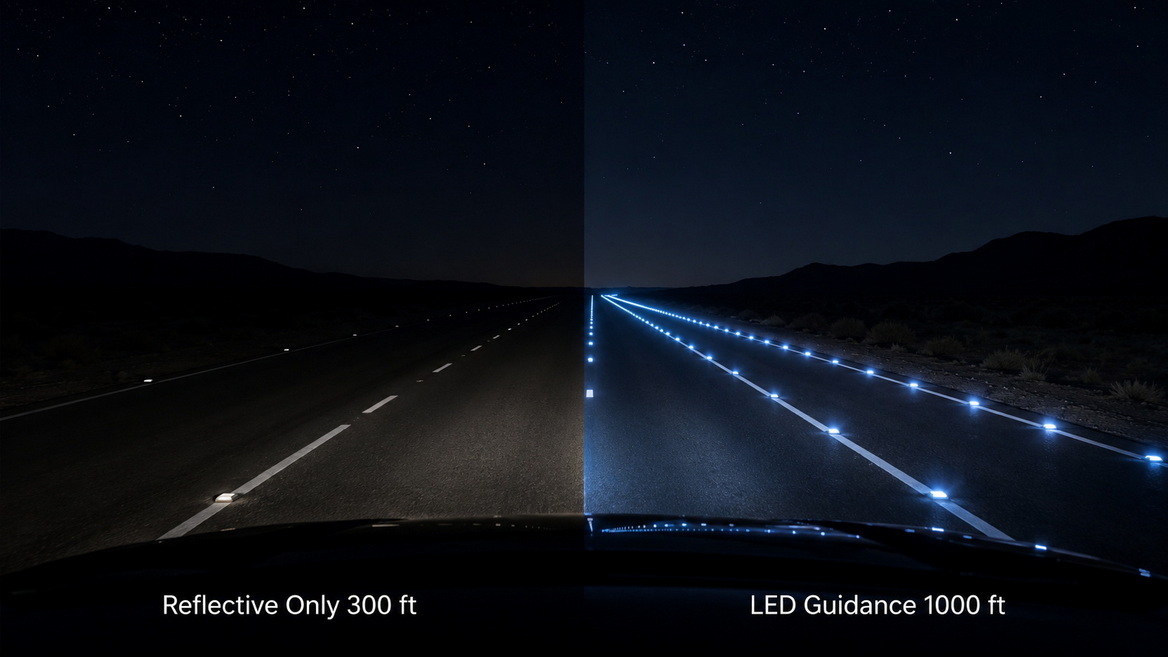
In real projects, "300 ft reflective visibility" usually refers to how far typical raised pavement markers or reflective sheeting can be seen when they rely solely on vehicle headlights. By contrast, "1000 ft LED visibility" describes active LED road studs or LED‑enhanced markers that emit light, so drivers can detect lanes, curves, and hazards at roughly three times the distance, even before their headlights hit the device.
For drivers on highways or dark rural roads, those extra 700 ft can translate into several more seconds to perceive, decide, and react. Research on reflective pavement markers alone shows nighttime crashes can be reduced by up to 30%; adding active LED guidance can push that benefit even further when conditions are wet or foggy. From a procurement perspective, the question is less "LED or reflective?" and more how to blend both to hit your site's safety, budget, and maintenance targets.
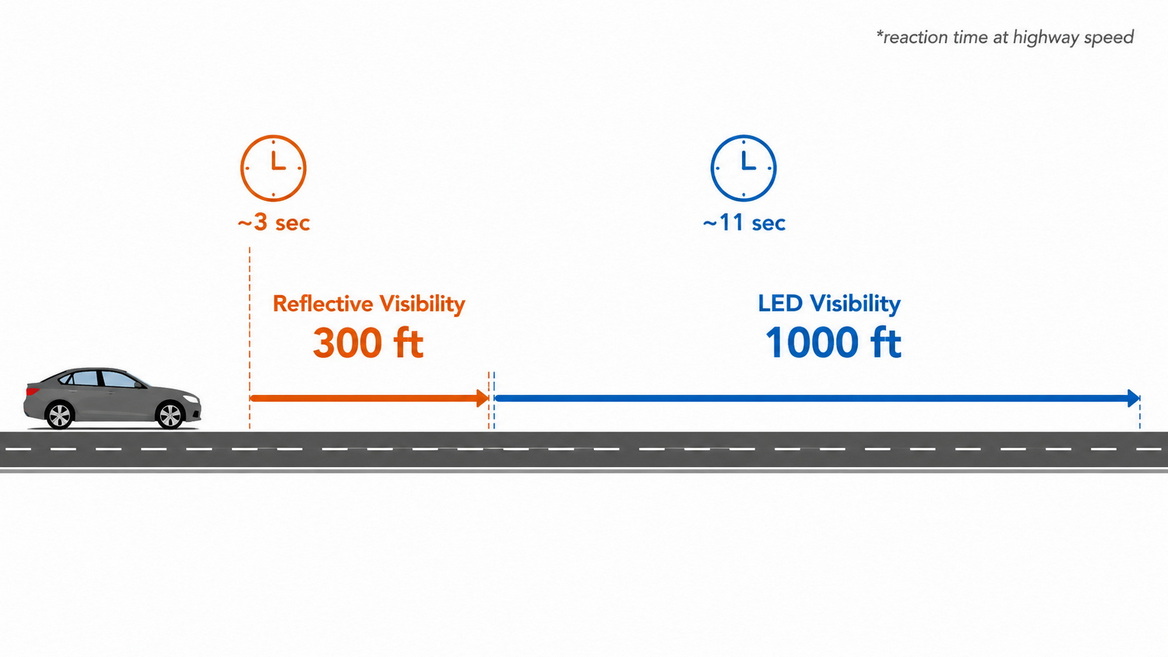
From an engineer's point of view, visibility distance is one of the strongest levers you can adjust without redesigning the entire road. Longer visibility directly extends driver reaction time. At 100 km/h (about 62 mph), a vehicle travels around 91 ft per second, which means:
- 300 ft reflective visibility ≈ 3.3 seconds to see and react
- 1000 ft LED visibility ≈ 11 seconds to see and react
Those extra seconds help drivers:
- Recognize curves, lane drops, and toll booths earlier
- Adjust speed gradually instead of braking hard
- Change lanes safely before a merge or exit
- Navigate complex parking lots or toll plazas more confidently
Insurance and risk‑management experts consistently list visibility and lighting among the top controllable factors in preventing parking‑lot and low‑speed collisions. As a manufacturer working with municipalities, logistics parks, and parking‑lot operators, this is exactly where we see LED studs and high‑performance reflectors making measurable impact in claims data and incident reports.
Reflective markers and sheeting are passive: they send light back toward its source but do not emit light on their own. Technically, they use microprisms or glass beads embedded in a durable base to retroreflect headlight beams back to the driver's eyes, making lines and markers "light up" at night.
In practice, standard reflective road reflectors:
- Provide reliable lane guidance in dry night conditions
- Are relatively low‑cost to purchase and maintain
- Can be produced in a wide range of colors and load ratings for highways, city streets, and parking lots
- Depend heavily on headlight angle, vehicle type, and pavement wetness
On wet nights, the water film on the road can scatter light, which reduces effective visibility and makes some reflective markers much harder to see. That's why many jurisdictions now combine reflective markers with advanced solutions like rumble strips, LED‑enhanced signs, or LED studs on curves and high‑risk segments.
LED road studs are active devices that incorporate high‑intensity LEDs, optics, and often solar panels inside a robust housing. Instead of waiting for headlights, they project light in defined directions, creating a visible "line" of light that drivers can track from up to around 1000 ft away in dark conditions.
Key advantages we see in deployments:
- Much longer detection distance: Drivers see lanes, curves, and hazards significantly earlier than with passive reflectors alone.
- Better performance in rain, fog, or low‑beam driving, when headlight output on the pavement is weaker
- Programmable flashing or color options for toll plazas, diverging lanes, pedestrian crossings, and school zones
- Strong visual guidance in complex sites like multi‑level parking structures or truck yards
From a maintenance perspective, modern solar LED studs can run autonomously for years with minimal intervention, and many operators now view them as long‑term infrastructure rather than temporary add‑ons.
Below is a practical view of where LED road studs (≈1000 ft visibility) and reflective markers (≈300 ft visibility) deliver the most value.
Application fit for LED vs. reflective visibility
| Scenario / Need | 300 ft reflective markers (passive) | 1000 ft LED studs (active) |
|---|---|---|
| Standard urban streets | Cost‑effective baseline guidance | Optional upgrade at high‑risk points |
| High‑speed highways / expressways | Helpful but limited reaction time | Ideal for long‑range lane and curve guidance |
| Sharp curves, tunnels, mountain roads | May be obscured in rain or fog | Strong continuous light path for drivers |
| Toll stations and toll plazas | Basic lane marks and arrows | Dynamic LEDs to channel vehicles into lanes |
| Parking lots and logistics yards | Delineate bays and walkways | LEDs for entrances, crossings, conflict points |
| Extreme low‑light / no overhead lighting | Fully dependent on headlights | Independent illumination, superior visibility |
| Budget‑constrained upgrades | Very low initial cost | Higher upfront, long‑term ROI in safety |
For many of our clients, the best strategy is hybrid: use reflective markers for broad coverage, and deploy LED studs where seconds matter most—approaches to toll booths, dangerous curves, pedestrian crossings, and critical decision points.
Feedback from drivers, fleet managers, and parking‑lot operators is remarkably consistent:
- Drivers feel more confident approaching interchanges or toll areas lined with LED studs, especially at night and in bad weather. They report that "the road feels like it's guiding you," which reduces stress and sudden maneuvers.
- Truck and bus operators value clear LED guidance in large parking areas, where traditional paint and reflectors can blend into background lighting or get obscured by parked vehicles.
- Business owners and site managers highlight improved perceived security in well‑lit lots, aligning with guidance that lighting and visibility are central to preventing incidents.
From our perspective as a manufacturer, the most successful projects start from these real‑world experiences and then translate them into specifications for visibility distance, viewing angle, load capacity, and power options rather than picking products purely by catalog category.
Based on industry practice and what we see across highways, toll stations, and parking projects, 1000 ft LED visibility is a smart upgrade in the following situations:
1. High‑speed approach zones
- Highway exits, lane drops, and curve approaches
- Toll stations where vehicles transition from 100 km/h to low speeds in a short distance
2. Complex decision points
- Multi‑lane diverging sections, reversible lanes, or weaving sections
- Intersections where horizontal and vertical curves limit sight distance
3. Low‑light or no‑light environments
- Rural highways with minimal overhead lighting
- Tunnels, bridges, and underpasses where glare or shadows are problematic
4. High‑liability sites
- School zones, hospital entrances, and high‑foot‑traffic crossings
- Logistics hubs and fuel stations where even minor collisions can be costly
In each of these scenarios, extending visibility from 300 ft to 1000 ft gives drivers extra time and confidence, which is often more valuable than adding more signage that drivers may not notice in time.
When we support OEM/ODM customers, we recommend a simple step‑by‑step approach to visibility planning:
1. Map the driver journey
- Identify where drivers are likely to be confused: abrupt curves, lane shifts, toll lanes, entry/exit ramps, and parking‑lot transitions.
- Walk or drive the route at night to see what drivers actually experience, not just what plans show.
2. Define your visibility targets
- For standard segments, 300 ft reflective visibility may be sufficient.
- For decision or braking zones, aim for at least 800–1000 ft LED visibility to maximize reaction time.
3. Select the right mix of devices
- Use reflective road studs and markings as your baseline for continuous delineation.
- Add LED studs and LED‑enhanced signs at critical points to create a clear "light story" the driver can follow.
4. Plan for durability and maintenance
- Match housing strength to traffic loads (cars vs. heavy trucks).
- Define cleaning and inspection intervals to keep optics and solar panels performing as designed.
5. Pilot, measure, and optimize
- Start with a pilot section and gather feedback from drivers, supervisors, and safety teams.
- Track changes in near‑misses or minor incidents, then extend the design to similar sites.
This process helps convert abstract specs like "1000 ft visibility" into concrete design and purchasing decisions that are defensible and data‑driven.
As a China‑based manufacturer specializing in traffic safety solutions, Shenzhen Xingsheng Traffic Facilities Co., Ltd. supports street, highway, toll station, and parking‑lot projects with both reflective and LED technologies.
Our OEM/ODM capabilities typically cover:
- LED road studs and markers with high‑intensity LEDs, solar or wired power options, and tailored viewing angles for straight segments or curves
- Raised reflective pavement markers and reflective sheeting products designed to meet regional standards for color, retroreflectivity, and durability
- Customized housings and materials (aluminum alloy, PC, or other engineering plastics) based on axle loads and climatic conditions
- Integrated solutions with signage, bollards, and parking accessories to create consistent visual guidance from road to lot
For international customers, we also collaborate on specification documents, sample validation, and packaging/branding so that our products can be seamlessly incorporated into local distributor ranges and project bid documents.
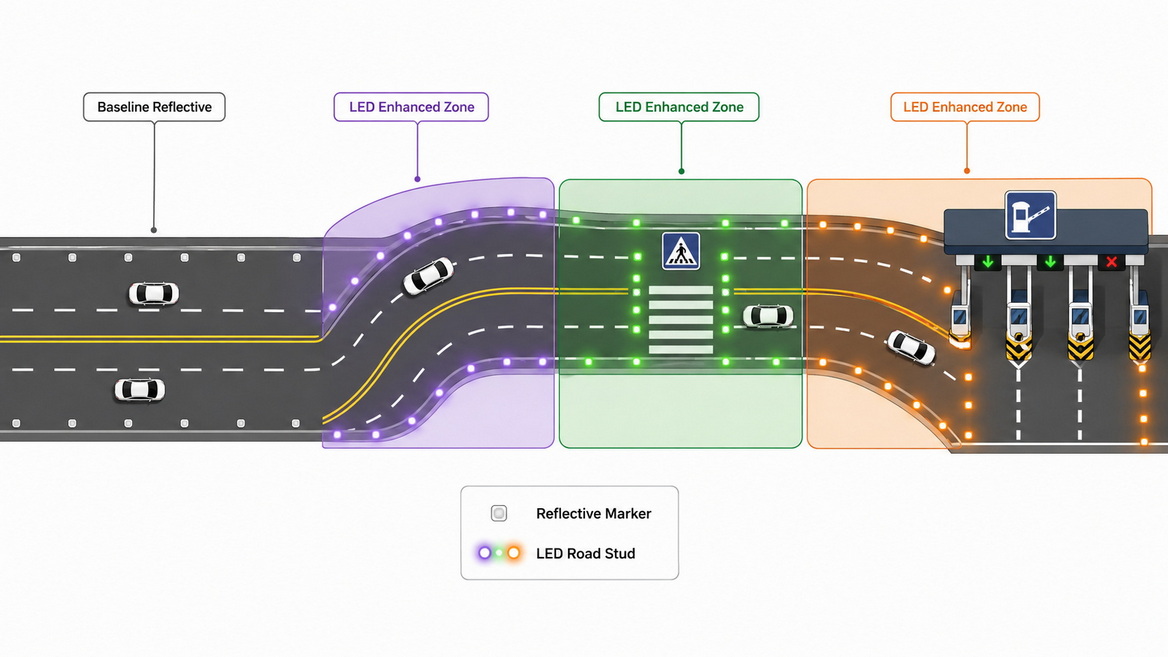
To illustrate how 1000 ft LED visibility compares with 300 ft reflective visibility in practice, consider a typical scenario we encounter in OEM/ODM discussions:
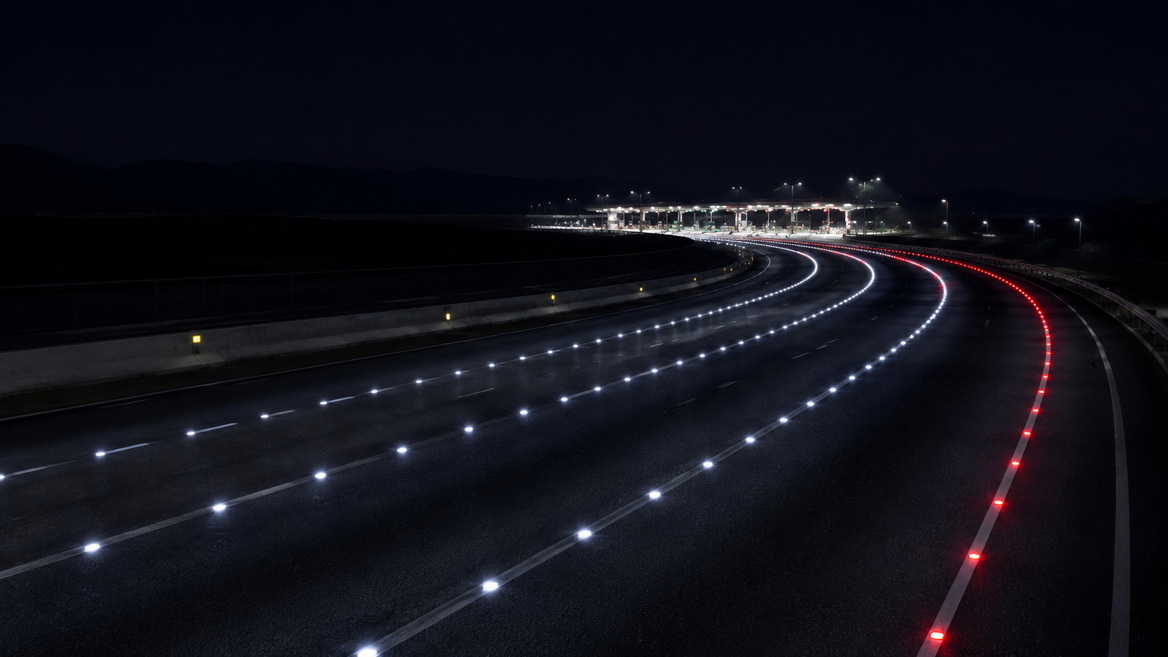
- A multi‑lane highway curve leading into a busy toll plaza
- Existing layout: standard pavement markings and reflective markers (≈300 ft visibility)
- Problems: late lane changes, sudden braking, and near‑miss collisions at night, especially in rain
By adding LED road studs along the lane lines and channelizing sections:
- Drivers see the entire curve and upcoming lane divisions from a much greater distance in low‑light conditions.
- The LED pattern guides vehicles smoothly into the correct toll lanes, reducing erratic lane changes close to the booths.
- Toll‑road operators report fewer minor fender‑benders and smoother traffic flow as visibility improves, echoing broader industry experience that better lighting and guidance reduce accidents.
While every site is unique, this kind of upgrade shows how combining 1000 ft LED guidance with 300 ft reflective backup can deliver both safety and operational benefits.
There are still many applications where reflective‑only solutions make perfect sense:
- Local streets with lower speeds and good overhead lighting
- Standard parking bays where reflective wheel stops and paint provide clear cues
- Temporary traffic control setups where cost and deployment speed are critical
In these situations, retroreflective markers and sheeting remain a cost‑effective foundation and are widely recognized by transportation agencies worldwide. Your decision to upgrade specific segments to LED should revolve around speed, complexity, weather, and crash history rather than technology preference alone.
If you are planning upgrades for highways, toll stations, or large parking facilities, now is the time to review whether 300 ft reflective visibility alone is enough for your safety targets. By partnering with Shenzhen Xingsheng Traffic Facilities Co., Ltd., you can design an integrated mix of reflective and LED solutions tailored to your speed limits, traffic volumes, climate, and budget.
Contact our team to discuss your project's visibility requirements, request OEM/ODM samples, or co‑develop a complete road‑safety package that brings 1000 ft LED guidance and robust reflective performance to your roads, plazas, and parking areas.
Reflective markers provide a solid baseline, but LED studs add long‑range visibility and active illumination, which is particularly valuable on high‑speed or complex sections where drivers need more time to react.
Yes. Modern LED studs are available in high‑load housings designed for intense truck and bus traffic, similar to heavy‑duty reflective markers; the correct specification is essential to ensure durability.
Because LEDs emit light rather than relying solely on retroreflection, they typically remain more visible in rain and light fog than passive reflectors, which can lose effectiveness under water films and diffuse light.
Many solar LED studs are designed to operate for several years with minimal maintenance, depending on battery type, solar exposure, and environmental conditions, making them a long‑term infrastructure solution.
Yes. Shenzhen Xingsheng Traffic Facilities Co., Ltd. offers OEM and ODM services for LED road studs and reflective markers, including custom colors, materials, optics, and branding to meet project or regional standards.
- TrafficCalm. "Improved Road Safety with Reflective Sign Posts and TrafficCalm's Sign Post Flasher." https://legacy.trafficalm.com/articles/improved-road-safety-reflective-sign-posts-and-trafficalms-sign-post-flasher
- Stop‑Painting. "Road Reflectors: Commonly Asked Questions." https://blog.stop-painting.com/some-commonly-asked-questions-about-road-reflectors/
- NATSO. "Drivers Want Well‑Lit, Easy‑to‑Access Sites to Boost Safety." https://www.natso.com/drivers-want-well-lit-easy-to-access-sites-to-boost-safety/
- Alibaba. "LED Road Reflectors." https://www.alibaba.com/showroom/led-road-reflectors.html
- RoadSky Safety. "What is Reflective Sheeting? A Comprehensive Guide." https://roadskysafety.com/what-is-reflective-sheeting-a-comprehensive-guide
- Transline. "The Importance of Reflective Pavement Markers for Road Safety." https://translineinc.com/the-importance-of-reflective-pavement-markers-for-road-safety/
- Intrepid Direct. "Preventing Parking Lot Traffic Accidents at Your Business." https://intrepiddirect.com/blog/preventing-parking-lot-traffic-accidents
- SafetyDecals. "How Reflective & LED‑Enhanced Signs Improve Road Safety at Night." https://www.safetydecals.com/blogs/news/how-reflective-led-enhanced-signs-improve-road-safety-at-night
- Grand View Research. "Road Reflectors Market Size & Share | Industry Report, 2030." https://www.grandviewresearch.com/industry-analysis/road-reflectors-market-report


