
Please Choose Your Language
Views: 222 Author: XS Traffic Facilities Publish Time: 2026-04-24 Origin: Site


Traffic lights are essential for managing vehicle and pedestrian flow at intersections, streets, highways, toll stations, and parking lots. As experts at Shenzhen Xingsheng Traffic Facilities Co., Ltd., a leading Chinese manufacturer of LED traffic warning lights and traffic safety products, we provide OEM and ODM solutions to enhance road safety worldwide.

Traffic lights have transformed from simple gas-powered signals in the 1860s to sophisticated LED traffic warning lights today. Early systems used manual operation or fixed timers, but modern versions incorporate sensors for adaptive control.
Key milestones:
- 1914: Cleveland's electric traffic tower introduced automated sequencing.
- 1920s: Three-color systems (red, yellow, green) became standard.
- 2000s: LED technology replaced incandescent bulbs for energy efficiency and durability.
This evolution prioritizes safety and efficiency, aligning with global standards for traffic management.
LED traffic warning lights consist of durable housings, high-visibility LEDs, and control modules. LEDs offer superior brightness (over 100mcd in high-end models), longevity (up to 100,000 hours), and weather resistance compared to traditional bulbs.
Main parts:
- Lens and housing: Polycarbonate for impact resistance and UV protection.
- LED modules: Multi-chip arrays for uniform light distribution.
- Controller: Manages timing and synchronization.
- Power supply: Solar-compatible for remote installations.
At Shenzhen Xingsheng, our LED traffic warning lights are engineered for highways and parking lots, supporting custom OEM designs.
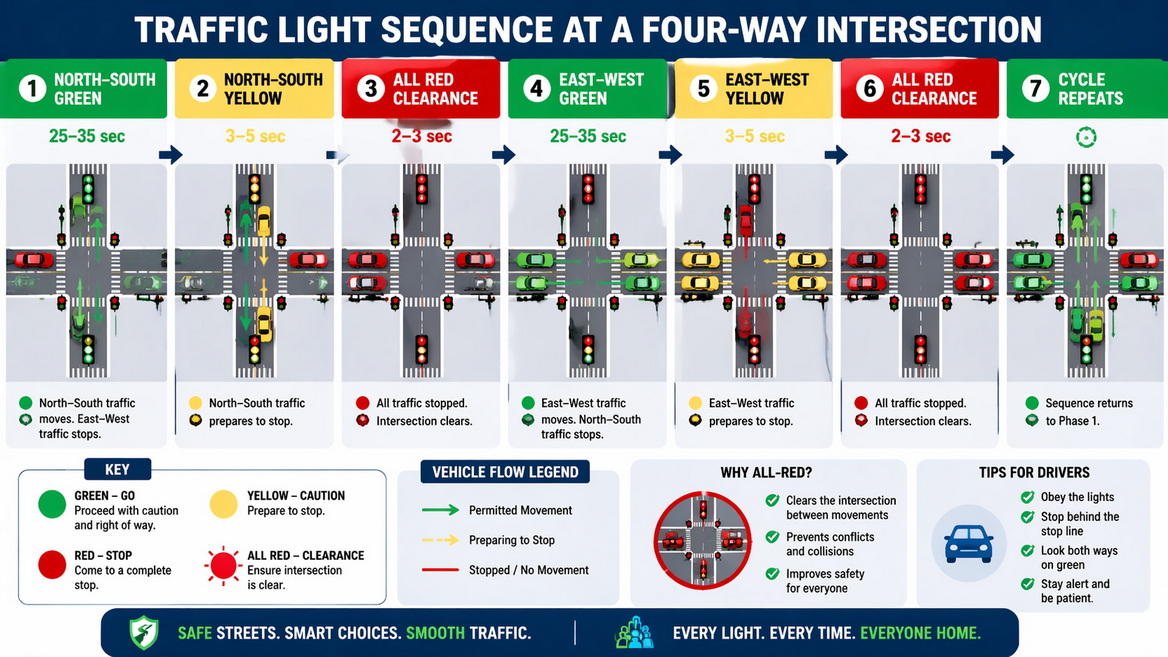
Traffic lights operate via controllers that cycle through phases: green (go), yellow (caution), red (stop). The controller uses pre-programmed cycles or real-time inputs to dictate changes.
Basic sequence:
1. Green allows flow in one direction.
2. Yellow warns of impending change.
3. Red halts traffic while perpendicular directions activate.
4. All-red clearance prevents conflicts.
Power from the grid or solar ensures reliability. Our LED traffic warning lights integrate seamlessly, reducing energy use by 90%.
Traffic lights change based on timers, sensors, or adaptive algorithms, not randomly. Fixed-time systems follow set intervals, ideal for predictable low-traffic areas like parking lots.
Advanced triggers:
- Inductive loops: Buried wires detect vehicle metal mass.
- Video cameras: AI analyzes movement for dynamic adjustments.
- Radar/microwave: Weather-proof motion detection.
- Adaptive timing: Real-time data creates "green waves" for smoother flow.
Changes occur during gap times—pauses ensuring safe transitions. In high-traffic zones, signals prioritize emergency vehicles via preemption.
Modern LED traffic warning lights pair with sensors for intelligent operation. Inductive loops cut road surfaces to embed coils that sense disruptions in magnetic fields.
Detection methods compared:
| Sensor Type | How It Works | Best For | Drawbacks |
|---|---|---|---|
| Inductive Loops | Metal detection via loops | High-volume intersections | Road cutting required |
| Video Detection | Camera + AI algorithms | Adaptive urban flow | Privacy concerns |
| Radar | Motion via microwaves | All-weather highways | Higher cost |
| LiDAR | Laser scanning | Pedestrian safety | Emerging, expensive |
These enhance safety at toll stations and highways, as implemented in our ODM projects.

LED traffic warning lights outperform older tech in visibility and maintenance. Energy savings: Up to 80-90% less power, critical for solar setups in remote areas.
Benefits:
- Durability: Withstand extreme weather (-40°C to 60°C).
- Visibility: High-intensity LEDs pierce fog and sunlight.
- Eco-friendly: Mercury-free, recyclable materials.
- Cost-effective: Lower lifetime costs for municipalities.
Shenzhen Xingsheng's products excel in high-traffic applications, reducing accidents by clear signaling.
Traditional articles overlook practical examples. Case 1: Urban Highway Integration—A Shenzhen project deployed LED traffic warning lights at toll stations, cutting congestion 25% via adaptive sensors.
Case 2: Parking Lot Efficiency—ODM solution for a major airport used video detection, reducing wait times by 30% during peaks.
Case 3: Highway Safety Upgrade—High-brightness LEDs in snowy regions improved recognition distance by 50%, per industry tests.
These showcase OEM/ODM value for global clients.

Few guides cover upkeep. Routine checks prevent failures:
1. Inspect LEDs: Test brightness quarterly.
2. Clean lenses: Remove dust/debris monthly.
3. Verify sensors: Simulate traffic to confirm detection.
4. Update firmware: For adaptive models.
5. Battery/solar check: In off-grid systems.
Common issues:
- Flickering: Loose wiring.
- No change: Controller fault—reset or replace.
Our LED traffic warning lights feature modular design for easy servicing.

Smart city integration is rising, with AI and 5G enabling vehicle-to-infrastructure (V2I) communication. Predictions:
- Fully adaptive networks reducing stops by 40%.
- Solar-powered LED traffic warning lights standard by 2030.
- Pedestrian/bike prioritization.
China leads with standards like GB/T for signal controllers. Shenzhen Xingsheng innovates for these trends.
Elevate your traffic management with custom LED traffic warning lights from Shenzhen Xingsheng Traffic Facilities Co., Ltd. We specialize in streets, highways, tolls, and parking—delivering reliable, scalable solutions.
Ready to optimize safety? Contact us today for a free consultation and quote.
They use inductive loops, cameras, or radar to sense presence and adjust timing dynamically.
Typically 80,000-100,000 hours, far exceeding incandescent bulbs.
Yes, with solar panels and batteries, ideal for remote highways.
By creating green waves and prioritizing pedestrians, reducing crashes by up to 25%.
Full customization: Design, manufacturing, and testing for LED traffic warning lights.
- BEA Sensors: LED Signal Traffic Lights https://us.beasensors.com/en/product/led-signal-traffic-lights/
- ZGSM: LED Traffic Light Manufacturer https://www.zgsm-china.com/led-products/led-traffic-light
- YouTube: How Traffic Lights Work https://www.youtube.com/watch?v=R_2qUW4h6NM
- Lightway Traffic: LED Traffic Light Classification https://www.lightwaytraffic.com/led-traffic-light-classification-4-key-ways-to-distinguish-them/
- JTI Traffic: Temporary Traffic Signals https://jtitraffic.com/temporary-traffic-signal-solutions/
- Original article: https://jackwinsafety.com/how-do-traffic-lights-work-and-when-traffic-lights-change/


