
Please Choose Your Language
Views: 230 Author: XS Traffic Facilities Publish Time: 2026-09-01 Origin: Site


Content Menu
● Why School Zone Safety Needs a Complete System
>> Common School Zone Safety Challenges
● How LED Traffic Signs Improve School Zone Visibility
>> Benefits of LED School Zone Signs
● Essential Components of a Safer School Zone
>> Crossing Guards and School Staff
>> Drop-Off and Pick-Up Management
● Choosing the Right LED Traffic Sign Solution
>> Roadway Speed and Traffic Volume
>> Sight Distance and Sign Placement
>> Weather and Environmental Conditions
● LED School Zone Sign Types and Applications
● Practical Steps for School Zone Safety Planning
>> Step 1: Observe Real Traffic Conditions
>> Step 2: Identify the Highest-Risk Locations
>> Step 3: Select a Suitable Sign and Power System
>> Step 4: Set an Appropriate Operating Schedule
>> Step 5: Inspect and Maintain the System
● OEM and ODM LED Traffic Sign Manufacturing
>> OEM LED Traffic Sign Services
>> ODM LED Traffic Sign Services
● Key Questions to Ask Before Buying
● Summary
>> What is an LED school zone sign?
>> Are solar-powered LED traffic signs suitable for school zones?
>> What is the difference between an LED school warning sign and a flashing speed-limit sign?
>> Can LED traffic signs be customized for OEM projects?
>> What information is needed for a customized LED traffic sign quotation?
A safer school zone begins before a driver reaches the school entrance. Clear signs, visible crosswalks, appropriate speed management, and reliable LED traffic signs can help drivers recognize that children may be walking, cycling, crossing, or entering vehicles nearby.
For schools, municipalities, road contractors, distributors, and private-campus operators, school zone safety is not simply about installing one warning sign. It requires a coordinated system that improves visibility, communicates the correct speed behavior, supports pedestrian crossings, and remains dependable throughout the school year.
Shenzhen Xingsheng Traffic Facilities Co., Ltd. manufactures LED traffic signs and traffic safety products for streets, highways, toll stations, parking areas, industrial facilities, and school-zone projects. We support OEM and ODM requirements for customers that need customized sign designs, LED configurations, solar-powered systems, mounting solutions, private labeling, and project-specific production.
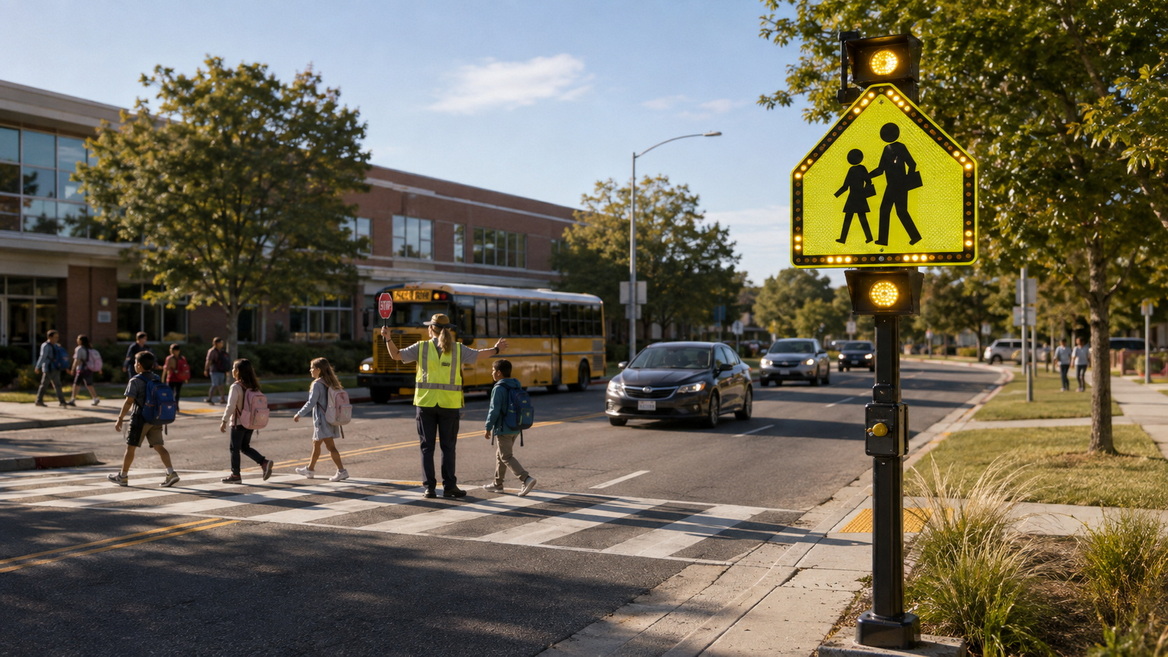
School zones create a unique traffic environment. During morning arrival and afternoon dismissal periods, a large number of pedestrians, cyclists, school buses, private cars, and delivery vehicles may use the same limited roadway space.
Children are especially vulnerable because they may have difficulty estimating vehicle speed, judging safe crossing gaps, or anticipating driver behavior. At the same time, drivers may be distracted by traffic queues, changing speed limits, parked vehicles, weather conditions, or unfamiliar road layouts.
A complete school-zone safety solution should make three messages clear to drivers:
1. They are entering or approaching a school zone.
2. Children may be crossing or walking near the roadway.
3. A lower speed limit or specific traffic rule may be active.
When these messages are visible, consistent, and easy to understand, drivers can react earlier and make safer decisions.
Many school areas face similar traffic and pedestrian safety concerns:
- Vehicles traveling too fast near school entrances.
- Drivers failing to notice school-zone speed restrictions.
- Limited visibility during rain, fog, dawn, dusk, or nighttime.
- Congestion caused by parent pick-up and drop-off activity.
- Pedestrians crossing outside designated crosswalks.
- School buses stopping near mixed vehicle traffic.
- Parked cars blocking a driver's view of children.
- Outdated, faded, damaged, or poorly positioned signs.
- Limited access to grid power for illuminated safety equipment.
- Insufficient sign visibility on wide roads or high-speed approaches.
The safest projects address the full traffic environment instead of relying on a single device.
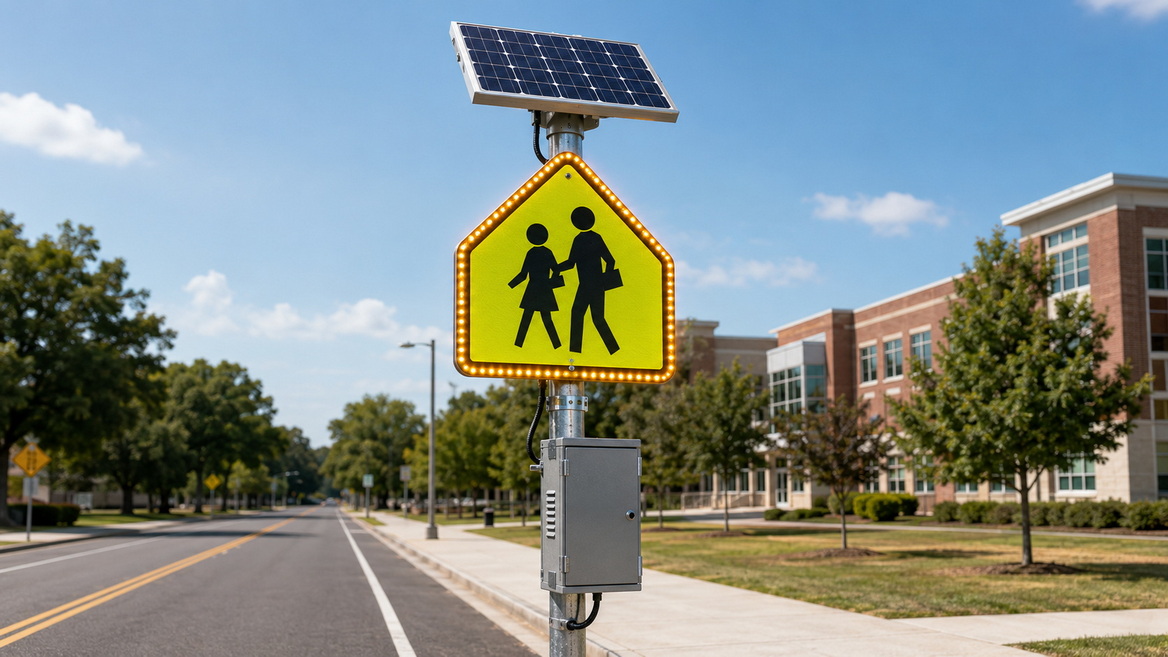
Traditional reflective signs remain an important part of roadway safety. However, standard signs can be less noticeable when drivers face visual clutter, low light, poor weather, or fast-changing traffic conditions.
LED traffic signs improve visibility by adding bright, targeted illumination to important warning or regulatory messages. They can help attract driver attention during the periods when children are most likely to be present.
LED-enhanced school-zone systems may include:
- Flashing LED school warning signs.
- LED pedestrian crossing signs.
- Flashing school speed-limit signs.
- Solar-powered traffic signs.
- LED borders around reflective warning signs.
- Radar speed-feedback displays.
- Programmable flashing schedules.
- Wireless or remote-control systems.
- Customized sign messages for local projects.
- Private-label traffic safety products.
The purpose of LED lighting should always be clear: to reinforce a traffic message at the point where drivers need to slow down, yield, or prepare to stop.
LED school-zone signs can provide several practical advantages for traffic safety projects.
| Benefit | Practical Value |
|---|---|
| Higher visibility | Bright LEDs can help signs stand out during low-light and visually busy conditions |
| Better driver awareness | Flashing illumination can draw attention to school-zone messages |
| Flexible scheduling | Timers and controllers can activate signs during arrival and dismissal periods |
| Solar-powered operation | Solar systems can support projects where grid power is unavailable or expensive |
| Reduced maintenance needs | Quality LED components can offer long operating life when correctly specified |
| Custom manufacturing | Sign size, message, LED layout, power system, and branding can be adapted to project needs |
| Wider application range | LED signs can be used near schools, crossings, parking lots, campuses, streets, and highways |
A visible sign does not replace roadway engineering, enforcement, crossing supervision, or responsible driving. It strengthens the communication between the road environment and the driver.
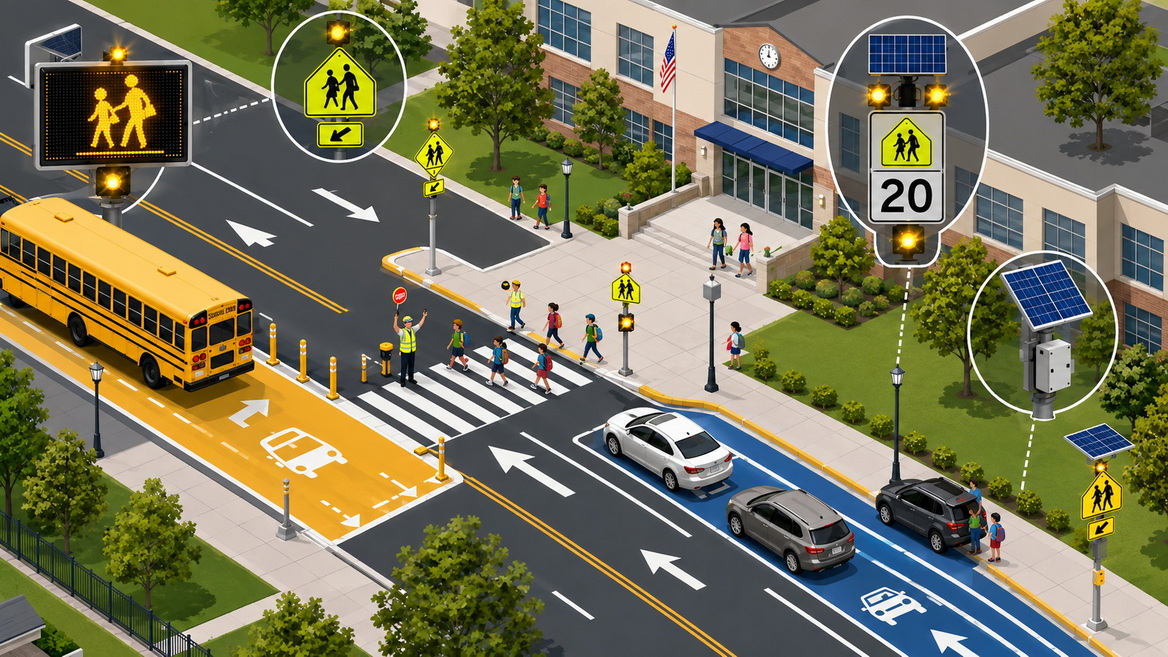
A school-zone safety system should be designed around the location's actual risks. A quiet residential street may require a different solution from a multi-lane road near a large school campus.
The following elements are often considered during school-zone planning.
School-zone warning signs alert drivers that children may be walking, cycling, or crossing near the roadway. These signs are usually placed on the approach to the school area and may be combined with supplemental plaques, flashing beacons, or LED borders.
Warning signs should be easy to see before a driver reaches the main conflict area. Trees, parked vehicles, roadside advertising, utility poles, and construction equipment should not block the sign face.
School speed-limit signs communicate a reduced speed requirement in designated areas. In many locations, the lower speed limit applies only during defined school periods, such as morning arrival and afternoon dismissal.
Flashing beacons can make temporary or scheduled speed restrictions easier for drivers to recognize. The system should be programmed to match the school timetable and should be checked regularly after schedule changes, holidays, early-release days, or special events.
Pedestrian crossing signs identify locations where students are expected to cross. At higher-risk locations, LED-enhanced crossing signs or flashing pedestrian devices may improve conspicuity.
The appropriate crossing treatment depends on road speed, traffic volume, lane configuration, pedestrian activity, sight distance, and local traffic-control requirements.
Crosswalk lines, stop bars, directional arrows, school-zone pavement legends, and parking restrictions can support the sign system by communicating roadway rules directly in the driver's path.
Pavement markings should remain visible in wet conditions and should be maintained when fading, cracking, or surface repairs reduce their clarity.
Traffic safety equipment works best when combined with safe operating procedures. Crossing guards, school staff, and trained volunteers can help children use designated crossing points and can reinforce safe driver behavior during high-activity periods.
Poorly organized vehicle circulation creates confusion and conflict. A well-designed drop-off area should separate buses, private cars, pedestrians, and delivery vehicles as much as possible.
Clear signs can support one-way vehicle flow, no-parking areas, loading zones, parent waiting zones, bus-only access, and pedestrian routes.
The best LED traffic sign is not always the largest or brightest model. The right product should match the roadway environment, operating conditions, installation method, and local project requirements.
Before selecting an LED traffic sign, project teams should evaluate the following conditions.
Higher vehicle speeds give drivers less time to recognize signs and respond safely. Roads with multiple lanes, heavy traffic, turning movements, or frequent congestion may require more visible warning treatments than low-speed residential streets.
A school zone near a wide arterial road may need advance warning signs, high-visibility LED devices, improved crosswalk treatments, speed feedback, and stronger traffic management. A small neighborhood school entrance may require a simpler solar-powered flashing sign system.
A sign must be visible early enough for drivers to respond. Curves, hills, trees, parked vehicles, roadside structures, and other obstacles can reduce sight distance.
Where drivers cannot clearly see the school-zone message from a sufficient distance, the sign position, mounting height, advance-warning location, or overall traffic-control design may need adjustment.
LED traffic signs can be powered by grid electricity, solar power, or a hybrid system.
Solar-powered LED traffic signs are especially useful for roadside projects where electrical trenching is difficult, expensive, or impractical. However, the solar panel, battery capacity, LED power consumption, local weather, shading conditions, and daily operating schedule must be considered together.
Traffic signs installed outdoors must withstand local environmental conditions. Buyers should consider rain, humidity, salt air, dust, extreme temperature, ultraviolet exposure, wind load, snow, and possible vandalism.
For long-term performance, specifications may include corrosion-resistant aluminum sign panels, durable reflective sheeting, sealed LED modules, waterproof electrical enclosures, reliable battery systems, and strong mounting brackets.
Different LED sign products serve different functions. Understanding their role helps buyers avoid selecting a device that looks suitable but does not match the project's safety objective.
| Product Type | Main Function | Typical Application |
|---|---|---|
| LED school warning sign | Warns drivers that a school area is ahead | Approaches to schools, campuses, and student activity areas |
| Flashing school speed-limit sign | Indicates that a reduced school speed limit is active | School-zone entrances during arrival and dismissal |
| LED pedestrian crossing sign | Increases visibility at a designated crossing | Crosswalks near schools, parks, and community facilities |
| Solar-powered LED traffic sign | Provides illuminated warning without a grid connection | Rural roads, temporary projects, parking areas, and remote sites |
| Radar speed-feedback sign | Shows approaching drivers their current speed | Speed-management zones near schools and residential roads |
| LED directional sign | Guides vehicle and pedestrian movement | School entrances, parking areas, bus lanes, and pick-up zones |
| Variable message sign | Communicates changing traffic instructions | Large campuses, temporary roadworks, and event traffic management |
The final selection should be based on the site's safety needs, relevant local standards, and the judgment of the responsible road authority or traffic professional.
A structured planning process can help schools, contractors, road authorities, and distributors move from a safety concern to a practical solution.
Visit the site during the busiest school periods. Morning and afternoon operations may reveal very different traffic patterns.
Record:
- Vehicle approach speeds.
- Student walking routes.
- Bicycle activity.
- Parent drop-off behavior.
- School bus movements.
- Illegal parking or stopping.
- Turning conflicts.
- Existing sign locations.
- Sight obstructions.
- Weather and lighting conditions.
- Pedestrian crossing behavior.
A short observation during quiet hours may not reveal the real risks faced by children and drivers.
Focus first on the places where drivers and pedestrians are most likely to conflict. These may include:
- Main school entrances.
- Mid-block pedestrian crossings.
- Bus loading zones.
- Parent pick-up lanes.
- Intersections near school gates.
- Roads with high approach speeds.
- Areas with poor visibility.
- Parking-lot exits.
- Places where children cross outside the marked crosswalk.
The goal is not to install signs everywhere. The goal is to make the most important safety messages visible where they are needed most.
After identifying the site conditions, define the sign requirements.
Important specification details include:
- Sign shape, message, and dimensions.
- Reflective sheeting grade.
- LED color and LED brightness.
- LED border or embedded LED arrangement.
- Flashing pattern and frequency.
- Solar panel size and battery capacity.
- Controller and timing function.
- Mounting pole, bracket, or overhead structure.
- Waterproofing and environmental protection.
- Operating temperature range.
- Packaging and shipping requirements.
- Private labeling and product branding.
Clear specifications reduce misunderstandings during production and help suppliers provide a more accurate quotation.
Flashing school-zone signs should operate when children are likely to be present. If a sign flashes continuously without a clear reason, drivers may become less responsive to the message.
A schedule should consider:
- Regular arrival times.
- Regular dismissal times.
- Bus schedules.
- After-school activities.
- Early-release days.
- Holiday closures.
- Weekend events.
- Seasonal timetable changes.
Timer-based, GPS-synchronized, photocell-controlled, and wireless-controlled systems may be used depending on project requirements.
School-zone safety equipment should be checked regularly. A non-functioning LED beacon, dirty solar panel, faded sign face, damaged pole, or incorrect timer setting can reduce the effectiveness of the entire installation.
A practical inspection program should include:
1. Checking that LEDs and flashing beacons operate correctly.
2. Testing timers and verifying seasonal schedules.
3. Cleaning solar panels when dust, snow, leaves, or debris reduce charging performance.
4. Inspecting batteries, controllers, cables, and connectors.
5. Confirming that trees, vehicles, banners, or construction materials do not block signs.
6. Reviewing mounting hardware for damage, corrosion, or loose components.
7. Replacing damaged reflective sign faces and worn pavement markings.
8. Recording maintenance work and recurring site issues.
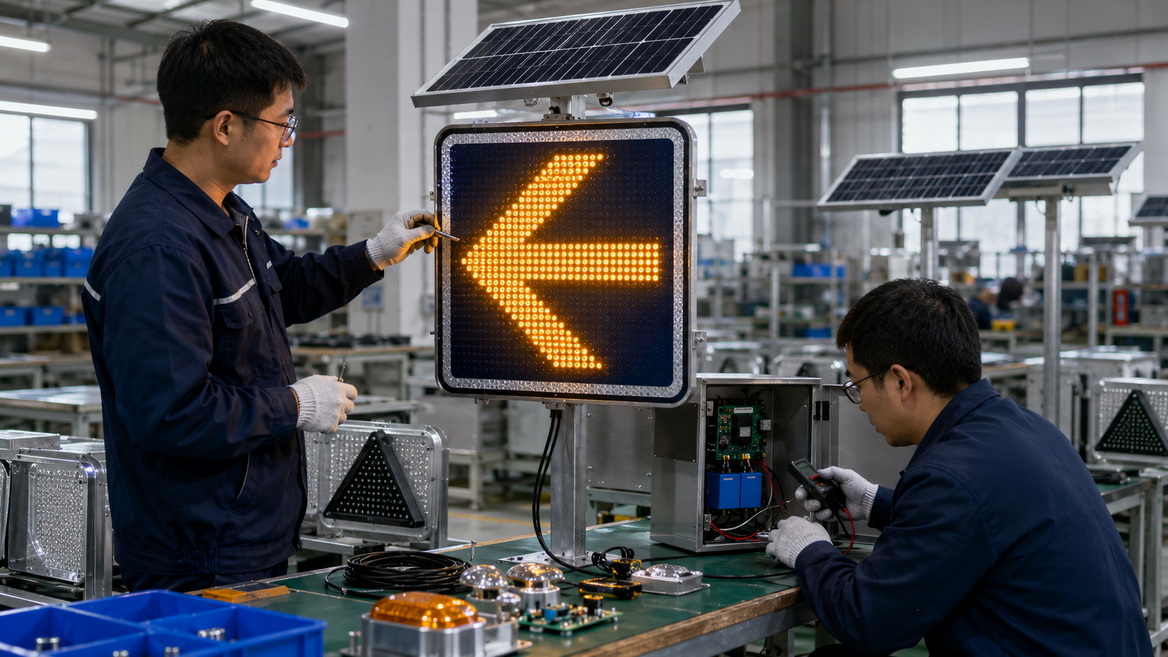
Every school-zone project has different requirements. A distributor may need private-label packaging. A contractor may need a custom solar-powered flashing sign. A municipality may require a specific sign size, bracket design, operating schedule, or inspection standard.
OEM and ODM manufacturing can support these different purchasing models.
OEM production is suitable for buyers that already have a defined product design, technical drawing, specification, or brand requirement.
Typical OEM customization may include:
- Customer logo and private labeling.
- Customized sign panel dimensions.
- Specific LED layout and flashing mode.
- Reflective film selection.
- Solar panel and battery configuration.
- Timer or controller settings.
- Pole brackets and installation hardware.
- Product packaging and carton markings.
- Inspection documentation.
- Export labeling and shipping support.
ODM support is useful when the customer has an application need but has not completed the final product design.
For example, a buyer may know that a school entrance needs a solar-powered flashing warning sign but may still need assistance with the sign dimensions, LED placement, power calculation, battery capacity, bracket style, controller function, and production details.
A strong ODM process should convert site requirements into a clear production specification before mass manufacturing begins.
Before ordering LED school-zone traffic signs, buyers should ask suppliers and project teams the following questions:
- What is the intended safety function of the sign?
- Where will the sign be installed?
- What are the local traffic-control and procurement requirements?
- Is grid power available at the installation location?
- Is solar power practical throughout the year?
- What are the required sign dimensions and reflective-material specifications?
- Is the sign required to flash continuously, on a timer, or when triggered?
- How many hours per day will the LEDs operate?
- What level of weather resistance is required?
- What mounting method will be used?
- What quality inspection process will be provided before shipment?
- Are spare parts, technical drawings, and installation instructions available?
- Is OEM branding or private-label packaging required?
- What are the expected shipping, installation, and maintenance conditions?
The more clearly these requirements are defined before production, the more reliable and cost-effective the final solution can be.
A safer school zone depends on clear communication between the road environment and every driver approaching it. LED traffic signs, flashing school speed-limit signs, pedestrian crossing signs, solar-powered warning systems, pavement markings, and organized drop-off procedures can work together to improve visibility and encourage safer behavior.
The most effective solution is not a one-size-fits-all product. It is a well-matched system designed around local road conditions, pedestrian activity, operating schedules, power availability, weather exposure, and maintenance capability.
Shenzhen Xingsheng Traffic Facilities Co., Ltd. provides LED traffic signs and traffic safety products for school zones, streets, highways, toll stations, parking areas, and other traffic-management projects. With OEM and ODM manufacturing support, buyers can develop customized LED sign solutions that match their technical, commercial, and installation requirements.
For project discussions, technical drawings, customized product specifications, or OEM and ODM manufacturing requirements, Shenzhen Xingsheng Traffic Facilities Co., Ltd. is prepared to support your traffic safety project with practical LED traffic sign solutions.
An LED school zone sign is a traffic sign that uses light-emitting diodes, flashing beacons, or illuminated borders to improve the visibility of a school-related warning, crossing message, or speed-limit instruction.
Yes. Solar-powered LED traffic signs can be suitable for school zones, especially where grid power is unavailable or electrical trenching is costly. The solar panel, battery, controller, operating schedule, and local weather conditions should be evaluated before selection.
An LED school warning sign alerts drivers that they are approaching an area where children may be present. A flashing school speed-limit sign communicates that a reduced speed requirement is active during designated periods.
Yes. OEM LED traffic sign customization may include private labeling, customer logos, sign dimensions, LED layout, flashing pattern, solar power configuration, controller settings, brackets, packaging, and inspection documentation.
Buyers should provide the sign drawing or message, required dimensions, LED requirements, power source preference, flashing schedule, installation method, order quantity, destination country, and applicable technical standards.
1. Carmanah Technologies. "[School Zone Safety Application Guide]." Guidance on school-zone signs, flashing beacons, crosswalk visibility, and related traffic safety equipment.
2. Federal Highway Administration. "[Manual on Uniform Traffic Control Devices, 11th Edition]." National guidance for the design and application of traffic-control devices.
3. Federal Highway Administration. "[MUTCD 11th Edition, Part 7]." School-area traffic-control provisions and school-zone sign requirements.
4. National Highway Traffic Safety Administration. "[Pedestrian Safety]." Pedestrian safety data and guidance for safer driving near schools and communities.
5. National Highway Traffic Safety Administration. "[School Bus Safety]." Information on school-bus-related crash trends and student transportation safety.
6. National Highway Traffic Safety Administration. "[Safe Routes to School]." School walking and bicycling safety strategies.
7. Safe Routes to School National Partnership. "[The School Zone]." Information on school-zone design, signs, crossings, and visibility improvements.


