
Please Choose Your Language
Views: 261 Author: XS Traffic Facilities Publish Time: 2026-08-31 Origin: Site


Content Menu
● What Does a Blue Road Sign Mean?
● Why Blue Road Signs Matter for Traffic Safety
>> Blue Signs Help Drivers Make Decisions Earlier
>> Nighttime Visibility Is Essential
● Common Blue Road Sign Meanings
>> Blue Fuel, Food, Lodging, and Rest Area Signs
>> Blue Bus Lane and Transit Signs
>> Blue Bicycle and Pedestrian Signs
● Blue Circular Road Signs and Mandatory Instructions
>> Blue Sign With a White Arrow
● Blue Signs With Red Lines or Red Crosses
● Blue Road Signs in the United States
>> Do Blue Street Signs Mean a Private Road?
● How to Specify Blue Road Signs for Projects
>> Blue Road Sign Procurement Checklist
>> Think in Systems, Not Individual Signs
● Blue Sign Design and Maintenance Tips
>> Sign Maintenance Priorities
>> What does a blue road sign mean?
>> What does a blue circular road sign mean?
>> What does a blue "P" sign mean?
>> What does a blue sign with a red X mean?
>> Why are service signs blue on highways?
Blue road signs usually provide guidance, identify services, indicate permitted use, or communicate mandatory instructions. Their exact meaning depends on the country, sign shape, symbol, border, text, and applicable local traffic rules.
For drivers, the safest approach is to read the entire sign—not the background color alone. For road authorities, contractors, toll-station operators, parking-facility managers, and project buyers, blue sign selection affects visibility, traffic flow, driver confidence, and nighttime safety.
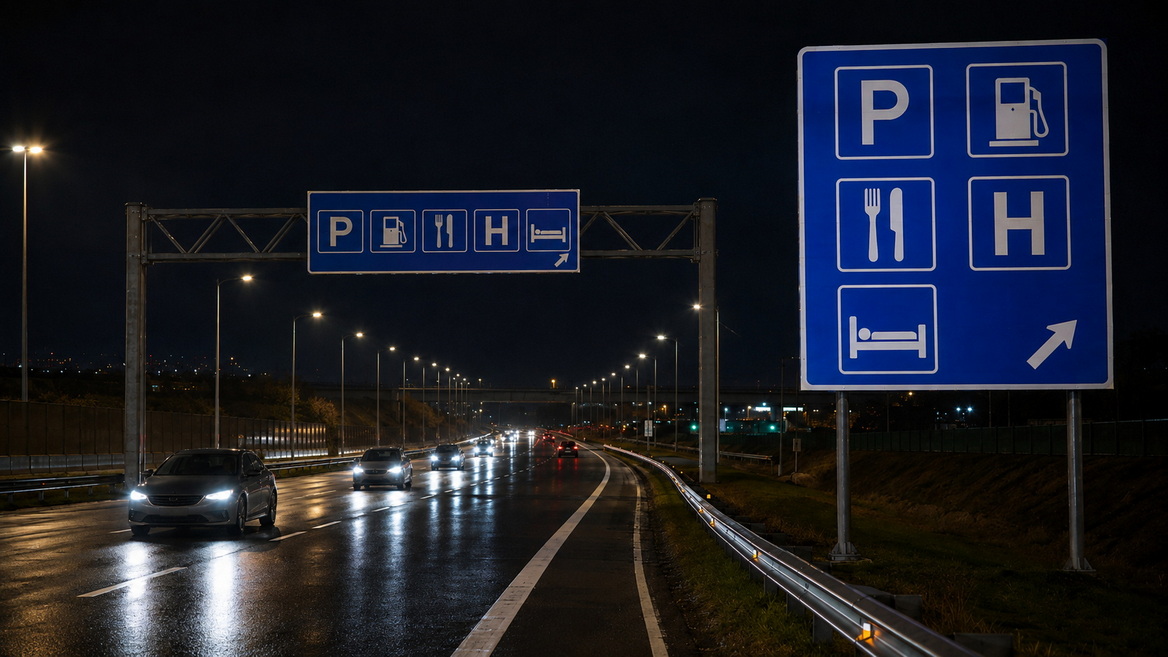
A blue road sign often gives useful traffic or facility information. It may help drivers find parking, medical services, rest areas, fuel stations, food, lodging, public transport, designated lanes, or specific road directions.
However, blue does not have one identical meaning in every country.
In the United States, blue is widely used for service and general-information signs. On highways, drivers may see blue signs directing them to fuel, food, lodging, rest areas, hospitals, parking areas, or traveler services.
In many European, Asian, and international traffic-sign systems, a blue circular sign with a white symbol often indicates a required instruction. It may tell drivers to keep left, keep right, turn in a designated direction, continue straight ahead, or use a specific bicycle or pedestrian path.
On private roads, industrial parks, campuses, residential developments, shopping centers, and parking facilities, blue signs may also be used for local wayfinding and street identification. In these situations, the color can reflect a site-management system, a property developer's design standard, or a municipal signage style.
The most important rule is simple: interpret the sign's complete design, not just its color.
| Sign Feature | Common Function | Typical Example |
|---|---|---|
| Blue rectangle or square | Guide, service, destination, or facility information | Hospital, parking, fuel, food, rest area |
| Blue circle with white symbol | Mandatory instruction in many countries | Keep right, turn left, cycle path |
| Blue sign with red border, slash, or cross | Parking or stopping restriction in many locations | No parking, no stopping |
| Blue street-name plate | Street identification or local wayfinding | Community road, campus route, private lane |
Blue signs are an important part of a well-organized road environment. They help drivers understand where they are, where they need to go, and what services or facilities are available ahead.
A clear blue sign can reduce confusion before drivers enter a highway exit, toll station, parking area, commercial district, hospital entrance, logistics center, or urban intersection.
For drivers, visible information supports earlier and safer decisions. For road managers, a well-planned sign system can help reduce sudden braking, missed turns, unsafe lane changes, unauthorized parking, and conflict between vehicles and pedestrians.
A useful road sign must be visible before a driver reaches the point where a decision is required.
For example, a motorist approaching a toll plaza or service area may need time to:
1. Recognize the sign.
2. Understand the message or symbol.
3. Identify the correct lane or exit.
4. Signal safely.
5. Reduce speed if necessary.
6. Complete the required maneuver.
This is especially important on highways, multi-lane roads, airport access roads, large parking facilities, and commercial logistics routes.
A sign that appears too late, is too small, has poor contrast, or is blocked by trees, vehicles, or other signs may not provide enough time for a safe response.
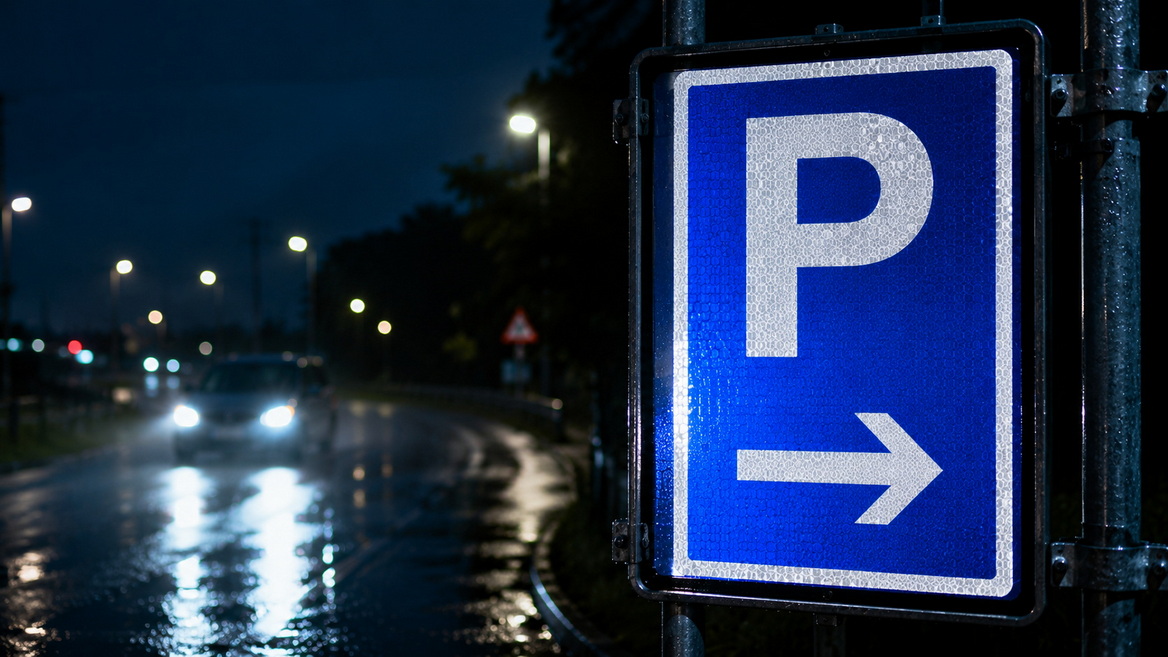
Traffic signs must remain visible when daylight conditions change. A blue sign that looks clear during the day may become difficult to recognize at night if its surface has faded, accumulated dust, lost reflective performance, or been installed at an ineffective angle.
High-quality retroreflective sheeting helps direct vehicle-headlamp light back toward approaching drivers. This improves sign recognition on dark roads, in rainy weather, and in low-light parking or industrial areas.
For project buyers, this means that a sign should not be evaluated only by its print quality or daytime appearance. The reflective material, sign substrate, mounting structure, environmental durability, and maintenance plan are all important.
A blue parking sign commonly identifies an authorized parking location, parking area, parking structure, parking zone, or vehicle-specific parking space.
Common blue parking signs may include:
- A white "P" on a blue background
- A white car symbol
- A wheelchair-accessibility symbol
- Directional arrows pointing toward parking
- Parking garage identification
- Vehicle-type restrictions
- Permit or paid-parking information
- Time-limit information
A blue parking sign does not automatically mean parking is free, unlimited, overnight-permitted, or open to all vehicles. Drivers should always read the supplementary information shown on the sign.
For parking-facility operators, clear blue signs can improve navigation in:
- Shopping centers
- Hospitals
- Airports
- Hotels
- Universities
- Industrial parks
- Factories
- Warehouses
- Residential communities
- Exhibition centers
- Transportation hubs
A complete parking guidance system may include advance signs, entrance signs, directional arrows, level-identification signs, accessible-parking signs, pedestrian-route signs, loading-zone restrictions, and exit guidance.
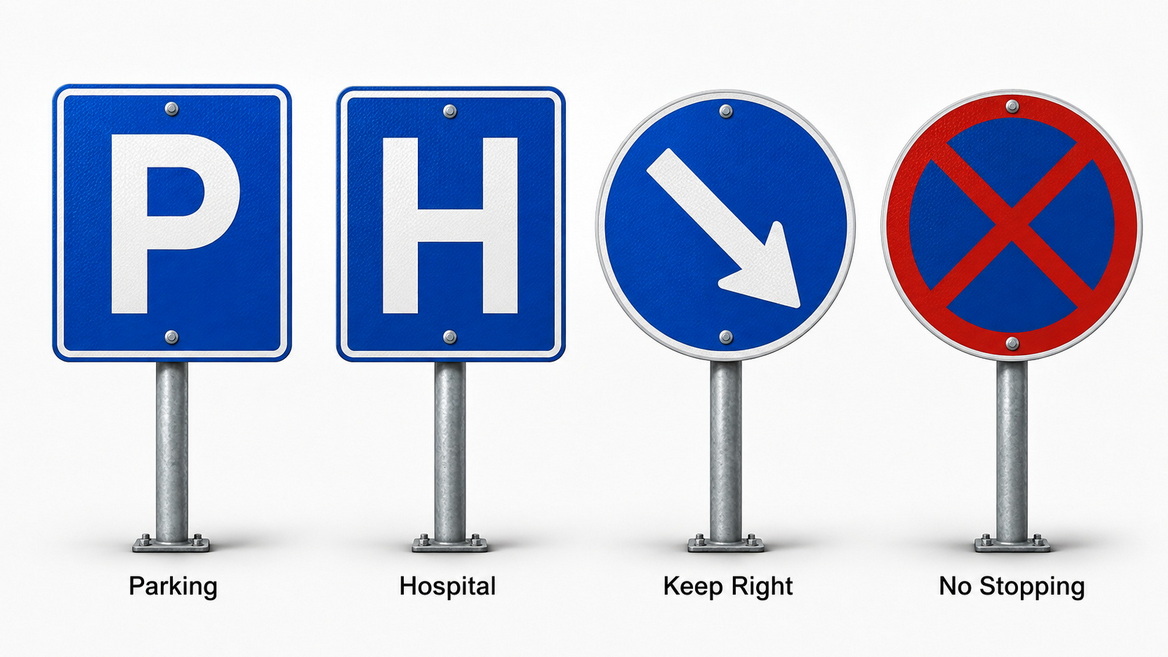
A blue sign with a white "H" or hospital symbol usually directs drivers toward medical services.
These signs are particularly useful near highway interchanges, major arterial roads, emergency routes, dense urban districts, airport corridors, and large medical campuses. They can help drivers locate emergency facilities without needing to search for information while driving.
A hospital sign should be placed early enough for drivers to select the correct lane or exit safely. Directional arrows, distance details, and advance guidance signs can make the system easier to follow.
Blue highway signs are often used to identify traveler services. They may guide road users toward fuel stations, restaurants, hotels, rest areas, restrooms, camping areas, telephones, emergency facilities, and parking locations.
Typical symbols include:
| Symbol or Message | Common Meaning |
|---|---|
| Fuel pump | Fuel station or fueling facility ahead |
| Fork and spoon | Food service available |
| Bed | Hotel, motel, or lodging |
| White “H” | Hospital or medical service |
| White “P” | Parking available |
| Bus symbol | Bus stop or transit connection |
| Tent or trailer | Camping or recreational vehicle facilities |
| Restroom icon | Public restroom facility available |
Standardized pictograms are usually easier to understand than long text messages. This is particularly valuable for drivers traveling at speed, international visitors, tourists, and commercial vehicle operators unfamiliar with the local area.
Blue signs may identify bus stops, public-transportation facilities, passenger-loading areas, bus-only lanes, transit corridors, or shuttle-vehicle routes.
The meaning can vary by location. In some cases, a blue sign identifies a bus route or stop. In others, it may indicate a restricted lane that private vehicles cannot use during certain times of day.
Drivers should always check for supporting information such as:
- Lane arrows
- Road markings
- Time restrictions
- Vehicle symbols
- Directional panels
- Access limitations
- Supplemental text
For transit hubs, airport terminals, schools, shopping centers, and large commercial developments, consistent blue transit signs can help separate bus traffic, private cars, taxis, delivery vehicles, cyclists, and pedestrians.
Blue signs can also identify bicycle lanes, cycle paths, pedestrian routes, shared-use paths, and mobility corridors.
In many locations, a blue circular sign with a bicycle, pedestrian, or combined symbol indicates a designated or required route. These signs are commonly used around:
- Urban cycle tracks
- Parks
- Waterfront paths
- School zones
- University campuses
- Pedestrianized districts
- Residential communities
- Recreation areas
- Industrial facilities with internal bicycle routes
The final sign design should always match the traffic rules, road layout, and project requirements in the destination market.
One of the most important distinctions in international traffic signage is the blue circular sign.
In many countries, a blue circular sign with a white symbol tells road users what they must do. It may identify a compulsory direction, a required lane, a designated route, or an exclusive-use facility.
Common examples include:
- Keep left
- Keep right
- Turn left only
- Turn right only
- Go straight ahead
- Pass on the indicated side
- Use the bicycle path
- Use the pedestrian path
- Follow the minimum-speed requirement where applicable
A white arrow on a blue circular background often communicates a required direction.
For example:
- A left-pointing arrow may mean turn left only or keep left.
- A right-pointing arrow may mean turn right only or keep right.
- A straight arrow may mean continue straight ahead.
- Two arrows positioned around an obstruction may show the permitted route around a traffic island, barrier, or roadwork area.
The exact interpretation depends on the sign design, the road layout, the country, and applicable traffic regulations.
A blue circular arrow sign should not be confused with a blue rectangular direction sign. The circular version often indicates an instruction that must be followed, while a rectangular sign may provide general guidance or navigation information.
A blue sign with a red border, diagonal line, or red cross often relates to parking and stopping restrictions.
These signs are frequently installed around:
- Fire lanes
- Hospital entrances
- Bus stops
- School gates
- Emergency vehicle routes
- Urban curbsides
- Toll plazas
- Loading areas
- Airport terminals
- High-security facilities
- Restricted roadside zones
| Sign Design | Common Interpretation |
|---|---|
| Blue circle with one red diagonal line | No parking |
| Blue circle with a red X or crossed red diagonals | No stopping or standing |
The difference between "no parking" and "no stopping" can be important.
A no-parking restriction may allow limited stopping for passenger pickup, drop-off, or loading under certain local rules. A no-stopping restriction generally prevents drivers from stopping, waiting, standing, loading, or parking except when required by traffic conditions or emergencies.
Drivers should read any supplementary plates carefully because the restriction may apply only during particular times, on specific days, to certain vehicle types, or along a defined section of road.
In the United States, blue signs are often associated with traveler services, facility information, motorist guidance, and parking-related information.
Drivers commonly see blue signs on highways and major roads for:
- Fuel
- Food
- Lodging
- Hospitals
- Rest areas
- Parking
- Public telephones where still applicable
- Camping facilities
- Tourist services
- Transportation-related facilities
Blue service signs are intended to help drivers locate useful facilities without distracting them from driving. They provide clear visual information that can be understood quickly.
Not always.
Some communities use blue street-name signs to distinguish private roads from public streets. However, this practice is not universal. A blue street sign may also reflect a local government design preference, a homeowner-association standard, a campus wayfinding system, or a developer's visual identity.
The color of a street-name sign alone does not confirm whether a road is public or private.
When road ownership matters, it is better to check:
- Local government road records
- Municipal engineering standards
- County property maps
- Community management documents
- Site ownership records
- Relevant traffic ordinances
For contractors, distributors, importers, wholesalers, infrastructure developers, and facility managers, specifying a blue road sign requires more than choosing a background color and printing a symbol.
A strong sign specification should account for traffic speed, visibility distance, site conditions, local requirements, climate exposure, nighttime performance, mounting method, and intended service life.
Before ordering blue traffic signs, confirm the following points:
1. Applicable traffic standard
Identify whether the project follows a national traffic standard, municipal guideline, regional standard, client specification, or private-site requirement.
2. Sign purpose
Define whether the sign is for parking, service information, mandatory movement, pedestrian guidance, bicycle guidance, hospital access, transit operations, or private-facility wayfinding.
3. Sign dimensions
Select a size suitable for vehicle speed, viewing distance, road width, lane count, and installation height.
4. Sign material
Choose a suitable substrate based on project conditions, such as aluminum sheet, composite panel, galvanized steel, or other specified material.
5. Reflective sheeting grade
Determine the required level of nighttime reflectivity for the roadway, facility, weather conditions, and expected traffic volume.
6. Graphics and wording
Confirm the required symbols, arrows, fonts, languages, colors, borders, and message hierarchy before production.
7. Mounting method
Decide whether the sign will be mounted on poles, brackets, walls, overhead structures, temporary bases, fences, or existing roadside supports.
8. Environmental conditions
Consider UV exposure, heavy rain, humidity, salt spray, wind load, dust, temperature changes, and the risk of vehicle impact.
9. Maintenance plan
Define how signs will be inspected, cleaned, repaired, replaced, and recorded throughout their service life.
A common project mistake is to purchase signs as separate products without considering the full driver journey.
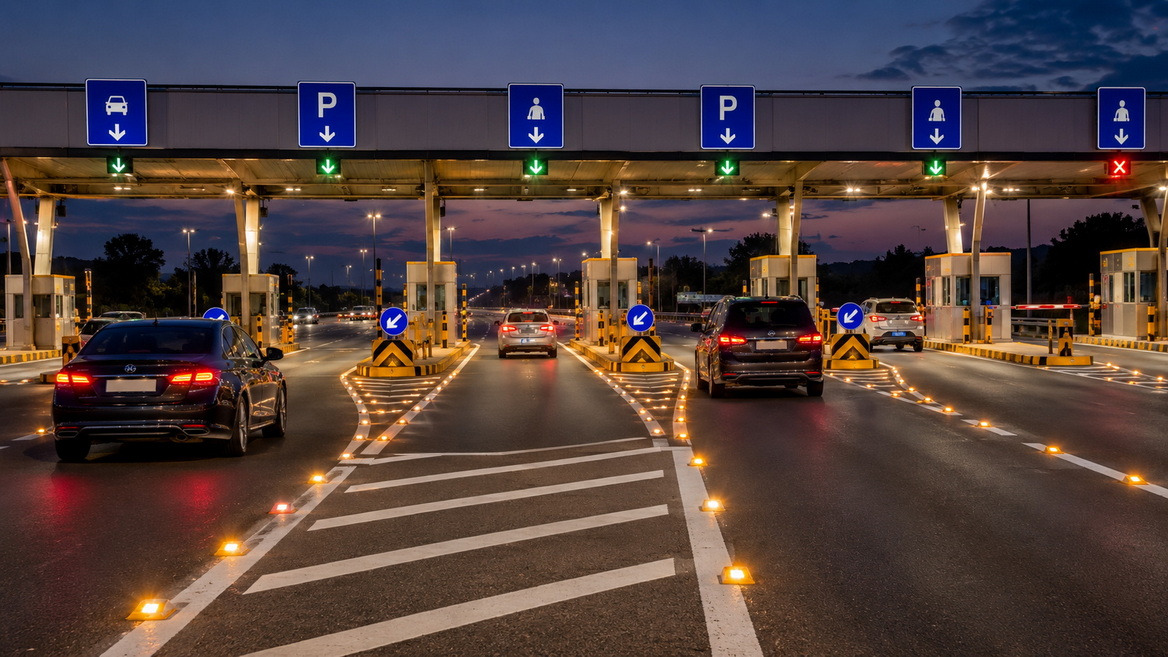
A parking facility at a toll station, for example, may require a complete sequence of safety and guidance products:
- Advance blue parking signs
- Lane-direction signs
- Vehicle-type guidance
- Accessible-parking identification
- Speed-control signs
- Loading-zone restrictions
- Pedestrian-crossing signs
- Pavement markings
- Reflective road studs
- Solar road markers
- Exit-direction signs
When these products work together, drivers receive information from the first approach to the final exit. The result is a more organized, visible, and safer traffic environment.
For highways, toll stations, streets, industrial parks, logistics facilities, and parking projects, Shenzhen Xingsheng Traffic Facilities Co., Ltd. provides traffic-safety products and customized solutions, including solar road markers, road studs, traffic signs, and related visibility products. OEM and ODM services can support project-specific dimensions, materials, colors, graphics, packaging, and branding requirements.
A correctly designed sign can still become ineffective if it is poorly installed or not maintained.
- Use high-contrast white symbols, text, and borders on blue backgrounds.
- Avoid overcrowding the sign face with too much information.
- Use simple and recognizable pictograms whenever possible.
- Make sure arrows clearly point toward the intended travel path.
- Select dimensions appropriate for traffic speed and viewing distance.
- Use suitable retroreflective sheeting for nighttime visibility.
- Coordinate signs with pavement markings, delineators, traffic cones, road studs, and lighting.
- Keep message hierarchy clear so drivers can understand the most important instruction first.
- Inspect signs for fading, dirt, graffiti, peeling film, corrosion, and collision damage.
- Check sign visibility at night, not only in daylight.
- Remove vegetation or objects that block the driver's line of sight.
- Check that signs remain correctly aligned after storms, roadwork, or vehicle impacts.
- Replace damaged or faded signs before they become difficult to read.
- Review facility traffic patterns periodically, especially after construction, expansion, or changes in road use.
A blue sign should remain readable in bright sunlight, rain, fog, low-light conditions, and nighttime driving environments. Visibility is not simply a product feature—it is a long-term operational requirement.
Blue road signs play a valuable role in guiding drivers, identifying services, organizing parking, directing traffic, and improving road-user confidence. Their meaning may vary from one country to another, but the most reliable interpretation always comes from the complete sign design: its shape, symbol, border, wording, location, and supporting panels.
For road authorities, contractors, property developers, parking operators, and infrastructure buyers, blue signs should be selected as part of a complete traffic-safety system. Proper sign size, clear graphics, durable materials, effective retroreflective performance, correct installation, and regular maintenance all contribute to safer and more efficient road environments.
Shenzhen Xingsheng Traffic Facilities Co., Ltd. supports customized traffic-safety projects for streets, highways, toll stations, industrial facilities, and parking areas. With OEM and ODM capabilities, the company can help develop practical solutions involving solar road markers, traffic signs, road studs, and related safety products based on specific project requirements.
A blue road sign usually provides guidance, service information, parking information, facility identification, or a mandatory instruction. Its exact meaning depends on the country, sign shape, symbol, text, and local traffic rules.
In many countries, a blue circular road sign with a white symbol indicates a required action. It may instruct drivers to turn left, turn right, go straight, keep to one side, use a cycle path, or use a pedestrian route.
A blue "P" sign generally indicates parking. It may direct drivers to a parking lot, parking garage, designated parking space, or specific vehicle parking area. Additional panels may show fees, time limits, permit rules, or restrictions.
A blue sign with a red X commonly means no stopping or standing. In many locations, drivers are not allowed to stop, wait, park, load, or unload in the marked area unless an emergency or traffic condition requires them to do so.
Blue signs are commonly used to identify useful services for road users, such as fuel stations, food, lodging, hospitals, rest areas, parking, public transport, and camping facilities.
1. Federal Highway Administration. [Manual on Uniform Traffic Control Devices]
2. Federal Highway Administration. [MUTCD Chapter 2A: General]
3. Federal Highway Administration. [MUTCD Chapter 2H: General Information Signs]
4. Federal Highway Administration. [Methods for Maintaining Minimum Retroreflectivity of Traffic Signs]
5. Federal Highway Administration. [Nighttime Visibility: Sign Retroreflectivity Regulations and Standards]
6. United Nations Treaty Collection. [Convention on Road Signs and Signals]
7. United Nations Economic Commission for Europe. [Road Traffic and Road Signs and Signals Agreements and Conventions]


