
Please Choose Your Language
Views: 269 Author: XS Traffic Facilities Publish Time: 2026-10-20 Origin: Site


Content Menu
● How These Rubber Corner Guard Suppliers Were Selected
● Why Source Rubber Corner Guards from China?
>> A Concentrated Traffic-Safety Supply Base
>> What Recent Industry Data Actually Shows
● Quick Comparison: Capacity, MOQ, and Certification Disclosures
● The Top 10 Rubber Corner Guard Manufacturers and Supply Partners in China
>> 1. Shenzhen Xingsheng Traffic Facilities Co., Ltd.
>> 2. Zhejiang Luba Traffic Technology Co., Ltd.
>> 4. Wuhan Jackwin Industrial Co., Ltd.
>> 5. Nanjing Roadsky Traffic Facility Co., Ltd.
>> 6. Beijing Wistron Technology Ltd.
>> 7. Taizhou Allroads Safety Co., Ltd.
>> 8. Sanmen Aroad Traffic Facility Factory
>> 9. Tiantai Yongsheng Traffic Facilities Co., Ltd.
>> 10. Hangzhou Sloan Safety Protection Equipment Co., Ltd.
● Technical Buyer's Guide: What Makes a Reliable Rubber Corner Guard?
>> Specify Measurable Performance, Not Just a Material Name
>> Separate Management Certification from Product Compliance
● The Overlooked Pitfall: An Approved Sample Does Not Lock the Production Specification
● How to Verify a Factory and Manage the First Order
>> Use a Staged Sample Process
>> Audit the Process Behind the Catalog
>> Write Logistics Requirements into the RFQ
● Conclusion: Select the Supplier That Can Reproduce the Approved Product
● FAQ
>> 1. How can I check whether a supplier's ISO 9001 certificate has expired or been suspended?
>> 2. Does a rubber corner guard need CE marking or RoHS certification for the EU?
>> 3. How can I detect material substitution between the sample and the shipment?
>> 4. How do I verify that published production capacity can meet my order?
>> 5. Can I accept a "REACH-compliant" report issued for another rubber product?
A rubber corner guard can look acceptable in a sample photograph and still fail after installation. Cracking around mounting holes, peeling reflective film, inconsistent flexibility, and strong residual odor can turn a low-cost purchase into a recurring maintenance problem.
For professional buyers, the real challenge is not finding a supplier that lists corner protectors. It is identifying a partner that can reproduce the approved material, geometry, finish, and installation performance across repeat orders.
China offers a substantial supplier base for rubber and plastic traffic-safety products. Public manufacturer information shows a particularly visible concentration around Sanmen and the wider Taizhou area of Zhejiang, alongside broader traffic-safety businesses in Shenzhen, Nanjing, and Wuhan. These locations give buyers access to both specialist rubber-product factories and suppliers that consolidate multiple parking-safety products.
This guide compares ten Chinese manufacturers and supply partners, explains their publicly documented strengths, and highlights the questions buyers should resolve before awarding a contract.
The central purchasing principle is traceability: the approved sample, production batch, test report, manufacturing site, and contracting company should form one verifiable chain.

This is a procurement-oriented shortlist, not an audited ranking by revenue, market share, or independently measured product performance.
The publisher, Shenzhen Xingsheng Traffic Facilities Co., Ltd., appears first by editorial arrangement. Its inclusion does not establish independently verified superiority over the other companies. Supplier descriptions draw on public company pages and business profiles; factory ownership, certificate validity, available capacity, and order terms require transaction-specific verification.
| Evaluation area | What a professional buyer should examine |
|---|---|
| Manufacturing identity | Registered legal entity, production address, factory ownership, and any subcontracted processes |
| Relevant product range | Dedicated rubber corner guard models, drawings, mounting details, and material options |
| Development capability | Ability to modify geometry, mounting holes, compound requirements, branding, and packaging |
| Quality control | Incoming-material checks, production records, dimensional inspection, hardness testing, and batch identification |
| Compliance evidence | Current management-system certificates and applicable, model-specific material test reports |
| Delivery reliability | Available molds, scheduled production capacity, material lead times, and contingency arrangements |
| Commercial suitability | Standard-model MOQ, customization MOQ, tooling ownership, payment terms, and complaint handling |
A supplier should not receive a higher evaluation simply because its website displays more certification logos. The scope and relevance of the underlying documents matter more than the number of badges. European Commission guidance, for example, expressly states that CE marking applies only where relevant legislation requires it.
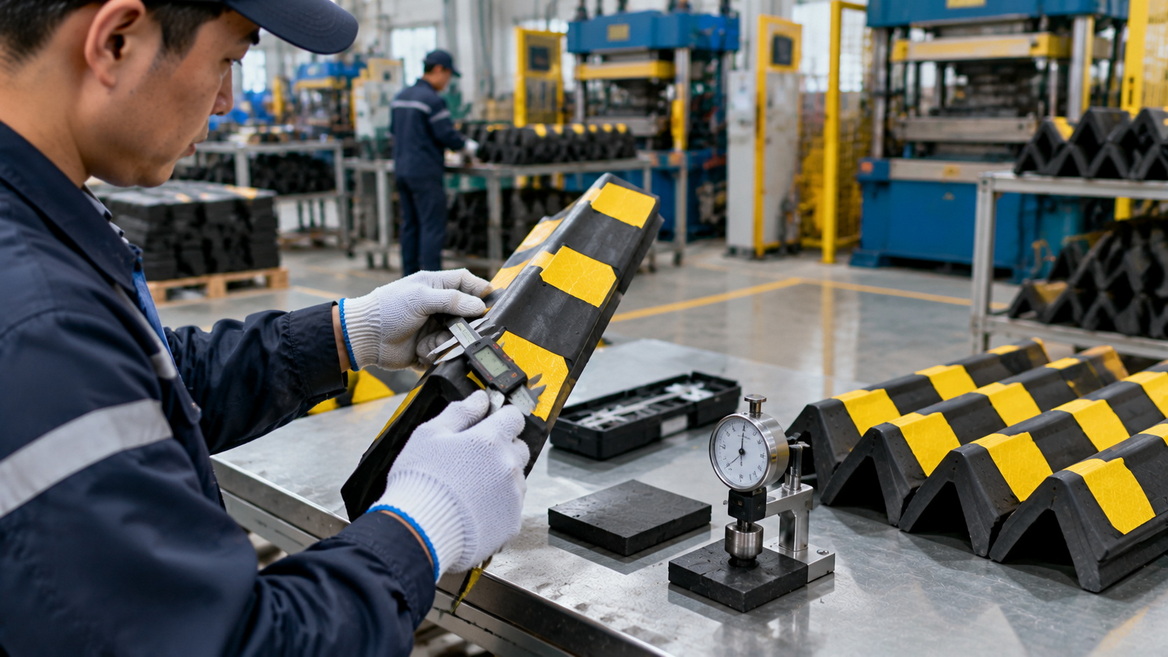
Sanmen-based manufacturers such as Luba, Eastsea, Allroads, and Aroad publicly offer overlapping ranges of speed humps, wheel stops, corner guards, cable protectors, and related safety products. That concentration creates a practical sourcing advantage for buyers comparing multiple parking-lot components within the same regional supplier base. It does not, by itself, prove identical quality or factory capability.
For distributors, this breadth can simplify assortment development. For contractors, it can make a consolidated purchase of corner protectors, wheel stops, warning products, and signs commercially attractive.
The China Rubber Industry Association's 2026 outlook for the rubber-products sector reports that its surveyed group of 71 member enterprises recorded the following results for 2025:
- Industrial output value of RMB 84.062 billion.
- Sales revenue of RMB 82.262 billion.
- Export delivery value of RMB 12.3 billion.
- Export delivery value growth of 17.69% year over year.
These figures describe the association's surveyed rubber-products enterprises. They are not a market-size estimate for rubber corner guards, do not cover every Chinese factory, and should not be presented as customs export totals.
The useful implication is narrower: overseas demand remains commercially important to the surveyed rubber-products businesses. Individual corner guard suppliers still need to demonstrate their own production capability and export experience.
The following table distinguishes published information from details requiring a quotation or document review. "Not verified" does not mean a supplier lacks the capability or certificate; it means the reviewed evidence does not establish it adequately.
| Supplier | Main sourcing focus | Public capacity information | Corner guard MOQ evidence | Certification position |
|---|---|---|---|---|
| Shenzhen Xingsheng Traffic Facilities | Customized traffic-safety and parking products | Corner guard-specific output not verified | Request standard and customized quotations separately | Company states ISO 9001; verify certificate, site, and scope |
| Zhejiang Luba Traffic Technology | Rubber and plastic parking-safety products | Corner guard-specific output not verified | Request model-specific MOQ | Obtain current certificates and relevant test reports |
| Zhejiang Eastsea | Rubber traffic and parking protection | Corner guard-specific output not verified | Request model-specific MOQ | Obtain current factory and product documentation |
| Wuhan Jackwin Industrial | Broad traffic-safety range and rubber protection | States 1,800 rubber-product pieces daily; not exclusively corner guards | Request model-specific MOQ | Verify documents for the selected model and production site |
| Nanjing Roadsky Traffic Facility | Project-oriented traffic and parking equipment | Corner guard-specific output not verified | Request quotation | Verify applicable reports rather than relying on group-wide claims |
| Beijing Wistron Technology | Integrated road-safety sourcing | Corner guard-specific output not verified | Request quotation | Company lists several certifications; corner guard applicability requires review |
| Taizhou Allroads Safety | Rubber and plastic traffic-safety products | Multiple production lines stated; corner guard output not verified | One marketplace listing shows 500 pieces for a 120 cm model | Obtain current certificates and model-specific reports |
| Sanmen Aroad Traffic Facility Factory | Customized rubber and traffic-safety products | Corner guard-specific output not verified | Request quotation | Verify factory assessment and current certificates separately |
| Tiantai Yongsheng Traffic Facilities | Rubber parking and traffic products | Corner guard-specific output not verified | Request quotation | Obtain current management-system and material-test documents |
| Hangzhou Sloan Safety Protection Equipment | Consolidated sourcing and export support | Partner-factory capacity requires verification | One listing under the Sloan name shows 504 pieces; confirm legal entity and model | Verify the actual manufacturing partner and its documents |
Capacity, MOQ, and certification disclosures above come from supplier pages and marketplace profiles. Published listing quantities are not binding offers, and similarly named trading entities should not be assumed to be interchangeable.
Established: 2014.
Location: Shenzhen, Guangdong.
Market coverage: Export-oriented global customers; regional sales proportions are not publicly established in the reviewed information.
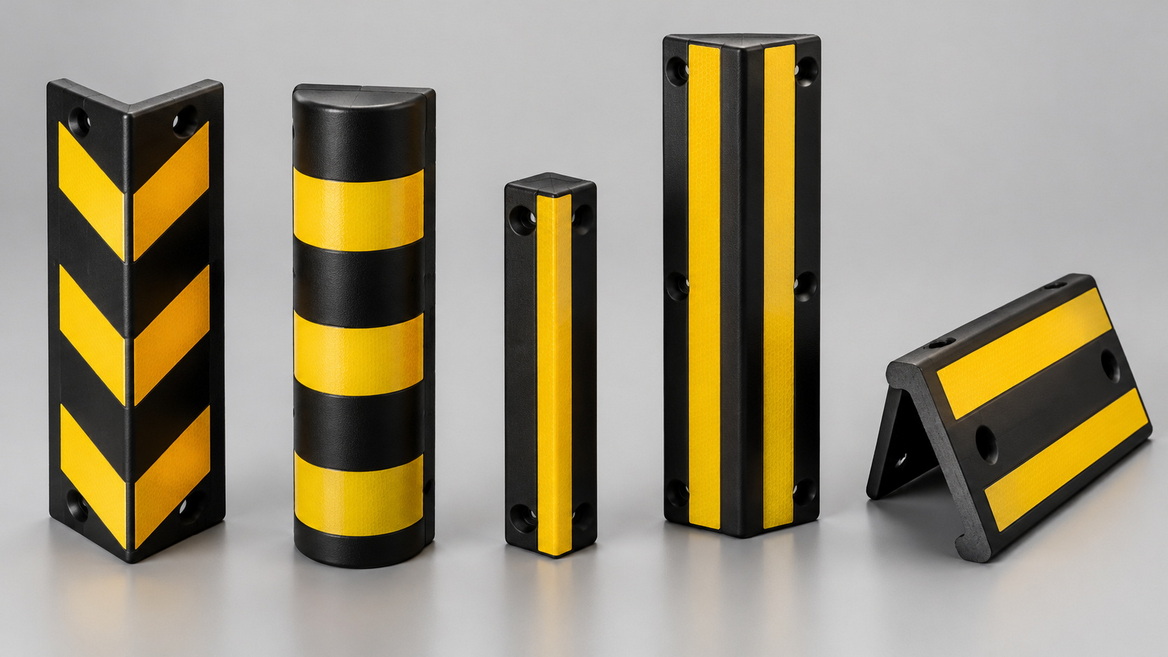
Shenzhen Xingsheng supplies traffic-safety products for streets, highways, toll stations, and parking facilities. Its published portfolio includes car-parking corner guards, wall rubber corner guards, wheel stops, traffic signs, and road markers. The company describes an R&D-supported business with OEM and ODM services extending from design through production.
Its most relevant positioning is as a potential value-oriented development partner for small and midsize brands that need more support than a standard catalog transaction. Buyers sourcing several parking-lot safety facilities may also find its broader product range useful.
However, "flexible service" and "efficient communication" should be tested rather than assumed. A practical evaluation should ask Xingsheng to return:
- An annotated drawing against the buyer's specification.
- Separate prices for a standard model and a customized version.
- A sample-development schedule.
- A written list of modifications available without new tooling.
- A named commercial contact and technical approval contact.
Its publicly described OEM/ODM capability supports discussing these requirements, but low MOQ, specific response times, corner guard production capacity, and cost leadership require direct confirmation. The company also states ISO 9001 certification; buyers should verify its current status and manufacturing scope.
Established: 2001, according to its current corporate website.
Location: Sanmen, Zhejiang.
Market coverage: International customers; regional sales shares are not disclosed in the reviewed corporate material.
Luba specializes in rubber and plastic traffic-safety products, including corner guards, wheel stops, speed humps, traffic cones, cable protectors, and barriers. Its dedicated rubber corner guard category makes it relevant for distributors developing a coordinated parking-safety assortment.
Its main purchasing attraction is product-family depth. A buyer can evaluate whether several rubber safety products can be developed under a common specification and inspection program.
Customization discussions should cover model dimensions, compound requirements, reflective layouts, packaging, and any new-mold requirement. Public profiles indicate customized services, but the precise boundary between standard customization and new development needs a quotation.
A significant verification point is company history. Public listings associated with the Luba name show different establishment dates and historical company names. Buyers should use the current business license, contracting entity, and certificate holder—not a brand name alone—to resolve those differences.
Established: 1981, according to the historical Zhejiang Eastsea Rubber Factory profile.
Location: Sanmen, Zhejiang.
Market coverage: Manufacturer and exporter; current regional sales proportions are not established in the reviewed sources.
Eastsea offers rubber and plastic products for traffic, parking, and facility protection. Its published range includes wall protectors, corner guards, wheel stops, speed humps, cable protectors, and ramps. A current product page also lists a round rubber corner guard for parking and facility applications.
The company's stated OEM/ODM support and long operating history make it a relevant candidate for buyers seeking a specialist rubber-product supplier rather than a narrow single-product vendor.
Procurement teams should clarify which legal entity will manufacture and invoice the order. Public pages use both historical factory naming and Zhejiang Eastsea Tech naming. Tooling ownership, sample approval responsibility, and product warranty should all attach to the contracting entity.
Established: Brand history begins in 2008; its published timeline identifies incorporation of the Wuhan company in 2011.
Location: Wuhan, Hubei.
Market coverage: International export customers; another company-operated product site reports coverage across more than 70 countries and regional markets.
Jackwin supplies road, construction, site, and parking-safety products, including rubber corner guards and wall bumpers. Its corner-protection page publishes unusually specific production information: a 3,000-square-meter workshop, nearly 60 hydraulic vulcanizing machines, approximately 150 molds, and output of 1,800 rubber-product pieces per day.
These are supplier-reported figures across rubber products, not verified corner guard capacity. Buyers should request a schedule showing how many units of their chosen model can be produced alongside existing orders.
Jackwin is particularly relevant for multi-product sourcing. Customization inquiries should distinguish existing-mold changes, branding, and packaging from work requiring new tooling. Its public material describes development, design, manufacturing, and export services, but project-specific commitments belong in the quotation and purchase agreement.
Established: Roadsky's published company presentation dates the business's origins to 2000; confirm the registration date of the contracting entity.
Location: Nanjing, Jiangsu.
Market coverage: Published corporate material identifies South America, Africa, and Southeast Asia among its export destinations.
Roadsky combines highway-safety equipment with road-marking and parking-safety products. Its rubber corner guard page explicitly offers right-angle and rounded versions in different colors, lengths, thicknesses, and weights, with custom designs available.
That published customization scope makes Roadsky relevant for project buyers working with installation drawings or mixed traffic-safety packages.
The main qualification question is production responsibility. Buyers should establish where the corner guards are molded, who controls the compound specification, and whether inspection occurs at the manufacturing site or a consolidation warehouse. A broad catalog is useful commercially, but it does not substitute for product-level process visibility.
Established: 2012.
Location: Company name references Beijing; its published contact address is in Baoding, Hebei.
Market coverage: The company states exports to more than 70 countries and regions.
Wistron describes itself as an integrated industry-and-trade business covering solar road-safety products and conventional traffic equipment. Its corner-protector category includes rubber parking guards and rubber protectors incorporating metal plates.
Its stated OEM/ODM and sampling-to-shipping services may suit buyers consolidating conventional parking protection with road studs or solar safety products.
Document relevance is particularly important here. The company page lists ISO 9001 and several product certifications and standards, but those claims span a broad portfolio. Electrical protection ratings and road-stud standards do not establish rubber corner guard performance. Request a report that identifies the actual corner guard model, material, and test scope.
Established: 2010.
Location: Gaojian Industrial Zone, Sanmen, Zhejiang.
Market coverage: Export-oriented supply; exact regional sales distribution is not established in the reviewed information.
Allroads manufactures rubber and plastic safety products, including speed humps, wheel stops, corner guards, traffic cones, and other customized items. Its public company material describes multiple production lines, assembly and testing equipment, and more than 100 staff.
Published corner guard listings include 80 cm and 100 cm products, while a marketplace listing advertises a 120 cm recycled-rubber model with a 500-piece MOQ. These listings provide useful starting points, but the MOQ should be reconfirmed for the exact profile, reflective material, and packaging.
Allroads states OEM service for rubber and plastic safety products. It is therefore a relevant candidate for private-label distributors, subject to verifying compound control, packaging development, and repeat-order consistency.
Established: A factory profile lists registration on January 17, 2012; other public histories differ.
Location: Sanmen, Zhejiang.
Market coverage: Its associated export business, Shanghai Eroson, reports sales across more than 50 countries and multiple continents.
Aroad presents itself as a custom manufacturer of traffic-safety products. Its associated export profile lists corner guards alongside cable protectors, speed bumps, wheel chocks, warning posts, barriers, and other safety equipment.
The company is worth considering where a buyer wants access to a rubber-product factory through an export-facing organization. Its public business-solutions page also lists OEM/ODM and sample services.
Before proceeding, establish the relationship among the factory, export company, certificate holder, and bank beneficiary. If these are different entities, the contract should identify who owns tooling, approves production changes, and handles defective goods.
Established: Its supplier profile dates Tiantai Yongsheng Rubber Factory to 2005.
Location: Tiantai, Taizhou, Zhejiang.
Market coverage: The profile lists North America, South America, Southeast Asia, Oceania, and the Middle East.
Yongsheng's range includes rubber corner guards, wall protectors, wheel stops, speed humps, cable protectors, ramps, and traffic cones. Its marketplace profile identifies both manufacturing and trading activities and explicitly lists OEM and ODM capability.
This makes it a relevant specialist candidate for parking-safety distributors seeking several rubber-product categories from the Taizhou area.
Buyers should verify whether the order will use an existing mold or require a new tool. For custom work, request the drawing revision, mold charge, ownership terms, sample approval procedure, and expected tooling life in writing.
Established: 2024, according to public business profiles; its website separately describes more than 12 years of industry experience.
Location: Hangzhou, Zhejiang.
Market coverage: Its website emphasizes Latin America; a business profile also lists North America, Southeast Asia, and the Middle East.
Sloan belongs in a different category from a verified molding factory. Its public profile identifies it as a trading company supported by manufacturing partners, and its product range includes corner protectors and other traffic-safety equipment.
Its potential value lies in sourcing coordination, multilingual communication, and consolidated shipments rather than independently established in-house rubber production. The founder's Spanish and English capability may be useful for some importers.
OEM discussions should therefore identify the actual factory and its responsibilities. Require direct access to production samples, factory documentation, material reports, and pre-shipment inspection. Treat Sloan as a supply-chain partner unless an audit establishes the relevant manufacturing operations.
"Rubber" is not a complete material specification. Even "EPDM" or "recycled rubber" leaves important questions unanswered.
A published EPDM corner guard datasheet, for example, specifies dimensions, density, and hardness of 75 ± 5 Shore A, while also identifying SBR as an alternative material. That illustrates how a usable specification combines material identification with measurable properties. It is not a universal requirement for every corner guard.
For your RFQ, request:
| Specification | What to define |
|---|---|
| Material | Declared polymer or compound type and permitted recycled content |
| Geometry | Length, leg widths, thickness, angle, hole positions, and tolerances |
| Hardness | Agreed range, test method, and measurement conditions |
| Appearance | Surface finish, allowable flash, color, and reflective layout |
| Installation | Substrate, fasteners, washers, hole geometry, and instructions |
| Environment | Indoor or outdoor location, temperature exposure, and cleaning chemicals |
| Packaging | Units per carton, stacking orientation, pallet limits, and labeling |
| Traceability | Batch identification linked to production and inspection records |
ASTM D2240 and ISO 48-4 describe durometer methods used to measure indentation hardness. Shore A is relevant to many rubber compounds, but a hardness number alone is not an impact-protection rating.
ISO 9001 concerns the supplier's quality-management system. Buyers should still verify the certificate's status, scope, certified locations, issuing body, and accreditation details. IAF CertSearch supports searches using company names and certificate identifiers and provides these verification fields.
CE marking requires a different analysis. It is not a general quality certificate for all products sold in Europe. European Commission guidance states that CE marking must not be used where no applicable EU requirement calls for it. Ask the supplier to identify the precise legal basis before accepting "CE-certified rubber corner guard" as meaningful evidence.
RoHS primarily concerns electrical and electronic equipment. A passive molded corner protector should not automatically be treated as a product within RoHS scope. Material testing requested by a customer may still have commercial value, but that is different from a legal obligation to apply RoHS conformity procedures.
For REACH-related chemical requirements, use the actual material and intended application. ECHA's PAH guidance considers factors including whether rubber or plastic components come into direct and prolonged or repeated skin contact; one generic report should not be assumed suitable for every application.
A frequently overlooked sourcing risk is approving a physical sample without approving the manufacturing specification behind it.
The buyer may retain a sample but leave the compound designation, permissible substitutions, reflective film, production site, or subcontractor undocumented. A later shipment can then resemble the approved item without being demonstrably equivalent.
The practical safeguard is a production-control agreement:
1. Identify the approved drawing and revision.
2. Record the compound designation and agreed material requirements.
3. Identify the reflective film and adhesive system.
4. Record the manufacturing site and any approved subcontractor.
5. Retain matching reference samples with buyer and supplier.
6. Require written approval before substitutions.
7. Take verification samples from the actual production batch.
This is a proposed purchasing safeguard, not an allegation about any supplier in this list. It follows the same distinction emphasized throughout this guide: company credentials, material identity, and a finished product's measured properties are separate forms of evidence.
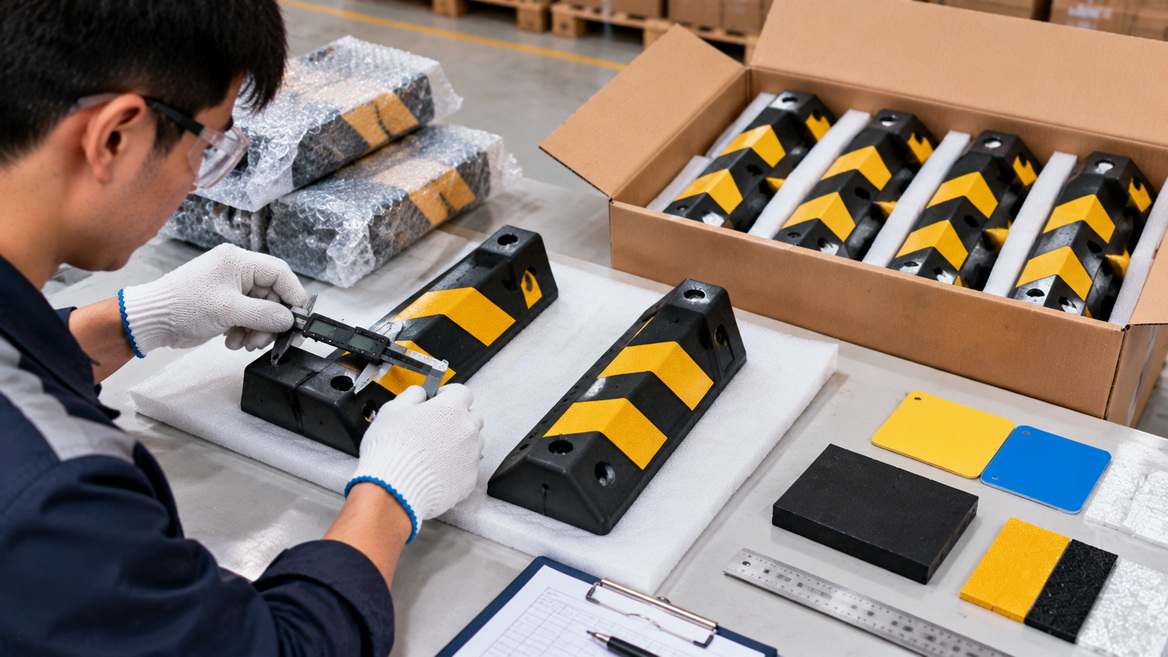
A useful qualification sequence moves from low-cost screening to production-representative evidence:
- Catalog sample: Assess basic geometry and finish.
- Customized sample: Check the intended dimensions, reflective arrangement, and packaging.
- Pilot batch: Evaluate consistency across multiple units.
- Production-batch sample: Confirm that the shipment matches the approved specification.
- Installation trial: Review mounting fit and actual site requirements.
The acceptance plan should use agreed dimensions, hardness methods, and inspection records rather than subjective statements such as "same quality as sample." Standardized hardness testing and batch-specific documentation make comparisons more defensible.
Before paying for significant tooling or placing a large order, request a live production walkthrough or independent audit covering:
- Rubber preparation or incoming compound control.
- Molding equipment and active molds.
- Trimming and finishing.
- Reflective-material application.
- Inspection and nonconforming-product handling.
- Packing and batch labeling.
Also reconcile the business license, factory address, invoice issuer, certificate holder, and beneficiary account. Certification databases can help verify the certified organization and location, but they do not replace a factory capability audit.
For quotation comparison, require suppliers to provide actual packed carton dimensions, gross weight, pallet configuration, and loading quantities. Avoid comparing only the unit price.
Ask the supplier and forwarder to confirm:
- Carton and pallet weight limits.
- Protection against deformation and film abrasion.
- Destination unloading arrangements.
- Treatment requirements for any wood packaging.
- Incoterm, named place, insurance, and responsibility for destination charges.
- Tariff classification and destination-specific import requirements.
Treat these as items for written confirmation with the appointed logistics and customs professionals, not as assumptions attached to a supplier's standard offer.
The most useful shortlist distinguishes specialist rubber manufacturers, broad traffic-safety businesses, and sourcing partners instead of treating them as identical.
Luba, Eastsea, Allroads, Aroad, and Yongsheng offer relevant rubber and parking-safety product ranges. Roadsky, Jackwin, Wistron, and Xingsheng combine corner protection with broader traffic-safety offerings. Sloan provides a sourcing-led alternative whose manufacturing partners require separate verification.
For buyers evaluating Shenzhen Xingssheng Traffic Facilities Co., Ltd., the next step is a specification-led inquiry—not an immediate volume commitment. Request a drawing review, sample plan, customization proposal, model-specific MOQ, and current quality documentation.
Shenzhen Xingsheng's published contact page lists sales@trafficthing.com for inquiries. Include the installation environment, annual forecast, target dimensions, branding requirements, destination, and requested delivery schedule so the quotation can address the real project.
Request the certificate number, complete certificate, legal company name, certified address, and issuing certification body. Search IAF CertSearch and, where necessary, confirm directly with the issuing body.
Check the current status as well as the printed expiration date. IAF distinguishes active, suspended, withdrawn, and expired certificates. Also confirm that the certified scope and location cover the business and site relevant to your purchase. An unresolved database search should trigger further verification rather than an automatic conclusion that a certificate is fraudulent.
Not automatically. CE marking is required only when applicable EU legislation mandates it, and it must not be applied to products outside those requirements. RoHS addresses electrical and electronic equipment, so a passive rubber protector should not be assumed to fall within its scope.
Ask the supplier to identify the applicable legislation and product classification. If the buyer separately requests restricted-substance testing, describe that requirement accurately rather than presenting it as a universal certification obligation.
Use a documented specification and test representative samples from the actual shipment. Compare dimensions, mass, appearance, and hardness under the same agreed conditions, then use an appropriate laboratory investigation if results differ materially.
Hardness testing alone cannot establish complete compound identity. Its value is as one controlled measurement within a broader verification plan, not as proof that two formulations are identical.
Ask for capacity allocated to your model—not a company-wide output figure. Require the supplier to identify the mold, production schedule, existing commitments, inspection time, and packing capacity.
For example, Jackwin's published 1,800-piece daily figure refers to rubber products generally. It should not be converted directly into a delivery promise for one corner guard model. Use a written order schedule and, for a critical purchase, verify progress at the manufacturing site.
Do not assume it applies. Review the report's sample description, material designation, date, tested substances, methods, and relationship to the corner guard being purchased.
The compliance assessment must also consider intended use. ECHA's guidance on PAH restrictions addresses exposure conditions such as direct, prolonged, or repeated skin contact. A report for a different compound or application may not answer the requirements of your order.


