
Please Choose Your Language
Views: 231 Author: XS Traffic Facilities Publish Time: 2026-10-14 Origin: Site


Content Menu
● Introduction: Why Source PVC Traffic Cones from China?
>> What Recent Market Reports Actually Tell Buyers
● How We Selected These PVC Traffic Cone Manufacturers
>> 1. Relevant Product Coverage
>> 2. Material and Process Control
>> 3. Customization and Development Capability
● Supplier Comparison: Capacity, MOQ, and Certification Disclosures
● The Top 10 PVC Traffic Cone Manufacturers in China
>> 1. Shenzhen Xingsheng Traffic Facilities Co., Ltd.
>> 2. Zhejiang Luba Traffic Technology Co., Ltd.
>> 3. Zhejiang Eastsea Tech Co., Ltd.
>> 4. Zhejiang Dingtian Traffic Facilities Co., Ltd.
>> 5. Tiantai Yuanda Traffic Device Co., Ltd.
>> 6. Zhejiang Sanmen Hongqiao Rubber & Plastic Technology Co., Ltd.
>> 7. Sanmen Aroad Traffic Facility Factory
>> 8. Sanmen Dingyuan Traffic Facilities Co., Ltd.
>> 9. Hangzhou Eaglerd Traffic Industry and Trade Co., Ltd.
>> 10. Sanmen Transpower Traffic Technology Co., Ltd.
● Technical Buyer's Guide: What Determines PVC Traffic Cone Quality?
>> Specify Performance, Not Just "High-Quality PVC"
>> Distinguish Road-Use Rules from Marketing Labels
>> Evaluate the Complete Cone, Not Just the Reflective Film
● Common Purchasing Traps and How to Avoid Them
>> Material Substitution After Sample Approval
>> Treating Weight as Proof of Durability
>> Confusing Advertised Capacity with Available Output
>> An Overlooked Risk: Approval Samples That Do Not Represent Packed Production
● Factory Verification, Sampling, and Logistics
>> Verify the Legal Entity and Production Site
>> Use a Three-Stage Sample Process
● Conclusion: Choose the Supplier That Makes Repeat Orders Predictable
● FAQ
>> 1. How Can I Check Whether a Manufacturer's ISO Certificate Has Expired?
>> 2. Does a CE Certificate Prove That a PVC Traffic Cone Meets European Requirements?
>> 3. How Can We Detect a Formulation Change Between Samples and Bulk Production?
>> 4. Can One PVC Traffic Cone Serve Both European and US Projects?
>> 5. What Should a Buyer Own When Paying for a Custom Cone Mold?
>> Manufacturer and Supplier Sources
>> Standards, Government Guidance, and Market Reports
Choosing a PVC traffic cone manufacturer is not simply a matter of finding the lowest quotation. Professional buyers need a partner that can maintain material consistency, document product performance, support customization, and deliver repeat orders without changing the approved specification.
China offers several sourcing routes: established rubber-and-plastic factories, specialized traffic safety manufacturers, and export-oriented suppliers that coordinate broader parking and roadway product ranges. This shortlist includes manufacturers concentrated around Sanmen, Tiantai, and Hangzhou in Zhejiang, alongside Shenzhen-based Shenzhen Xingsheng Traffic Facilities Co., Ltd. Their published portfolios illustrate the availability of cones, wheel stops, speed humps, delineators, and related products within these regional supply networks.
For international distributors, these networks can make combined purchasing and product development more practical. However, a broad catalog does not prove that every item is manufactured in-house. Buyers should establish which company controls cone molding, compound preparation, reflective collar application, and final inspection.
This guide uses verification as its central purchasing principle. It presents ten sourcing candidates rather than an independently audited ranking by sales, factory size, or product quality. Shenzhen Xingsheng appears first as the commissioning company and a relevant option for customized, mixed-product procurement. Placement does not imply that it has outperformed the other manufacturers in comparative testing.
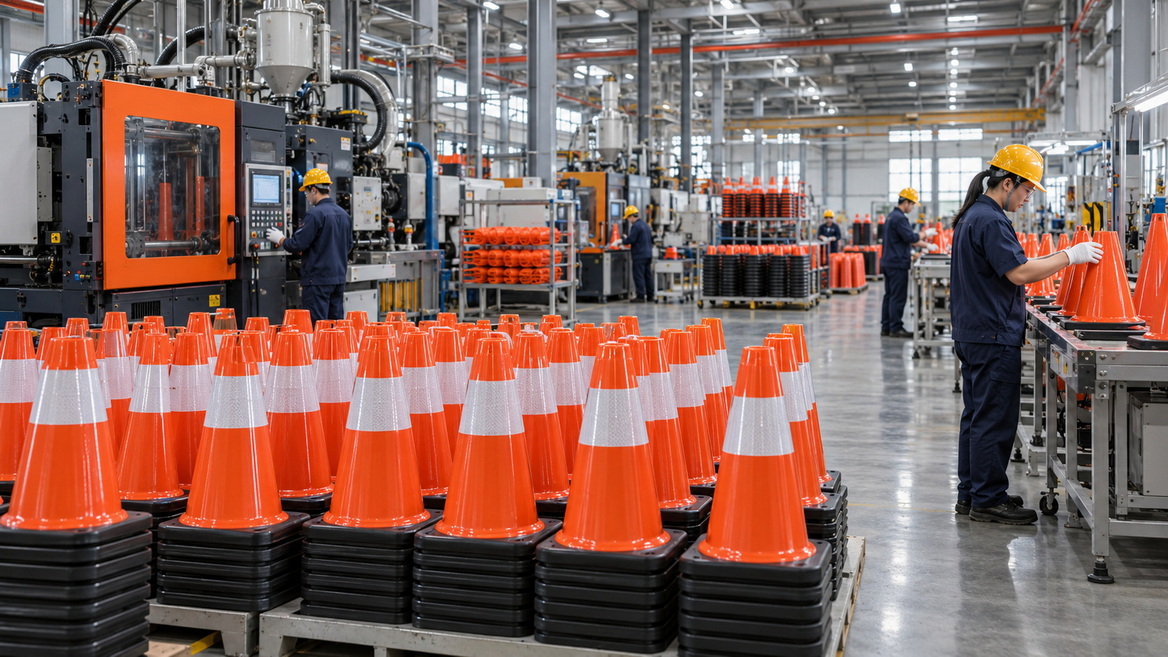
Business Research Insights estimates the global traffic cone market at USD 260 million in 2026, with a forecast of USD 380 million by 2035. A separate WiseGuyReports publication estimates the market at USD 1.32 billion in 2025. These substantially different figures should not be treated as interchangeable measurements; buyers would need to examine each report's definitions and methodology before using them for investment decisions. Neither figure represents China's PVC traffic cone exports specifically.
For trade research, China Customs provides official statistics and a commodity-query platform. Buyers should confirm the appropriate customs classification before extracting export data, rather than treating a broad plastics category as a dedicated traffic cone market.
The selection considers public evidence of relevant products, manufacturing or development capability, export experience, customization support, and quality documentation.
It does not include factory visits, independently measured delivery performance, or laboratory testing commissioned for this article. Manufacturer statements and marketplace disclosures therefore remain claims that buyers should validate.
Each candidate has publicly listed PVC traffic cones or a traffic cone manufacturing range. This matters because a company specializing in metal barriers or electronic signs may not have the same polymer-processing capability as a cone producer.
A useful supplier should explain:
- Whether the cone body uses virgin PVC, controlled recycled content, or another compound.
- How plasticizer, pigment, stabilizer, and filler additions are controlled.
- Whether the base is integral or separately manufactured.
- Which molding and assembly operations take place in-house.
- How batches are identified and retained for traceability.
Logo printing is only one part of OEM support. Buyers should also assess color matching, reflective collar configuration, base design, packaging, tooling ownership, and engineering change control.
ODM capability requires additional evidence: drawings, prototype development, design review, and documented validation of modified products.
Company-level certification and product-level testing serve different purposes. An ISO 9001 certificate concerns a quality management system; it does not establish that every cone meets a particular road-use specification.
Similarly, a test report should identify the cone model, dimensions, material configuration, and test standard—not merely show a recognizable laboratory logo.
Publicly advertised capacity is not the same as available capacity. Buyers should request an order-specific production schedule, actual monthly output for the relevant model, tooling availability, and a written plan for handling delays.
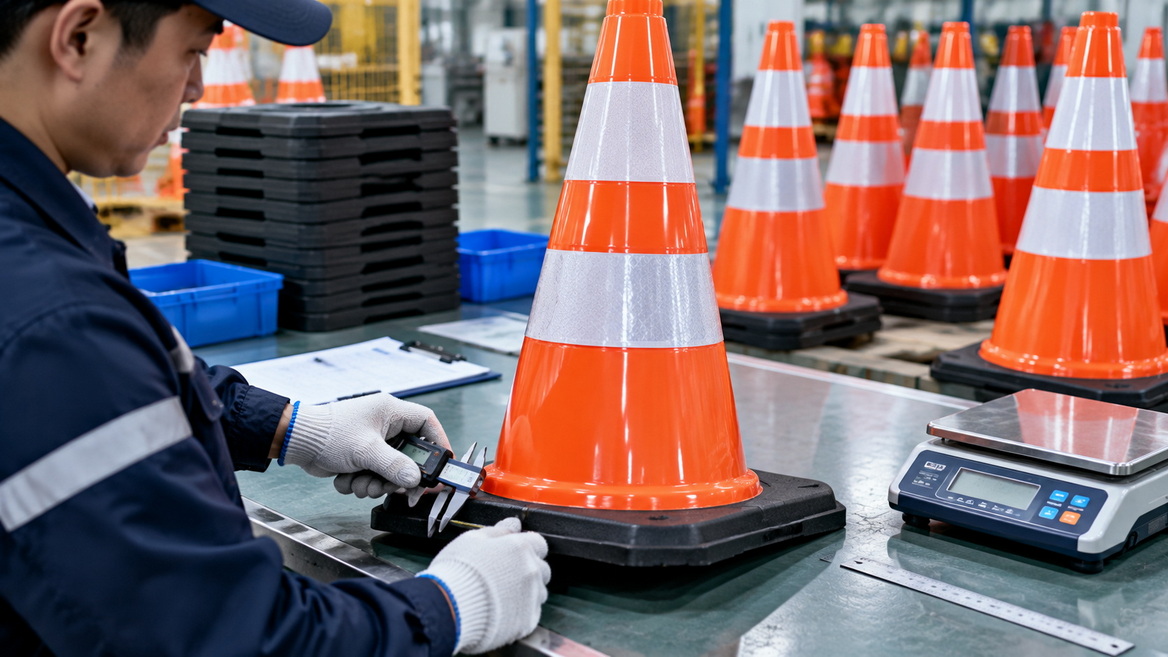
"Not disclosed" means that a reliable figure was not established from the reviewed sources. It does not mean that the supplier lacks capacity or certification.
| Manufacturer | Main sourcing focus | Public capacity disclosure | Published PVC cone MOQ | Certification or compliance disclosure |
|---|---|---|---|---|
| Shenzhen Xingsheng Traffic Facilities | Customized cones within broader roadway and parking solutions | Cone-specific capacity not disclosed | Cone-specific MOQ not disclosed | Website states ISO 9001 and broader CE/RoHS credentials; request cone-specific evidence. trafficthing |
| Zhejiang Luba Traffic Technology | Rubber and plastic traffic and parking products | Claims more than 20,000 tonnes annually across its product portfolio, not cones alone | Not established | Product pages describe material performance; obtain applicable test reports. cnluba+1 |
| Zhejiang Eastsea Tech | Rubber/plastic manufacturing and OEM/ODM development | Current cone-specific output not disclosed | Not established | Publishes certification and quality-control information; validate current documents. zjeastsea+1 |
| Zhejiang Dingtian Traffic Facilities | Multi-process traffic safety manufacturing | Publishes factory-area and staffing claims, not cone output | Not established | Current model-specific certification not established from reviewed sources. dingwang+1 |
| Tiantai Yuanda Traffic Device | Traffic cones and complementary traffic control products | Not disclosed | Not established | Request model-specific compliance documentation. ydtrafficsafety+1 |
| Zhejiang Sanmen Hongqiao Rubber & Plastic Technology | Export-focused rubber/plastic products and custom molds | Marketplace profile lists 1.5 million cones for a previous year; reporting year is unspecified | Not established | Profile claims ISO, CE, and SGS documentation; current validity requires checking. cnzjhongqiao.made-in-china |
| Sanmen Aroad Traffic Facility Factory | Catalog cones and complementary rubber products | Not disclosed | One PVC cone listing states 300 pieces | Listing advertises CE; verify applicable legislation and supporting documents. aroad.alibaba+1 |
| Sanmen Dingyuan Traffic Facilities | Rubber/plastic traffic products and customization | Not disclosed | Listings show 100 or 200 pieces, depending on PVC cone model | Current certificates not established from reviewed sources. chuanganjt.goldsupplier |
| Hangzhou Eaglerd Traffic Industry and Trade | Broad export-oriented traffic safety supply | Cone-specific output not disclosed | Not established | Website claims ISO 9001 and CE approval; scope and validity need confirmation. eaglerd |
| Sanmen Transpower Traffic Technology | Multiple PVC cone dimensions and parking products | Not disclosed | Not established | Current model-specific certification not established from reviewed sources. samtranspower+1 |
Published marketplace MOQs are starting points, not binding commitments. Custom colors, branded collars, new molds, and special packaging may have different minimums.
Shenzhen Xingsheng Traffic Facilities Co., Ltd., also known as XS Traffic, states that it was established in 2014. Its website lists PVC traffic cones, black-base PVC cones, wheel stops, corner guards, reflective materials, signs, and electronic traffic safety products. The published contact address is in Longhua District, Shenzhen, Guangdong.
Its relevance to smaller brands is the possibility of developing cones within a broader parking safety product range. A distributor sourcing cones alongside corner guards, wheel stops, and warning products may find this integrated approach useful.
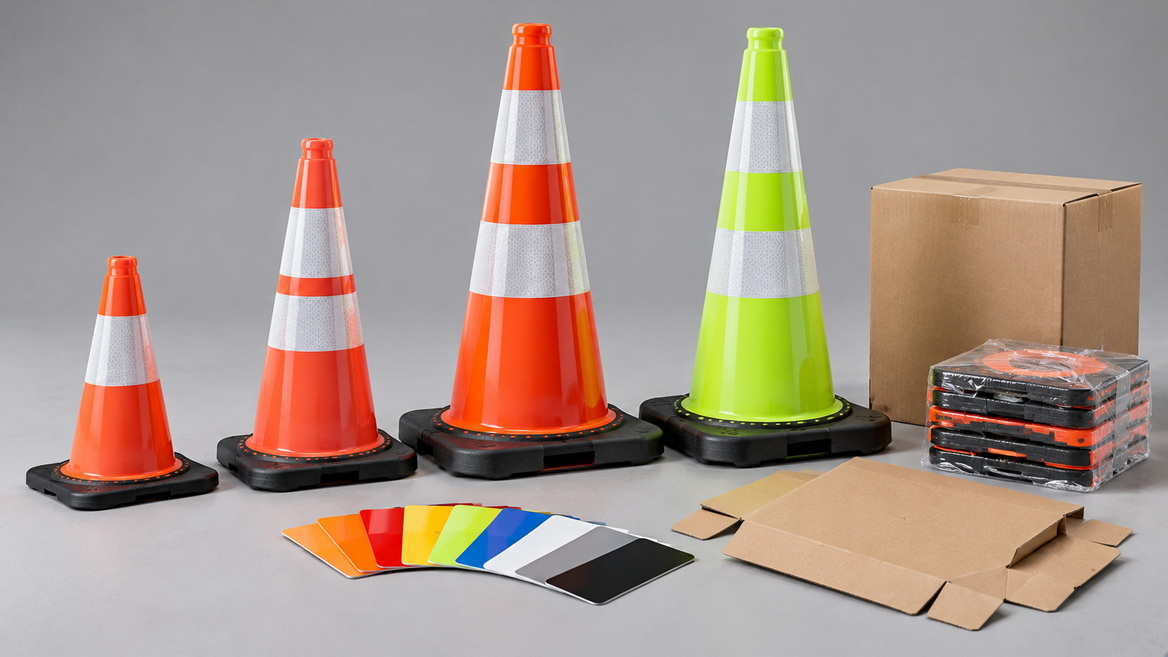
The company publicly emphasizes OEM/ODM engineering, flexible customization, prototyping, and responsive technical support. These are reasons to consider it for a development discussion, but buyers should confirm which services apply specifically to PVC cones rather than assuming that capabilities advertised for electronic products transfer directly to molded cones.
- Establishment: 2014, according to the company.
- Market reach: Export-oriented; its website describes projects in the Middle East, South America, and Europe, although these examples concern other traffic products.
- OEM/ODM scope: Broader traffic safety customization is advertised; confirm cone color, logo, collar, packaging, base, and tooling options.
- Core purchasing fit: Smaller-brand customization and mixed-product procurement.
- Due diligence priority: Cone-specific production control, MOQ, sample timing, and documentation.
For buyers seeking cost-effective development support, the practical test is a detailed quotation and sample project—not a general promise of low prices or fast communication.
Luba states that it was established in 2001 and specializes in rubber and plastic traffic safety products. Its portfolio includes traffic cones, speed humps, wheel stops, corner guards, and barriers. The company is located in Sanmen County, Zhejiang.
Luba's published annual capacity exceeds 20,000 tonnes, but this is a portfolio-wide figure. It should not be converted into cone production capacity without model-specific output and material-weight information.
Its PVC cone catalog includes a 700 mm model described as using wear-, UV-, and temperature-resistant PVC. Buyers should request the actual test conditions behind these descriptions.
- Establishment: 2001.
- Markets: International supply is advertised; regional cone sales shares are not disclosed.
- OEM/ODM scope: OEM services are promoted across traffic safety products; confirm cone-specific modifications.
- Core strength: A broad rubber/plastic portfolio suitable for consolidated purchasing.
- Due diligence priority: Current monthly cone output, compound control, and supporting performance reports.
Eastsea traces its manufacturing history to 1985. Its published timeline distinguishes this origin from its later entry into traffic safety products in 2000 and development of PVC cones for US specifications in 2008.
That distinction matters: a long corporate history does not automatically represent equally long experience with every product category.
Eastsea's quality-control page describes incoming material checks, dimensional and weight inspection, assembly checks, and simulated-use testing. Its Intertraffic profile states that it operates two factories in China and one in Thailand and offers OEM/ODM support.
- Establishment: Manufacturing roots in 1985.
- Markets: Documented historical US orders and internationally oriented production.
- OEM/ODM scope: Rubber/plastic product development and customization.
- Core strength: Relatively detailed public descriptions of manufacturing history and QC activities.
- Due diligence priority: Factory location for the proposed order and test coverage for the exact cone model.
Dingtian's published profile identifies an earlier Dingwang factory founded in 1984 and Zhejiang Dingtian Traffic Facilities Co., Ltd. established in 2010. Buyers should preserve this distinction when evaluating the company's history.
Its website advertises PVC cone manufacturing, independent development capability, and equipment including hydraulic presses, vulcanizers, blow-molding machines, and injection-molding machines. It also publishes staffing and factory-area figures, which should be reconfirmed during an audit.
- Establishment: Current company established in 2010; earlier factory roots in 1984.
- Markets: Export supply is advertised, but a current regional market breakdown was not established.
- OEM/ODM scope: OEM PVC cones and development of new traffic safety products.
- Core strength: Multiple production processes and a broad manufacturing portfolio.
- Due diligence priority: Legal entity, actual production address, available tooling, and current cone line capacity.
Yuanda states that its traffic safety business began in 2000 under the name Tiantai Langge Traffic Equipment Plant. Its cone range spans approximately 30–100 cm and includes color options.
This range makes it relevant to buyers assembling a catalog for parking, maintenance, and traffic control applications. However, the appropriate cone should be selected by the destination specification, not height alone.
- Establishment: Business roots in 2000.
- Markets: International marketing activity is documented, including a Dubai exhibition; this does not establish its largest sales region.
- OEM/ODM scope: OEM orders are explicitly accepted; request evidence for new-design development.
- Core strength: A broad cone range and complementary traffic control products.
- Due diligence priority: Model-by-model materials, weight tolerances, reflective performance, and production documentation.
Hongqiao's marketplace profile describes rubber, plastic, and PVC traffic safety manufacturing, including cones, barriers, speed humps, and wheel stops. It also advertises OEM/ODM capability and custom mold development.
The same profile identifies customers in Europe, Australia, North America, Asia, and South America. It lists historical output of 1.5 million traffic cones, but the unspecified reporting year prevents treating that number as verified 2026 capacity.
- Establishment: Exact founding year not verified; marketplace registration in 2011 is not a founding date.
- Markets: Europe, Australia, and North America are highlighted in its published profile.
- OEM/ODM scope: Rubber/plastic customization and opening molds for special requirements.
- Core strength: Export-oriented manufacturing with published tooling support.
- Due diligence priority: Current output, certificate validity, mold ownership, and approval of production materials.
Aroad lists traffic cones, cable protectors, rubber speed humps, anti-impact products, and wheel stops. One published PVC cone listing gives a minimum order of 300 pieces.
This provides a useful commercial starting point for buyers comparing standard catalog products. It does not establish the minimum for special colors, different reflective materials, or proprietary tooling.
- Establishment: Exact founding year not reliably verified from the reviewed sources.
- Markets: International supplier-platform presence; regional sales concentration is not disclosed.
- OEM/ODM scope: Confirm branding, packaging, material changes, and tooling directly.
- Core strength: Accessible catalog sourcing with a published model-specific MOQ.
- Due diligence priority: Factory identity, cone formulation, and the basis of advertised CE claims.
Dingyuan states that its predecessor factory began in 2009 and that the business changed to its current company name in 2013. It specializes in rubber and plastic traffic and parking safety products and advertises OEM/ODM services.
Published PVC cone listings show different MOQs, including 100 and 200 pieces. Buyers should therefore compare the exact models rather than assume a single company-wide minimum.
- Establishment: Predecessor in 2009; current company in 2013.
- Markets: Worldwide customers are described without a regional breakdown.
- OEM/ODM scope: Customized traffic and parking products, including cones.
- Core strength: A potentially useful option for trial orders and mixed-product purchasing.
- Due diligence priority: Actual MOQ for the required formulation, collar, color, and packaging.
Eaglerd presents itself as a broad traffic safety supplier and lists PVC cones alongside road studs, signs, guardrails, marking equipment, and other products. Its website claims sales to more than 100 countries, ISO 9001 certification, and CE approval. These remain supplier statements requiring document checks.
For buyers consolidating several categories, this breadth may be useful. Nevertheless, the words "industry and trade" and a large catalog make it especially important to distinguish owned production from sourced products.
- Establishment: Exact legal founding year not verified; experience claims should not substitute for a registration date.
- Markets: More than 100 countries, according to its website.
- OEM/ODM scope: Cone customization and design ownership should be confirmed directly.
- Core strength: Broad export-oriented traffic safety sourcing.
- Due diligence priority: Producing factory identity, production QC responsibility, and certificate scope.
Transpower's catalog lists PVC cone models with different heights and base dimensions, including products described as American-standard cones. Its Intertraffic profile identifies it as a producer of cones, speed humps, wheel stops, corner protectors, and warning posts.
The catalog breadth is relevant to distributors building a multi-size range. However, "American standard" is not a substitute for a documented assessment against the applicable project requirements.
- Establishment: Exact founding year not verified; marketplace registration in 2017 is not proof of establishment.
- Markets: International promotion and US-oriented product descriptions; sales proportions are not disclosed.
- OEM/ODM scope: Confirm logo, color, collar, packaging, and new-tooling capability.
- Core strength: Multiple catalog cone geometries and complementary parking products.
- Due diligence priority: Exact model drawings, weight distribution, and supporting compliance evidence.
A purchasing specification should define the finished product and its approved formulation controls. "Virgin PVC," "heavy-duty," and "flexible" are incomplete descriptions.
Ask the supplier to identify:
- Cone-body material and permitted recycled content.
- Total weight and separate body/base weights.
- Dimensions and tolerances.
- Hardness test method and approved range.
- Low-temperature conditioning and recovery requirements.
- Reflective collar material and configuration.
- Batch identification and change-notification procedures.
EN 13422:2019 covers new retroreflective cones and cylinders and includes visual and physical requirements, such as color, retroreflectivity, cold-weather performance, stability, and impact resistance. It provides a more meaningful framework than an unsupported claim of durability.
For European projects, obtain reports identifying the relevant EN 13422 edition, tested model, and declared performance.
For US projects, check the current MUTCD requirements and the purchasing authority's specifications. FHWA identifies the 11th Edition with Revision 1, effective March 5, 2026, as its current official edition. A cone marketed as "MUTCD compliant" still needs to match the intended application.
CE marking is required only when applicable legislation mandates it. A supplier should identify the legal basis rather than present CE as a universal quality badge for every traffic product.
RoHS concerns electrical and electronic equipment. For a conventional non-electronic PVC cone, a RoHS report may provide limited substance information, but it should not replace an assessment of the chemical requirements actually applicable to that product. EU REACH restrictions, including those concerning certain phthalates, deserve separate attention.
A branded reflective material does not by itself establish complete-cone performance.
Specify the collar supplier, material designation, dimensions, placement, attachment method, and inspection criteria. Request reports for the assembled cone where the purchasing specification requires them, rather than relying solely on a film datasheet.
A carefully prepared sample does not prove that later production will use the same compound.
Reduce this risk by approving a controlled specification, retaining reference samples, requiring written approval for material changes, and selecting inspection samples from finished production.
A heavier cone is not automatically a better cone. EN 13422 addresses multiple physical and visual properties rather than weight alone. Evaluate stability, impact behavior, recovery, and visibility against the intended conditions.
Compare total weight with body weight, base weight, dimensions, and the test results. Otherwise, suppliers can offer products with similar headline weights but materially different constructions.
A factory-wide annual tonnage or historical production figure does not establish how many units of your specific cone can ship next month.
Request:
1. Recent monthly output for the relevant model.
2. Number and condition of available molds.
3. Current production commitments.
4. Reflective collar and packaging supply arrangements.
5. A dated production and inspection schedule.
An easy-to-miss problem is testing cones individually while purchasing them tightly nested for shipment.
Add a packing-recovery check to the approval process. Pack a trial stack using the proposed commercial method, expose it to agreed storage conditions, then check separation, shape recovery, collar attachment, surface marking, and base flatness.
This is a recommended purchasing control, not a claim that every supplier has this problem. It connects the approved product to the actual delivery condition—and can reveal issues that a pristine showroom sample misses.
Request a business license, registered company name, production address, and bank beneficiary details. Resolve any difference between the seller, manufacturer, certificate holder, and payment recipient before transferring funds.
During a live factory review, ask to see the actual cone-production process, material storage, molds, collar application, inspection records, and finished packing—not only a reception area or product showroom.
1. Catalog sample: Assess basic geometry, material behavior, and suitability.
2. Customized approval sample: Confirm branding, color, collar, base, and packaging.
3. Production sample: Select from the actual order to check consistency with approval.
Define acceptance criteria before ordering. Where compliance is consequential, use an appropriately qualified independent laboratory and specify the exact tests required.
Request packed dimensions, nesting quantity, gross weight, pallet configuration, and container-loading assumptions. Compare transport cost per delivered cone, not merely factory price.
The quotation should also distinguish tooling, testing, inspection, freight, insurance, duties, destination charges, and local delivery. Confirm customs classification and origin-document requirements with the destination broker; China Customs provides an official export-origin verification platform.
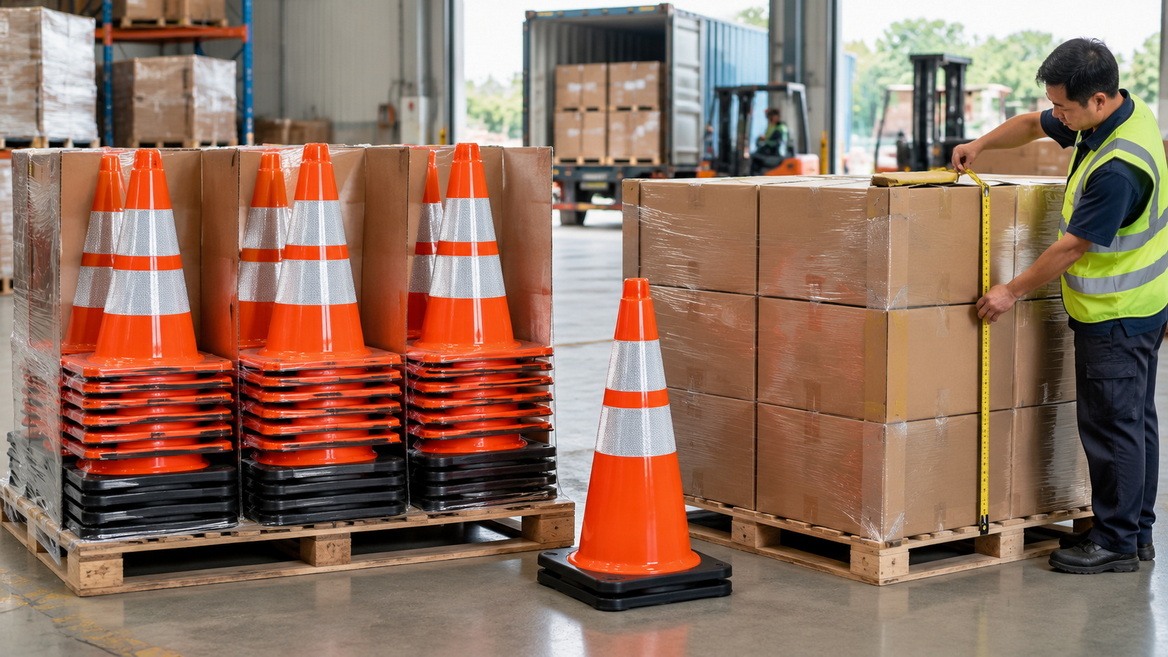
The most useful PVC traffic cone manufacturer is not necessarily the oldest company, the largest catalog owner, or the lowest bidder. It is the supplier that can connect your approved specification to repeatable production, traceable materials, reliable documentation, and a realistic delivery plan.
This shortlist offers several purchasing routes: established rubber/plastic manufacturers, cone-focused product ranges, and broader traffic safety partners.
For smaller brands and distributors combining cones with parking lot safety facilities, Shenzhen Xingsheng Traffic Facilities Co., Ltd. is a relevant starting point for a customized sourcing discussion. Its published portfolio and OEM/ODM positioning support that consideration, while cone-specific capacity, MOQ, and performance evidence should still be confirmed.
Send your required cone height, weight, destination market, reflective configuration, branding, forecast volume, and delivery target to the shortlisted suppliers. Request a model-specific quotation, an approval sample plan, and supporting documents before negotiating the final unit price.
Search the legal company name or certificate details through IAF CertSearch. Check the certificate status, covered location, standard, scope, certification body, and accreditation information. IAF describes the platform as a means of validating certificates and the accreditation chain behind them.
Also compare the certificate holder with the factory producing your cones. If information is missing or inconsistent, contact the issuing certification body directly rather than relying on a supplier's PDF alone.
Not by itself. First establish whether CE-marking legislation applies to the exact product. The European Commission states that CE marking must not be used where no applicable requirement exists.
Then examine the evidence relevant to the cone's intended use, including the required EN 13422 performance and any applicable chemical obligations. A general certificate covering another product family is insufficient.
Use a controlled approval specification and retain signed reference samples. Agree on incoming and final inspection measurements, including dimensions, body/base weights, hardness, and relevant performance tests.
For high-risk orders, ask a laboratory to recommend material-comparison methods suited to the suspected substitution. No single visual check can establish that two compounds are identical.
Possibly, but dual suitability must be established rather than assumed. European projects may specify EN 13422 performance, while US projects use the applicable MUTCD provisions and purchaser requirements. These are distinct frameworks.
Check the exact model's dimensions, visibility configuration, physical performance, and documentation against both specifications. If requirements differ, maintaining separate models may be more practical.
The tooling agreement should identify the mold, approved drawings, ownership, storage location, permitted use, maintenance responsibility, and transfer conditions.
It should also address replacement components, access to design files, sample approval, modification charges, and use for third-party customers. Paying a development fee should not be assumed to grant unrestricted ownership unless the contract expressly says so.
1. Shenzhen Xingsheng Traffic Facilities Co., Ltd. — Company history, PVC cone portfolio, and advertised OEM/ODM support. Contact address and sales information. [trafficthing]
2. Zhejiang Luba Traffic Technology Co., Ltd. — Establishment, product range, and portfolio-wide capacity disclosure. Published PVC cone specifications. [cnluba]
3. Zhejiang Eastsea Tech Co., Ltd. — Manufacturing and PVC cone development timeline. OEM/ODM profile and factory network. Published quality-control procedures. [zjeastsea]
4. Zhejiang Dingtian Traffic Facilities Co., Ltd. — PVC cone manufacturing capabilities. Current-company and predecessor-factory dates. [dingwang]
5. Tiantai Yuanda Traffic Device Co., Ltd. — Business history. Cone range. OEM service statement. [ydtrafficsafety]
6. Zhejiang Sanmen Hongqiao Rubber & Plastic Technology Co., Ltd. — Supplier profile, export markets, historical output, and customization claims. [cnzjhongqiao.en.made-in-china]
7. Sanmen Aroad Traffic Facility Factory — Product portfolio. Model-specific PVC cone MOQ listing. [aroad.en.alibaba]
8. Sanmen Dingyuan Traffic Facilities Co., Ltd. — Business history, OEM/ODM statement, and published PVC cone MOQs. [chuanganjt.goldsupplier]
9. Hangzhou Eaglerd Traffic Industry and Trade Co., Ltd. — Product range and export/certification claims. [eaglerd]
10. Sanmen Transpower Traffic Technology Co., Ltd. — PVC cone catalog. Intertraffic manufacturer profile. [samtranspower]
11. Federal Highway Administration — Current Manual on Uniform Traffic Control Devices and 2026 revision information. [mutcd.fhwa.dot]
12. Estonian Centre for Standardisation and Accreditation — EN 13422:2019 scope. [evs]
13. EN 13422:2019 standard catalog — Visual and physical performance requirements. [standards.iteh]
14. European Commission, Your Europe — CE-marking applicability and manufacturer responsibilities. [europa]
15. European Commission — RoHS Directive scope. [environment.ec.europa]
16. EUR-Lex — Commission Regulation (EU) 2018/2005 concerning restrictions on specified phthalates. [eur-lex.europa]
17. International Accreditation Forum — IAF CertSearch certificate-validation guidance. [iaf]
18. General Administration of Customs of China — Official trade statistics and commodity-query platform. [english.customs.gov]
19. China Customs — Export certificate-of-origin verification platform. [origin.customs.gov]
20. Business Research Insights — Traffic Cone Market report, including its 2026 estimate. [businessresearchinsights]
21. WiseGuyReports — Traffic Cones Market report, including its 2025 estimate. [wiseguyreports]


