
Please Choose Your Language
Views: 245 Author: XS Traffic Facilities Publish Time: 2026-10-19 Origin: Site


Content Menu
● Speed Bumps vs Speed Humps at a Glance
>> Why Speed Bump Height Alone Is Misleading
>> Why Product Names Can Confuse Buyers
● Speed Bumps vs Speed Humps: Which Location Fits Each?
>> Parking Lots and Controlled Entrances
>> Residential Streets and School Approaches
>> Highways, Toll Facilities, and Industrial Routes
● Emergency Vehicles, Buses, Cyclists, and Pedestrians
>> Emergency Response and Passenger Comfort
>> Cycling and Accessible Movement
● Rubber, Asphalt, or Concrete: What Should Buyers Compare?
>> Modular Rubber and Plastic Products
>> Asphalt and Concrete Construction
● What Field Evidence Shows—and What It Does Not
>> A Municipal Example: Separating Humps from Cushions
● A Five-Step Selection and Verification Process
>> 2. Identify Constraints Before Selecting Products
>> 3. Define a Measurable Objective
>> 4. Approve the Complete Layout
>> 5. Measure and Inspect After Installation
● Road Reflectors and Nighttime Visibility: Plan the Whole Approach
● Procurement Details That Prevent Expensive Mistakes
>> 1. What is the main difference between speed bumps and speed humps?
>> 2. Are speed bumps better for parking lots?
>> 3. Can speed humps be installed on public roads?
>> 4. Can speed bumps or speed humps damage vehicles?
>> 5. Is a speed table the same as a speed hump?
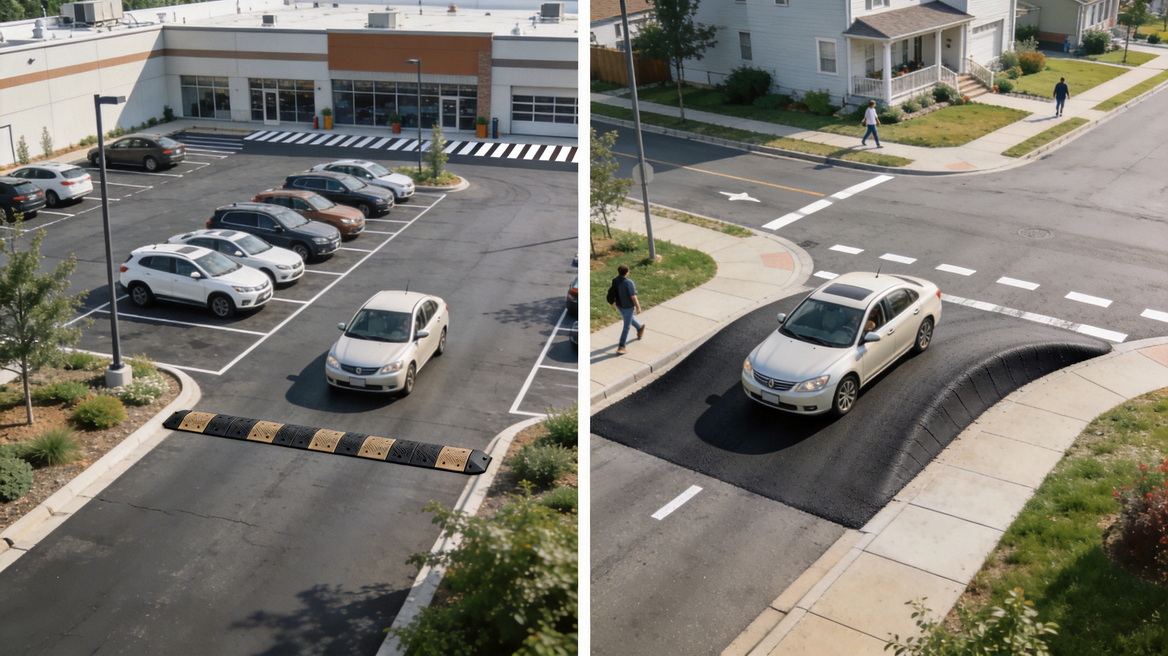
Speed bumps vs speed humps: which option belongs in your parking lot, residential street, or access road? Speed bumps create a sharper interruption and generally suit very low-speed private areas. Speed humps use a longer, gentler profile to manage traffic on suitable low-speed streets.
The most important difference is geometry, not simply height. Two devices can rise the same distance above the pavement yet produce very different vehicle responses.
At Shenzhen Xingsheng Traffic Facilities Co., Ltd., we approach traffic safety as a coordinated system. Choosing a raised device should involve the road layout, vehicle mix, drainage, warning signs, and road reflectors—not just the product price.
This guide explains the practical differences and provides a purchasing framework for property managers, contractors, and traffic safety distributors.

The dimensions below describe common configurations, not universal specifications. Local requirements and approved engineering drawings take priority.
| Comparison | Speed Bumps | Speed Humps |
|---|---|---|
| Main purpose | Encourage very slow movement at a specific location | Reduce speeds along suitable low-speed streets |
| Profile | Shorter and more abrupt | Longer with a gradual rise and fall |
| Typical travel length | Approximately 1–2 feet; products vary | Approximately 12 feet; some designs extend farther |
| Typical height | Variable; some designs reach 6 inches | Usually 3–4 inches |
| Indicative crossing speed | Often around 5–10 mph, depending on design | Commonly around 15–20 mph |
| Common locations | Parking lots and commercial driveways | Residential streets and suitable school approaches |
| Main trade-off | Stronger vehicle disturbance | More roadway space and careful placement |
| Emergency access | Requires particular caution | Can cause delays; alternatives may be preferable |
Crossing speeds are indicative, not guaranteed safe speeds for every vehicle or installation.
A speed bump is a short raised feature placed across a vehicle path. Its abrupt profile encourages drivers to slow substantially before crossing.
That makes speed bumps for parking lots useful where vehicles already travel slowly and pedestrians may emerge between parked cars.
Potential locations include:
- Private parking aisles.
- Controlled entrances.
- Low-speed commercial driveways.
- Selected private access lanes.
However, a bump should not become a last-second obstacle. Drivers need sufficient visibility and advance warning to reduce speed progressively.
A taller bump is not automatically the better choice.
The approach slope, travel length, vehicle clearance, wheelbase, and crossing speed all affect the result. An aggressive profile can create unnecessary discomfort or clearance problems without improving the overall layout.
Our recommendation is to specify the intended operating conditions first, then select the profile.
A speed hump is an elongated raised area extending across the travel way. Compared with a bump, it spreads the vertical movement over a longer distance.
A common public-road configuration is approximately 12 feet long in the direction of travel and 3–4 inches high.
Speed humps for residential streets can discourage speeding while allowing a less abrupt crossing than short bumps.
Commercial terminology is inconsistent. A supplier may describe a relatively short modular product as a "speed hump," although its profile differs substantially from a conventional public-road hump.
Always request a dimensioned drawing showing:
1. Height above the finished pavement.
2. Length in the direction of travel.
3. Width across the lane.
4. Approach and departure profiles.
This distinction matters internationally, where "speed breaker," "road hump," and "speed bump" may overlap in everyday usage.
A short bump may be appropriate when the objective is very slow movement within a private facility.
Still, location matters more than adding the maximum number of devices. Review pedestrian routes, parking maneuvers, delivery access, and queue formation.
For a parking exit, consider whether slowing vehicles at the proposed position would obstruct a sidewalk or leave vehicles queuing into another traffic lane.
A properly designed hump is usually the more relevant option for suitable low-speed streets.
Public-road installation requires the responsible authority's approval. Street classification, existing speeds, traffic volume, visibility, and emergency access all affect suitability.
A school location also needs a pedestrian-access assessment. A conventional rounded hump is not automatically a suitable crossing point.
Neither device should be treated as a general solution for high-speed highway lanes.
At toll facilities, distinguish controlled low-speed areas from faster approaches. Any raised treatment requires a site-specific design that considers braking, queues, lane guidance, and vehicle composition.
Industrial routes also need caution. Frequent heavy vehicles may make conventional humps unsuitable, particularly on primary commercial access roads.
Raised devices can delay emergency vehicles. Published guidance reports typical fire-truck delays of approximately 3–5 seconds per hump, with longer delays possible for ambulances carrying patients.
These figures vary by vehicle and installation, but they show why emergency-service consultation matters.
Speed cushions may provide an alternative. Their gaps can allow certain wide-track vehicles to straddle the raised sections. Compatibility must be checked against the actual fleet; not every ambulance benefits equally.
Gradual profiles generally provide a more manageable crossing than abrupt obstacles, but detailed design still matters.
Review:
- Surface grip and transitions.
- Turning movements near intersections.
- Bicycle routes and bypass arrangements.
- Pedestrian desire lines.
- Accessible crossing requirements.
Where the main objective is a pedestrian crossing, an appropriately designed raised crosswalk or speed table may deserve consideration instead.
Material selection is separate from the bump-versus-hump decision. The same material can support different profiles.
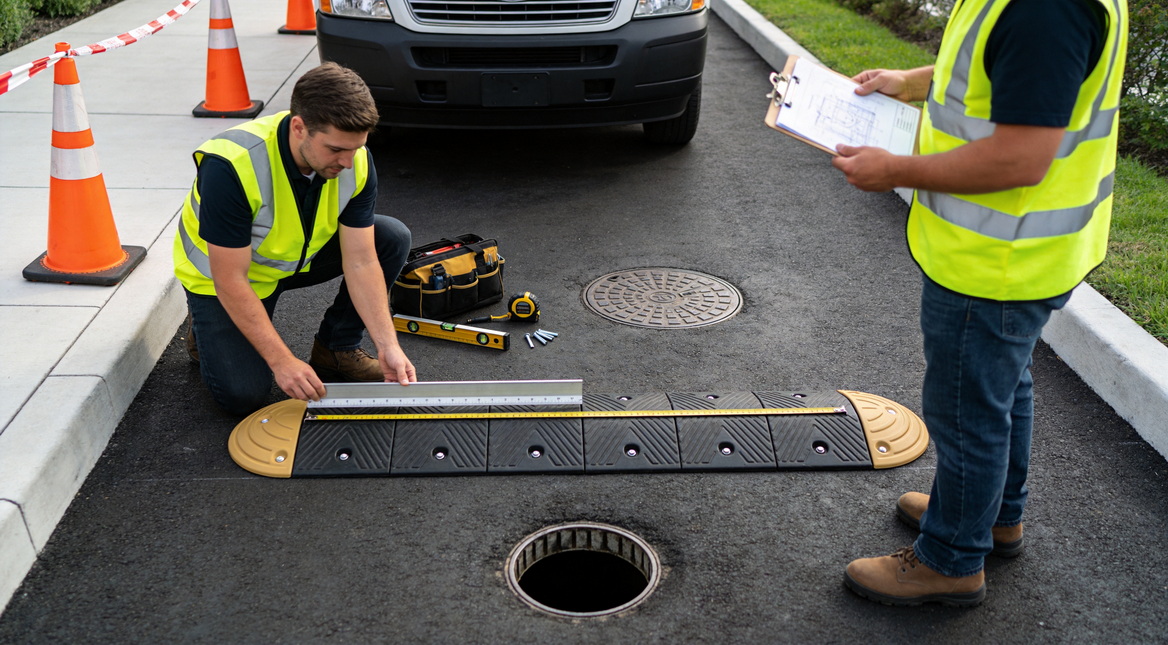
Modular products can be useful when buyers need defined components, replacement sections, or a potentially removable installation.
Before purchasing, ask about:
- Material formulation and environmental suitability.
- Anchoring requirements for the actual pavement.
- Surface texture.
- Joint design and end sections.
- Inspection and replacement instructions.
Do not assume every plastic or rubber product has equivalent performance. Request evidence relevant to the proposed application.
Asphalt and concrete are options for permanent raised treatments.
Their performance depends heavily on construction quality. The finished profile must match the approved design, and transitions must integrate with the surrounding pavement.
For either material, assess drainage, markings, repair access, and eventual resurfacing—not only initial construction cost.
Published evaluations provide useful context, but they are not performance guarantees.
A federal traffic-calming review summarizes seven field studies covering 199 speed humps. Reported reductions in 85th-percentile speeds ranged from 6 to 13 mph.
The 85th-percentile speed is the speed at or below which 85% of observed vehicles travel. It helps describe faster traffic rather than only the average driver.
The same review summarizes five studies covering 51 humps, with reported crash reductions between 33% and 48%.
These results come from particular sites and study conditions. They should not become a promise that a purchased product will produce the same outcome.
Seattle typically uses humps on residential streets and cushions on arterial streets to accommodate emergency vehicles and buses.
The city reports approximately 20% speed reductions following cushion installations on arterial streets.
That distinction is important: cushion results should not be presented as evidence for every speed bump or conventional hump.
Record existing speeds, traffic volumes, vehicle types, pedestrian activity, and reported problems.
Include different operating periods. A quiet midday visit may miss school arrival traffic, evening speeding, or delivery peaks.
Check road ownership, approval requirements, drainage, pavement condition, slopes, utilities, emergency routes, and heavy-vehicle access.
Rule out unsuitable locations before requesting quotations.
Specify what success means: slower crossing speeds, reduced speeding along a street, or improved conditions near a pedestrian conflict.
Avoid a vague instruction such as "install something to slow traffic."
Review the device alongside signs, markings, lighting, drainage, and reflector placement.
For longer streets, evaluate a coordinated series rather than assuming one hump controls the entire corridor. Spacing should follow the project's approved design, not a universal supplier recommendation.
Repeat speed observations under comparable conditions.
Inspect transitions, fixings, surface condition, drainage, and visibility. Also check whether drivers bypass the treatment or accelerate sharply afterward.
This closes the gap between buying a device and verifying a useful outcome.
A raised device must be recognizable early enough for drivers to respond.
Road reflectors can form part of an approved delineation plan, alongside signs, pavement markings, and lighting. They should not be treated as substitutes for required warnings.
From our manufacturing perspective, reflector selection deserves its own specification:
- Required color and viewing direction.
- Mounting method and pavement compatibility.
- Placement relative to vehicle paths.
- Local weather and maintenance conditions.
- Applicable project standards and supporting test evidence.
Reflectors improve delineation; they do not correct an unsuitable bump profile or poor placement.

For international buyers, compare complete installed solutions rather than unit prices.
A quotation should clarify:
| Procurement Item | What to Confirm |
|---|---|
| Geometry | Full dimensions and profile drawing |
| Installation | Pavement preparation, anchors, joints, and end sections |
| Visibility | Markings, reflective components, and replacement provisions |
| Evidence | Product-specific reports and their test scope |
| Logistics | Packing, quantities, freight assumptions, and spare parts |
| Support | Installation guidance, inspection instructions, and warranty terms |
There is no responsible universal answer to "Which is cheaper?" A low product price can be offset by installation work, traffic management, maintenance, or early replacement.
For OEM and ODM projects, separate customizable features from engineering requirements. Branding and packaging can follow commercial preferences; safety-critical geometry and installation details must follow the approved application.
Speed bumps have a shorter, more abrupt profile. Speed humps extend farther in the direction of travel, creating a more gradual crossing. Height alone does not distinguish them.
They can be suitable where very slow private-site movement is needed. The decision still depends on visibility, pedestrians, vehicle clearance, delivery access, and the intended crossing speed.
Yes, where the responsible authority permits them and the street meets relevant design criteria. Private purchasers should not install raised devices on public roads without authorization.
Unsuitable profiles, excessive crossing speeds, poor transitions, or insufficient clearance can create problems. Correct selection and installation reduce avoidable risks but cannot guarantee compatibility with every vehicle.
No. A speed table has a longer profile with a flat top. When properly designed and marked for pedestrian use, it may function as a raised crosswalk.
1. Traffic Safety Warehouse — ["Speed Bumps vs. Speed Humps."] Commercial comparison used for the original topic, private-site applications, and indicative bump crossing speeds. Its product-oriented dimensions are distinguished here from public-road engineering configurations. [trafficsafetywarehouse]
2. Federal Highway Administration — ["Traffic Calming ePrimer, Module 3: Toolbox of Individual Traffic Calming Measures, Part 2."] Principal technical reference for hump and bump dimensions, suitable applications, crossing speeds, emergency delays, field-study summaries, speed cushions, speed tables, drainage, and placement considerations. The cited study summaries draw on publications from July 2014 and are not presented as newly collected data. [highways.dot]
3. Seattle Department of Transportation — ["Speed Humps."] Municipal example distinguishing residential-street humps from arterial-street cushions; source of the approximately 20% speed-reduction figure specifically associated with arterial cushion installations. [seattle]
4. National Association of City Transportation Officials — ["Vehicle Speed and Volume Management," Urban Bikeway Design Guide.] Guidance on coordinated treatments, context-dependent spacing, smooth profiles, cycling considerations, and emergency/transit constraints. [nacto]
5. Federal Highway Administration — ["Traffic Calming ePrimer, Module 5: Effects of Traffic Calming Measures on Non-Personal Passenger Vehicles."] Supporting discussion of emergency-service delays and measures intended to reduce conflicts with emergency vehicles. [highways.dot]


