
Please Choose Your Language
Views: 277 Author: XS Traffic Facilities Publish Time: 2026-10-15 Origin: Site


Content Menu
● How Does Galvanizing Protect Steel Against Rust?
>> Zinc Creates a Physical Barrier
>> Zinc Provides Sacrificial Protection
>> A Protective Patina Develops Over Time
● When Does Galvanized Steel Rust?
>> Why "20–50 Years" Is Not a Universal Guarantee
>> First Maintenance Is Not the Same as Product Failure
● White Rust vs. Red Rust: What Are You Seeing?
● What Makes Galvanized Steel Rust Faster?
>> Coastal Air and Deicing Salts
>> Standing Water and Poor Drainage
>> Scratches, Cutting, and Welding
>> Pollutants and Chemical Exposure
● Which Galvanized Finish Suits Traffic Safety Products?
>> Why Fabrication Sequence Matters
>> When a Duplex System Is Worth Considering
● How to Specify Galvanized Parking Lot Safety Facilities
>> 1. Describe the Actual Installation Environment
>> 2. Identify the Applicable Coating Standard
>> 3. Request Measured Coating Evidence
>> 4. Clarify Repairs, Packaging, and Documentation
● A Practical Inspection and Maintenance Routine
>> Step 1: Check High-Risk Locations
>> Step 2: Remove Contaminants Appropriately
>> Step 3: Separate Coating Damage From Structural Damage
>> Step 4: Use a Defined Repair Procedure
>> Step 5: Record Conditions and Follow Up
● Why Salt Spray Hours Do Not Equal Outdoor Service Years
● Specify Corrosion Protection Before You Place Your Order
>> Does galvanized steel rust in rain?
>> Does galvanized steel rust in saltwater?
>> Is white rust a reason to reject galvanized products?
>> Will galvanized steel rust if scratched?
>> Can galvanized steel be painted?
Does galvanized steel rust? Yes—but usually only after its protective zinc coating has been significantly consumed or damaged. Galvanized steel is rust-resistant, not rust-proof. Its performance depends on coating thickness, fabrication quality, exposure conditions, and maintenance.
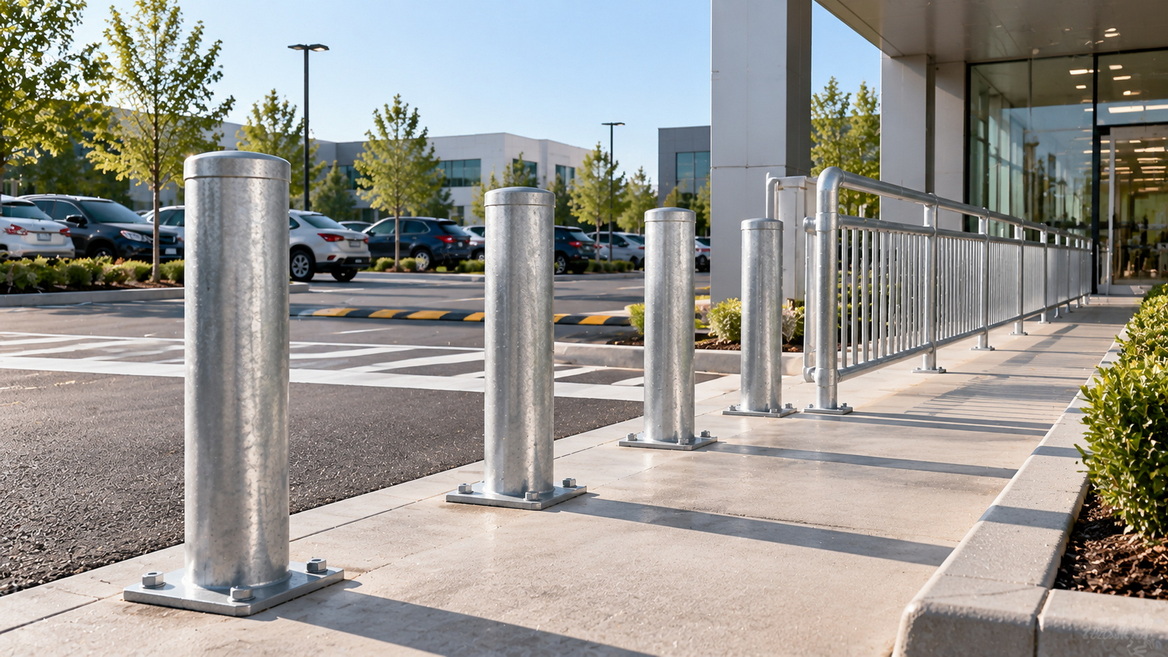
For buyers sourcing parking lot safety facilities, this distinction matters. A galvanized bollard in a sheltered parking garage faces different conditions from a roadside barrier exposed to coastal air, standing water, or winter deicing salts.
At Shenzhen Xingsheng Traffic Facilities Co., Ltd., we focus on traffic safety solutions for streets, highways, toll stations, and parking lots, with OEM and ODM services. Our approach to corrosion protection starts with the application—not a universal lifespan promise.
This guide explains how galvanizing works, why corrosion develops, and what buyers should specify before ordering galvanized traffic safety products.
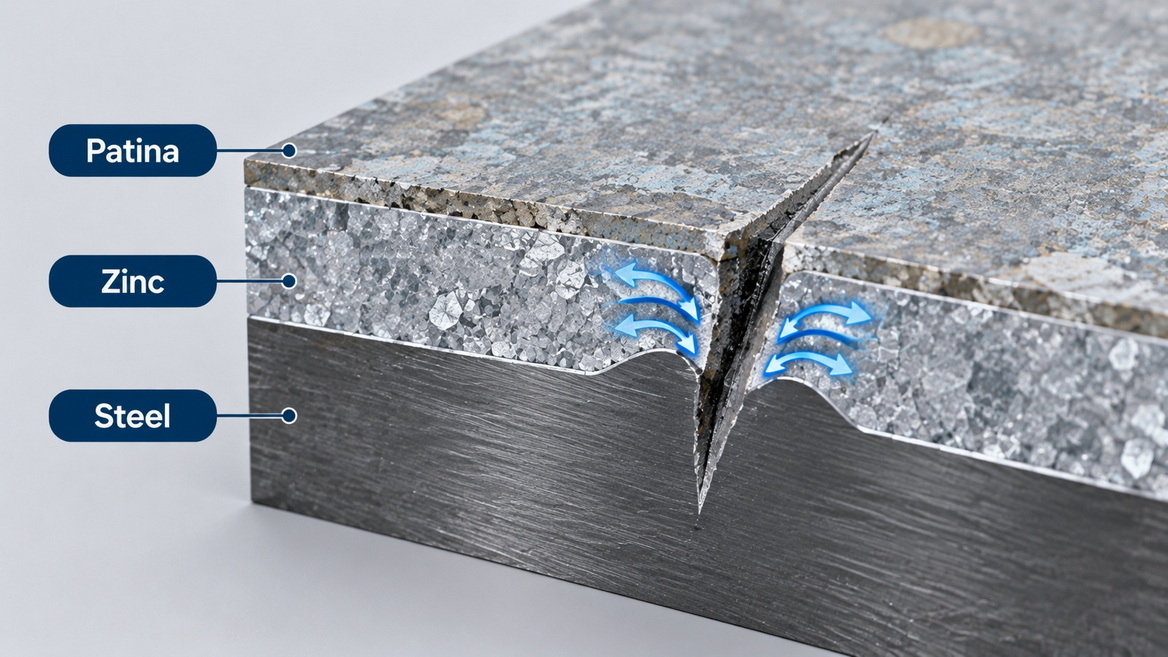
Galvanizing applies a zinc coating to steel. The coating provides three complementary forms of protection.
The coating separates steel from moisture and oxygen. In hot-dip galvanizing, prepared steel enters molten zinc, producing a metallurgically bonded coating.
This protection depends on coverage and thickness. Unprotected welds, damaged surfaces, and untreated fabrication areas can become weak points.
Zinc corrodes preferentially to steel. Where a small scratch exposes the underlying metal, surrounding zinc can help protect the exposed area.
However, this protection has limits. A broad, deeply damaged area should not be left untreated simply because nearby zinc remains.
During normal atmospheric exposure, zinc reacts with oxygen, moisture, and carbon dioxide to develop a protective surface film called a patina.
This film slows further zinc corrosion. Natural wet-and-dry cycles help it develop, which explains why freely draining outdoor steel behaves differently from tightly stacked, continuously damp products.
There is no reliable answer based on age alone. The important relationship is between the amount of protective zinc and the rate at which the environment consumes it.
A thin coating in an aggressive location may deteriorate much sooner than a thicker coating in a mild atmosphere.
Broad lifespan ranges can provide context, but they cannot replace project-specific assessment.
Before accepting a durability claim, ask:
- Which galvanizing process was used?
- What coating thickness was measured?
- Is the estimate for atmospheric exposure or immersion?
- Does the location experience salt, pollution, or trapped moisture?
- Does "lifespan" mean first maintenance or structural service life?
Without these details, a year-based claim is difficult to evaluate.
Industry guidance commonly defines time to first maintenance as the point when approximately 5% of the underlying steel surface shows rust.
That does not mean the entire product has failed. Much of the surface may still retain zinc protection, and appropriate maintenance can extend service.
For safety facilities, corrosion assessment must also consider function. A bollard with loose anchors or impact damage may require attention before widespread rust appears.
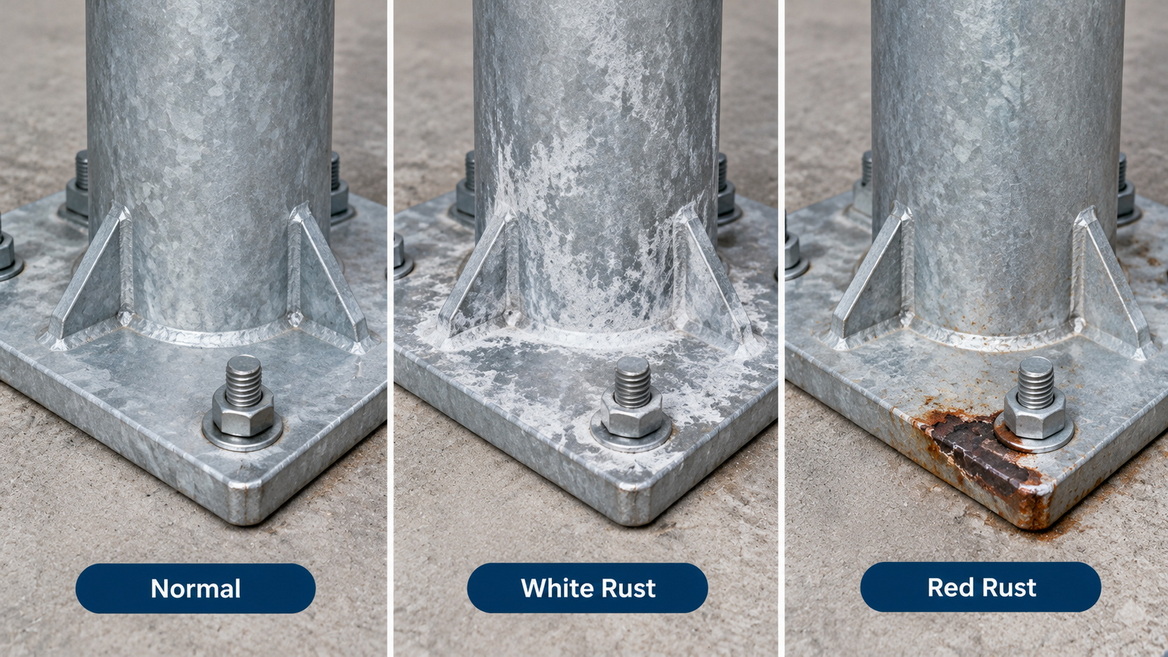
Not every white mark means the steel underneath is rusting.
White or gray powdery deposits often indicate wet storage stain: zinc corrosion products formed when moisture remains trapped against newly galvanized surfaces.
Red-brown rust generally indicates corrosion of exposed steel, although rust-colored contamination from another source should also be investigated.
| Surface appearance | Likely explanation | Recommended response |
|---|---|---|
| Uniform dull gray finish | Normal weathering and patina development | Monitor during routine inspections |
| Light white powder | Early wet storage stain | Improve drying and ventilation; assess cleaning needs |
| Heavy white deposits | More substantial zinc corrosion | Clean appropriately and verify remaining coating thickness |
| Localized red-brown spots | Exposed steel or external contamination | Identify the source and assess repair |
| Rust around damaged anchors or welds | Local coating failure or moisture retention | Inspect both coating condition and structural integrity |
Appearance alone cannot confirm how much protection remains. Where deposits are heavy or red rust is present, coating measurements and closer inspection provide better evidence.
Parking lots combine weather exposure, vehicle movement, cleaning chemicals, and occasional impacts. Several conditions deserve particular attention.
Salt contamination increases corrosion risk, especially when moisture remains on the surface.
For coastal parking areas and winter-maintained roads, examine splash zones, low-level connections, and sheltered surfaces where contaminants accumulate.
Do not assume rain washes every component clean. Covered areas may receive salt spray without receiving enough rainfall to remove it.
Water trapped around base plates, inside poorly detailed assemblies, or between closely fitted surfaces can create unfavorable exposure conditions.
Product design should help moisture escape. Drainage deserves attention during fabrication and installation, not only after rust appears.
Installation can damage an otherwise satisfactory coating.
Common examples include:
- Drilling additional mounting holes.
- Cutting a component to fit.
- Welding an attachment after galvanizing.
- Dragging products during unloading.
- Repeated contact from vehicles or equipment.
Identify these areas before installation is signed off, and agree on an appropriate repair method.
Industrial contaminants and unsuitable cleaning chemicals can accelerate coating deterioration.
Use cleaning methods compatible with galvanized surfaces. Avoid assuming that stronger acids, more abrasive tools, or harsher chemicals provide better maintenance.
"Galvanized steel" describes a family of coatings and manufacturing routes. It does not identify one uniform level of protection.
| Manufacturing route | Key consideration | Buyer’s question |
|---|---|---|
| Hot-dip galvanizing after fabrication | Can coat the completed fabricated article | Were welds and accessible surfaces included? |
| Pre-galvanized sheet or tube | Zinc is applied before later fabrication | How are cut edges and welded areas protected? |
| Electrogalvanizing | Often provides a thinner, smoother coating | Is the specified coating suitable for the exposure? |
| Galvanizing plus paint or powder coating | Adds an additional protective and decorative layer | How will the zinc surface be prepared? |
A product made from galvanized tube is not necessarily equivalent to a product galvanized after welding.
Later cutting and welding may interrupt the original coating. Buyers should therefore review the finished assembly, not just the raw material description.
For bollards, barriers, and mounting brackets, ask where fabrication occurs in the coating sequence and how affected areas are treated.
A duplex system combines galvanizing with paint or powder coating.
The outer coating provides another barrier and can deliver safety colors or a specified appearance. The zinc underneath continues to provide barrier and sacrificial protection.
However, adhesion depends on preparation. An attractive topcoat is not proof of a durable system. Cleaning, profiling, compatible materials, and the coating application process must be coordinated.
A useful purchase specification describes the product, its environment, and how coating quality will be accepted.
Provide more than "outdoor use."
Include:
- Installation location and exposure to coastal air.
- Whether deicing salts are used.
- Covered or uncovered installation.
- Possible soil contact or standing water.
- Cleaning practices and chemical exposure.
- Expected impact, abrasion, and handling conditions.
These details help the manufacturer assess suitable protection without relying on generic assumptions.
Depending on the product and destination market, relevant standards may include:
- ASTM A123/A123M for hot-dip galvanized fabricated iron and steel products.
- ASTM A153/A153M for certain hardware and small components.
- ISO 1461 for hot-dip galvanized coatings on fabricated iron and steel articles.
These standards are not interchangeable in every detail. State the applicable standard, edition, product scope, and inspection requirements in the order.
Ask for inspection records linked to the supplied batch.
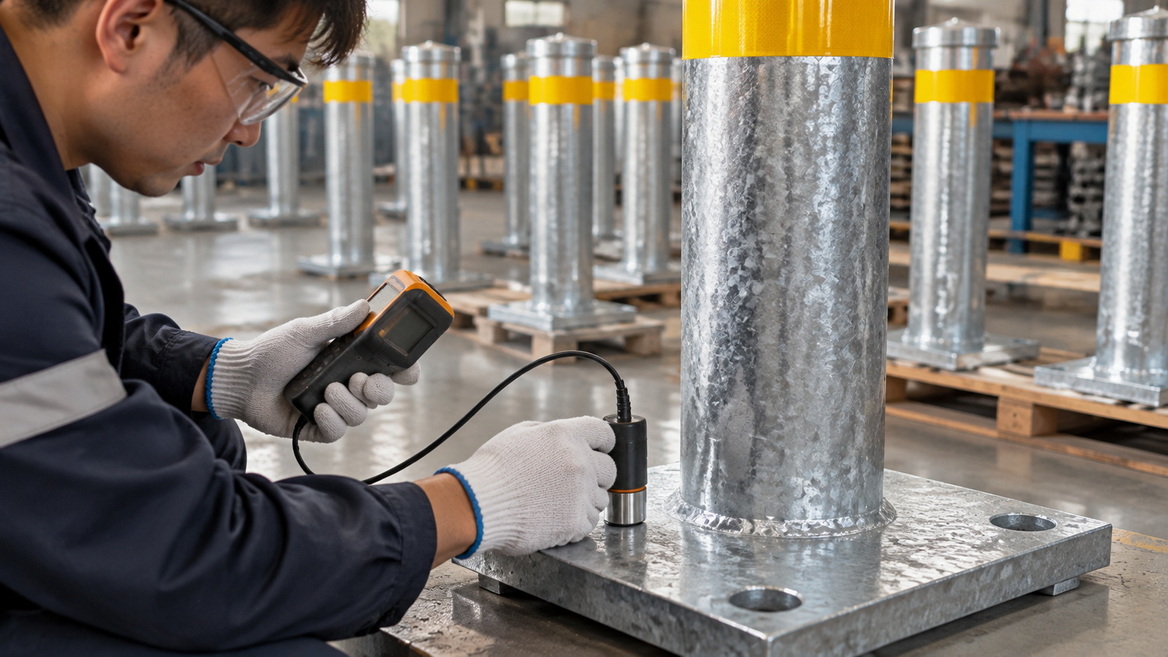
Useful information includes coating thickness measurements, sampling locations, product identification, and treatment of repaired areas.
A glossy finish does not establish compliance. Likewise, a dull finish does not automatically indicate poor protection.
Agree on how handling damage, uncoated areas, and site modifications will be addressed.
Include packaging expectations that reduce trapped moisture and abrasion. For exported products, the condition after transport matters as much as the condition leaving production.
Galvanized products generally need less coating maintenance than unprotected steel, but "low maintenance" should not mean "never inspect."
Inspect base plates, welds, fasteners, drainage points, and areas close to the ground.
Also check impact-prone surfaces and locations where road salts or debris collect.
Use a compatible cleaning method to remove accumulated dirt and salts.
For suitable wet storage stain conditions, a stiff nonmetallic brush may help. Avoid aggressive abrasion that unnecessarily removes sound zinc.
Allow cleaned components to dry.
A damaged coating and a damaged safety product are different problems.
Check for loose fixings, distorted components, cracked connections, and significant section loss. Cosmetic repair cannot restore a structurally compromised barrier or bollard.
ASTM A780/A780M addresses repair of damaged and uncoated areas of hot-dip galvanized coatings.
Repair options include zinc-rich paint, zinc-based solder, and sprayed zinc, subject to the applicable requirements.
Do not treat any silver-colored paint as an equivalent repair material.
Keep dated photographs and maintenance records.
Set inspection frequency according to exposure and risk. Coastal locations, salt-treated entrances, and impact-prone areas may justify closer attention than sheltered, low-exposure installations.
A test report can help buyers evaluate coating quality, but it must be interpreted correctly.
Salt spray testing does not reproduce the natural wet-and-dry cycles that help galvanized steel develop its protective patina.
Consequently, a claim such as "1,000 salt spray hours equals ten years outdoors" should not be accepted without an appropriate technical basis.
When reviewing test results, ask:
- Which test method was followed?
- Was the specimen zinc-coated, painted, or duplex-coated?
- What was the acceptance criterion?
- Were cut edges protected?
- Does the tested specimen represent the supplied product?
Use test data alongside coating measurements, specifications, and exposure assessment—not as a standalone lifespan guarantee.
Choosing galvanized traffic safety products is not simply a choice between "rusts" and "does not rust."
The better question is whether the coating system, fabrication details, and maintenance plan match the installation environment.
For your next project, send Shenzhen Xingsheng Traffic Facilities Co., Ltd. your drawings, quantities, destination, exposure conditions, and required finish.
Through our OEM and ODM services, we can discuss product configuration and coating requirements for street, highway, toll station, and parking lot applications. Request a quotation that identifies the proposed finish, inspection requirements, packaging, and repair provisions.
It can eventually rust, but normal rain exposure does not automatically cause early failure. Coating thickness, contaminants, drainage, and drying conditions all influence performance.
It can. Saltwater exposure is not equivalent to ordinary atmospheric exposure. Continuous immersion and splash conditions require separate assessment rather than a general outdoor lifespan estimate.
Not automatically. Light wet storage stain may be mainly an appearance issue. Heavy deposits require closer assessment because more zinc may have been consumed. Check coating condition and the agreed acceptance requirements.
A small scratch may receive sacrificial protection from nearby zinc. However, extensive damage, welding, and large exposed areas should be evaluated and repaired rather than left untreated.
Yes. Paint or powder coating over galvanizing forms a duplex system. Appropriate preparation and compatible coating materials are essential for adhesion and performance.
1. [JACKWIN — "Does Galvanized Steel Rust?"]
Original article reviewed for restructuring, topic coverage, and correction of broad lifespan and maintenance claims. [jackwinsafety]
2. [American Galvanizers Association — "Corrosion Protection for Steel"]
Technical basis for barrier protection, sacrificial protection, and protective zinc patina formation. [galvanizeit]
3. [American Galvanizers Association — "Estimating the Life of Hot-Dip Galvanized Coatings"]
Basis for relating coating thickness and environmental exposure to maintenance timing, and distinguishing first maintenance from service life. [galvanizeit]
4. [American Galvanizers Association — "Time to First Maintenance"]
Supports the approximately 5% rust criterion and explains limitations of salt spray testing for predicting atmospheric performance. [galvanizeit]
5. [American Galvanizers Association — "Wet Storage Stain"]
Basis for white deposit identification, storage ventilation, moisture management, and assessment of severe staining. [galvanizeit]
6. [American Galvanizers Association — "Storage"]
Supports nonmetallic brushing, coating thickness checks, and repair of damaged areas in accordance with ASTM A780. [galvanizeit]
7. [American Galvanizers Association — "Inspection of Hot-Dip Galvanized Steel"]
Supports coating inspection guidance and the differing scopes of ASTM A123/A123M and ASTM A153/A153M. [galvanizeit]
8. [American Galvanizers Association — "Other Galvanizing Standards"]
Supports ISO 1461 scope and the need to distinguish inspection and documentation requirements between standards. [galvanizeit]
9. [American Galvanizers Association — "Duplex Systems for Corrosion Protection"]
Basis for galvanizing-plus-topcoat protection and surface preparation requirements. [galvanizeit]
Updated practical guidance on clean, dry, appropriately profiled galvanized surfaces and compatible coating preparation. [galvanizeit]


