
Please Choose Your Language
Views: 260 Author: XS Traffic Facilities Publish Time: 2026-08-28 Origin: Site


Content Menu
● How to Evaluate an LED Stop Sign Supplier
>> Research and Customization Capability
>> Compliance and Documentation
● Comparison of LED Stop Sign Suppliers
● 1. Shenzhen Xingsheng Traffic Facilities Co., Ltd.
● 5. ZGSM
● Technical Requirements for LED Stop Signs
>> Sign Body and Face Materials
>> Waterproofing and Electrical Protection
>> Choosing the Lowest Quote Without Controlling Specifications
>> Approving a Catalog Image Instead of a Sample
>> Assuming an IP Rating Applies to the Whole Product
>> Ignoring Maintenance Requirements
>> Treating Certificates as Automatic Product Approval
● Recommended Procurement Process
>> Prepare a Technical Specification
>> Conduct Pre-Shipment Inspection
● FAQ
>> 1. How can buyers verify whether an LED stop sign manufacturer is a real factory?
>> 2. What technical specifications should be included in an LED stop sign RFQ?
>> 3. Is an IP65 rating sufficient for outdoor LED stop signs?
>> 4. How can buyers confirm that an ISO certificate is still valid?
>> 5. What should buyers test before approving a solar LED stop sign sample?
Kazakhstan's road network, freight corridors, rapidly developing urban areas, toll facilities, and industrial zones continue to create demand for durable traffic-control products. LED stop signs are increasingly specified where conventional reflective signs alone may not provide sufficient day-and-night conspicuity—such as school crossings, toll plazas, construction approaches, hazardous intersections, parking entrances, and private industrial sites.
For procurement managers, the question is not simply where to find an LED stop sign at the lowest price. The more important task is choosing a supplier that can meet approved drawings, deliver reliable LED performance in challenging weather, provide traceable materials and quality documentation, and support spare parts over the operating life of the sign.
Kazakhstan has local road-sign manufacturers and installation contractors that understand domestic project conditions. At the same time, many buyers source specialized LED traffic signs from export-oriented manufacturers in China, Europe, the Middle East, and North America. A combined sourcing approach can often be effective: obtain customized LED products from a specialist factory while working with a local contractor or integrator for installation, civil works, and on-site coordination.
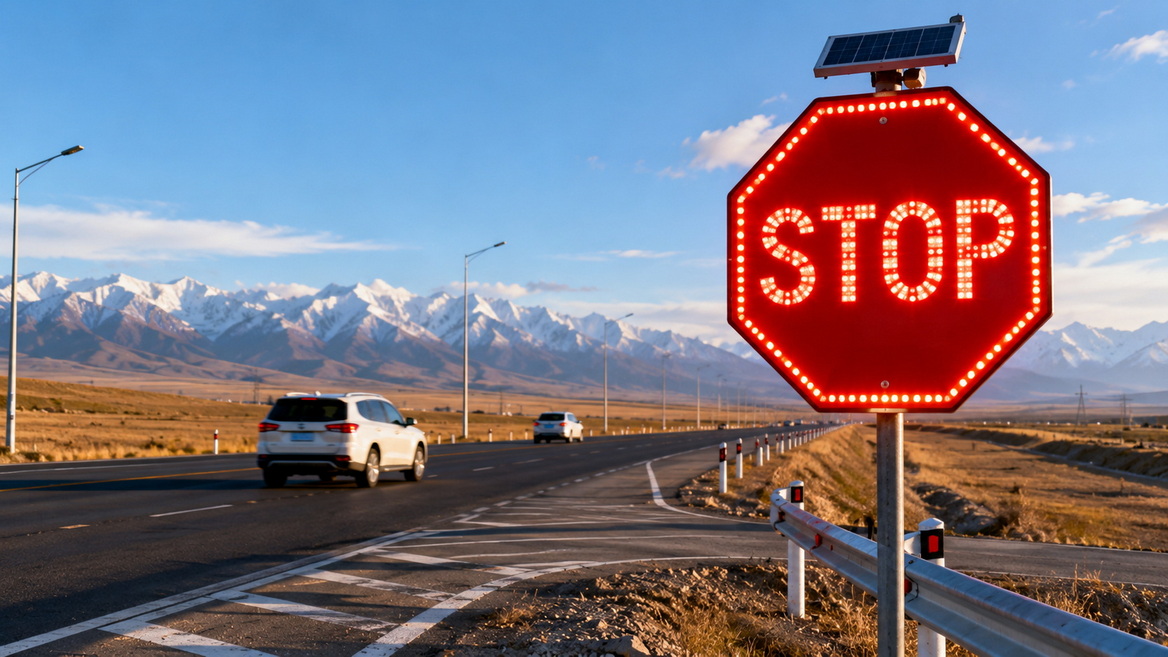
A reliable supplier should be evaluated beyond catalog photos, product claims, and a low quotation. The following criteria help procurement teams identify partners that are suitable for repeat orders and project-based supply.
A qualified supplier should clearly explain whether it is a manufacturer, an assembler, a distributor, or a project integrator. Buyers should request factory information, production photos, equipment lists, sample lead times, monthly output estimates, and details about which core components are produced in-house.
For LED stop signs, the critical production elements include:
- Aluminum sign blanks or metal enclosures
- Reflective sheeting and printed graphics
- LED modules or LED boards
- LED drivers and control systems
- Solar panels, batteries, and charge controllers for solar models
- Wiring harnesses, connectors, cable glands, and waterproof seals
- Mounting brackets, poles, and installation hardware
A company that controls more of these components or has stable long-term component partners is generally better positioned to keep product quality and delivery schedules consistent.
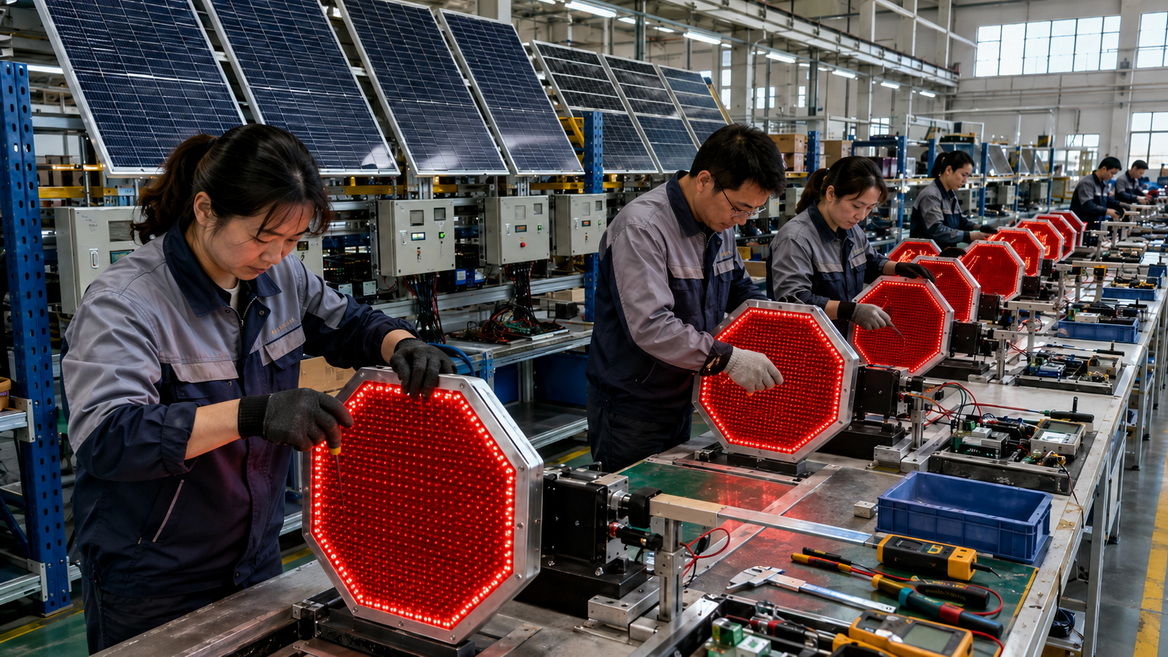
LED stop signs may require different sign sizes, border-light arrangements, flash patterns, voltage options, solar configurations, mounting systems, and artwork layouts. This is especially important when the buyer supplies project-specific drawings or needs a private-label product range.
A capable supplier should be able to support:
- Customized STOP sign dimensions and octagonal geometry
- Russian, Kazakh, English, or multilingual instructions and labels
- OEM logo placement and carton branding
- Flashing or steady-light configurations
- AC, DC, solar, or hybrid-power solutions
- Mounting brackets compatible with local poles or structures
- Custom packaging, manuals, and spare-parts kits
- Product drawings and pre-production samples
A dependable quality-control process should cover incoming materials, assembly, electrical function, waterproofing, appearance, packaging, and final inspection. Buyers should ask suppliers to explain how they test finished signs before shipment.
Useful quality-control evidence includes:
- Incoming inspection records for LEDs, batteries, drivers, and reflective materials
- Function-test videos for completed signs
- Burn-in testing for LED modules and control systems
- Waterproofing checks for assembled enclosures
- Final inspection photos with batch markings
- Packaging and loading photos
- Pre-shipment inspection reports
Lead time should be assessed together with component availability and customization complexity. A supplier may quote a short lead time for a standard sample but face delays when custom electronics, special reflective films, solar batteries, or branded packaging are required.
Buyers should request separate timelines for:
- Sample production
- Artwork confirmation
- Pre-production approval
- Mass-production lead time
- Inspection period
- Export packing
- Delivery to port, border terminal, or destination warehouse
LED stop signs for roads are not merely electrical products. They are traffic-control devices that must fit the applicable project design, sign standards, and local authority requirements.
Buyers should request relevant documentation based on the destination market and project requirement, including:
- Product drawings and technical data sheets
- Material specifications
- Electrical specifications
- Ingress-protection information
- CE declarations where applicable
- RoHS declarations where applicable
- Quality-management certificates
- Battery and solar-system documents for solar models
- Test reports for the finished sign assembly where available
For Kazakhstan public-road projects, it is important to verify the approved sign layout, dimensions, colors, symbols, and installation requirements against the relevant project specification and local standards before production begins.
| Supplier | Location / Supply Role | Core Product Focus | OEM / ODM Suitability | Capacity and MOQ | Best Fit |
|---|---|---|---|---|---|
| Shenzhen Xingsheng Traffic Facilities Co., Ltd. | Shenzhen, China; export manufacturer | LED traffic signs, reflective signs, solar road markers, LED signals, road-safety accessories | High; graphics, LED layouts, power options, branding, packaging, brackets | Project-dependent; confirm by model and customization scope | Distributors, private-label programs, small-to-mid-sized projects |
| ALEX Astana LLP | Kazakhstan; local manufacturer and installer | Road signs, road markings, installation and traffic-safety equipment | Moderate; local project and sign customization | Not publicly disclosed | Kazakhstan projects requiring local coordination and installation |
| Golden Falcon Group | UAE; regional supplier | LED road-safety signs and solar signage | Moderate; confirm model-level customization | Not publicly disclosed | Regional buyers seeking LED and solar traffic-safety products |
| RoadSky Safety | China; export manufacturer | Road signs, customized traffic signs, road-safety products | High for conventional and customized signage | Not publicly disclosed | Mixed orders of reflective and illuminated traffic signs |
| ZGSM | China; LED traffic-equipment manufacturer | LED traffic lights, controllers, traffic systems | Moderate to high for LED traffic-control systems | Not publicly disclosed | Intersection, crossing, and intelligent-traffic projects |
| SEA Components | Germany / international supplier | LED traffic lights, signal optics, traffic-control components | Project-dependent | Not publicly disclosed | Technical signal-system applications |
| ATS Traffic | Canada; traffic-solution provider | Blank-out LED signs and traffic-control products | Project-dependent | Not publicly disclosed | Advanced LED sign and traffic-management applications |
Shenzhen Xingsheng Traffic Facilities Co., Ltd. is a China-based traffic-safety products manufacturer serving customers who require LED traffic signs, solar road products, reflective signs, traffic-signal equipment, and related road-safety accessories.
The company is located in Shenzhen, a major electronics and manufacturing center with established supply chains for LED components, printed circuit boards, power supplies, solar panels, batteries, aluminum fabrication, and export packaging. This location can be particularly helpful for projects that require multiple customized components to be integrated into a finished LED traffic sign.
The product range includes LED traffic signs, reflective traffic signage, solar road markers, push-button systems, solar radar speed signs, LED traffic lights, and supporting traffic-safety products.
- Broad product coverage for traffic-safety and road-control projects
- Flexible support for customized LED stop sign configurations
- Suitable for OEM and ODM projects involving logo, artwork, packaging, manuals, voltage, brackets, and flashing modes
- Practical option for distributors, contractors, and smaller brands that need responsive factory communication
- Ability to combine multiple traffic-safety product categories into one sourcing program
- Suitable for sample orders, pilot projects, distributor trials, and repeat purchasing programs
For LED stop sign programs, Shenzhen Xingsheng Traffic Facilities Co., Ltd. can be considered for customization requirements such as:
- Customized octagonal STOP sign dimensions
- LED border layouts or internal illumination configurations
- Flashing, steady, or sensor-controlled operation
- Solar-powered, battery-powered, AC-powered, or low-voltage DC models
- Customized graphics and multilingual instructions
- Branded labels, cartons, manuals, and export packaging
- Mounting brackets for roadside poles, gates, parking entrances, or portable stands
- Mixed orders with solar road studs, reflective signs, traffic signals, and traffic accessories
This makes the company particularly relevant for buyers that want a factory capable of supporting different stages of market entry—from initial samples to customized distribution programs.
Before placing an order, buyers should confirm the exact configuration of the LED stop sign:
- Aluminum alloy and sheet thickness
- Sign-face reflective material and graphic method
- LED quantity, color, spacing, and expected service life
- LED driver and flashing controller specifications
- Power input and current consumption
- Waterproofing design for the finished assembly
- Operating-temperature range
- Battery chemistry and autonomy period for solar models
- Solar panel wattage and controller settings
- Mounting-hole pattern and bracket configuration
- Spare-parts recommendation for long-term maintenance
A controlled technical specification is essential. A generic product photo may not show the actual LED layout, enclosure construction, cable-entry design, or solar-system capacity that will be supplied.
ALEX Astana LLP is a Kazakhstan-based road-equipment company established in 2010. The company operates production facilities in Astana and Almaty and offers road signs, traffic-safety products, road marking services, installation, and related road-infrastructure support.
For procurement teams that require local production, local installation, domestic transport coordination, or on-site technical support, ALEX Astana can be a relevant candidate.
- Kazakhstan-based production and project presence
- Road-sign manufacturing and customization
- Road-marking and installation capability
- Potentially simpler site coordination for domestic projects
- Production coverage in Astana and Almaty
- Suitable for projects combining traffic signs, pavement marking, and installation services
ALEX Astana may be suitable for:
- Municipal road-sign projects
- Highway and urban-road signage
- Standard regulatory and warning signs
- Road-marking contracts
- Installation-led traffic-safety projects
- Domestic projects requiring local logistics and service support
Buyers looking specifically for LED stop signs should request detailed information about:
- Available illuminated STOP sign models
- LED source and driver specifications
- Solar-powered options
- Finished-product waterproof rating
- Cold-weather performance
- Local project references for illuminated signs
- Spare-part availability
- Installation and maintenance support
Its road-sign and road-safety experience is relevant, but LED stop-sign capabilities should be reviewed on a model-by-model basis.
Golden Falcon Group is a regional supplier offering LED road-safety signs and solar-powered signage solutions. Its range is relevant to buyers looking for active warning signs, illuminated regulatory signs, and solar traffic-control products.
The company may be useful for procurement teams comparing direct factory supply from China with regional sourcing alternatives from the Middle East.
- Product focus includes LED road-safety signs
- Solar-signage options for locations without reliable grid access
- Regional sourcing alternative for international buyers
- Suitable for traffic-awareness, warning, and control applications
Golden Falcon Group may be considered for:
- Solar LED stop signs
- Parking and access-control signage
- Temporary road-safety applications
- Industrial and construction-site traffic control
- Regional projects requiring LED warning products
Buyers should clarify whether the quoted product is manufactured directly by the supplier or sourced from another factory. It is also important to request full details of:
- Sign-body materials
- LED modules and driver systems
- Solar panel output
- Battery type and capacity
- Charge-controller settings
- Operating-temperature limits
- Ingress-protection rating
- Spare-parts availability
- After-sales support in Kazakhstan
RoadSky Safety is a China-based supplier focused on road signs, traffic signs, and customized road-safety products. Its product offering can be relevant to buyers sourcing a combination of standard reflective signage and customized traffic-control products.
For customers who require both conventional traffic signs and LED stop signs in the same order, a supplier with broad sign-production capability can help simplify sourcing and reduce coordination between multiple vendors.
- Broad road-sign and traffic-sign product focus
- Custom graphics and sign-design support
- Suitable for mixed traffic-sign procurement
- Potentially useful for highway, urban-road, parking, and construction-signage packages
RoadSky Safety may be suitable for:
- Conventional reflective stop signs
- Customized regulatory and warning signs
- Road-construction signage
- Parking and private-facility signs
- Combined orders of LED signs and standard traffic signs
A buyer should distinguish carefully between:
- A reflective stop sign with decorative LED border lighting
- A purpose-built LED stop sign with outdoor-grade electrical design
- A solar active-warning sign designed for remote installation
Request confirmation of the LED layout, heat-dissipation method, driver design, controller protection, cable glands, rear enclosure, and field-service access before approving a model.
ZGSM is an LED traffic-equipment manufacturer with a product range centered on LED traffic lights, traffic-control equipment, controllers, and related signal systems. The company is more closely aligned with traffic-light engineering than conventional road-sign manufacturing.
This can make it a suitable candidate for buyers developing intersection projects, pedestrian crossings, school-zone safety systems, or intelligent traffic-control installations.
- Focus on LED traffic-control equipment
- Suitable for signal-system and intersection-related projects
- Potential compatibility with traffic controllers and integrated road-safety systems
- Experience with different traffic-light configurations and LED optical applications
ZGSM may be considered for:
- Traffic-light and intersection projects
- Pedestrian crossings
- School-zone warning systems
- LED traffic-control hardware
- Projects combining signs, signals, controllers, and sensors
Although its traffic-signal background is relevant, buyers should request specific evidence that the company can provide an LED stop sign matching the required sign geometry, artwork, flashing pattern, mounting design, and outdoor durability requirement.
SEA Components specializes in LED traffic-light systems, traffic-signal components, optical systems, and related electronic traffic-control products. The company's technical focus can be useful for projects that require more advanced LED optical performance or traffic-signal integration.
- Technical experience with LED traffic-light systems
- Focus on optical components and signal performance
- Suitable for projects requiring engineered traffic-control hardware
- Potential option for buyers prioritizing technical design and optical consistency
SEA Components may be suitable for:
- Traffic-signal projects
- Advanced intersection control systems
- LED optical components
- Specialized traffic-light applications
- Projects where an illuminated stop indication forms part of a broader signal system
For a standalone LED stop sign, buyers should request a dedicated product specification rather than assuming that traffic-light capability automatically translates into regulatory LED-sign manufacturing.
ATS Traffic offers LED traffic-sign solutions, including blank-out LED signs and modular traffic-control products. Its product range is particularly relevant for buyers seeking advanced active-signage solutions rather than basic flashing LED stop signs.
- LED traffic-sign and blank-out-sign expertise
- Modular product concepts that may simplify maintenance
- Suitable for traffic-management and controlled-message applications
- Focus on visibility and active traffic control
ATS Traffic may be considered for:
- Advanced LED stop-sign systems
- Blank-out regulatory signs
- Variable traffic-control applications
- Lane-control and managed-traffic projects
- Complex highway or urban traffic-management programs
International buyers should clarify export arrangements, spare-part supply, technical support, voltage compatibility, maintenance procedures, and total landed cost before selecting an imported system.
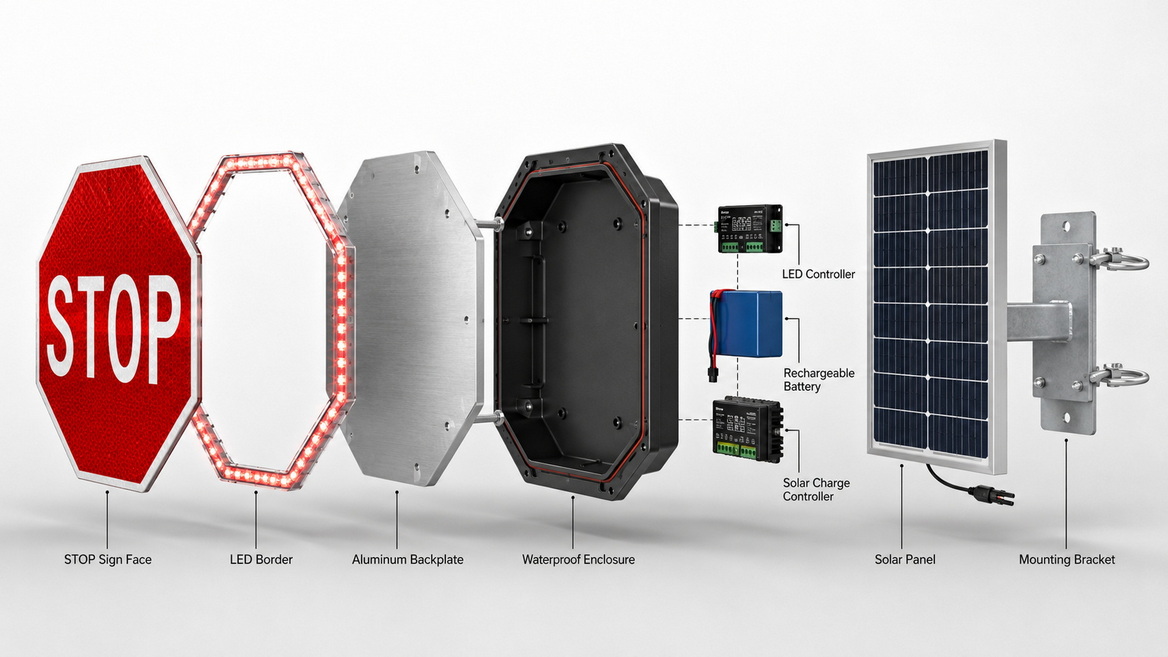
An LED stop sign should be specified as a complete outdoor traffic-control system. The sign body, reflective face, LED modules, controller, electrical protection, solar components, mounting hardware, and maintenance access must work together.
The sign body should be durable enough for wind, vibration, moisture, ultraviolet exposure, road dust, and temperature variation.
Common requirements include:
- Aluminum sign blank or corrosion-resistant metal body
- Defined material thickness
- Rounded or safely finished edges
- Durable red-and-white graphic construction
- Outdoor-grade reflective sheeting
- UV-resistant printing or overlay film
- Corrosion-resistant bolts, brackets, and fasteners
- Rear reinforcement where required by sign size and wind load
For safety-critical applications, passive reflectivity remains important. If the LED system stops operating because of a power failure, battery issue, or damaged controller, the stop sign should still remain visible under vehicle headlights.
LED performance should be assessed using practical project requirements rather than vague terms such as "super bright."
The technical sheet should identify:
- LED color and arrangement
- Number of LEDs or LED modules
- Flash pattern and flash frequency
- Rated voltage
- Rated power consumption
- Driver type
- Controller protection
- Expected service life
- Visibility distance
- Daytime and nighttime operation mode
- Replaceability of LED modules and drivers
Border LEDs are common for drawing attention to a standard stop-sign face. Internally illuminated signs can produce a more uniform appearance, but may require more complex sealing, thermal management, and service access.
Solar LED stop signs are useful for rural roads, construction zones, school crossings, parking facilities, and sites without dependable grid power. However, buyers should not select a solar configuration based only on solar-panel size.
The complete system should be sized according to:
- LED power consumption
- Daily operating hours
- Flashing mode
- Panel wattage
- Battery capacity
- Battery chemistry
- Controller efficiency
- Required autonomy days
- Winter sunlight conditions
- Snow coverage risk
- Shading from trees, buildings, or roadside structures
- Low-temperature charging and discharge performance
A solar sign that performs well in a short summer demonstration may not remain reliable during winter if the energy budget is not designed with enough reserve.
The final assembled sign should be protected against rain, dust, vibration, and cable-entry failures.
Buyers should inspect:
- Rear enclosure design
- Gaskets and sealing surfaces
- Cable glands
- Connector quality
- Drainage and condensation control
- Battery compartment sealing
- Solar-controller placement
- Surge-protection measures
- Grounding requirements
- Service access without damaging the sign face
The lowest offer may use thinner aluminum, lower-grade reflective sheeting, fewer LEDs, smaller batteries, weaker solar panels, basic controllers, or insufficient packaging.
The solution is to provide every supplier with the same controlled RFQ document. The document should define dimensions, graphics, materials, LED arrangement, power system, mounting hardware, inspection requirements, delivery terms, and spare-parts quantities.
Catalog images often do not reveal the true construction of the product. The rear enclosure, cable entries, battery housing, driver system, and mounting bracket may differ significantly from the image.
Always approve a pre-production sample or a detailed production drawing before confirming mass production.
A supplier may show an IP rating for an LED module or electrical box, while the complete sign assembly has unsealed fasteners, poorly designed cable exits, or weak enclosure joints.
Ask for the IP rating of the complete finished sign and inspect photos or videos of the actual assembly.
A sign installed on a highway, remote access road, toll plaza, or industrial site must be maintainable. If a small driver, controller, battery, or LED board fails, replacement should not require changing the entire sign.
Specify replaceable components and order initial spare parts with the first shipment.
Certificates should be reviewed carefully. Buyers should confirm the name of the certified company, factory address, certificate scope, issuing organization, validity date, and whether the certificate covers the actual manufacturing activity.
A certificate alone does not prove that a specific LED stop-sign model meets a specific project requirement.
One of the most overlooked issues in LED stop-sign purchasing is voltage behavior under real operating conditions.
A sign can look bright during a short factory demonstration but perform poorly after extended operation. This often occurs when battery voltage drops, cables are undersized, a controller reduces current, or LEDs are not properly regulated.
During sample approval, request a recorded endurance test showing:
1. Input voltage at startup.
2. Current draw in the specified flashing mode.
3. LED appearance at startup.
4. LED appearance after several hours of operation.
5. Input voltage at the end of the test.
6. Controller low-voltage cutoff setting.
7. Battery condition for solar-powered models.
This simple check can reveal whether the quoted product is designed for sustained field use or only for a short showroom demonstration.
Identify whether the sign will be installed on a public road, toll road, school zone, parking entrance, construction site, industrial facility, pedestrian crossing, or private property.
The intended application affects the sign design, approval process, power source, mounting method, and maintenance plan.
A complete specification should include:
- Sign size and octagonal geometry
- STOP text and approved artwork
- Reflective sheeting requirement
- Aluminum thickness
- LED color, spacing, and flashing mode
- Power source and voltage
- Solar panel and battery requirements, if applicable
- Waterproofing requirement
- Operating-temperature range
- Mounting bracket design
- Spare-parts requirement
- Packaging standard
- Inspection procedure
- Delivery terms
Compare suppliers based on their response quality, not only their price. A professional supplier should answer technical questions clearly, identify assumptions, provide drawings, and explain which details can be customized.
Sample approval should cover:
- Dimensions
- Color and graphics
- Material thickness
- LED visibility
- Flash pattern
- Waterproofing construction
- Mounting compatibility
- Solar performance
- Packaging
- Electrical operation after burn-in
Before final payment, verify:
- Quantity
- Model numbers
- Approved artwork
- LED function
- Random-unit test results
- Packaging quality
- Carton labels
- Spare parts
- Packing list
- Loading condition
For large projects, an independent inspection can provide additional assurance that the production batch matches the approved sample.
Kazakhstan's traffic-safety market offers opportunities for both local road-sign integrators and international LED traffic-sign manufacturers. The most suitable supplier depends on whether the project prioritizes local installation, advanced traffic-control technology, customized OEM production, cost control, or a complete road-safety sourcing package.
For buyers seeking flexible customization, responsive communication, and the ability to source LED traffic signs alongside related traffic-safety products, Shenzhen Xingsheng Traffic Facilities Co., Ltd. is a practical supplier to include in an initial supplier evaluation. Its product range, Shenzhen-based supply-chain access, and support for OEM/ODM projects make it relevant for distributors, contractors, and private-label customers serving Kazakhstan and Central Asian markets.
A well-defined technical specification, approved sample, documented quality inspection, and spare-parts plan will do more to protect a project than selecting a supplier based on price alone. Procurement teams should compare suppliers carefully, validate each model against project requirements, and prioritize long-term operational reliability.
Request the business registration, factory address, production photos, live video inspection, product assembly videos, and a current factory audit where available. Confirm that the factory address on ISO certificates, invoices, bank details, and export documents belongs to the same legal entity. Buyers should also ask for a pre-production sample before committing to a volume order.
A complete RFQ should define the octagonal sign size, STOP artwork, reflective-sheeting grade, aluminum thickness, LED color and quantity, flashing pattern, input voltage, waterproof rating, power consumption, mounting bracket, operating-temperature range, packaging standard, spare-parts list, and delivery terms. For solar models, include panel wattage, battery capacity, controller type, required autonomy days, and winter operating conditions.
IP65 is commonly suitable for outdoor signs exposed to dust, rain, and low-pressure water jets. However, it may not be enough for locations exposed to flooding, high-pressure cleaning, severe driving rain, or persistent standing water. Buyers should evaluate the actual installation environment and check the rating of the complete assembled sign, including the rear enclosure, cable glands, connectors, controller box, and battery compartment—not only the LED module.
Ask for the complete certificate showing the certificate number, issuing certification body, validity period, legal entity name, factory address, and certification scope. Verify the certificate through the issuer's public database or directly with the certification body. Confirm that the certified scope includes the relevant manufacturing activity, rather than an unrelated service or trading activity.
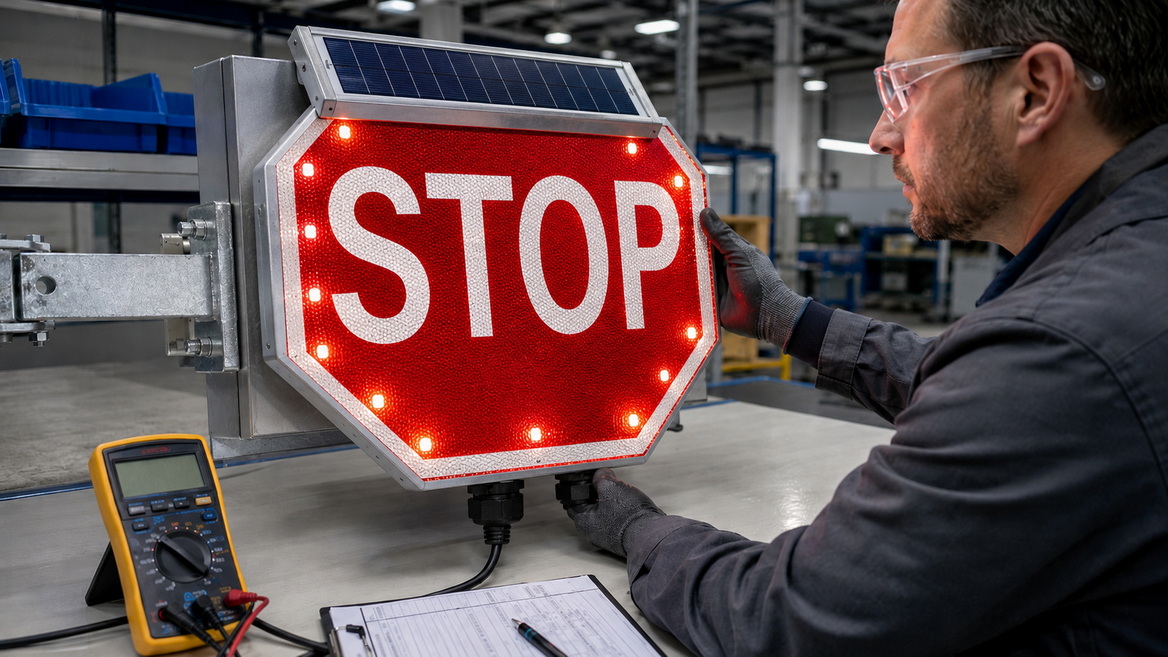
Test the sign's brightness, flashing mode, power consumption, battery voltage, charging performance, controller cutoff setting, enclosure sealing, mounting hardware, and solar-panel output. A useful endurance test records voltage and current at startup and after several hours of operation. This can expose dimming, unstable drivers, weak batteries, or undersized solar systems that may not appear during a short demonstration.
- Kazakhstan Traffic Rules and Regulatory Information https://adilet.zan.kz/eng/docs/P1400001196
- ALEX Astana LLP – Road Signs and Road Safety Equipment https://tooaleks.kz/eng/
- MIGA – Kazakhstan Road Rehabilitation and Infrastructure Development https://www.miga.org/press-release/miga-standard-chartered-jp-morgan-commerzbank-collaborate-dbk-rehabilitate-roads
- Shenzhen Xingsheng Traffic Facilities Co., Ltd. https://www.trafficthing.com/contactus.html
- ZGSM LED Traffic Light Manufacturer https://www.zgsm-china.com/led-products/led-traffic-light
- SEA Components Traffic Signal Solutions https://sea-components.de/en/verkehrssignale/
- ATS Traffic LED Sign Solutions https://www.atstraffic.ca/solutions/blank-out-led-signs/led-signs/


