
Please Choose Your Language
Views: 253 Author: XS Traffic Facilities Publish Time: 2026-08-26 Origin: Site


Content Menu
● What Are Traffic Cones Used For?
>> Small Traffic Cones: 12 Inch to 18 Inch
>> Standard Traffic Cones: 28 Inch
>> Heavy-Duty Traffic Cones: 36 Inch
● Traffic Cone Sizes and Their Best Uses
● Traffic Cone Materials and Construction
● Why Reflective Collars Matter
● How to Select the Right Traffic Cone
>> 2. Assess Daytime and Nighttime Use
>> 3. Review Wind and Site Conditions
>> 4. Consider Storage and Transportation
>> 5. Confirm Product Requirements
● Common Traffic Cone Buying Mistakes
● Custom Traffic Cone Solutions for Global Buyers
● Building Safer Temporary Traffic Routes
>> What size traffic cone is best for a parking lot?
>> What is the difference between a PVC traffic cone and a PE traffic cone?
>> Do traffic cones need reflective collars?
>> What is a rubber-base traffic cone?
>> Can traffic cones be customized with a logo?
Traffic cones are among the most recognizable temporary traffic-control products in the world. From a busy highway maintenance zone to a commercial parking lot, a properly selected traffic cone helps guide vehicles, alert pedestrians, identify hazards, and create safer temporary routes.
However, not all traffic cones are designed for the same purpose. A lightweight cone used for indoor queue management is very different from a heavy-duty reflective cone designed for nighttime highway construction. For contractors, distributors, parking facility operators, municipalities, and industrial buyers, selecting the correct cone requires more than choosing a size or color.
The best traffic cone depends on the operating environment, vehicle speed, lighting conditions, weather exposure, base stability, material performance, and local project requirements.
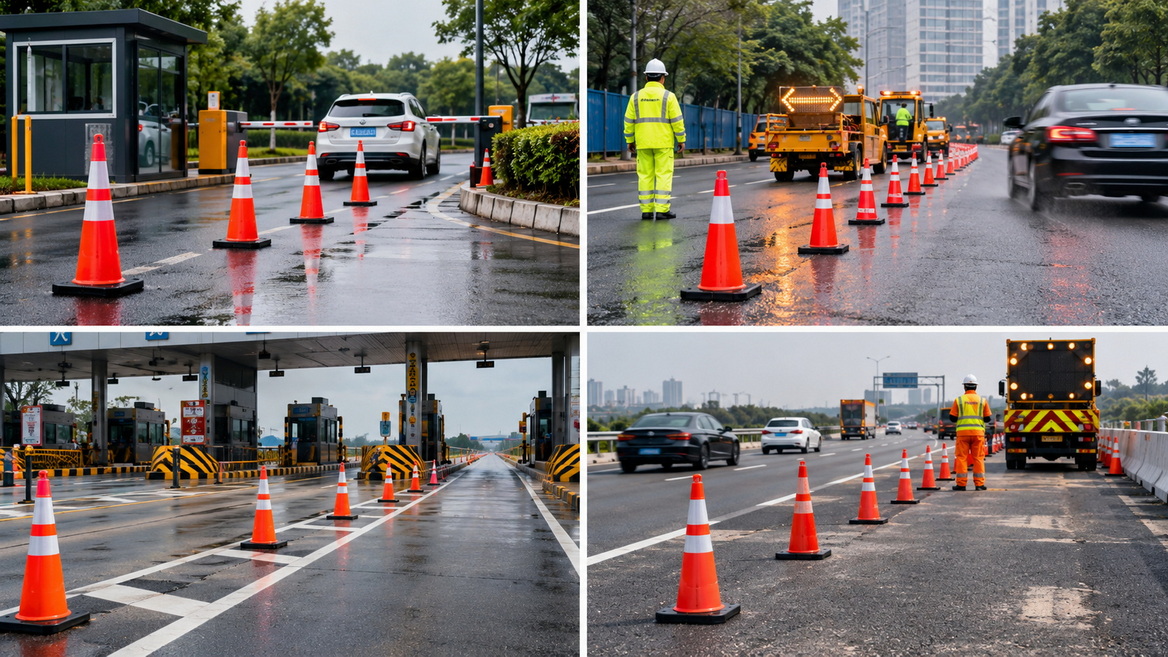
Traffic cones are portable safety devices used to warn, guide, channelize, separate, or temporarily restrict traffic. They are commonly made in high-visibility orange and can include reflective collars for improved nighttime recognition.
They are widely used in environments where traffic patterns may change temporarily or where people need to be protected from a hazard.
Common uses include:
- Temporary lane closures
- Road repair and maintenance projects
- Parking lot entrances and exits
- Toll booth lane guidance
- Construction and utility work zones
- Warehouse loading areas
- Forklift and pedestrian separation
- Emergency breakdown locations
- School drop-off and pickup zones
- Sports fields and event management
- Restricted parking spaces
- Queue control and crowd guidance
Traffic cones are most effective when they are part of a complete traffic management arrangement. Depending on the project, they may be used with signs, barricades, warning lights, delineators, cone bars, traffic chains, and temporary barriers.
Traffic cones can be classified by their height, material, base design, reflective configuration, and application environment. Understanding these differences helps buyers choose products that perform reliably in real working conditions.
Small traffic cones are lightweight, easy to transport, and suitable for low-speed environments. They are often selected for areas where visual guidance is needed but the risk level is relatively low.
Typical applications include:
- Indoor facilities
- Retail stores
- Private driveways
- Sports training
- Schools and playgrounds
- Event organization
- Pedestrian routing
- Light-duty warehouse operations
- Low-speed parking areas
A 12-inch traffic cone is usually best for indoor activities, sports drills, and visual marking. An 18-inch traffic cone provides a more noticeable warning signal and is often used for parking lots, private roads, and temporary daytime traffic control.
Small cones are convenient and affordable, but they should not be used as the primary channelizing device on high-speed roads or in demanding nighttime work zones.
The 28-inch traffic cone is one of the most popular sizes for professional traffic-control applications. It provides a practical balance of visibility, stability, portability, and cost.
This size is frequently used for:
- Municipal road maintenance
- Parking lot traffic control
- Toll station lane guidance
- Utility works
- Temporary lane closures
- Construction site access points
- Commercial property safety
- Urban roadway projects
- Logistics and distribution centers
A 28-inch cone can be supplied with a black rubber base to improve stability. It is also commonly fitted with one or two reflective collars for nighttime visibility.
For many professional roadwork environments, the 28-inch cone is a reliable all-purpose choice. It is large enough to be easily seen by approaching drivers while still being easy for workers to carry, stack, store, and deploy.
A 36-inch traffic cone is designed for more demanding conditions. Its taller profile helps drivers notice the work zone earlier, especially where traffic is moving quickly or where sightlines are limited.
Heavy-duty cones are commonly used for:
- Highways
- Major road reconstruction projects
- Night construction zones
- Airport service roads
- Long-distance lane closures
- Toll plaza approaches
- Truck routes
- Bridges and tunnels
- High-traffic industrial sites
A 36-inch cone should typically be paired with a strong, weighted base and high-quality reflective collars. In open, windy environments, a heavier base is especially important because a fallen cone can create confusion and reduce the effectiveness of the traffic layout.
Collapsible traffic cones are designed for easy storage and transport. They can be folded down when not in use and expanded quickly during emergencies or temporary traffic-control situations.
They are often used in:
- Passenger vehicles
- Emergency response vehicles
- Roadside assistance fleets
- Security patrol vehicles
- Schools
- Event operations
- Facility maintenance teams
- Small storage spaces
Many collapsible cones are available with LED warning lights or reflective bands. These features can improve visibility when the cone is used in poor weather, darkness, or roadside emergencies.
Although collapsible cones are convenient, they may not offer the same long-term stability as heavy-duty PVC or rubber-base traffic cones. They are best suited for portable, short-term, and low- to medium-risk applications.
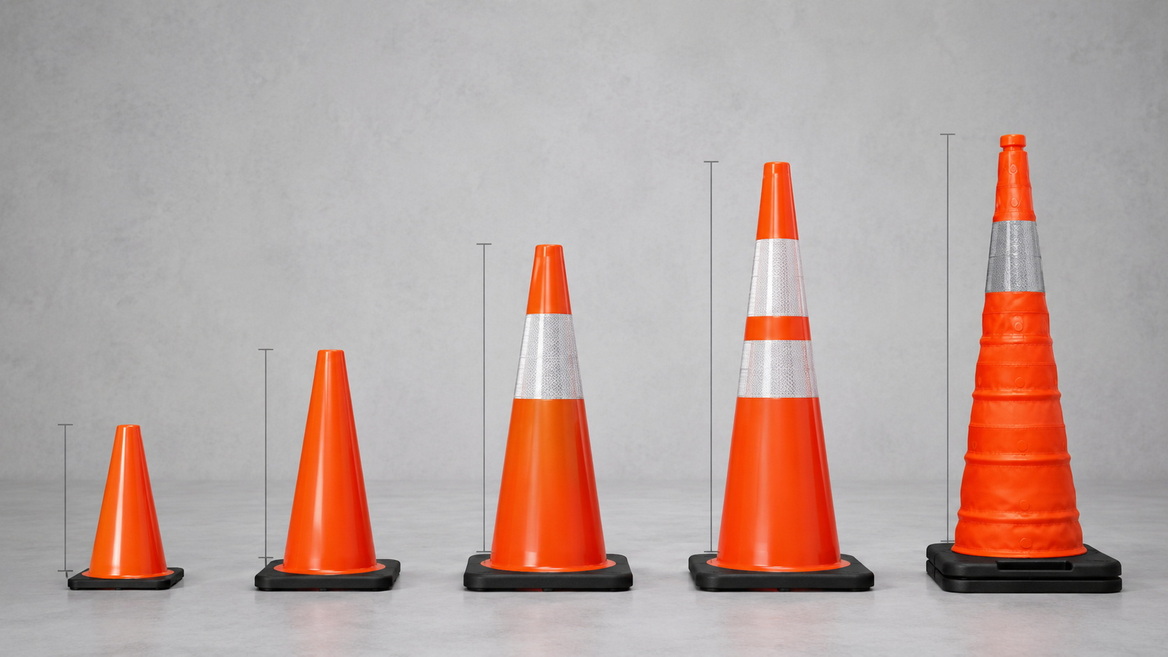
| Cone Height | Typical Environment | Recommended Use | Main Consideration |
|---|---|---|---|
| 12 inch / 305 mm | Indoor areas, sports fields, events | Visual marking and low-risk separation | Lightweight and easy to store |
| 18 inch / 457 mm | Parking lots, private roads, schools | Low-speed traffic guidance | Better visibility than small cones |
| 28 inch / 711 mm | Roadworks, utility projects, toll areas | Professional temporary traffic control | Reflective collars and stable base |
| 36 inch / 914 mm | Highways, night work, major projects | High-visibility traffic channelization | Heavy base and durable construction |
As a general rule, higher traffic speeds require larger and more visible cones. A parking lot may need an 18-inch or 28-inch cone, while highway maintenance areas may require taller cones with reflective collars and stronger bases.
The material of a traffic cone affects flexibility, durability, weather resistance, weight, stability, and overall service life. Buyers should select materials according to their local climate, project duration, handling frequency, and traffic conditions.
PVC traffic cones are widely used because they are flexible, durable, and suitable for many outdoor traffic-control applications. A quality PVC cone can recover after minor impacts and remain stable during repeated handling.
PVC cones are often used for:
- Parking facilities
- Municipal roadworks
- Toll stations
- Construction zones
- Utility maintenance
- Commercial property management
- Temporary lane closures
For outdoor projects, it is important to choose PVC cones with reliable UV resistance and temperature performance. A cone used under strong sunlight, heavy rain, or extreme heat should maintain its shape and color over time.
Rubber-base traffic cones typically use a bright cone body combined with a heavy black rubber base. The additional weight improves stability and makes the cone more suitable for outdoor traffic environments.
Rubber-base cones are ideal for:
- Roadsides
- Parking lot entrances
- Highway maintenance
- Truck routes
- Toll stations
- Open and windy locations
- Logistics parks
- Industrial yards
The base weight should match the working environment. A cone with an overly light base may tip over when exposed to wind, passing trucks, vehicle turbulence, or accidental contact.
PE traffic cones are commonly lightweight and cost-effective. They can be suitable for low- to medium-duty safety applications where transport convenience and budget control are important.
PE traffic cones are often selected for:
- Indoor spaces
- Promotional activities
- Event management
- Temporary parking guidance
- Schools
- Retail areas
- Short-term site marking
For demanding outdoor work zones, buyers should carefully evaluate the cone's flexibility, impact resistance, base stability, and weather performance before selecting PE construction.
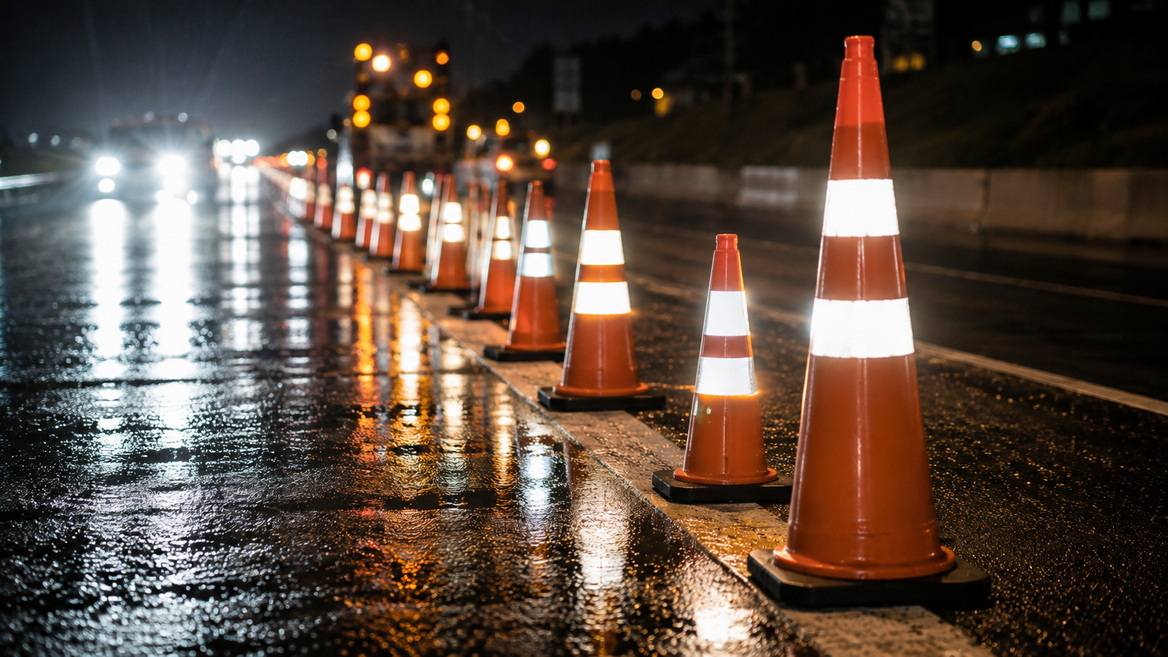
Reflective collars are one of the most important features for cones used at night, at dawn, during rain, in tunnels, or in poorly lit parking areas. They help vehicle headlights illuminate the cone from a greater distance.
A reflective traffic cone may use one or two white reflective collars. Double-collar configurations are common for taller professional cones because they create stronger visual contrast and improve recognition in low-light conditions.
When comparing reflective traffic cones, buyers should review:
- Reflective collar width
- Collar position on the cone
- Reflective material quality
- Bonding strength between collar and cone
- Visibility under headlights
- Resistance to rain and dirt
- UV resistance
- Long-term color stability
A reflective collar should remain securely attached after repeated handling, stacking, transportation, and outdoor exposure. Poor-quality reflective material can fade, peel, crack, or lose visibility over time.
Choosing the right traffic cone begins with understanding the actual working environment. A product specification should reflect the conditions in which the cone will be used.
Vehicle speed is one of the most important selection factors. Low-speed parking lots may only require smaller cones, while city roads, highways, and truck routes need taller products with stronger visual presence.
As traffic speed increases, drivers need more time and distance to identify a hazard and respond safely.
If cones will be used at night or in low-light areas, reflective collars or warning lights should be included in the specification.
For daytime-only projects, a non-reflective cone may be sufficient. However, it is often more practical to choose reflective cones when the same product may later be used for early-morning, evening, emergency, or rainy conditions.
Outdoor sites can expose cones to wind, rain, truck turbulence, and uneven pavement. A heavier rubber base provides better stability in these conditions.
For open roads, logistics yards, toll stations, and coastal locations, base weight should be reviewed carefully before bulk purchasing.
For distributors and project contractors, storage efficiency can affect total operating cost. Stackable cones reduce warehouse space and make loading easier. Collapsible cones are useful when storage space is highly limited.
Buyers should also consider:
- Carton dimensions
- Quantity per carton
- Pallet loading
- Container loading efficiency
- Product stacking height
- Damage protection during transport
Different markets, road authorities, contractors, and project owners may have different requirements for cone height, reflective configuration, color, base weight, and performance.
Before placing an order, confirm the target market and project specification. This helps prevent unsuitable product selection and avoids delays after delivery.
Choosing traffic cones only by price can lead to avoidable safety and replacement problems. A lower-cost product may create higher long-term costs if it tips over, fades quickly, cracks, loses reflective material, or needs frequent replacement.
Common purchasing mistakes include:
- Buying cones that are too short for the traffic environment
- Selecting non-reflective products for nighttime operations
- Ignoring the importance of base weight
- Using lightweight cones in exposed outdoor locations
- Assuming all reflective collars offer the same performance
- Failing to check weather and UV resistance
- Selecting one product for every application
- Treating traffic cones as impact barriers
- Ignoring packaging and shipping efficiency
- Ordering without confirming logo, color, and labeling requirements
Traffic cones are designed to provide visual warning and temporary channelization. They do not replace crash barriers, concrete barriers, water-filled barriers, or other protective systems intended to resist vehicle impact.
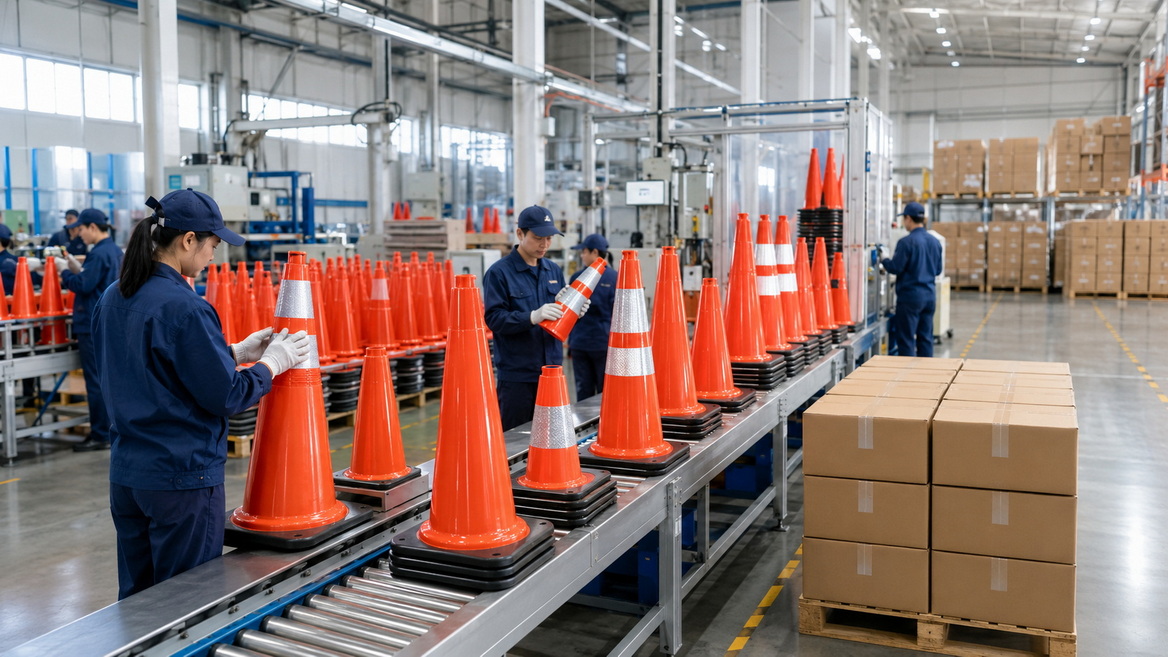
For importers, wholesalers, contractors, retailers, and private-label brands, customized traffic cones can create a more competitive and complete product offering.
Shenzhen Xingsheng Traffic Facilities Co., Ltd. provides traffic safety solutions for streets, highways, toll stations, parking lots, industrial facilities, and commercial projects. OEM and ODM services can support customized traffic cone specifications based on the target market and intended application.
Available customization options may include:
- Traffic cone height
- Cone material selection
- Rubber base weight
- Single or double reflective collars
- Custom cone colors
- Embossed company logo
- Printed logo and branding
- Private-label packaging
- Barcode labels
- Retail-ready cartons
- Cone bars and traffic chains
- LED warning lights
- Related parking lot safety products
- Traffic-control product kits
A successful custom project starts with a clear product brief. Buyers should provide the target market, quantity, application scenario, expected performance level, logo artwork, packaging requirements, and preferred delivery method.
Traffic cones are a small part of a larger safety system, but they can make a major difference in how clearly drivers and pedestrians understand a temporary route.
The right cone height, material, base design, and reflective configuration can improve visibility, reduce confusion, and help create a more organized traffic environment. Whether the project involves a parking lot, toll station, construction site, warehouse, city street, or highway, the best solution should always match the site conditions and the people who will use it.
Shenzhen Xingsheng Traffic Facilities Co., Ltd. supports buyers looking for reliable traffic cones, parking lot safety facilities, and customized traffic safety products for international markets. From standard products to OEM and ODM development, our team can help create practical solutions for safer and more efficient traffic management.
An 18-inch or 28-inch traffic cone is usually suitable for a parking lot. Use 18-inch cones for low-speed daytime guidance and 28-inch cones when stronger visibility, heavier traffic, or reflective collars are needed.
PVC traffic cones are generally more flexible and better suited for frequent outdoor use. PE traffic cones are often lighter and more cost-effective for low- to medium-duty applications, indoor areas, events, and short-term traffic marking.
Reflective collars are recommended for nighttime, low-light, rainy, and high-speed environments. They help vehicle headlights make the cone more visible from a greater distance.
A rubber-base traffic cone combines a colored cone body with a heavy black rubber base. The weighted base improves stability and helps prevent the cone from tipping over in windy areas or near passing vehicles.
Yes. Traffic cones can be customized with embossed logos, printed company names, custom colors, reflective collar options, private-label packaging, barcode labels, and other branding features.
1. Federal Highway Administration, *Manual on Uniform Traffic Control Devices, 11th Edition, Part 6: Temporary Traffic Control*. Available at: FHWA MUTCD Part 6 PDF https://mutcd.fhwa.dot.gov/pdfs/11th_Edition/part6.pdf
2. Federal Highway Administration, *2009 MUTCD, Chapter 6F: Temporary Traffic Control Zone Devices*. Available at: FHWA Chapter 6F https://mutcd.fhwa.dot.gov/htm/2009/part6/part6f.htm
3. Occupational Safety and Health Administration, *Work Zone Traffic Safety Fact Sheet*. Available at: OSHA Work Zone Traffic Safety https://www.osha.gov/sites/default/files/publications/WORK_ZONE_TRAFFIC_SAFETY.pdf
4. Occupational Safety and Health Administration, *Regulations Concerning the Size and Use of Safety Traffic Cones in General Industry*. Available at: OSHA Standard Interpretation https://www.osha.gov/laws-regs/standardinterpretations/2004-09-20
5. CEN, *EN 13422:2019 — Portable Traffic Cones and Cylinders with Retroreflective Properties*. Available at: EN 13422:2019 Overview https://standards.iteh.ai/catalog/standards/cen/4e64f60c-8a7e-48af-87ad-98669e7269ad/en-13422-2019
6. Traffic Safety Warehouse, *The Types of Traffic Cones*. Available at: Original Reference Article https://www.trafficsafetywarehouse.com/Resources/types-of-traffic-cones.asp


