
Please Choose Your Language
Views: 239 Author: XS Traffic Facilities Publish Time: 2026-08-19 Origin: Site


Content Menu
● Why Traffic Barricade Selection Matters
● Traffic Barricade Types at a Glance
● Type I Traffic Barricades for Low-Speed Control
>> When to Use Type I Barricades
>> When Type I Barricades May Not Be Enough
● Type II Traffic Barricades for Enhanced Visibility
>> Why Type II Barricades Are More Visible
>> A Practical Site Review Checklist
● Type III Traffic Barricades for Road Closures
>> Why Type III Barricades Are Used for Closures
>> Type III Barricades Are Not Automatically Crash Barriers
>> Type III Barricade Installation Considerations
● A-Frame Barricades for Portable Traffic Control
>> Common Benefits of A-Frame Barricades
● Water-Filled Barriers and Modular Road Safety Systems
>> Typical Uses for Water-Filled Barriers
>> Understand the Intended Function
>> Water-Filled Barriers vs. Concrete Barriers
● Solar Road Markers for Nighttime Guidance
>> Where Solar Road Markers Add Value
>> A Layered Visibility Approach
● How to Choose the Right Traffic Barricade
>> Step 1: Identify the Main Objective
>> Step 2: Review Traffic Conditions
>> Step 3: Plan for Day and Night Visibility
>> Step 4: Consider Pedestrian Safety
>> Step 5: Confirm Product Specifications
● Custom Traffic Safety Product Solutions
● Summary
Traffic barricade selection is more than a product decision. The right traffic barricades help drivers, pedestrians, and work crews recognize changing conditions, follow a safe route, and avoid restricted areas.
For street maintenance, highway lane closures, toll plazas, parking facilities, construction sites, and temporary events, a well-planned combination of traffic barricades, reflective devices, warning lights, and solar road markers can improve road guidance in both daytime and nighttime conditions.
At Shenzhen Xingsheng Traffic Facilities Co., Ltd., we provide traffic safety products and customized solutions for distributors, contractors, project buyers, and infrastructure applications. This guide explains the differences between Type I, Type II, and Type III barricades, A-frame barricades, and water-filled barriers, along with practical selection guidance for real project conditions.
> Important note: Portable traffic barricades are mainly used to warn, guide, channelize, restrict, or close an area. They should not automatically be considered vehicle-containment barriers. Always select products according to local regulations, project drawings, installation conditions, and applicable safety requirements.
Roadworks, utility maintenance, parking-lot repairs, lane closures, and construction activities all change the normal path of travel. Drivers may need to merge, slow down, detour, or stop. Pedestrians may need to use a temporary route. Without clear traffic control devices, these changes can create confusion and increase risk.
Traffic barricades help create a visible and understandable boundary between moving traffic, work crews, equipment, pedestrians, and restricted areas.
A properly selected traffic barricade system should perform several essential functions:
- Warn road users about a changed, hazardous, or restricted condition.
- Guide drivers through a taper, lane shift, detour, or controlled access point.
- Delineate a clear boundary around work areas, excavations, equipment, or pedestrian routes.
- Restrict access to closed lanes, sidewalks, parking areas, or construction zones.
- Support visibility during nighttime, rain, fog, glare, or low-light conditions.
The most effective traffic control setup does not rely on one product alone. It combines clear barricades, retroreflective materials, warning signs, lights, road studs, and appropriate installation practices.
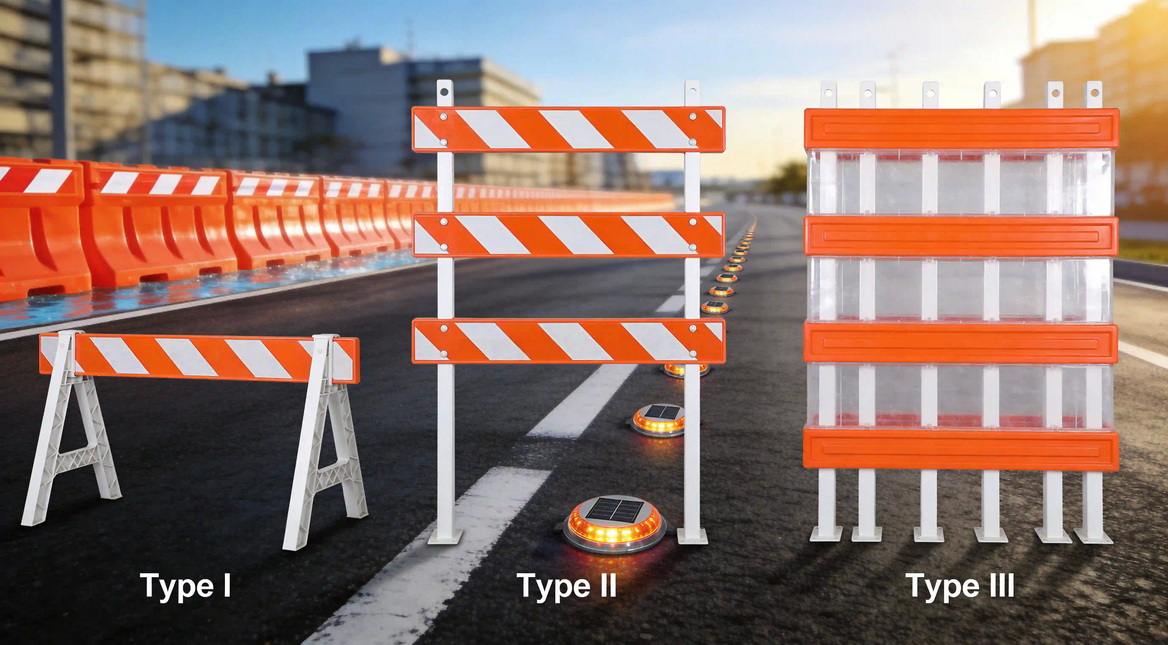
Traffic barricades are often identified by the number of reflective rails they use. However, the correct barricade type should also be selected according to road speed, traffic volume, project duration, visibility requirements, and whether traffic needs to pass through or be completely stopped.
| Feature | Water-Filled Barrier | Concrete Barrier |
|---|---|---|
| Transportation | Lightweight before filling | Heavy during transport |
| Installation | Can be installed empty and filled on site | Requires lifting equipment |
| Flexibility | Modular layouts and curved configurations | Less flexible after placement |
| Typical Use | Temporary delineation and separation | Higher-demand separation and containment applications |
| Storage | Easier to store when empty | Requires more space and handling equipment |
| Performance | Depends on specific product design | Depends on barrier design, installation, and project specification |
A Type I traffic barricade has one retroreflective rail. It is commonly used for temporary control in low-speed environments, especially where workers need a lightweight, portable, and easy-to-deploy solution.
Many Type I barricades use a foldable A-frame structure. This design allows crews to transport multiple units efficiently, set them up quickly, and store them compactly after work is complete.
Type I barricades are commonly used for:
- Sidewalk repairs and pedestrian redirection.
- Residential utility work.
- Landscaping projects.
- Parking-lot maintenance.
- Minor roadway repairs.
- Temporary access restrictions.
- Event traffic control.
- Short-duration construction tasks.
Type I barricades are generally suitable when vehicles are still moving through the surrounding area at relatively low speeds. They can indicate a minor obstruction, guide pedestrians around a work area, or mark temporary restrictions in a parking environment.
For example, a facilities team repairing a drainage cover in a parking lot may use Type I A-frame barricades to establish a visible perimeter around the repair area. The barricades inform drivers and pedestrians that the space is restricted while allowing traffic to continue safely around it.
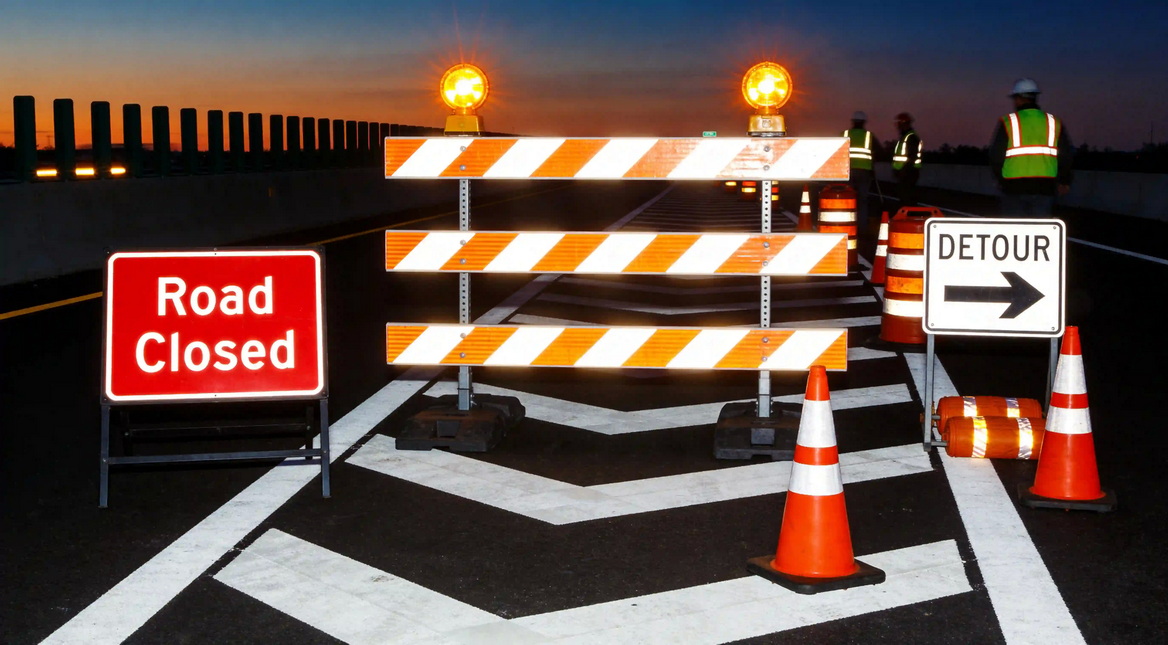
A single-rail barricade may not offer sufficient visibility for higher-speed roads, complex detours, nighttime operations, or full road closures. In these situations, a Type II or Type III barricade may provide a stronger visual message.
Additional warning signs, solar-powered warning lights, reflective delineators, and solar road markers can also improve recognition distance where visibility is limited.
A Type II traffic barricade has two retroreflective rails. The additional rail creates a larger reflective target for approaching drivers, making Type II barricades a strong choice for locations where higher visibility is required.
They are often used in environments where traffic remains active but drivers need more time and clearer guidance to react safely.
Type II barricades are commonly used for:
- Lane restrictions.
- Lane shifts.
- Urban detours.
- Road maintenance projects.
- Toll plaza approaches.
- Temporary construction entrances.
- Nighttime work zones.
- Parking-garage circulation changes.
The two-rail design offers more reflective surface area than a Type I barricade. This can be especially valuable at night, during rain, or in visually complex environments with streetlights, commercial signs, vehicle headlights, and other distractions.
Reflective stripes should be positioned to guide road users in the correct direction. When multiple barricades are installed together, their orientation should create a clear and continuous visual path rather than a confusing sequence of isolated devices.
Before selecting Type II barricades, review the full approach to the work zone:
1. Approach speed: How quickly are vehicles traveling before they reach the barricade?
2. Sight distance: Can drivers see the barricades early enough to react safely?
3. Road geometry: Are there curves, hills, parked vehicles, walls, or trees blocking visibility?
4. Operating hours: Will the work continue after sunset or during early-morning darkness?
5. Weather conditions: Is rain, fog, dust, snow, or glare likely to reduce visibility?
6. Traffic pattern: Are vehicles merging, turning, detouring, or traveling through a narrowed lane?
7. Pedestrian movement: Will pedestrians need a separate, clearly marked path?
A traffic barricade should not simply tell people that an obstruction exists. It should help them understand where to go next.
A Type III traffic barricade has three retroreflective rails and is designed to create a strong visual indication of a full or partial road closure.
Because Type III barricades have a wider and more prominent horizontal profile, they are commonly placed across a roadway, lane, ramp, bridge access point, or construction entrance where vehicles must not proceed.
Typical Type III barricade applications include:
- Full road closures.
- Partial road closures.
- Highway maintenance zones.
- Bridge repair projects.
- Closed ramps and service roads.
- Major utility excavation work.
- Detour entry points.
- Restricted construction entrances.
- Closed toll lanes.
A Type III barricade provides a broad, highly visible message that the road ahead is unavailable or restricted. It is often used together with road-closure signs, directional signs, warning lights, detour signs, and advance warning devices.
For a complete road closure, the traffic control arrangement should begin well before the actual closure point. Drivers need enough time to slow down, read signs, choose an alternate route, and safely turn away from the restricted area.
This is an important distinction for contractors, distributors, and project buyers.
A Type III barricade is a closure and guidance device. It helps communicate that a route is closed. It does not automatically stop, redirect, or contain an errant vehicle.
Where a project requires worker protection from moving vehicles, the site may need an approved temporary barrier, impact attenuator, crash cushion, or other vehicle-containment system. Product selection should always be based on the actual risk assessment and the required safety performance.
For effective installation, project teams should consider:
- Road width and closure location.
- Vehicle approach speed.
- Required advance warning distance.
- Nighttime visibility.
- Wind conditions.
- Barricade stability and ballast needs.
- Access for authorized vehicles.
- Emergency vehicle requirements.
- Detour route clarity.
- Ongoing inspection and maintenance.
An A-frame barricade refers to the product's support structure. It is not necessarily a separate barricade category. A-frame designs are commonly used for Type I and Type II barricades because they are practical, foldable, and easy to deploy.
For temporary projects, portability is a major advantage. Work crews can transport multiple A-frame barricades in service vehicles, set them up quickly, and remove them when the work is complete.
- Quick deployment for short-term work.
- Compact storage in warehouses and vehicles.
- Reusable construction for recurring maintenance work.
- Lightweight handling for crews.
- Custom reflective rails for project-specific requirements.
- Flexible material selection, including plastic and galvanized steel components.
- Optional branding and labeling for distributors and contractors.
Portability should never compromise stability. A-frame barricades must remain upright in wind, rain, vehicle turbulence, and normal site activity.
Before installation, verify:
- The surface is level and stable.
- The barricade legs are fully opened.
- The reflective rails are correctly positioned.
- The unit is not blocked by equipment, parked vehicles, or vegetation.
- Approved ballast is used where necessary.
- The barricade does not create a trip hazard for pedestrians.
For areas exposed to heavy wind or frequent vehicle movement, a heavier-duty barricade design or approved ballast solution may be more appropriate.
Water-filled barriers are modular plastic units that can be transported empty and filled with water after installation. They are widely used for temporary traffic separation, long work-zone boundaries, parking control, toll plaza management, and construction-site access organization.
These barriers are often connected together to create a continuous visual line. Their modular design makes them practical for projects that require a flexible layout, curved alignment, or repeated installation and removal.
- Construction-zone perimeter control.
- Toll station lane separation.
- Parking-lot traffic channelization.
- Roadwork area delineation.
- Temporary pedestrian separation.
- Access-road management.
- Event traffic management.
- Warehouse and logistics-area routing.
Not all water-filled barriers provide the same level of performance. Some are designed mainly for visual delineation, while others may have tested performance for specific applications.
A water-filled barrier should not be assumed to provide vehicle containment simply because it is large, heavy, or visually similar to a concrete barrier. Buyers should confirm the product's intended use, testing information, installation requirements, connection method, water-fill capacity, and local approval requirements.
| Feature | Water-Filled Barrier | Concrete Barrier |
|---|---|---|
| Transportation | Lightweight before filling | Heavy during transport |
| Installation | Can be installed empty and filled on site | Requires lifting equipment |
| Flexibility | Modular layouts and curved configurations | Less flexible after placement |
| Typical Use | Temporary delineation and separation | Higher-demand separation and containment applications |
| Storage | Easier to store when empty | Requires more space and handling equipment |
| Performance | Depends on specific product design | Depends on barrier design, installation, and project specification |
Traffic barricades are highly visible when they use quality reflective materials, but road users often need additional guidance in dark, wet, foggy, or complex road environments.
Solar road markers, also called solar road studs or solar LED pavement markers, can help create a more continuous visual path along lanes, curves, toll plazas, parking entrances, construction detours, and restricted areas.
Solar road markers absorb sunlight during the day and use stored energy to provide LED illumination at night. They can be installed where wired power is difficult, expensive, or impractical.
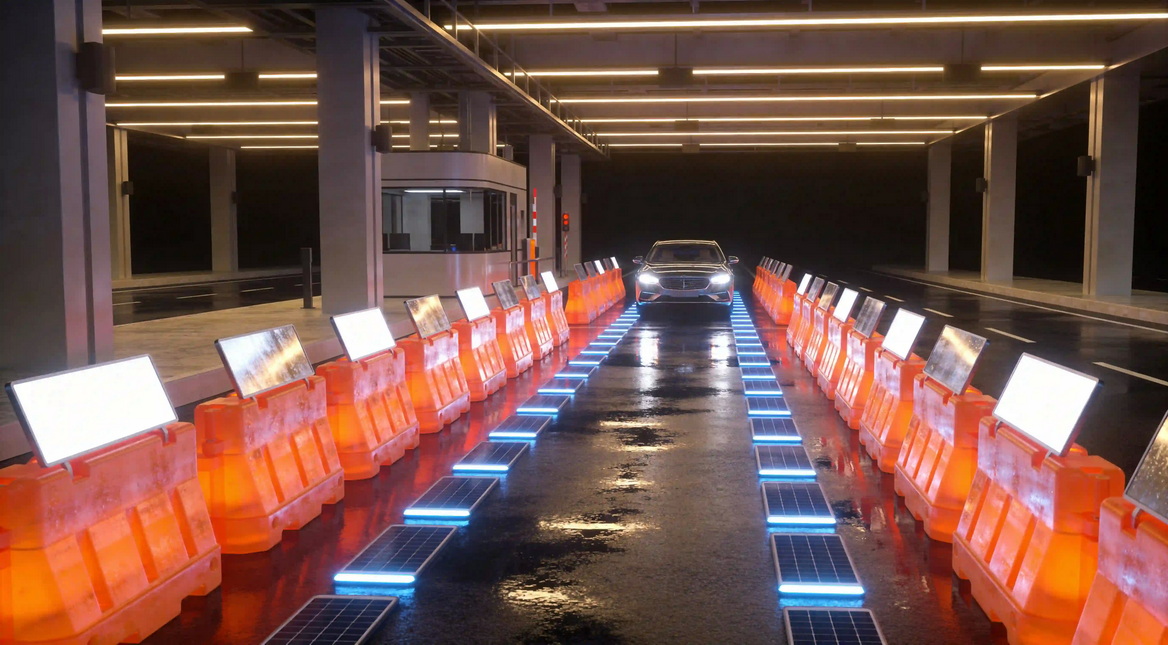
- Highway curves and ramps.
- Toll plaza lane guidance.
- Parking-lot entrances and exits.
- Construction-zone detours.
- Bridge approaches.
- Low-light road sections.
- Temporary lane channelization.
- Warehouse and logistics routes.
- Pedestrian crossings and safety islands.
For projects with nighttime traffic, one safety device is rarely enough. A more effective arrangement may combine:
- Type II or Type III traffic barricades.
- High-quality retroreflective sheeting.
- Solar warning lights.
- Solar road markers.
- Directional signs.
- Delineator posts.
- Water-filled barriers.
- Temporary road markings.
This layered approach helps drivers identify the work zone earlier, understand the required direction of travel, and maintain a safer path through changing conditions.
The best traffic barricade depends on the purpose of the installation, not just the product price or rail count.
Before selecting a barricade system, define the site conditions and the expected movement of vehicles and pedestrians.
Ask whether the project needs to:
- Warn road users.
- Guide traffic through a temporary path.
- Restrict access to a small area.
- Close a lane or road.
- Separate pedestrians from vehicles.
- Delineate a long construction boundary.
- Improve nighttime road guidance.
This first step helps determine whether a Type I, Type II, Type III barricade, water-filled barrier, solar road marker, or a combination of products is most appropriate.
Evaluate the operating environment:
- Vehicle speed.
- Traffic volume.
- Lane width.
- Road type.
- Visibility distance.
- Curves and intersections.
- Weather exposure.
- Nighttime operation.
- Nearby pedestrian activity.
- Work-zone duration.
A short-term repair on a local street may only require portable Type I or Type II barricades. A highway closure, bridge repair, or major detour may require Type III barricades, advance warning signs, flashing lights, and a more comprehensive traffic control arrangement.
Reflective surfaces should remain clean, visible, and correctly oriented. Dirty, faded, damaged, or overturned barricades can reduce the effectiveness of the entire traffic control system.
For night work, consider adding:
- Solar-powered warning lights.
- LED barricade lights.
- Solar road markers.
- High-intensity reflective sheeting.
- Additional delineators.
- Larger signs.
- More frequent inspection intervals.
Pedestrian management is essential wherever sidewalks, crossings, parking areas, or access routes are affected.
Barricades used near pedestrian routes should help people understand where they can safely walk. The setup should be continuous, visible, stable, and suitable for people with visual impairments, mobility limitations, strollers, wheelchairs, and luggage.
When a pedestrian route is closed, provide a clear alternate path before people arrive at the blocked point.
For traffic safety procurement, buyers should confirm the complete product specification before placing an order.
Key points may include:
- Product dimensions.
- Material type.
- Rail configuration.
- Reflective sheeting grade.
- Frame construction.
- Ballast method.
- Wind stability.
- Warning light compatibility.
- Solar road marker specifications.
- Color options.
- Logo and labeling requirements.
- Packaging method.
- Container loading plan.
- Required test reports or documentation.
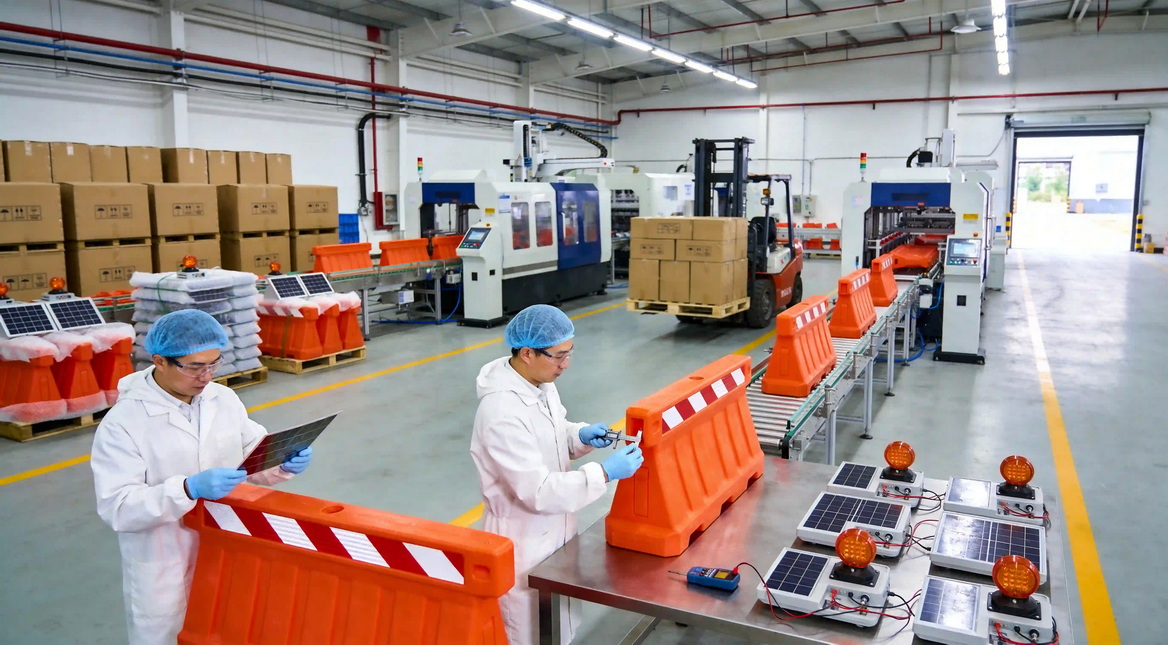
Shenzhen Xingsheng Traffic Facilities Co., Ltd. supplies traffic safety products for streets, highways, toll stations, parking facilities, construction zones, and other controlled traffic environments.
We support OEM and ODM requirements for customers who need products adapted to their local market, project specifications, brand identity, packaging standards, or application conditions.
Our product solutions can include:
- Type I traffic barricades.
- Type II traffic barricades.
- Type III traffic barricades.
- A-frame barricades.
- Reflective barricade boards.
- Water-filled barriers.
- Modular traffic channelizers.
- Solar road markers.
- Solar LED warning lights.
- Customized colors, logos, labels, and packaging.
For each project, product configuration should be matched to the road environment, visibility conditions, local requirements, installation method, and intended level of traffic control.
Traffic barricades are essential tools for guiding road users through temporary and permanent changes in the traffic environment.
Type I barricades are practical for low-speed and short-duration applications. Type II barricades provide stronger visibility for lane restrictions and active traffic zones. Type III barricades are widely used for road closures, detours, and restricted access points. Water-filled barriers offer modular delineation for longer work zones, while solar road markers improve nighttime guidance in low-light environments.
The safest and most effective traffic control solution is usually a combination of properly selected devices, clear signs, reflective materials, reliable installation, and regular inspection.
For streets, highways, toll plazas, parking lots, construction sites, and custom traffic safety projects, Shenzhen Xingsheng Traffic Facilities Co., Ltd. provides practical product options and flexible OEM/ODM manufacturing support.
1. Federal Highway Administration. Work Zone Facts and Statistics https://ops.fhwa.dot.gov/wz/resources/facts_stats.htm
2. Federal Highway Administration. Chapter 6F: Temporary Traffic Control Zone Devices https://mutcd.fhwa.dot.gov/htm/2003r1r2/part6/part6f3.htm
3. Federal Highway Administration. 2009 Edition Chapter 6F: Temporary Traffic Control Zone Devices https://mutcd.fhwa.dot.gov/htm/2009/part6/part6f.htm
4. Federal Highway Administration. FAQs: Work Zone Traffic Control Devices https://highways.dot.gov/safety/rwd/reduce-crash-severity/faqs-work-zone-traffic-control-devices
5. Traffic Safety Warehouse. Traffic Barricade Types by Category https://www.trafficsafetywarehouse.com/Resources/traffic-barricades-types-by-category.asp


