
Please Choose Your Language
Views: 267 Author: XS Traffic Facilities Publish Time: 2026-08-14 Origin: Site


Content Menu
>> Product and Engineering Capability
● Top LED Stop Sign Manufacturers and Suppliers Serving Mexico
>> Shenzhen Xingsheng Traffic Facilities Co., Ltd.
>> SEMEX
>> Tussan
>> Tecnivial
● Technical Requirements for LED Stop Signs
>> Recommended Material Considerations
>> Solar-Powered LED Stop Sign Requirements
● Common Purchasing Problems and How to Avoid Them
>> Low-Grade Reflective Sheeting
● Buyer's Guide for Samples and Orders
>> Information to Provide Before Requesting a Quotation
>> How Can I Check Whether a Supplier's ISO Certificate Is Still Valid?
>> Can a CE-Marked LED Stop Sign Be Used in Mexico?
>> What Is the Most Important Test for a Solar LED Stop Sign?
>> Why Are Some LED Stop Signs Much Cheaper Than Others?
>> Should I Buy From a Local Supplier or a Direct Export Manufacturer?
Mexico is an active market for road-safety products used in municipal intersections, toll stations, industrial parks, school zones, parking facilities, private developments, construction sites, and logistics centers.
LED stop signs are increasingly selected for locations where conventional reflective signs may not provide enough nighttime visibility. Solar-powered flashing stop signs, LED-enhanced warning signs, and illuminated regulatory signs can improve visibility at intersections, pedestrian crossings, toll-road entrances, school zones, and high-risk private roads.
However, sourcing LED traffic signs for Mexico requires more than comparing unit prices. Buyers need to understand whether a supplier is a local manufacturer, installer, distributor, traffic-system integrator, or export factory. Each supplier model has different strengths in customization, engineering support, local installation, delivery time, spare-parts availability, and warranty management.
The companies below represent suppliers that may be relevant for buyers sourcing LED stop signs and related traffic-safety products for Mexico. The best option depends on the project size, product specification, installation environment, local service requirements, and required order quantity.
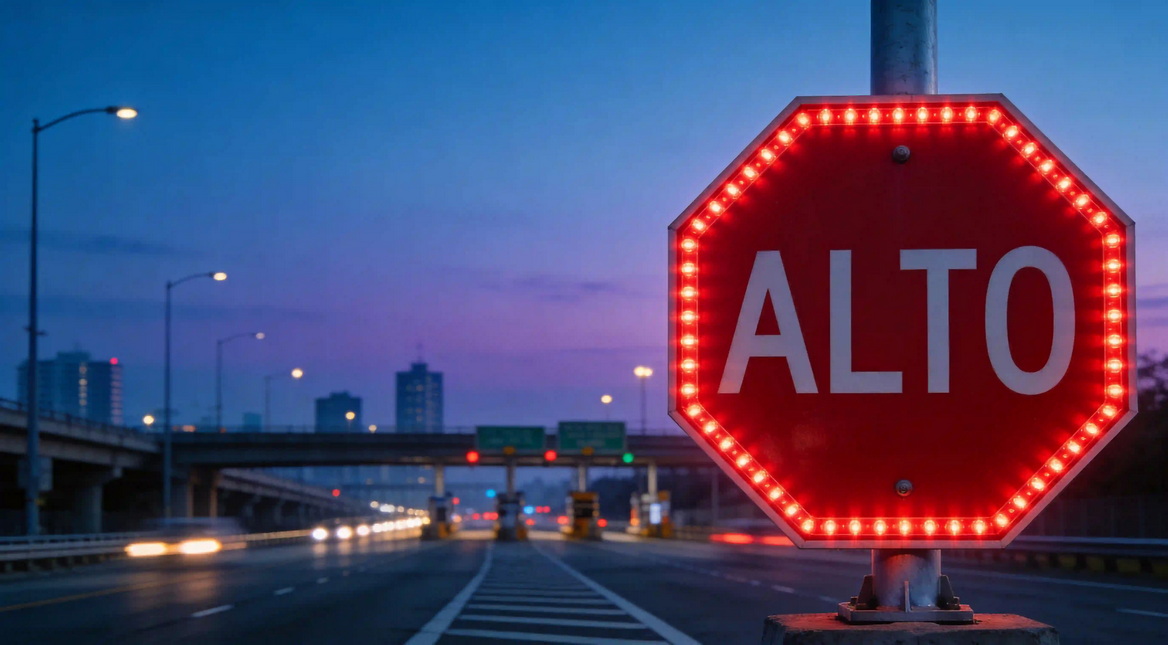
Professional buyers should assess LED stop-sign suppliers through a clear and consistent evaluation process.
A qualified supplier should be able to provide detailed product information covering the sign panel, reflective sheeting, LED modules, solar panel, battery, controller, wiring, enclosure, bracket, and mounting system.
The supplier should also be able to explain how the product performs in high heat, dust, rain, vibration, road-side exposure, and limited sunlight conditions.
A reliable manufacturer should carry out incoming-material inspections, LED testing, flashing-pattern checks, waterproofing inspections, charging tests, battery checks, appearance inspections, and final packing verification.
For solar-powered LED stop signs, buyers should ask how the supplier tests battery performance, solar charging, controller protection, LED flashing consistency, and operating time after several days of poor sunlight.
Depending on the project, buyers may need to request quality-system certificates, electrical safety documents, environmental declarations, reflective-sheeting data, battery transport documentation, and local product-compliance information.
A certificate should always be checked against the factory address, certificate scope, issue date, expiry date, and product category. A quality certificate does not automatically mean that every sign model meets a specific road-authority requirement.
For customized LED traffic signs, delivery time may be influenced by the availability of solar panels, batteries, controllers, aluminum panels, reflective sheeting, special brackets, private-label packaging, and export documentation.
Fast and accurate communication is especially important when a buyer needs to adjust the sign face, LED layout, voltage, flash mode, mounting arrangement, or packaging after the first quotation.
OEM and ODM support is valuable for traffic-safety distributors, contractors, parking-system providers, and private-label brands.
Common customization options include:
- Spanish-language ALTO stop-sign faces
- Customized sign dimensions and shapes
- Solar-powered or AC-powered configurations
- Flash pattern and brightness adjustment
- Private-label logo printing
- Customized cartons and manuals
- Special mounting brackets
- Battery-capacity upgrades
- Solar-panel upgrades
- Mixed orders of traffic-safety products
| Supplier | Main Role | Core Product Focus | MOQ and Capacity | Certification or Documentation Focus |
|---|---|---|---|---|
| Shenzhen Xingsheng Traffic Facilities Co., Ltd. | Export manufacturer | LED traffic signs, reflective signs, solar road markers, traffic-safety products | Quote-based according to product and customization | Product drawings, samples, inspection requirements, project documentation |
| SEMEX | Mexican traffic-systems provider | LED-reinforced signs, signals, intelligent traffic systems | Project-based quotation | ISO 9001:2015 and product-specific documentation |
| Tussan | Mexican signage and installation provider | Vertical signs, road markers, traffic paint, installation services | Product and project-based quotation | Local project and installation documentation |
| Tecnivial | International road-safety supplier | Signage, beaconing, road, rail, and airport systems | Project-based quotation | Engineering, road-safety, and project documentation |
| Carmanah Technologies | Specialist LED traffic-safety supplier | Solar and AC-powered LED-enhanced signs | Distributor or project basis | Technical specifications, solar-system design, product testing |
Best suited for: Distributors, contractors, parking-system providers, road-safety brands, and buyers seeking flexible OEM/ODM manufacturing support.
Shenzhen Xingsheng Traffic Facilities Co., Ltd. is a China-based manufacturer supplying LED traffic signs, reflective signs, solar road markers, traffic lights, push-button systems, traffic cones, wheel stops, safety tape, and other traffic-safety products.
The company is a practical option for buyers serving Mexico who need customized LED stop signs rather than standard catalog products. Its broader product range can also help buyers consolidate multiple traffic-safety categories into one order.
Potential customization options include:
- ALTO stop signs for Mexico and Spanish-speaking markets
- Customized LED flashing layouts
- Solar-powered, battery-powered, and AC-powered systems
- Different reflective-sheeting grades
- Custom sign dimensions and shapes
- Private-label logos and packaging
- Customized wall-mount, pole-mount, or bracket-mount structures
- Mixed orders of signs, road studs, traffic cones, wheel stops, and parking products
The company is particularly suitable for small-to-medium-sized brands that require flexible communication, fast quotation feedback, and practical support during product development.
Buyers should request technical drawings, material specifications, sample photos or videos, solar-system details, inspection requirements, and agreed packing standards before confirming mass production.
Best suited for: Municipal traffic-control projects, traffic-signal integration, LED-reinforced sign projects, and intelligent transportation applications.
SEMEX is a Mexican provider of traffic signage, traffic signals, LED-reinforced signs, semi-variable signs, elevated signage, and intelligent traffic systems.
The company may be suitable for buyers that require more than a standalone LED stop sign. It can be relevant for intersection upgrades, warning systems, traffic-control integration, municipal projects, and infrastructure work involving signals and signage.
SEMEX has published quality-management information related to ISO 9001:2015 across several operational areas. Buyers should still verify whether the intended product model has the appropriate technical records, electrical specifications, and project-level documentation.
Before purchasing, ask for confirmation of:
- The exact LED stop-sign model
- Local installation and commissioning support
- Maintenance capability
- Lead time for customized items
- Available spare parts
- Controller and power-system details
- Project warranty terms
- Product-specific testing information
Best suited for: Local road-marking, construction, parking-area, industrial-site, and traffic-sign installation projects.
Tussan is a Mexican provider of road signage, traffic paint, road markers, installation services, and traffic-safety equipment.
Its main advantage is its ability to support projects that require several on-site road-safety products at the same time. This may include vertical signs, pavement-marking materials, road markers, parking guidance products, and installation work.
Tussan may be a suitable option for buyers who prioritize local service, installation coordination, and project convenience.
For LED stop-sign projects, buyers should clarify whether the electrical components are manufactured internally, assembled from third-party components, or supplied through another partner. This information can affect delivery time, technical support, warranty handling, and availability of replacement parts.
Important questions include:
- Is the LED stop sign produced locally?
- What solar and battery options are available?
- Can the supplier provide installation support?
- Are spare parts stocked locally?
- What is the warranty process?
- Can sign faces be customized for a specific project?
- Can the supplier combine LED signs with road-marking and installation services?
Best suited for: Toll-road, railway, airport, highway, and engineering-led road-safety projects.
Tecnivial is an established road-safety company founded in 1973. It supplies integrated signage, beaconing, delineation, and road-safety systems for roads, railways, and airports.
The company is more suitable for large and technically demanding projects than for buyers searching for entry-level private-label LED stop signs. Its experience with integrated road-safety systems can be valuable where multiple product categories must work together.
Potential project applications include:
- Toll-road entrances
- Highway intersections
- Airport access roads
- Railway crossings
- Large infrastructure projects
- Roadwork zones
- High-risk intersections
- Intelligent road-safety installations
Buyers should confirm supply arrangements for Mexico, local technical support, available inventory, project delivery time, warranty coverage, and spare-parts procedures before selecting the supplier.
Best suited for: Solar-powered LED stop signs, pedestrian-crossing systems, school-zone signs, and high-visibility warning-sign applications.
Carmanah Technologies specializes in solar and AC-powered traffic-safety systems. Its product range includes LED-enhanced stop signs, school-zone signs, pedestrian-crossing systems, warning signs, and related traffic-safety equipment.
The company is relevant for projects where solar-system reliability, LED visibility, traffic-safety engineering, and long-term operating performance are more important than the lowest purchase price.
Typical applications include:
- Stop-controlled intersections
- Pedestrian crossings
- School zones
- Rural roads
- Private developments
- Industrial parks
- Parking-facility entrances
- High-risk road junctions
Before purchasing a solar-powered LED stop sign, buyers should request a project-specific solar calculation. This should include solar-panel wattage, battery capacity, flash pattern, expected daily operating hours, local sunlight conditions, and backup operating days.
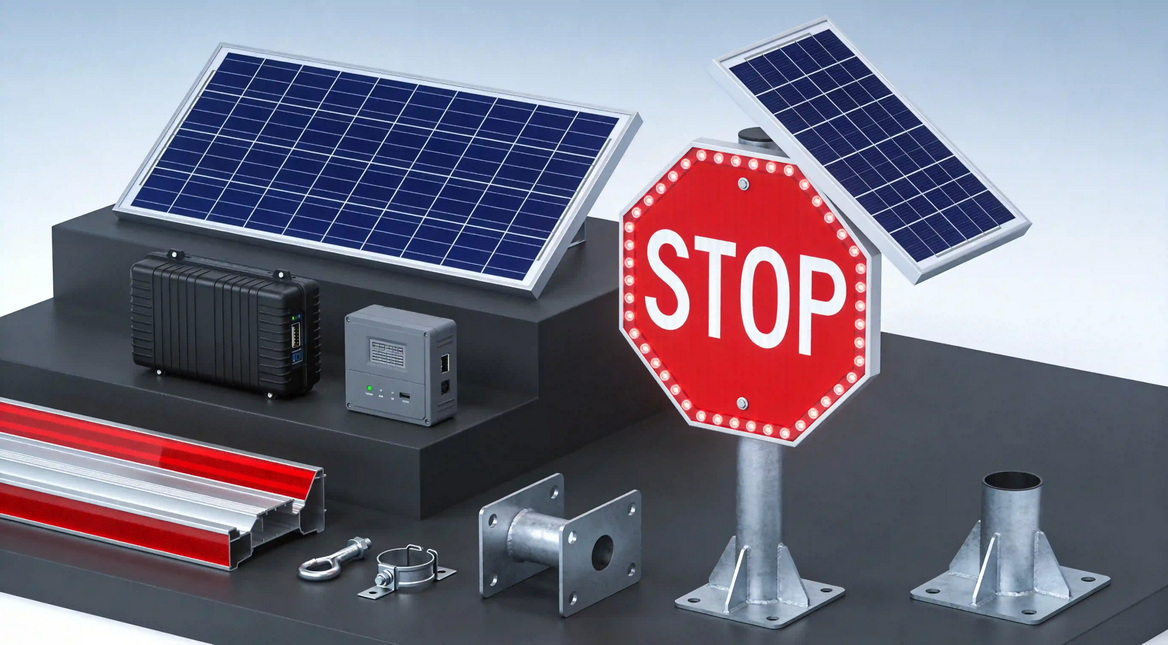
An LED stop sign should be evaluated as a complete system rather than a standard reflective sign with LED lights added around the border.
| Component | What Buyers Should Confirm | Common Risk |
|---|---|---|
| Aluminum Sign Panel | Thickness, material grade, reinforcement, corrosion resistance | Warping, vibration damage, edge corrosion |
| Reflective Sheeting | Grade, supplier, color consistency, traceability | Weak nighttime visibility |
| LED Modules | Brightness, flash uniformity, lens quality, replacement method | Uneven lighting or early failure |
| Solar Panel | Wattage, cell quality, mounting angle, cable protection | Low charging performance |
| Battery | Capacity, chemistry, operating temperature, cycle life | Short operating time |
| Controller | Charging protection, low-voltage protection, flash settings | Battery over-discharge |
| Electrical Enclosure | Water resistance, UV resistance, cable sealing | Moisture and dust damage |
| Mounting Bracket | Pole size, wind resistance, anti-theft design | Loose or unstable installation |
For outdoor LED stop signs, buyers should generally specify:
- Corrosion-resistant aluminum sign panels
- UV-resistant reflective film
- Waterproof LED modules
- Sealed electrical enclosures
- UV-resistant cable protection
- Stainless-steel or galvanized mounting hardware
- High-temperature battery protection
- Reliable cable glands and waterproof connectors
The performance of a solar LED stop sign depends on the balance between power generation and daily energy consumption.
The supplier should provide information covering:
- Solar-panel wattage
- Battery voltage and capacity
- LED operating power
- Flashing frequency
- Daily operating hours
- Expected backup days
- Charging-controller specifications
- Expected sunlight conditions
- Operating temperature range
A solar LED stop sign may perform well during a short factory inspection but fail in the field if the solar panel is too small, the battery capacity is insufficient, the controller is poorly configured, or the installation location has partial shade.
Some products use reflective materials that look acceptable in daytime images but have weak nighttime performance.
Buyers should request the reflective-sheeting grade, color requirement, technical specification, and supporting documentation before approving production.
A sign panel may bend during transport or after installation if the aluminum is too thin or lacks rear reinforcement.
Confirm the panel thickness, mounting-hole position, reinforcement method, and packing structure before placing an order.
One of the most common product failures is an undersized solar panel combined with a low-capacity battery.
The supplier should provide a written solar-autonomy calculation based on the project location, operating hours, flash pattern, expected sunlight, battery capacity, and required backup days.
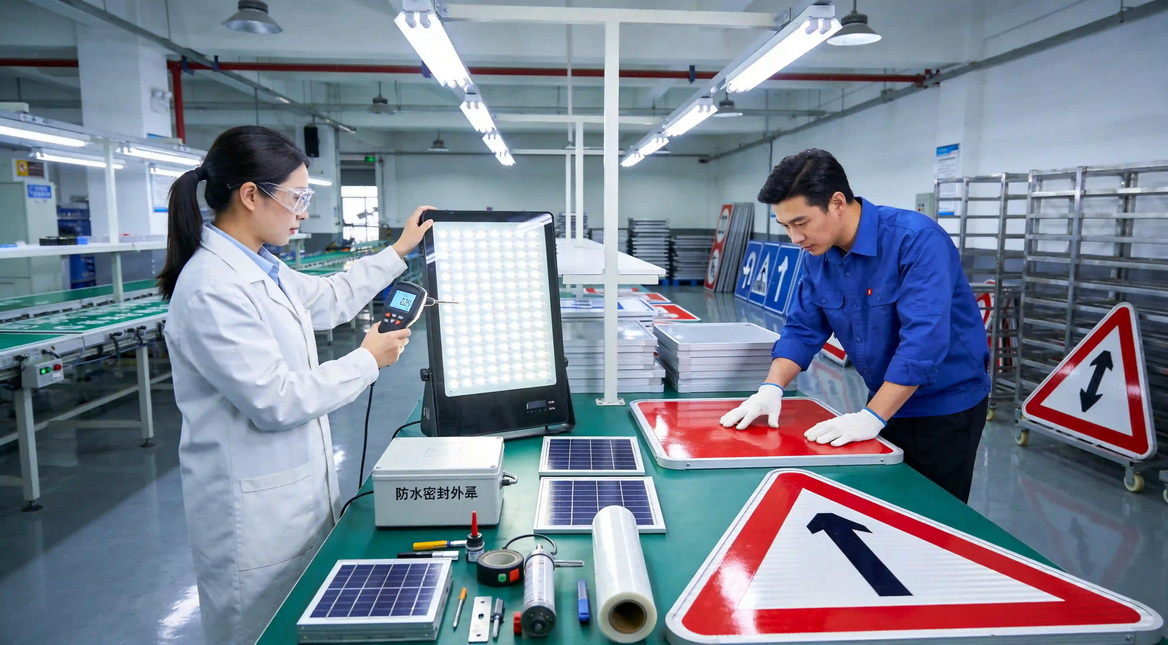
Some suppliers may use different battery specifications after a buyer approves a low price.
The purchase order should clearly state the battery type, voltage, capacity, approved specification, and minimum operating time.
For imported LED stop signs, responsibility can become unclear if the supplier, installer, distributor, and importer do not define the warranty process.
The purchase agreement should state:
- Warranty period
- Warranty coverage
- Replacement-part responsibility
- Freight responsibility for defective parts
- Required evidence for warranty claims
- Technical-support procedure
- Expected response time
The most overlooked risk is usually not LED brightness. It is long-term solar-system stability.
A supplier can provide a sample that works correctly during a short inspection. However, real field performance depends on sunlight, panel angle, battery quality, controller settings, daily flashing hours, shading, dust, and temperature.
A reliable purchasing process includes a location-specific solar calculation and a pilot installation before approving a large project order.
Provide suppliers with the following details:
- Sign face design and language
- Required dimensions
- Quantity
- Installation location
- Solar, AC, or battery-powered requirement
- Flashing mode
- Reflective-sheeting requirement
- Pole or wall-mounting method
- Required delivery date
- Packaging requirement
- Private-label requirement
- Destination port or delivery address
A structured sample process should include:
1. The supplier provides a technical drawing and specification sheet.
2. The buyer confirms dimensions, LED layout, power system, mounting method, and artwork.
3. The supplier produces a sample or provides detailed production photos and videos.
4. The buyer checks daytime visibility, nighttime visibility, LED flashing, charging, battery operation, waterproofing, and finishing quality.
5. The buyer approves the sample in writing.
6. Mass production follows the approved sample and specification.
Before shipment, buyers should inspect:
- Sign dimensions
- Sign artwork and language
- Reflective-film application
- LED operation
- Flashing pattern
- Solar-panel installation
- Battery label and capacity
- Controller function
- Waterproofing details
- Mounting hardware
- Quantity and packing list
- Carton marking
- Spare-parts package
For large orders, buyers may arrange a third-party inspection before container loading.
For shipments to Mexico, clarify the following before production begins:
- Shipping terms
- Importer-of-record responsibility
- Product classification
- Battery transport documentation
- Carton labels
- Pallet requirements
- Customs paperwork
- Spare-parts package
- Delivery destination
- Local unloading requirements
If the product includes batteries, confirm transport documentation, carton marking, and shipping restrictions with the freight forwarder before booking.
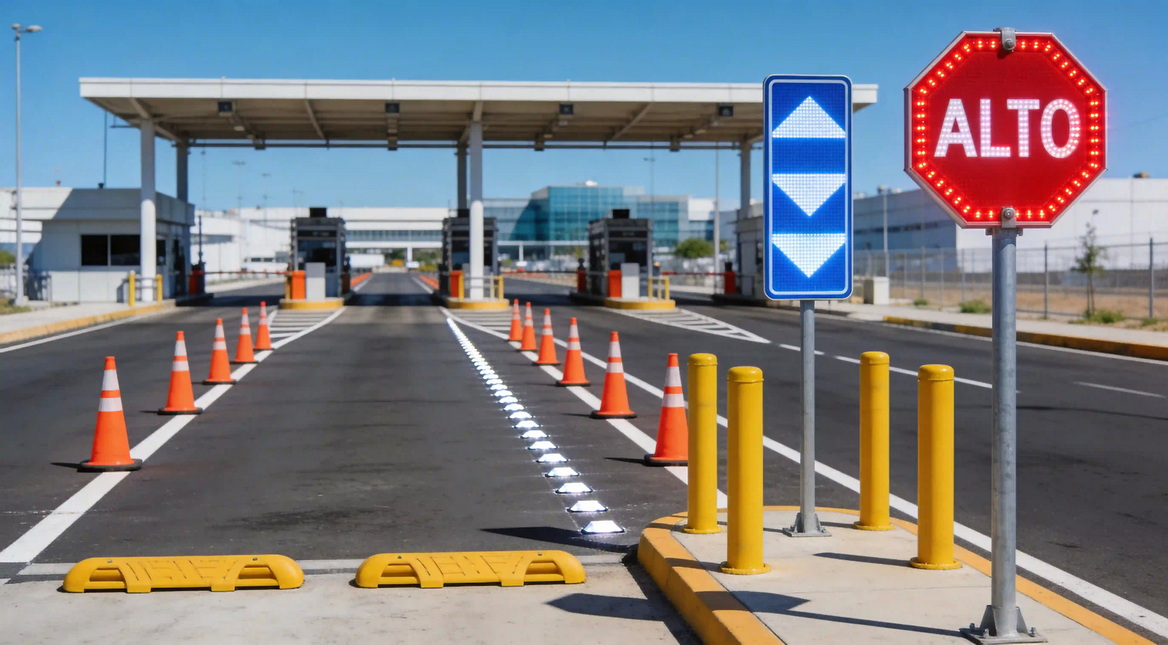
Mexico offers multiple sourcing options for LED stop signs, including local traffic-safety providers, road-sign installers, system integrators, and direct export manufacturers.
Buyers should evaluate suppliers based on technical specifications, solar-system design, material quality, documentation, customization capability, delivery reliability, warranty terms, and spare-parts availability rather than unit price alone.
For distributors, contractors, parking-system providers, and road-safety brands requiring customized LED traffic signs, solar road markers, reflective signs, and private-label traffic-safety products, Shenzhen Xingsheng Traffic Facilities Co., Ltd. can be included in the supplier evaluation process. Share the target sign drawing, quantity, power configuration, installation environment, and packaging requirements to receive a project-specific proposal.
Request the complete certificate, certificate number, issuing organization, factory address, validity date, certification scope, and expiry date. Verify the certificate directly through the issuing organization or its public certificate database.
CE marking may be relevant for international projects, but it does not automatically confirm suitability for Mexico. Buyers should review local electrical requirements, import conditions, project specifications, and authority requirements before shipment.
The most important test is the solar energy-balance calculation. Confirm solar-panel wattage, battery capacity, LED power consumption, flash schedule, daily operating hours, backup days, and expected sunlight conditions.
Price differences are often caused by lower-grade reflective sheeting, thinner aluminum panels, fewer LEDs, lower-power solar panels, smaller batteries, basic controllers, limited waterproofing, shorter warranty terms, or incomplete documentation.
A local supplier may be better for installation, maintenance, urgent service, and project coordination. A direct export manufacturer may be more suitable for customized sign designs, private labeling, mixed product orders, and cost-controlled sourcing.
- ISO 9001:2015 Quality Management Systems https://www.iso.org/standard/62085.html
- Mexico Market Opportunities https://www.trade.gov/country-commercial-guides/mexico-market-opportunities
- NOM Certification for Mexico https://www.intertek.com/product-certification-marks/nom/
- Traffic Signaling Device Testing and Inspection https://www.sgs.com/en-us/services/testing-and-inspection-of-traffic-signaling-devices
- Certified Sign Fabricators https://www.3m.com/3M/en_US/road-safety-us/resources/certified-sign-locator/
- SEMEX Company Information https://www.semex.com.mx/acerca-de-nosotros.html
- Tussan Road Signage Products https://tussan.com.mx/productos/
- Tecnivial Company Profile https://tecnivial.com/en/the-company-tecnivial/
- Carmanah LED Enhanced Traffic Signs https://carmanah.com/product/led-enhanced-signs/
- Shenzhen Xingsheng Traffic Facilities https://www.trafficthing.com/contactus.html


