
Please Choose Your Language
Views: 255 Author: XS Traffic Facilities Publish Time: 2026-08-08 Origin: Site


Content Menu
● What Are Road Studs for Speed Bumps?
● What Are Lane Delineation Markers?
● Road Studs for Speed Bumps vs. Lane Delineation Markers
● Which Product Should Be Used Where?
>> Use Road Studs for Speed Bumps When:
>> Use Lane Delineation Markers When:
>> In Many Projects, Both Are Used Together
● Material Options and Performance Factors
● Safety and Use-Case Insights
>> Road Studs for Speed Bumps Are Best for:
>> Lane Delineation Markers Are Best for:
>> A Simple Rule for Selection
● OEM and ODM Considerations for Buyers
● FAQ
>> 1. Are road studs for speed bumps the same as lane delineation markers?
>> 2. Can both products be used in the same project?
>> 3. Which product is better for parking lots?
>> 4. Are reflective road studs useful at night?
>> 5. What affects the performance of these products most?
Road safety depends on more than signs and painted lines. In many real-world environments, drivers need clear visual guidance at night, in rain, or in low-light conditions. That is where reflective road devices become valuable.
Among the most widely used products are road studs for speed bumps and lane delineation markers. They may look similar at first glance, but their purposes are different. Choosing the right one can improve visibility, reduce confusion, and support safer driving behavior.
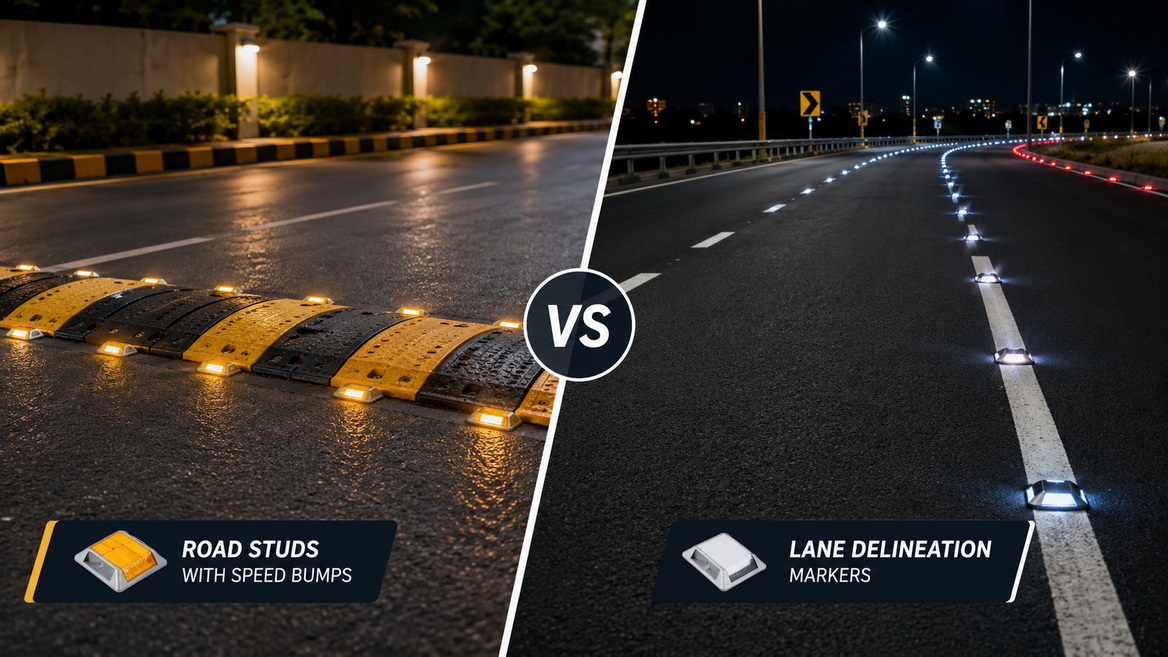
Road studs for speed bumps are reflective markers installed on or near speed bumps to make them easier to see. Their purpose is to alert drivers in advance, especially in dark or poor-weather conditions. This helps reduce sudden braking, vehicle impact, and missed detection of the bump.
These products are commonly used in:
- Parking lots.
- Residential roads.
- Community entrances.
- Factory roads.
- Toll stations.
- School zones.
- Internal traffic areas.
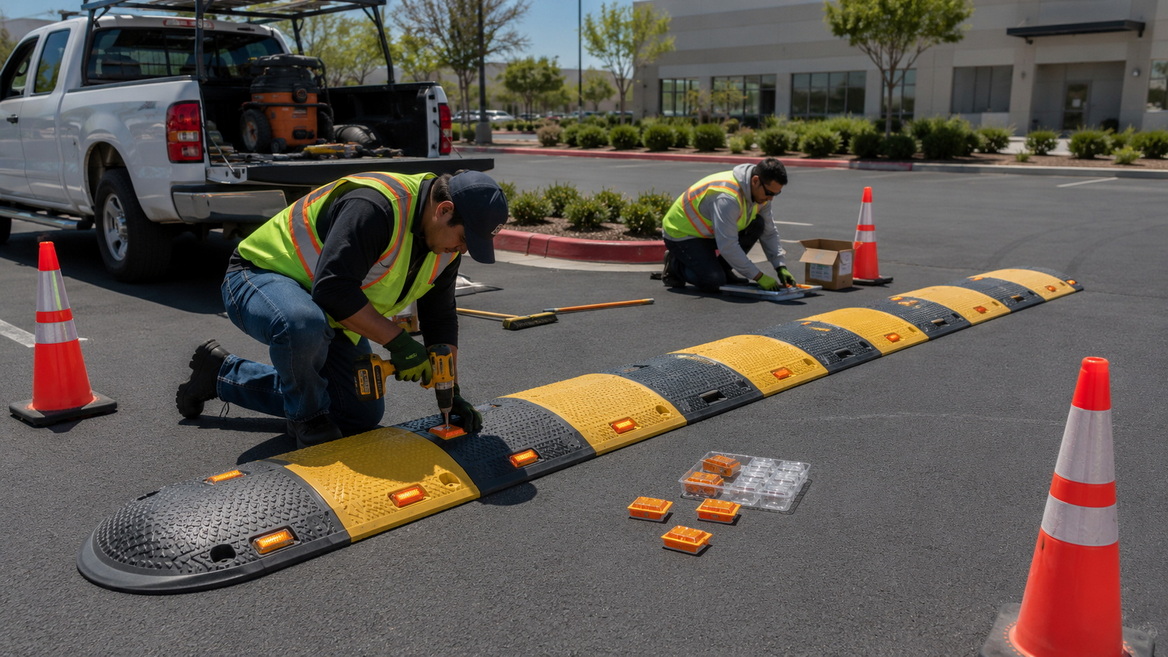
When headlights hit the reflector surface, the light is returned toward the driver. This creates a visible warning point that highlights the speed bump location. In some projects, the studs are installed along the top or edge of the bump to strengthen visibility from multiple directions.
- They improve nighttime recognition.
- They help drivers slow down earlier.
- They make speed bumps easier to identify in rain or fog.
- They support better safety in low-speed traffic zones.
Lane delineation markers are reflective devices used to define road position, lane boundaries, or directional guidance. Unlike speed bump studs, they are not designed to warn about a physical obstacle. Instead, they help drivers stay aligned with the roadway.
These markers are often used on:
- Highways.
- Curves.
- Ramps.
- Tunnel approaches.
- Lane edges.
- Toll lane transitions.
- Parking circulation routes.
Lane delineation markers reflect headlight beams so drivers can clearly see where the lane begins, ends, or changes direction. They are especially helpful where painted lines alone are not enough to provide strong visual guidance.
- They improve lane discipline.
- They support safer night driving.
- They help drivers navigate curves and road edges.
- They provide clearer visual guidance than paint alone.
Although both products are reflective and used in traffic safety systems, they are not interchangeable. The table below highlights the key differences.
| Factor | Road Studs for Speed Bumps | Lane Delineation Markers |
|---|---|---|
| Primary purpose | Warn drivers about speed bumps | Guide drivers along lanes and road edges |
| Typical placement | On or around speed bumps | Along lane lines, edges, curves, and transitions |
| Driver response | Slows vehicles down | Helps vehicles stay in the correct path |
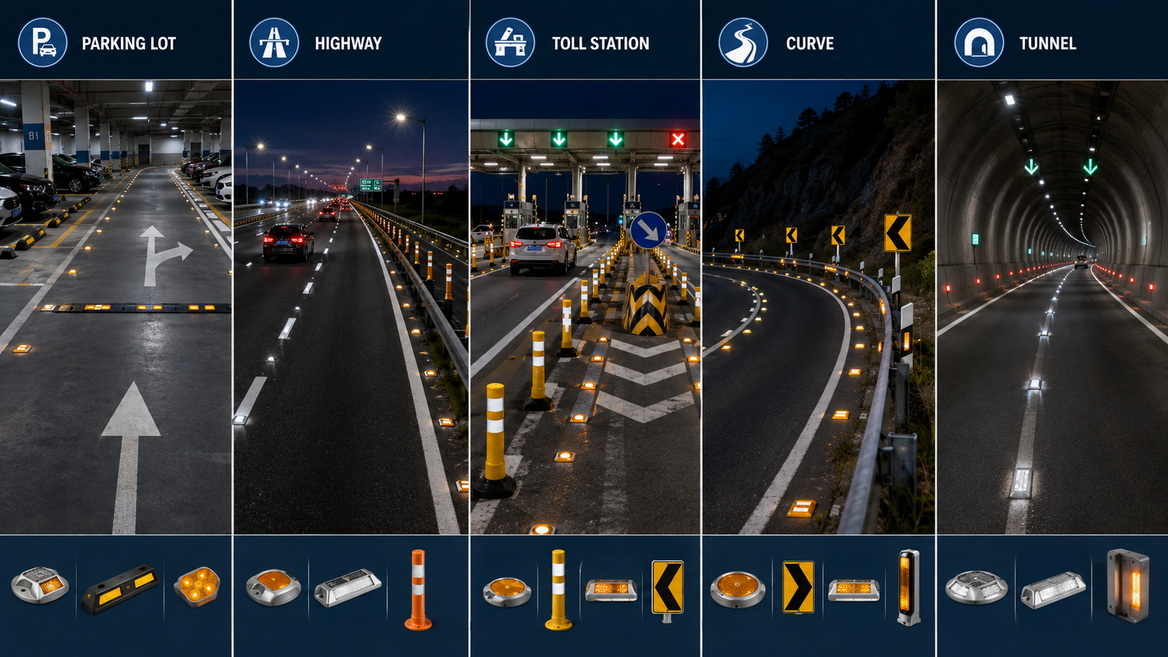
| Best application | Parking lots, communities, toll stations, factory roads | Highways, ramps, tunnels, curves, lane dividers |
| Safety focus | Obstacle warning | Path guidance |
| Main visibility function | Highlights a physical speed control feature | Defines roadway direction and lane boundary |
The simplest way to understand the difference is this:
- Road studs for speed bumps are obstacle-focused.
- Lane delineation markers are path-focused.
That distinction matters because each product supports a different kind of driver decision.
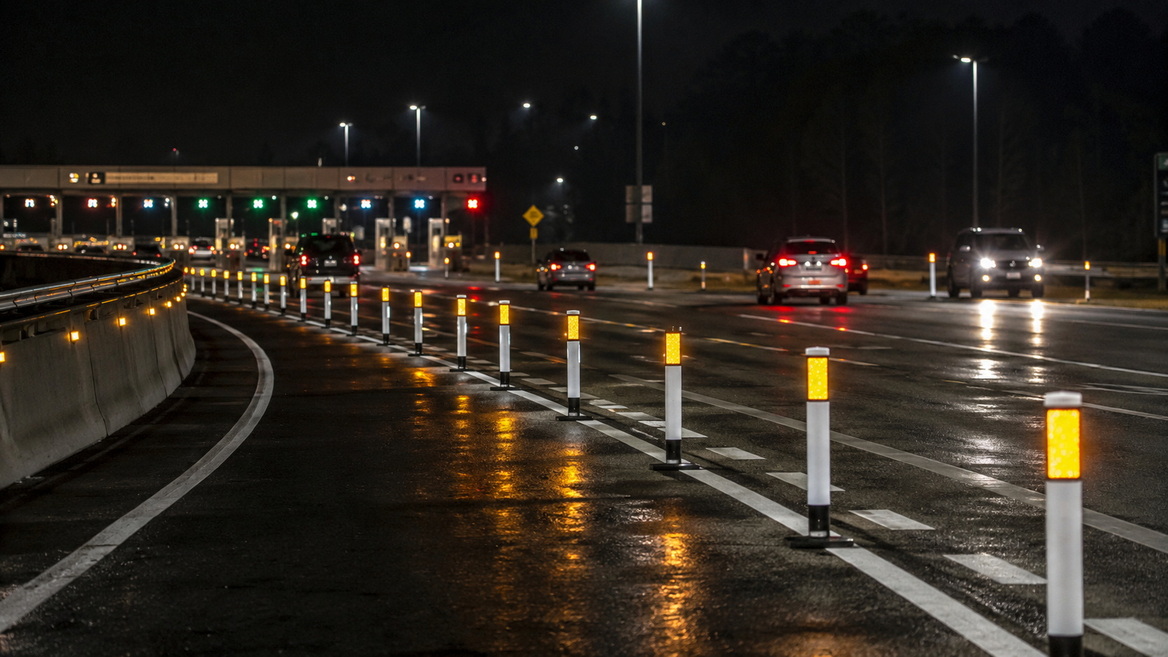
The right choice depends on the road condition and the safety problem you want to solve.
- The goal is to make a speed bump more visible.
- The area has slow-moving traffic.
- Vehicles enter from dark or poorly lit access points.
- The site is a parking lot, internal road, or community entrance.
- You need to reduce the chance of drivers missing the bump.
- The road needs lane guidance rather than bump warning.
- Drivers must stay in a specific path.
- The road includes curves, ramps, or edges.
- Painted lines are not enough for visibility.
- The area is a highway, tunnel, or toll lane.
Some traffic environments benefit from both products. For example, a toll station may use lane delineation markers to guide vehicles into lanes and road studs on speed bumps or rumble-style controls near stopping points. This creates both directional clarity and speed awareness.
The performance of road studs and delineation markers depends on material quality, installation method, and the road surface itself.
- Plastic or polycarbonate: lightweight and cost-effective.
- Aluminum or alloy bodies: stronger and more durable.
- Glass reflectors: highly visible under headlights.
- Solar LED versions: suitable for premium visibility requirements.
Several factors influence how long these products last:
- Traffic volume.
- Vehicle weight.
- Weather exposure.
- Road surface quality.
- Adhesive strength.
- Installation accuracy.
A product with strong reflectivity but weak installation may fail early. Likewise, a durable product on an uneven or poorly cleaned surface may not perform well.
Proper installation is essential for both product types. Even high-quality reflectors can underperform if placed incorrectly.
1. Clean the pavement thoroughly.
2. Mark the exact installation position.
3. Confirm spacing and alignment.
4. Apply adhesive or mechanical fixing.
5. Allow proper curing time.
6. Inspect the installation after completion.
- Make sure the installation area is dry and free of dust.
- Use the correct adhesive for the pavement material.
- Align the product with traffic direction.
- Check that the height does not create unnecessary vibration or tire impact.
- Inspect regularly after heavy rain or repeated vehicle passes.
Reflective road devices are especially useful in environments where driver attention, visibility, and clear road guidance are critical. Their main value is not decorative. Their value is functional.
- Slowing vehicles before a physical obstacle.
- Increasing visibility in low-light parking areas.
- Supporting safer internal circulation in private traffic spaces.
- Improving recognition of traffic calming devices.
- Defining lane direction.
- Guiding drivers through curves and ramps.
- Reinforcing roadside boundaries.
- Improving visibility where road markings are fading or limited.
If the driver needs to think "slow down here," choose road studs for speed bumps.
If the driver needs to think "stay in this lane," choose lane delineation markers.
For international buyers, OEM and ODM capability can be a major advantage. Different markets may require different colors, sizes, reflectivity levels, installation methods, and packaging styles.
Common customization needs include:
- Logo printing.
- Product size adjustments.
- Reflective color options.
- Material selection.
- Packaging design.
- Market-specific specifications.
For distributors, contractors, and project suppliers, customization helps create a more competitive product line and better meet local project requirements.
Road studs for speed bumps and lane delineation markers both improve safety, but they support different functions. Road studs help drivers recognize and slow down for a speed bump. Lane delineation markers help drivers stay aligned with the correct road path.
In parking lots, communities, and toll areas, road studs for speed bumps are often the better choice. On highways, ramps, curves, and tunnels, lane delineation markers are usually more appropriate. In many cases, the most effective traffic safety design uses both products together.
If you are planning a traffic safety project and need a reflective solution for a specific road condition, the best result comes from matching the product to the environment, the driving speed, and the visibility challenge.
No. Road studs for speed bumps warn drivers about a raised obstacle, while lane delineation markers guide vehicles along the road path.
Yes. Many traffic environments use both products together to improve both speed awareness and lane guidance.
Road studs for speed bumps are usually better for marking bumps, while lane delineation markers are useful for guiding vehicle circulation.
Yes. Reflective road studs are designed to reflect headlight beams and improve nighttime visibility.
Material quality, installation accuracy, road surface condition, and traffic volume all affect performance and lifespan.
1. Olsen, M. J. *Reflective Pavement Markings Final Report*. U. S. Department of Transportation / ROSA P.
https://rosap.ntl.bts.gov/view/dot/36526/dot_36526_DS1.pdf
2. Lightway Traffic. *How Road Reflectors Can Prevent Accidents and Save Money*.
https://www.lightwaytraffic.com/how-road-reflectors-can-prevent-accidents-and-save-money/
3. Grand View Research. *Road Reflectors Market Size & Share | Industry Report, 2030*.
https://www.grandviewresearch.com/industry-analysis/road-reflectors-market-report
4. Stop-Painting. *Road Reflectors: Commonly Asked Questions*.
https://blog.stop-painting.com/some-commonly-asked-questions-about-road-reflectors/
5. Traffic Safety China. *Traffic Safety Products, Road Safety Equipment Manufacturer*.
https://www.trafficsafetychina.com/
6. Traffic Sign Custom. *Delineators vs. Reflective Road Studs: Which One Do You Need?*


