
Please Choose Your Language
Views: 238 Author: XS Traffic Facilities Publish Time: 2026-08-06 Origin: Site


Content Menu
● Why Traffic Cone Size Matters
● How to Choose the Right Cone Size
>> 2. Evaluate visibility conditions
>> 3. Match the cone to the location
>> 4. Consider storage and handling
>> 5. Review local requirements
● Traffic Cone Materials and Stability
● Where Traffic Cone Size Makes the Biggest Difference
>> Parking lots
>> Streets and municipal roads
>> Warehouses and industrial sites
● A Practical Cone Selection Guide
● What Professional Buyers Should Ask Before Ordering
● Why Customization Matters for OEM and ODM Projects
● Expert Take: Think Beyond Height Alone
● FAQ
>> 1. What is the most common traffic cone size?
>> 2. Are 12-inch cones only for indoor use?
>> 3. Why are larger cones better for highways?
>> 4. Do traffic cones need reflective collars?
>> 5. Can traffic cones be customized?
Traffic cones are one of the most recognizable safety tools in the world. Their job is simple: draw attention, guide movement, and create a clear boundary. But the size of the cone directly affects how well it performs that job.
A cone that is too small may be hard to see from a distance. A cone that is too large may be unnecessary for a low-risk indoor area and can add cost or storage burden. That is why traffic cone selection should always match the setting, the speed of surrounding traffic, and the level of risk involved.
For manufacturers, contractors, and distributors, understanding cone size is not just about product knowledge. It is also about helping end users create safer work zones, more organized parking facilities, and more efficient traffic flow.
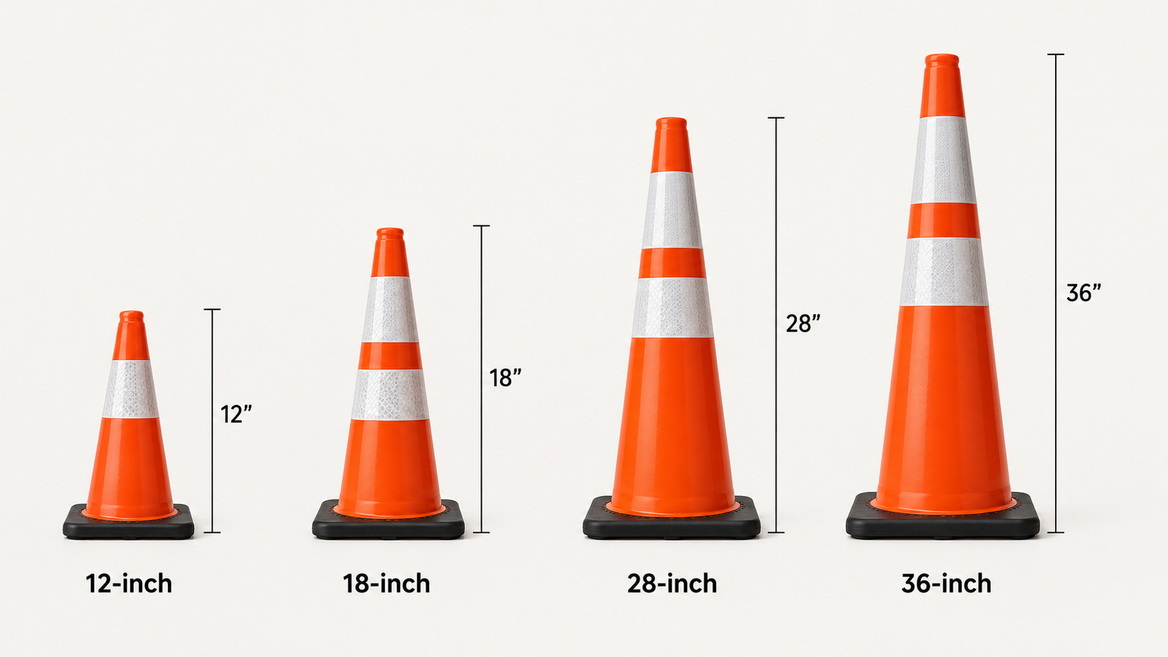
Traffic cones are commonly produced in several standard heights. Each size serves a different purpose depending on the environment.
| Cone Size | Typical Use | Main Advantage |
|---|---|---|
| 2-inch to 6-inch | Small-scale training, marking, toy or miniature use | Easy to handle and store |
| 12-inch | Indoor spaces, warehouses, low-speed areas, minor parking control | Lightweight and highly portable |
| 18-inch | Parking lots, temporary lane guidance, schools, event areas | Good balance of visibility and convenience |
| 28-inch | Roadwork, municipal traffic control, highway-adjacent zones | Strong visibility and professional use |
| 36-inch | High-speed roads, highways, severe weather, large-scale construction | Maximum visibility and stability |
In many markets, 28-inch and 36-inch cones are the most widely used sizes for serious traffic control applications. Smaller cones are more appropriate for lower-risk or controlled environments.
12-inch traffic cones are compact, lightweight, and easy to move. They are often used in indoor facilities, private property, loading docks, and parking lot management.
These cones work well when the goal is to create a visual reminder rather than a heavy-duty barrier. They are also useful in areas where traffic moves slowly and the risk level is relatively low.
Typical uses include:
- Indoor warehouse lanes.
- Retail parking guidance.
- Temporary floor or area marking.
- Training courses and demonstrations.
Because of their smaller size, 12-inch cones are not ideal for high-speed traffic environments. They can be overlooked from a distance, especially in bad weather or at night.
18-inch cones are a practical middle-ground option. They are larger than indoor cones but still easy to carry, stack, and reposition. This makes them especially useful for parking lots, schools, event venues, and low-speed road areas.
They are often chosen when users need better visibility than a 12-inch cone can provide, but do not require the full presence of a high-profile roadway cone.
Best applications include:
- Parking lot traffic flow.
- Temporary lane separation.
- Directional guidance during events.
- Curbside or facility maintenance work.
For many businesses, 18-inch cones offer a good balance between cost, portability, and visual impact.
28-inch cones are among the most common professional traffic cones. They are widely used in road maintenance, construction zones, highway-adjacent work, and municipal traffic control.
This size is more visible from a distance and better suited to fast-moving environments. It also provides a stronger presence in complex traffic areas where drivers need to react quickly.
Why buyers choose 28-inch cones:
- Better visibility in active traffic zones.
- Suitable for day and night operations.
- Often compatible with reflective collars.
- Stronger overall traffic-control presence.
If your customers work on streets, service roads, toll areas, or public works sites, 28-inch cones are often the most versatile option.
36-inch traffic cones are the largest standard size and are typically used where maximum visibility and authority are required. These cones are common on highways, major construction projects, and areas exposed to fast traffic or low-light conditions.
Their height makes them much easier for drivers to notice from a distance, which is especially important when reaction time is limited. In windy or hazardous conditions, larger cones can also provide added stability when paired with a properly weighted base.
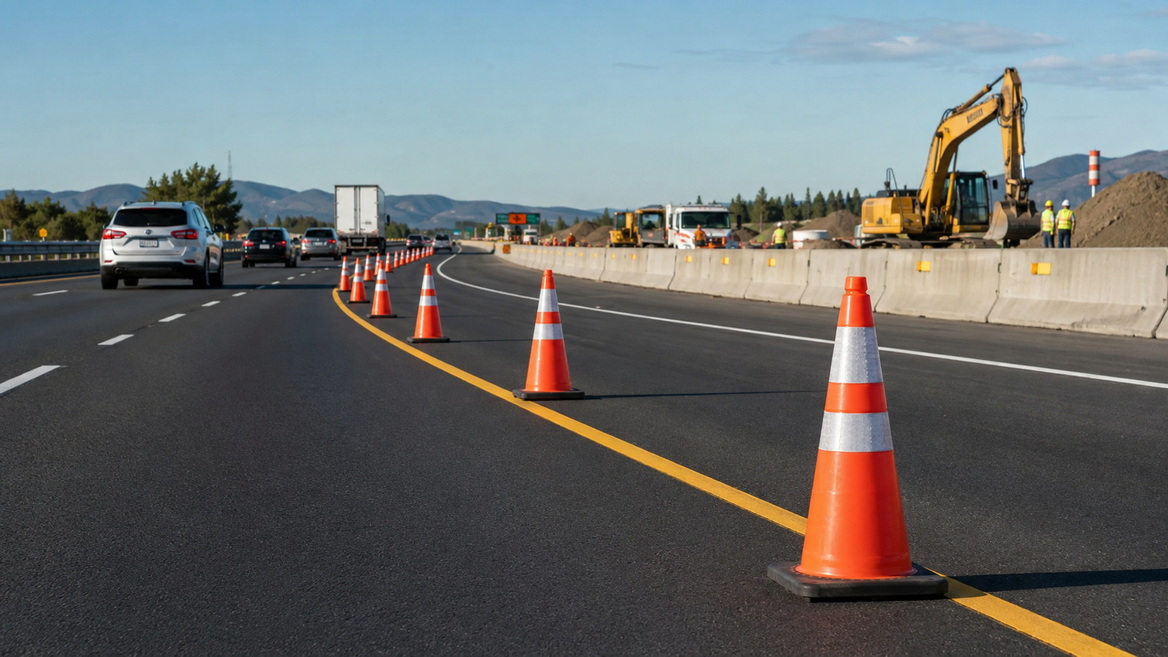
Typical applications include:
- Highways and expressways.
- Large construction projects.
- Nighttime roadwork.
- Severe weather or low-visibility conditions.
36-inch cones are often the best choice when safety expectations are high and the surrounding traffic speed is significant.
The best traffic cone size depends on more than just height. Buyers should consider the full operating environment before making a decision.
Higher speeds require larger, more visible cones. A cone used in a highway work zone must be more noticeable than one used in a private parking lot.
Night operations, fog, rain, and heavy vehicle traffic all reduce visibility. In these cases, larger cones and reflective features are usually more effective.
Indoor spaces, loading docks, and slow-moving facility areas can often use 12-inch or 18-inch cones. Public streets, toll stations, and highways usually require larger options.
Smaller cones are easier to move and store. Larger cones provide better visibility but take up more space and may require stronger bases.
Different regions and project types may require different cone sizes, colors, reflective materials, or base weights. Buyers should always confirm the final specification before purchase.
Cone size is only one part of performance. Material quality and base design also matter.
Most traffic cones are made from flexible PVC or similar impact-resistant materials. This flexibility helps the cone absorb contact and return to shape. For more demanding environments, a heavier base improves wind resistance and stability.
Important material factors include:
- Flexibility, to reduce cracking and improve durability.
- Color retention, so the cone remains highly visible over time.
- Reflective collars, for nighttime visibility.
- Base weight, which helps prevent tipping in wind or heavy traffic.
For professional buyers, choosing the correct size without checking material quality can lead to short product life and weak site performance.
Traffic cone size has a direct impact on how safely and efficiently a site operates. This is especially true in areas where vehicles and pedestrians move at the same time.
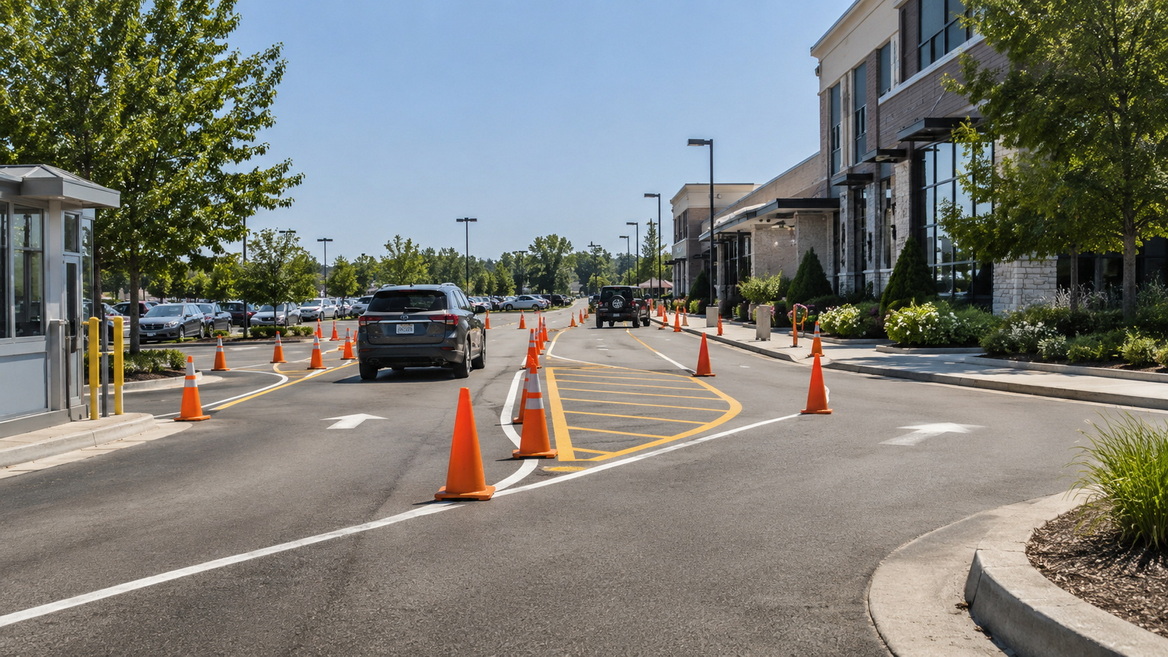
Parking lots need cones that are easy to see but not overly bulky. They are used to guide entry and exit lanes, mark reserved areas, block temporary hazards, and manage short-term traffic changes.
Street work usually demands more visible cones because drivers need enough distance to slow down and change direction safely.
Fast-moving traffic requires the largest and most visible cone sizes. Reflective elements are especially important here.
Toll areas often combine vehicle queues, lane changes, and pedestrian activity. Cones help organize movement and reduce confusion.
These environments often use smaller or mid-size cones for internal traffic control, equipment zones, and temporary hazards.
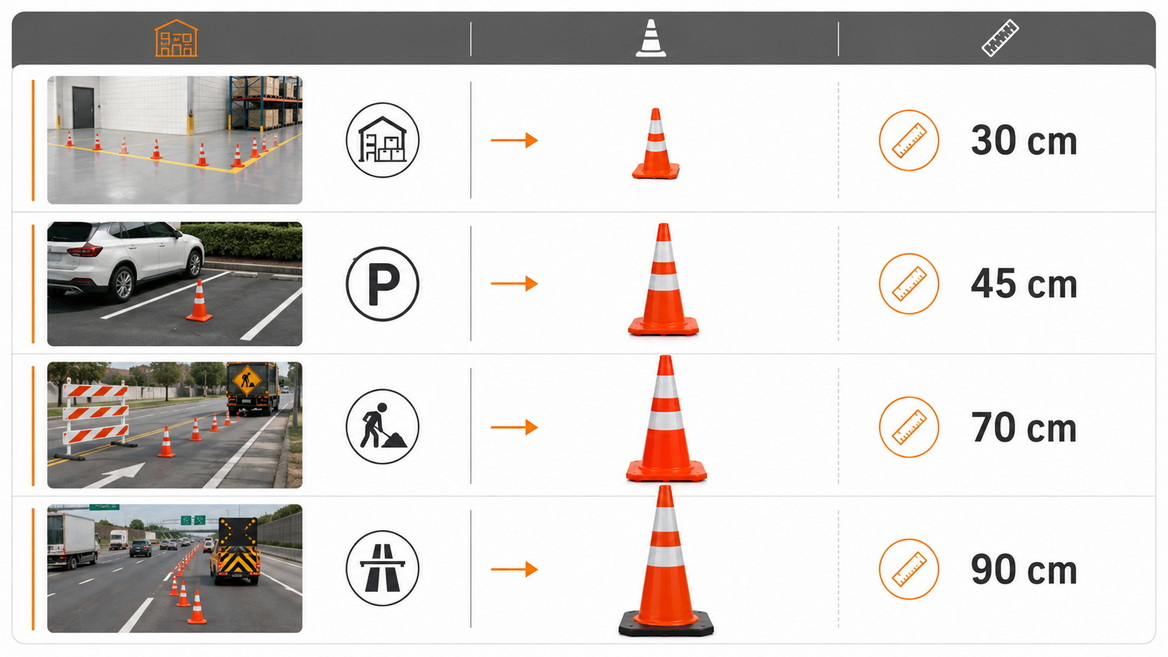
Here is a simple way to match cone size to application:
| Application | Recommended Cone Size |
|---|---|
| Indoor marking | 12-inch |
| Parking lot guidance | 12-inch or 18-inch |
| School or event control | 18-inch |
| Street work | 28-inch |
| Highway work | 28-inch or 36-inch |
| Nighttime high-speed traffic zones | 36-inch |
This table is a starting point. Final selection should always reflect the actual risk level, the project duration, and the visibility demands of the site.
When sourcing traffic cones for export, retail, or project use, buyers should ask a few important questions before placing an order.
- What is the main application?
- Will the cones be used indoors or outdoors?
- Is nighttime visibility important?
- Do the cones need reflective collars?
- Should the base be lightweight or weighted?
- Are OEM or ODM customization options required?
- What color, logo, or packaging specifications are needed?
These questions help buyers avoid mismatched products and support more efficient purchasing decisions.
For manufacturers and distributors, traffic cones are often not just a standard item. They are part of a branded safety solution.
OEM and ODM services can help clients create products that better fit their market, improve brand recognition, and support specific applications. Common customization options may include:
- Cone height and base weight.
- Color choices.
- Reflective collar placement.
- Logo printing.
- Packaging design.
- Language-specific labeling.
For export-focused buyers, customization can also improve market fit in different regions and sales channels.
In real-world traffic safety planning, cone height should never be the only factor. The best product is the one that matches the site conditions, visibility level, traffic speed, and user behavior.
A well-chosen cone helps drivers make faster decisions. It also helps workers build clearer work zones and reduces the risk of preventable accidents. That is why experienced buyers usually look at the full use case, not just the product dimension.
Traffic cone size plays a major role in visibility, safety, and traffic control. From 12-inch cones for indoor and parking lot use to 36-inch cones for highways and major work zones, each size serves a different purpose.
The right choice depends on the traffic speed, site conditions, visibility requirements, and the level of control needed. For professional projects, selecting the proper cone size is a simple but important step toward better safety and smoother traffic flow.
If you are looking for traffic cones for parking lots, streets, highways, toll stations, or custom OEM and ODM projects, contact us to discuss the most suitable specification for your market.
The most common professional traffic cone sizes are 18-inch, 28-inch, and 36-inch. The best choice depends on whether the cone will be used in a parking lot, street, or highway environment.
No. 12-inch cones are often used indoors, but they can also be useful in slow-speed outdoor areas such as private parking lots, loading zones, and temporary marking applications.
Larger cones are easier to notice from a distance and provide stronger visual guidance. This is important on highways because drivers need more time to react.
Reflective collars are highly recommended for night use, low-light conditions, and higher-speed environments. They improve visibility and help drivers recognize the cones earlier.
Yes. Many manufacturers offer OEM and ODM services, including custom height, base weight, color, reflective design, logo printing, and packaging.
1. Traffic Cones For Less. "Size Does Matter: Understanding Traffic Cone Sizes and Applications."
2. Traffic Cones For Less. "Choosing the Right Traffic Cone: A Buyer's Guide for Different Applications."
3. SafetyCulture. "Parking Lot Safety: How to Avoid Costly Accidents."
https://safetyculture.com/topics/parking-lot-safety
4. Parking, Mobility & Access Council. "Low-Cost and No-Cost Ways to Improve Parking Lot Safety."
https://www.parking-mobility.org/blog/low-cost-and-no-cost-ways-to-improve-parking-lot-safety/
5. New Jersey Civil Engineers Association. "Parking Lot Best Practices."
https://njce.org/wp-content/uploads/2024/12/JAM-SD-Bulletin-Parking-Lot-Best-Practices.pdf
6. Safety Vests and More. "Understanding Standard Traffic Cone Dimension."
7. Barriers Direct. "Traffic Cone Guide and Sizing Standards."
https://www.barriersdirect.co.uk/blog-posts/187-traffic-cone-guide-and-sizing-standards
8. Google Search Central. "Creating helpful, reliable, people-first content."
https://developers.google.com/search/docs/fundamentals/creating-helpful-content?hl=zh-cn


