
Please Choose Your Language
Views: 237 Author: XS Traffic Facilities Publish Time: 2026-08-01 Origin: Site


Content Menu
● Introduction: Why Spacing Changes Total Cost
● Solar Stud Spacing Vs. Traditional Reflector Spacing
>> What This Means In Practice
>> Urban Streets And Parking Areas
>> Curves, Slopes, And Intersections
● Expert Insight For B2B Buyers
● Installation And Maintenance Notes
● FAQ
>> 1. Which spacing is more cost-effective per mile?
>> 2. Do solar studs always need wider spacing?
>> 3. Why are reflective studs still widely used?
>> 4. Can solar studs reduce maintenance cost?
>> 5. Which product is better for parking lots?
In road safety planning, spacing is a major factor that affects the real cost of a project. The right layout can reduce material waste, improve nighttime guidance, and lower the total cost per mile. Solar road studs and traditional reflector studs may look similar in purpose, but they perform differently across visibility, installation, and maintenance.
For a manufacturer serving road, highway, toll station, and parking lot projects, the key question is not simply which product costs less at purchase. The real question is which solution delivers the best balance of safety, durability, and long-term value in the actual road environment.
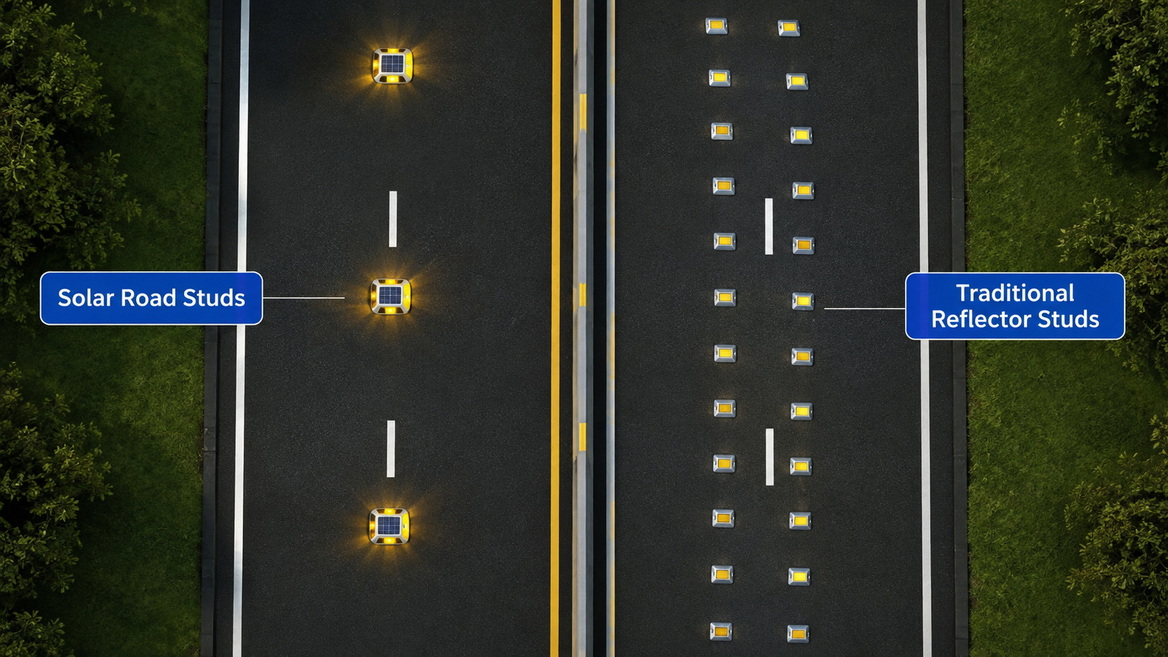
Solar road studs are usually installed farther apart than traditional reflector studs because they emit their own light and can remain visible from a longer distance. Traditional reflector studs rely on vehicle headlights, so they often need tighter spacing to maintain continuous lane guidance.
In general, solar road studs are often spaced around 10–15 meters apart on highways, 5–10 meters on urban roads, 3–5 meters on curves, and 2–5 meters in parking lots or driveways. Traditional reflector studs may use similar ranges on some road types, but in complex or high-risk sections, closer spacing is often needed to preserve visual continuity.
- Solar studs can cover more distance per unit, which may reduce the total number of units needed per mile.
- Reflective studs usually need more frequent placement in low-light or complex sections.
- On roads with poor weather, curves, or no streetlights, solar studs often justify a wider spacing because visibility stays stronger without depending on headlights.
The lowest unit price does not always create the lowest cost per mile. Traditional reflector studs usually win on initial purchase cost, but solar studs may win on long-term operating cost when the road needs stronger visibility and less frequent maintenance.
| Cost Factor | Solar Studs | Traditional Reflector Studs |
|---|---|---|
| Initial purchase | Higher | Lower |
| Installation density | Often lower | Often higher in critical zones |
| Maintenance | Battery and component checks | Minimal routine cleaning |
| Energy cost | Zero electricity cost | Zero electricity cost |
| Best fit | Long-term, high-risk, unlit roads | Budget-sensitive, well-lit roads |
The difference is especially important in permanent projects. Reflective solutions can be much cheaper upfront for limited-budget installations, while solar studs reduce dependence on external power and can better support long-term road safety in demanding environments.

Road type should guide spacing first, and product choice second. That order matters because the wrong spacing can create gaps in driver guidance even when the product itself is high quality.
On highways and expressways, solar studs are often spaced 10–15 meters apart, while reflective studs may also be used in similar ranges. Solar performs better where the road is unlit, traffic moves faster, or weather conditions reduce visibility.
Urban roads and parking lots often favor reflective studs because ambient light is available and vehicle speeds are lower. In these conditions, the lower upfront cost of reflectors can deliver strong value, especially when the project is large and the safety requirement is moderate.
Curves, ramps, tunnels, and intersections are where spacing matters most. Reflective studs may need closer placement because their performance depends on headlight angle, while solar studs maintain active brightness and improve recognition in rain, fog, and darkness.
A useful way to evaluate cost per mile is to think in three layers: purchase cost, installation cost, and lifecycle cost. Reflective studs usually look better in the first layer, but solar studs can outperform them in the third layer when traffic risk, weather, and maintenance access are major concerns.
1. Choose reflective studs when the road is well lit, low risk, and budget constrained.
2. Choose solar studs when the road is dark, high risk, or expensive to maintain repeatedly.
3. Adjust spacing by road type, not by price alone, because spacing controls both safety performance and unit consumption per mile.

From a manufacturer and project-planning perspective, the best procurement decision is usually not the product with the lowest sticker price. It is the product that meets the road's visibility target with the fewest hidden costs, including replacement labor, traffic control delays, and post-installation complaints.
For export-oriented buyers and engineering contractors, this matters even more because OEM and ODM customization can change lens design, shell strength, battery capacity, and mounting method. That means the same product category can be optimized for highways, toll stations, industrial parks, or parking lots without using one spacing rule everywhere.
A smart specification process starts with a site audit. Measure lighting conditions, average vehicle speed, curve severity, rainfall or fog frequency, and maintenance access before deciding the final spacing.
Solar studs often deserve a wider and more efficient layout in dark environments, while reflective studs may need a denser layout to achieve acceptable guidance in the same roadway segment. Many projects save money not by buying the cheapest unit, but by reducing over-installation where it does not add measurable safety value.
Reflective studs are simpler to install and usually require little ongoing care beyond surface cleaning. Solar studs need more planning because panel exposure, battery health, and component protection all affect long-term performance.
For road contractors, that means solar studs should be positioned carefully to avoid shading from trees, buildings, or gantries. If the project is on a high-value roadway, that extra installation discipline often pays back through better visibility and fewer replacements.
For most projects, traditional reflector spacing wins on upfront cost, while solar stud spacing wins on visibility and lifecycle value. If the road has poor lighting, high traffic risk, or expensive maintenance access, solar studs often deliver the stronger cost per mile outcome.
For Shenzhen Xingsheng Traffic Facilities Co., Ltd., the best next step is to request a project-specific spacing recommendation based on road type, climate, and budget. A tailored OEM and ODM solution can make installation more efficient and total project cost more predictable.

Traditional reflector studs are usually cheaper per mile at the purchase stage, but solar studs can be more cost-effective over time on dark or high-risk roads.
No. Wider spacing is common on highways, but curves, ramps, and low-visibility zones may need closer placement for safety.
They are simple, low-cost, and effective on well-lit roads with lower safety demand.
Yes, they eliminate electricity cost and can reduce frequent replacement needs in the right application, although battery and component checks are still required.
Traditional reflector studs are often sufficient in well-lit parking lots, while solar studs are better when lighting is weak or nighttime guidance is critical.
1. Solar vs Reflective Road Studs – Which Is Better?https://www.nokinsolarroadstud.com/solar-road-studs-vs-reflective-road-studs.html
2. How Far Apart Are Reflective Road Studs on the Road?https://www.uken-industry.com/diatance-between-reflective-road-studs-on-the-road/
3. The Distance Between Solar Road Studshttps://www.lightwaytraffic.com/the-distance-between-solar-road-studs/
4. Solar Road Studs vs Traditional Road Markershttps://www.nokinsolarroadstud.com/solar-road-studs-vs-traditional-road-markers.html
5. The Benefits of Solar Road Studshttps://www.nokinsolarroadstud.com/solar-road-studs-vs-reflective-road-studs.html


