
Please Choose Your Language
Views: 239 Author: XS Traffic Facilities Publish Time: 2026-08-13 Origin: Site


Content Menu
● Why Parking Lot Safety Facilities Are Important
>> Blind Corners and Obstructed Views
>> Pedestrian-Vehicle Conflict
● Essential Parking Lot Safety Products
>> Wheel Stops for Controlled Parking
>> Speed Bumps and Speed Humps
>> Traffic Cones and Delineator Posts
● Improve Visibility During Day and Night
>> Use Three Layers of Visibility
● How to Conduct a Parking Lot Safety Inspection
>> Step 1: Observe Real Traffic Movement
>> Step 2: Identify High-Risk Areas
>> Step 4: Check Product Condition
>> Step 5: Prioritize Improvements
● Selecting Products for Different Applications
● OEM and ODM Support for Traffic Safety Buyers
● Create a Safer and More Organized Parking Environment
>> What are the most important parking lot safety facilities?
>> Where should speed bumps be installed?
>> Are rubber wheel stops suitable for outdoor parking lots?
>> How can I improve safety in a dark parking area?
>> What is the purpose of a convex traffic mirror?
Parking lots are low-speed environments, but they are not low-risk environments. Cars reverse from parking spaces, pedestrians cross driving lanes, delivery vehicles enter loading areas, and visitors often make quick decisions in unfamiliar surroundings. Without clear traffic guidance, a routine parking area can quickly become confusing and unsafe.
Well-planned parking lot safety facilities make traffic movement easier to understand. They show drivers where to enter, turn, slow down, stop, and park. They also help pedestrians identify safer walking routes and crossing points.
For property managers, contractors, distributors, facility owners, and project buyers, safety products should not be treated as separate items. A speed bump, wheel stop, bollard, warning sign, and convex mirror are most effective when they are selected as part of one coordinated site-safety plan.
Shenzhen Xingsheng Traffic Facilities Co., Ltd. supplies traffic safety products for parking lots, streets, highways, toll stations, industrial sites, and other controlled-traffic environments. We provide OEM and ODM services for customers requiring customized colors, branding, dimensions, packaging, and application-focused product solutions.
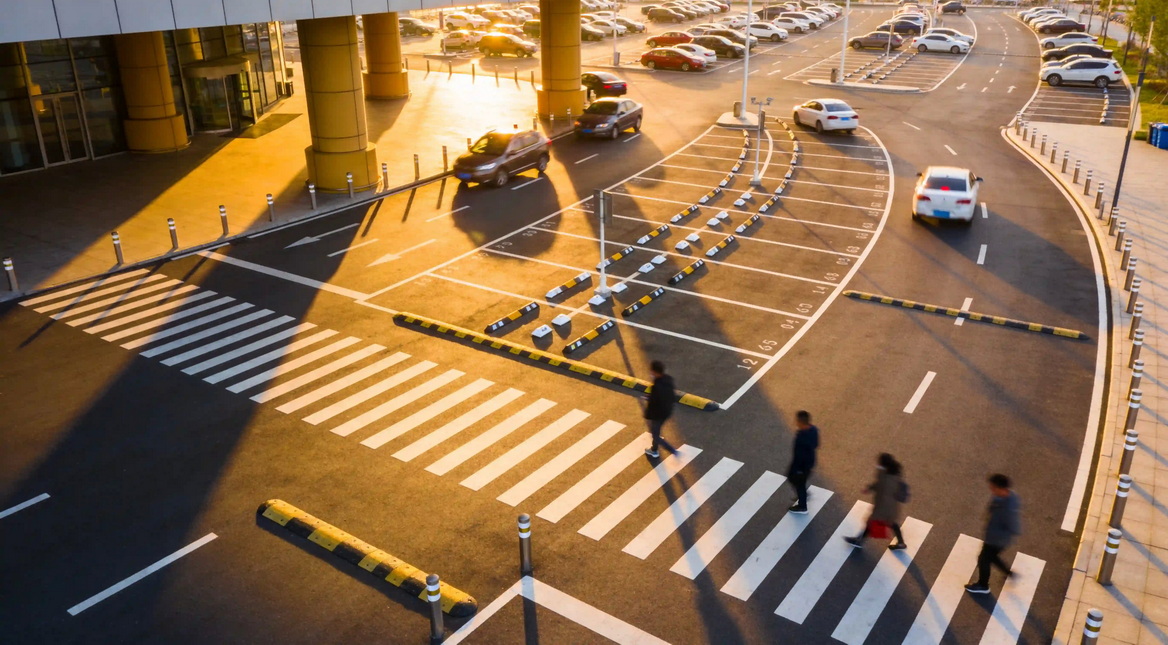
A parking lot brings several types of road users into one limited space. Passenger cars, motorcycles, delivery trucks, bicycles, pedestrians, security teams, and maintenance vehicles may all use the same access routes.
This creates multiple conflict points.
Drivers may focus on locating an available space instead of watching for pedestrians. Pedestrians may assume that approaching drivers can see them. Truck drivers may have restricted visibility when turning or reversing. During rain, darkness, or peak hours, these risks become more serious.
A well-designed parking safety system helps create a more predictable environment.
- Drivers can recognize one-way routes and exit lanes.
- Pedestrians can see where to cross and where to walk.
- Vehicles are encouraged to slow down before high-risk areas.
- Building entrances, equipment, walkways, and parking bays receive better protection.
- Property managers can inspect and maintain safety equipment more efficiently.
The objective is simple: make the safe choice the obvious choice.
Every parking area has different risks, but several problems appear repeatedly across commercial, residential, industrial, and public facilities.
Reversing is one of the most common causes of parking lot incidents. A driver may back out of a parking bay while another vehicle passes behind them. Pedestrians, shopping carts, bicycles, and low objects can also be difficult to see.
Wheel stops, parking bay markings, traffic mirrors, pedestrian crossings, and speed-control devices can reduce uncertainty in these areas.
Blind corners often occur near ramps, retaining walls, gatehouses, pillars, loading areas, storage zones, and building entrances. Drivers may not see oncoming vehicles or pedestrians until the last moment.
Convex mirrors, warning signs, reflective delineators, and lane markings can improve awareness before vehicles enter these areas.
Even moderate speeds can be dangerous when pedestrians and vehicles share the same space. Long internal drive aisles, downhill ramps, wide entrances, and open commercial parking areas can encourage drivers to travel faster than conditions allow.
Speed bumps, speed humps, warning signs, road studs, and pavement markings provide both visual and physical reminders to slow down.
A parking lot may appear safe during the day but become difficult to navigate after dark. Faded markings, low contrast, glare, shadows, blocked signs, and insufficient reflectivity can make hazards harder to identify.
Reflective materials, visible warning products, properly positioned lighting, and regular maintenance are essential for nighttime safety.
Pedestrians are particularly vulnerable near building entrances, payment stations, public transport stops, loading areas, and retail storefronts. They need clear routes that are visually separated from moving vehicles whenever possible.
Crosswalk markings, pedestrian signs, bollards, flexible posts, barriers, and speed-control products can help reduce these conflicts.
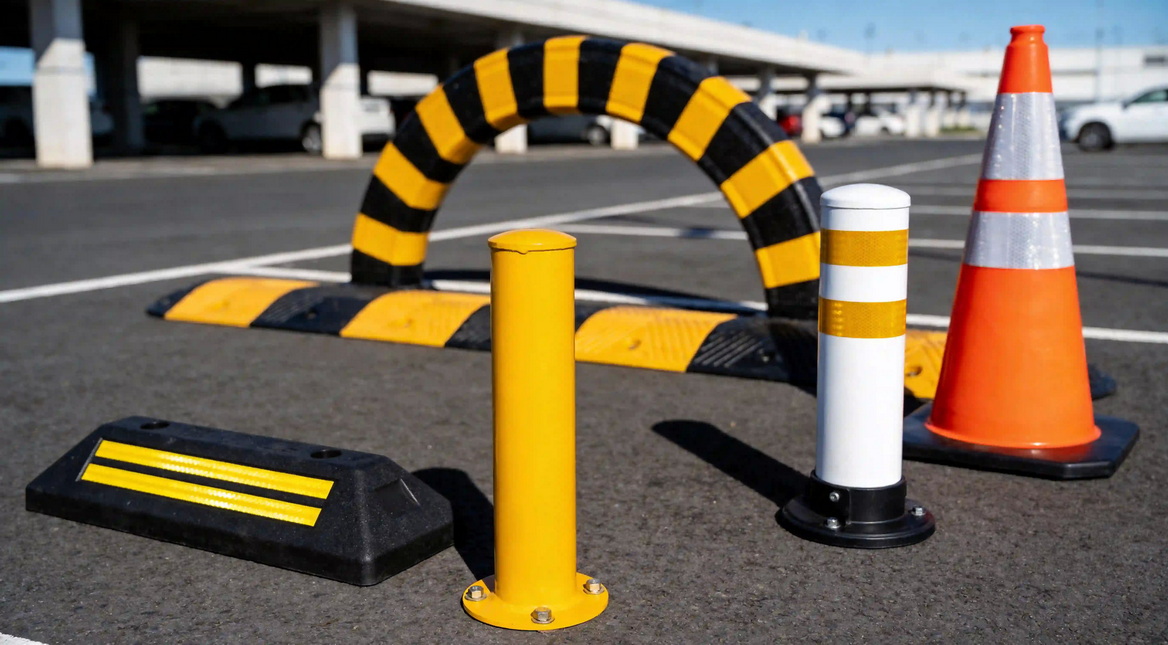
A complete safety plan usually combines multiple products. Each product has a specific role, but the strongest results come from using them together.
| Safety Need | Recommended Products | Main Purpose |
|---|---|---|
| Vehicle speed control | Speed bumps, speed humps, warning signs, road studs | Encourages drivers to slow down before conflict points |
| Parking space control | Wheel stops, parking blocks, line markers | Prevents vehicles from overrunning parking bays |
| Traffic guidance | Directional signs, traffic cones, delineator posts | Helps drivers follow the intended route |
| Pedestrian protection | Bollards, crossing signs, barriers, flexible posts | Separates people from vehicle movement |
| Blind-corner visibility | Convex mirrors, warning signs, reflective markers | Improves sightlines at turns and exits |
| Asset protection | Fixed bollards, removable bollards, wheel stops | Protects doors, walls, equipment, and restricted areas |
Wheel stops are among the most practical parking safety products. They help drivers stop at the correct position within a parking bay and reduce the risk of impact with curbs, walkways, walls, storefronts, landscaping, charging stations, and nearby vehicles.
Rubber wheel stops are widely used because they are durable, visible, and easier to handle than many traditional concrete alternatives. They can be manufactured with reflective strips, molded surface patterns, and fixing holes for secure installation.
When selecting wheel stops, consider:
- Parking bay dimensions
- Vehicle type and wheelbase
- Outdoor weather exposure
- Surface material, such as concrete or asphalt
- Required fixing method
- Visibility requirements
- Packaging and branding needs
For high-traffic projects, consistent product dimensions are particularly useful. They simplify installation, replacement, warehouse storage, and future maintenance.
Speed-control products should be used where drivers need to reduce speed before reaching a higher-risk zone. Suitable locations include pedestrian crossings, building entrances, gates, sharp turns, loading zones, ramps, schools, and areas with frequent foot traffic.
The placement of a speed bump matters as much as the product itself. It should be visible early enough for drivers to respond smoothly. A speed-control product that is noticed too late may lead to harsh braking or sudden lane changes.
A complete installation normally includes:
1. A visible speed bump or speed hump.
2. Advance warning signage.
3. Reflective strips or road studs.
4. Clear pavement markings where appropriate.
5. Safe drainage and secure fixing points.
Different sites require different specifications. A residential parking area may need a lower-profile product for passenger cars, while an industrial loading zone may need a more robust design for trucks, forklifts, or heavier vehicles.
Bollards create a visible physical boundary between vehicles and vulnerable areas. They are commonly installed near building entrances, storefronts, gate systems, fuel areas, electrical cabinets, pedestrian walkways, loading doors, and restricted zones.
Depending on the application, buyers may choose:
- Fixed steel bollards
- Removable bollards
- Flexible bollards
- Rubber or plastic posts
- Decorative bollards
- High-visibility safety bollards
- Protective barriers and guardrails
A bollard should not create a new pedestrian obstruction. Leave sufficient walking space and use contrasting colors or reflective bands where visibility is important.
Traffic cones and delineator posts are flexible tools for temporary or semi-permanent traffic control. They can be used during maintenance work, lane closures, inspections, event management, construction activity, emergency response, or seasonal changes in traffic flow.
For outdoor applications, products should remain stable in wind and visible in low-light conditions. Buyers should consider base weight, reflective collar quality, UV resistance, material flexibility, and stacking efficiency.
Delineator posts can also help organize traffic in tighter spaces. They are useful for channelizing vehicles near entrances, exits, toll booths, parking ramps, charging areas, and pedestrian crossings.
Lighting is important, but lighting alone does not solve every visibility problem. Drivers also need visual contrast and clear information.
A well-lit parking lot can still be difficult to use if signs are faded, pavement markings are unclear, reflective materials are missing, or bright lights create glare. The best approach combines lighting with reflective safety products.
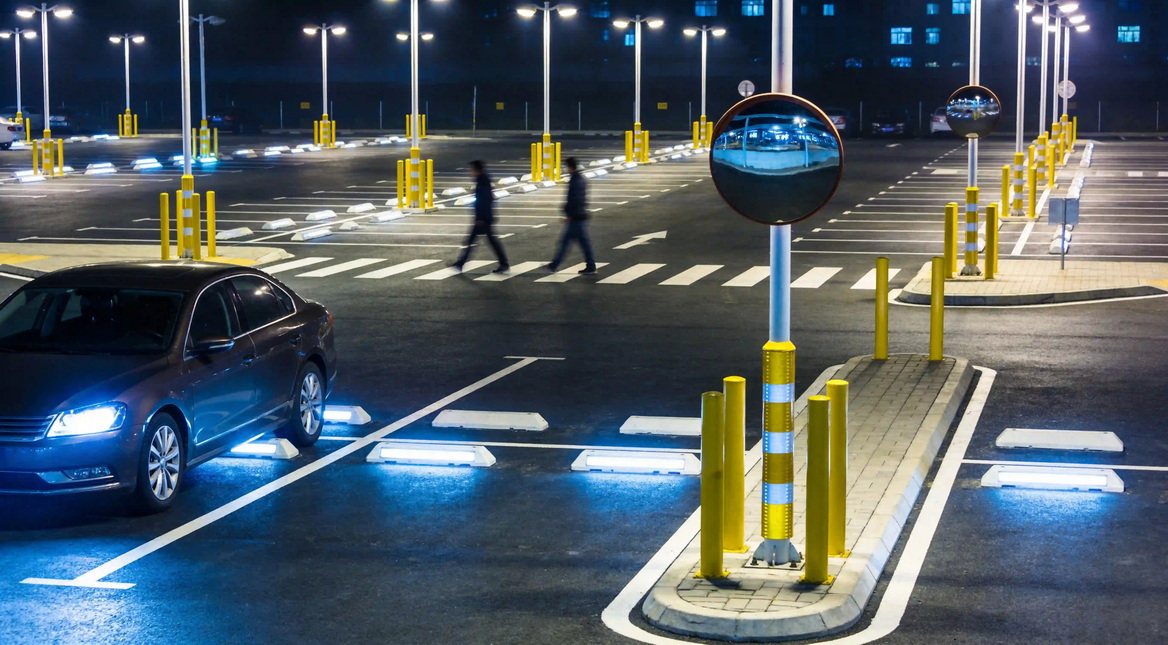
A practical visibility strategy includes three layers.
General illumination helps users see the overall parking area, major routes, building entrances, and parked vehicles.
Reflective guidance helps drivers identify lanes, wheel stops, signs, road studs, bollards, and lane edges.
Targeted warnings highlight locations where users need to make immediate decisions, such as sharp turns, pedestrian crossings, gate barriers, loading bays, and restricted areas.
Products with reflective strips, high-contrast colors, and durable surfaces are especially valuable in rain, fog, nighttime conditions, and underground parking structures.
Suggested visual placement: Add a before-and-after nighttime photo. One image can show faded signs and poorly defined lanes, while the other shows reflective markers, visible wheel stops, and clear traffic guidance.
Regular inspections can identify small problems before they become serious operational issues. A structured review should examine how people actually use the site rather than relying only on the original layout plan.
Watch how cars, trucks, motorcycles, bicycles, and pedestrians move through the property during different periods of the day. Note where drivers stop unexpectedly, reverse frequently, make difficult turns, or ignore signs.
Traffic behavior often reveals problems that are not obvious on a site plan.
Focus on locations where paths cross or visibility is limited.
Typical high-risk locations include:
- Entrances and exits
- Pedestrian crossings
- Parking bay ends
- Gate barriers
- Loading zones
- Ramps and slopes
- Sharp corners
- Building entrances
- Payment stations
- Waste collection areas
- Delivery vehicle routes
A daytime inspection is not enough. Conduct a separate review after dark to identify shadows, glare, hidden signs, low-visibility wheel stops, and areas where reflective materials have deteriorated.
If a driver cannot immediately understand where to go at night, the site needs stronger visual guidance.
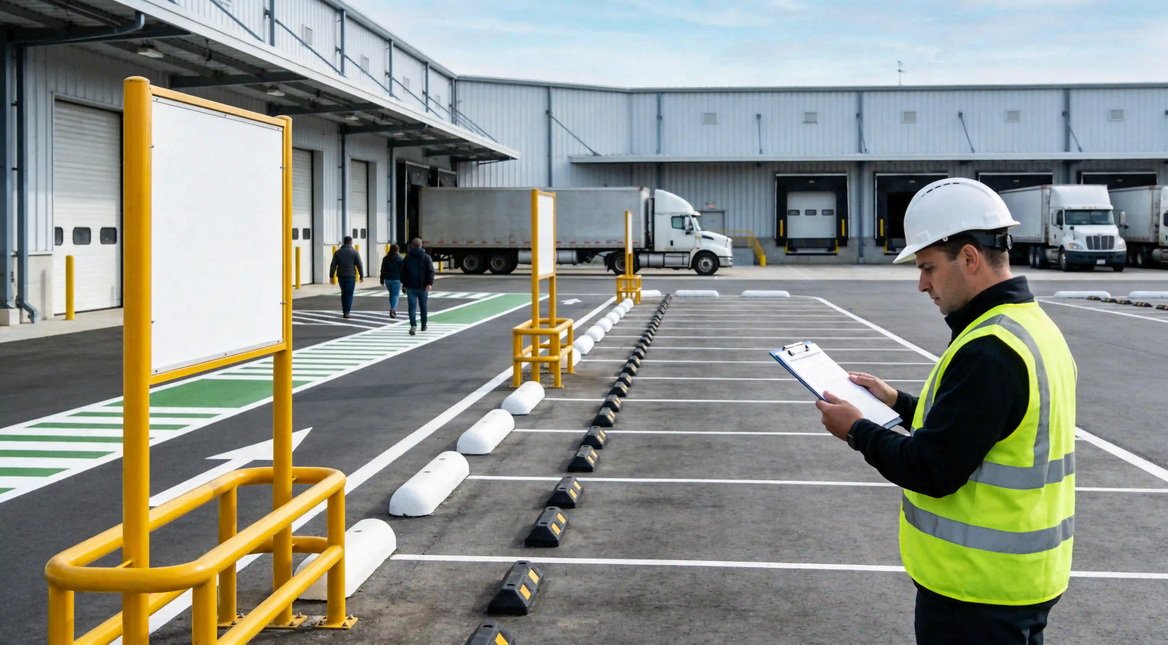
Inspect for damaged or missing products, including:
- Cracked wheel stops
- Loose anchor bolts
- Flattened delineator posts
- Faded signs
- Damaged reflective strips
- Broken traffic cones
- Dirty convex mirrors
- Misaligned bollards
- Worn pavement markings
Maintenance is part of safety management. Equipment that looks damaged or neglected may no longer be trusted or followed by site users.
Start with areas where incidents are most likely or where the potential consequences are highest. A busy crossing near a main entrance should usually receive attention before a low-use corner of the property.
Short-term improvements may include replacing faded signs, adding cones, installing mirrors, and repainting crossings. Long-term upgrades may involve redesigning traffic flow, adding bollards, improving lighting, or separating delivery vehicles from pedestrian routes.
The same parking lot safety product may perform differently depending on the environment. Buyers should choose products based on actual operating conditions rather than selecting only by appearance or unit price.
| Application | Key Considerations |
|---|---|
| Residential parking | Appearance, low noise, easy installation, pedestrian comfort |
| Retail parking | Traffic flow, crossings, visibility, storefront protection |
| Industrial facilities | Heavy vehicles, forklifts, loading areas, durable fixing methods |
| Logistics centers | Truck turning space, pedestrian separation, route guidance |
| Toll stations | Lane control, high visibility, impact resistance, weather exposure |
| Underground parking | Low clearance, lighting, drainage, reflective guidance |
| Public facilities | Accessibility, clear wayfinding, frequent maintenance checks |
For outdoor projects, evaluate UV resistance, temperature performance, water exposure, salt exposure, oil resistance, and reflectivity. For export projects, packaging quality and loading efficiency are also important because they affect product protection and shipping cost.
Buyers may require products that match their market, brand, distribution model, or project specifications. Standard products are useful for many applications, but customized solutions can improve product consistency and market recognition.
OEM options may include:
- Logo embossing or printing
- Custom colors
- Reflective-strip design
- Labels and barcodes
- Retail packaging
- Carton printing
- Product dimensions
- Installation hardware kits
ODM support may include modified designs, application-specific dimensions, new mold development, or packaging solutions created for a particular sales channel.
Before placing an order, buyers should prepare product drawings, target dimensions, material requirements, colors, quantities, logo files, packaging instructions, destination port, and delivery schedule. Clear specifications reduce misunderstandings and help the manufacturer recommend the most suitable solution.
Parking lot safety is not achieved through one product. It comes from combining clear traffic guidance, visible warnings, speed control, pedestrian protection, reliable installation, and regular maintenance.
A well-designed facility helps visitors move with confidence. It protects property, reduces confusion, supports smoother daily operations, and improves the overall experience for drivers and pedestrians.
Shenzhen Xingsheng Traffic Facilities Co., Ltd. can support your parking lot, roadway, toll station, or industrial-site project with coordinated traffic safety products and customized OEM or ODM solutions. Share your product list, drawings, quantities, target market, and packaging requirements to begin planning a solution that fits your application.
Common products include wheel stops, speed bumps, bollards, traffic cones, delineator posts, warning signs, convex mirrors, road studs, pavement markings, and pedestrian barriers. The right combination depends on traffic volume, vehicle type, site layout, and pedestrian activity.
Install speed-control products before pedestrian crossings, gate barriers, building entrances, sharp turns, ramps, loading areas, and other locations where vehicles should reduce speed. Use warning signs and reflective markings to improve early visibility.
Yes. Quality rubber wheel stops can perform well in outdoor environments when they are made with durable materials, appropriate reflectors, and secure fixing holes. Product selection should consider weather exposure, surface type, vehicle weight, and installation conditions.
Use suitable lighting together with reflective signs, road studs, wheel stops, bollards, pavement markings, and convex mirrors. A nighttime inspection is the best way to identify glare, shadows, faded reflectors, and unclear driving routes.
A convex traffic mirror helps drivers see around blind corners, exits, ramps, pillars, and obstructed intersections. It improves visibility but should be used together with signs, markings, and appropriate speed control.
1. Carmanah. Dancing Lights of the Sea https://carmanah.com/news/industry-dancing-lights-sea/
2. U. S. Department of Transportation. FHWA Releases New Traffic Control Device Manual with Updates to Improve Safety for Pedestrians https://www.transportation.gov/briefing-room/fhwa-releases-new-traffic-control-device-manual-updates-improve-safety-pedestrians
3. Occupational Safety and Health Administration. Traffic Safety in Marine Terminals https://obis.osha.gov/Publications/3337-07-2007-English-07192007.html
4. Illuminating Engineering Society. Recommended Practice: Lighting Roadway and Parking Facilities https://store.ies.org/product/rp-8-22-recommended-practice-lighting-roadway-and-parking-facilities/
5. Illuminating Engineering Society. Position on Legislation and Ordinances for Outdoor Light at Night https://ies.org/advocacy/ps-06-24-ies-position-on-legislation-and-ordinances-for-outdoor-light-at-night/
6. Parking & Mobility. Low-Cost and No-Cost Ways to Improve Parking Lot Safety https://www.parking-mobility.org/blog/low-cost-and-no-cost-ways-to-improve-parking-lot-safety/


