
Please Choose Your Language
Views: 234 Author: XS Traffic Facilities Publish Time: 2026-08-15 Origin: Site


Content Menu
● Understanding Anti-theft and Standard Removable Road Studs
● What Are Anti-theft Road Stud Designs?
>> Key Anti-theft Design Features
>> Best Applications for Anti-theft Road Studs
● What Are Standard Removable Road Studs?
>> Benefits of Standard Removable Units
>> Best Applications for Removable Road Studs
>> Risks of Removable Road Stud Designs
● Anti-theft Road Stud Designs Vs. Standard Removable Units
● Total Cost of Ownership: A Better Way to Compare Road Studs
>> Questions to Ask Before Purchasing
● Installation Quality Determines Service Life
● Recommended Designs by Application
● OEM and ODM Considerations for Road Stud Projects
● A Practical Selection Process
● Summary
>> Are anti-theft road studs more durable than standard removable road studs?
>> Can a removable road stud still provide theft resistance?
>> Which design is better for solar LED road studs?
>> Can anti-theft road studs be installed on asphalt and concrete?
>> Are raised road studs suitable for snow-prone locations?
Choosing between anti-theft road stud designs and standard removable road studs affects more than initial procurement cost. It directly influences roadway visibility, asset security, maintenance efficiency, replacement speed, and long-term operating expenses.
For highways, toll stations, urban roads, parking facilities, logistics parks, and industrial zones, both options can provide effective lane guidance. The right choice depends on theft risk, traffic volume, site access, pavement condition, weather exposure, and the maintenance resources available after installation.
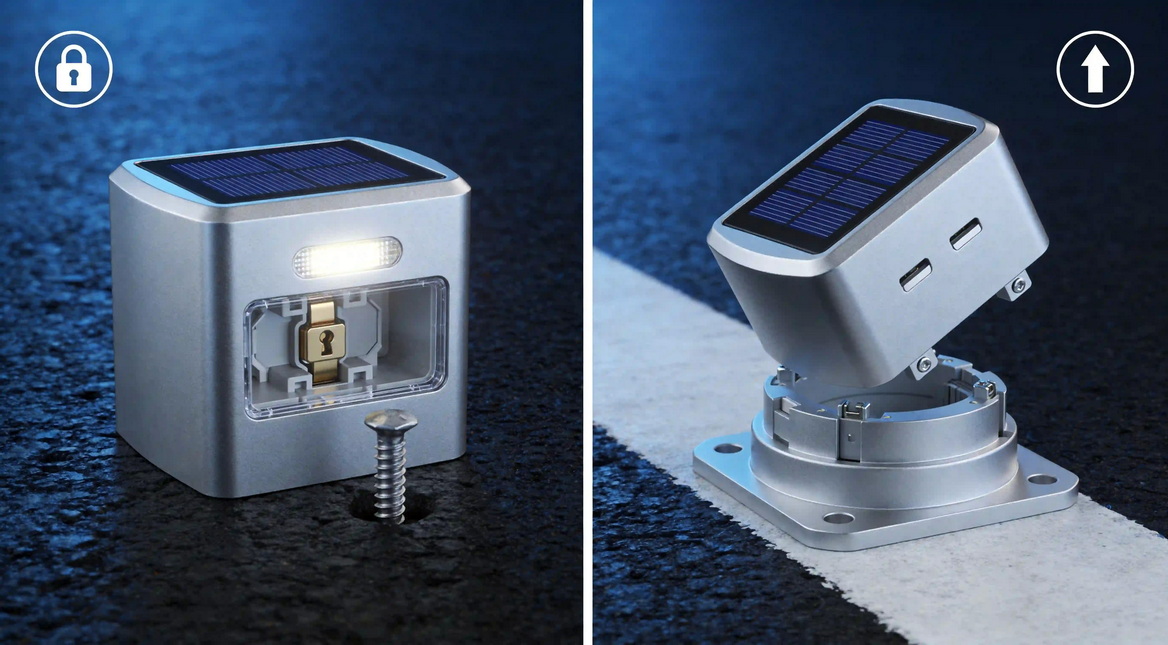
Road studs are raised or embedded pavement devices that improve lane guidance, edge-line visibility, traffic channelization, and hazard awareness. Depending on the application, they may use retroreflective lenses, LED lighting, solar power, or a combination of these technologies.
Anti-theft road studs are designed to resist unauthorized removal. They often use concealed anchors, locking bases, recessed fasteners, tamper-resistant screws, reinforced housings, or dedicated removal tools.
Standard removable road studs are designed for faster maintenance, replacement, upgrading, and layout adjustment. Their structure may include detachable modules, replaceable solar components, screw-fixed bases, or plug-in mounting systems.
The core decision is simple:
- Choose anti-theft road studs when long-term asset protection is the priority.
- Choose standard removable road studs when fast maintenance and flexible deployment are more important.
Anti-theft road studs are built for locations where theft, vandalism, intentional damage, or unauthorized relocation could affect traffic guidance and project performance.
They are especially suitable for higher-value products, including solar LED road studs, synchronized flashing road studs, intelligent warning studs, and other active traffic-safety devices.
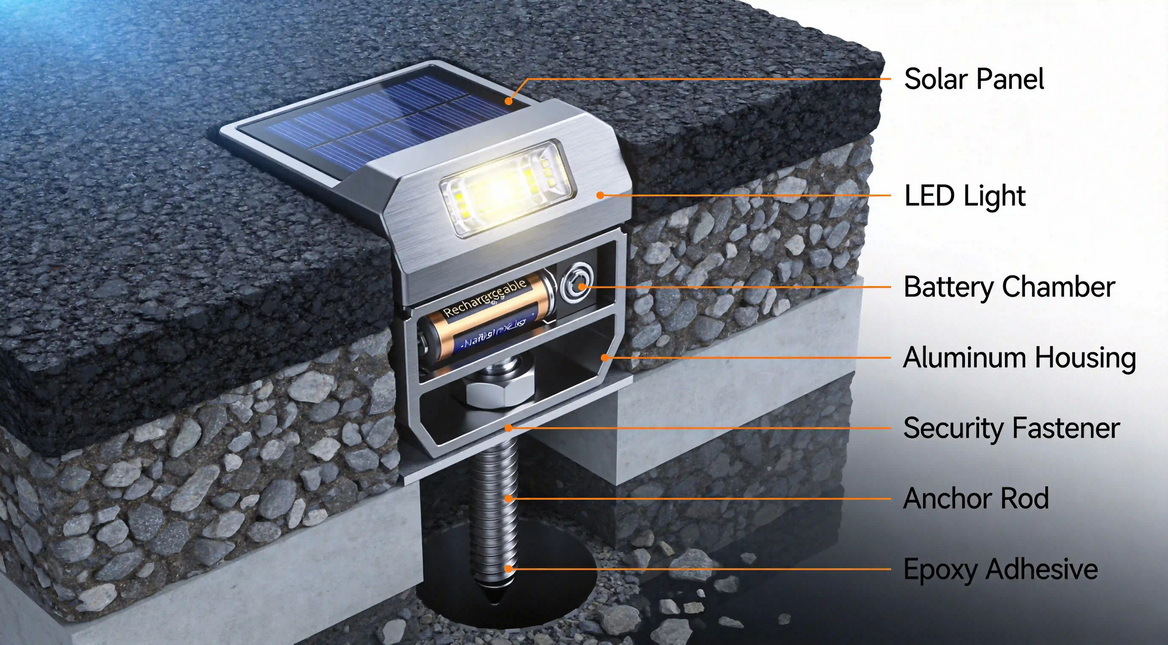
A high-quality anti-theft road stud may include:
- Concealed or recessed fastening points
- Tamper-resistant screws
- Embedded metal anchor rods
- Locking base systems
- Specialized removal tools
- Reinforced aluminum or engineering polymer housings
- Protected battery compartments
- Anti-pry housing structures
- One-way locking mechanisms
- Deep-mounted installation designs
These features are intended to make unauthorized removal difficult, time-consuming, and highly visible.
A well-designed anti-theft system does not only protect the product itself. It helps protect the continuity of the entire road-guidance layout.
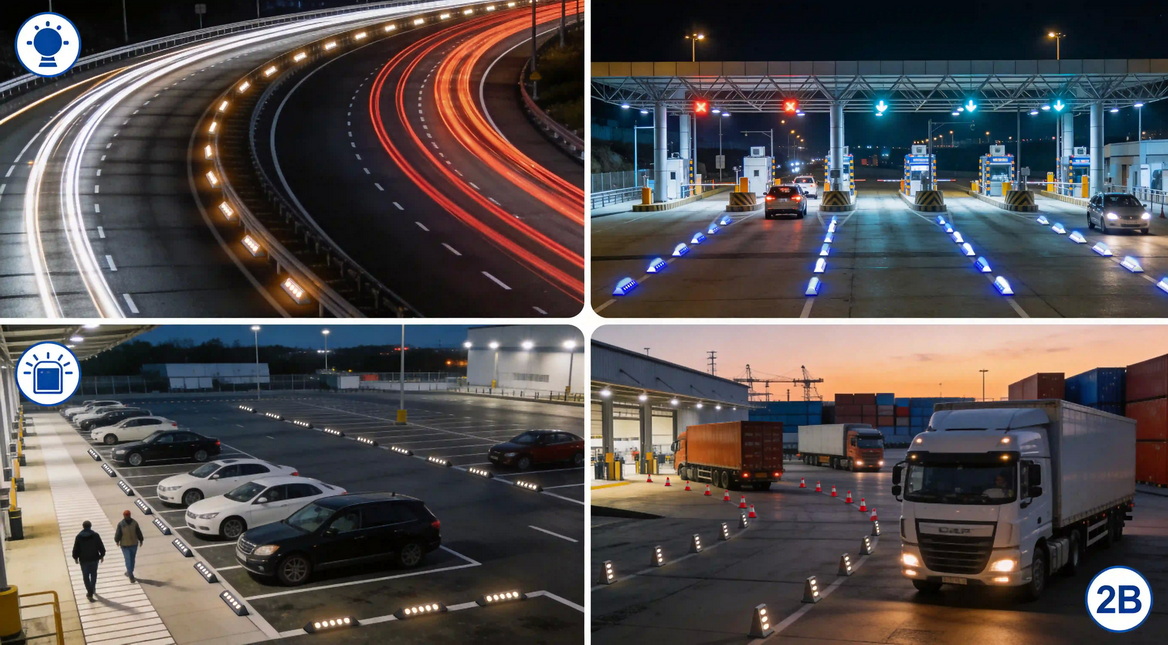
Anti-theft road studs are often recommended for:
- Highways and expressway ramps
- Toll stations and toll-lane transitions
- Remote roads with limited inspection frequency
- City intersections with vandalism concerns
- Public parking areas
- Bridges and bridge approaches
- Mountain roads and sharp curves
- Pedestrian crossings
- Commercial streets
- Logistics parks with public access
- Smart transportation projects
- Solar LED road stud installations
In these environments, a missing road stud can create a visible gap in lane delineation. If maintenance teams cannot respond quickly, the safety and operational value of the overall system may decline.
Anti-theft protection can increase installation and service complexity.
Maintenance personnel may require:
- Dedicated removal tools
- Product-specific installation instructions
- Approved replacement modules
- Clear records for installed locations
- Technician training
- Spare parts prepared in advance
This does not make anti-theft road studs impractical. It means the product should be selected together with a realistic maintenance plan.
Standard removable road studs are designed around serviceability. They allow maintenance teams to inspect, remove, replace, or upgrade components more quickly than fully locked or deeply embedded designs.
They are useful for road systems that require frequent adjustment, scheduled inspection, temporary traffic management, or low-cost replacement.
The main benefit is fast maintenance.
If an LED module, solar panel, reflector, battery, or upper housing is damaged, the team may only need to replace the removable component rather than rebuild the full installation base.
This can reduce:
- Lane closure time
- Labor requirements
- Road drilling work
- Pavement repair needs
- Replacement material use
- Traffic disruption
- Maintenance cost per unit
For controlled areas, removable road studs can create a highly efficient maintenance system.
Standard removable road studs are well suited to:
- Controlled industrial parks
- Factory roads
- Warehouse yards
- Parking lots
- Private commercial properties
- Airports and airport support roads
- Temporary roadwork areas
- Event traffic-control zones
- Logistics facilities
- Internal access roads
- Low-risk residential communities
They can also be useful where traffic flow patterns change frequently.
For example, a large parking area may need to modify entrance lanes, emergency access routes, loading bays, or pedestrian flow. A removable road stud system makes these changes easier than a permanently anchored layout.
The same feature that makes a road stud easy to replace can also make it easier to steal, move, or damage.
Standard removable units may be less suitable when:
- The site is open to the public
- Theft has occurred previously
- The units contain valuable electronic parts
- Routine inspections are difficult
- Road access is remote
- Maintenance response times are long
- Traffic volume is high
- Missing units would create immediate safety concerns
In these cases, the lowest-priced removable product may become more expensive over its operating life.
| Evaluation Factor | Anti-theft Road Stud Designs | Standard Removable Units |
|---|---|---|
| Primary purpose | Prevent unauthorized removal | Enable rapid maintenance and replacement |
| Theft resistance | High | Low to moderate |
| Authorized removal speed | Moderate to slow | Fast |
| Installation complexity | Moderate to high | Low to moderate |
| Maintenance flexibility | Lower without a dedicated service system | High |
| Best for remote sites | Yes | Only with frequent inspections |
| Best for temporary layouts | Less suitable | Highly suitable |
| Initial installation cost | Usually higher | Usually lower |
| Long-term loss risk | Lower | Higher in uncontrolled areas |
| Best for solar LED road studs | Strong choice in public or remote locations | Suitable for managed private sites |
| Replacement process | May require dedicated tools | Often quick and simple |
| Recommended buyer priority | Security and lifecycle stability | Fast servicing and layout flexibility |
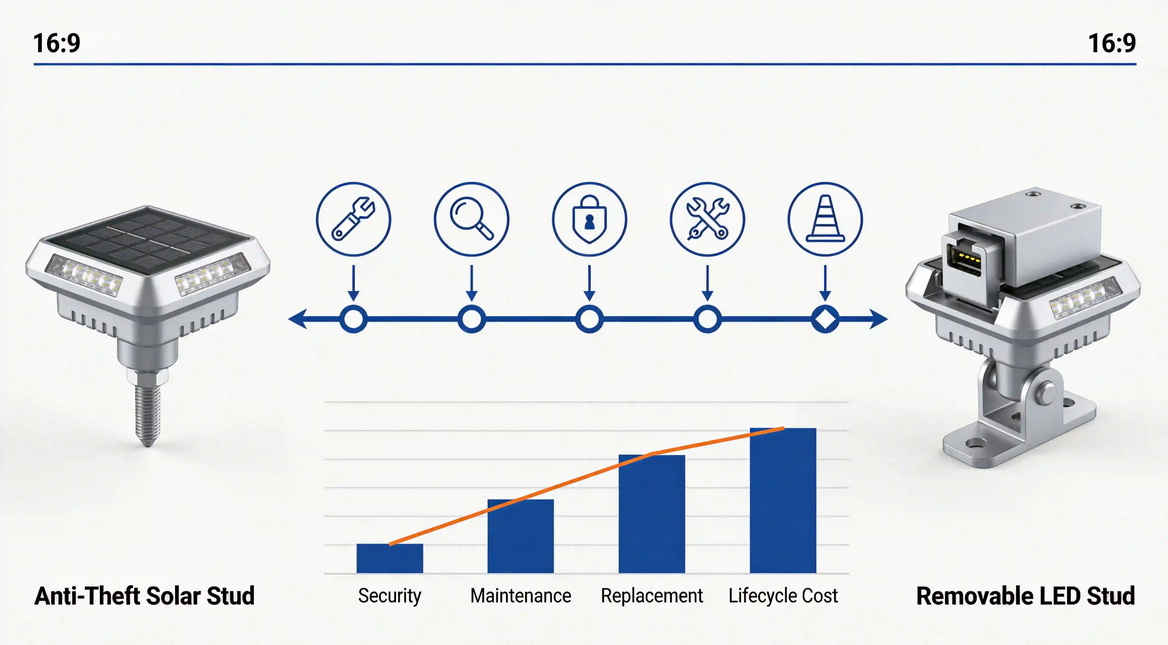
The best choice is not always the unit with the lowest purchase price. The best choice is the system that delivers the lowest total operating cost throughout the project lifecycle.
A road stud project should not be evaluated only by unit cost.
A more realistic comparison includes installation, inspection, replacement, theft, labor, traffic control, and pavement repair.
Total Lifecycle Cost=Purchase Cost+Installation Cost+Inspection Cost+Replacement Cost+Loss Cost+Traffic Disruption Cost
An anti-theft solar road stud may have a higher initial price. However, it may produce lower overall expenditure when theft, vandalism, emergency replacements, and repeated site visits are common.
A standard removable road stud may have a lower purchase cost. Its advantage is strongest when the project has reliable maintenance access and low theft exposure.
1. How often can the site be inspected?
2. Is theft or vandalism a local concern?
3. How quickly can maintenance staff access the location?
4. What is the operational cost of closing one lane?
5. Will the pavement be resurfaced in the near future?
6. Does the project require replaceable batteries, LED modules, or solar panels?
7. What happens if several road studs disappear at the same time?
8. Are spare modules and removal tools locally available?
9. Will heavy trucks, standing water, snowplows, or extreme heat affect the installation?
10. Does the project require custom colors, flash patterns, product labels, or mounting structures?
Even a high-quality road stud can fail early if the installation method does not match the road surface and traffic conditions.
For anti-theft road studs, accurate drilling, anchoring, adhesive application, and fastener positioning are essential. Poor installation can reduce both load capacity and theft resistance.
For standard removable road studs, the mounting base must remain stable while still allowing the authorized user to remove the upper unit when needed.
- Asphalt quality: Weak or cracked asphalt may not provide stable anchor retention.
- Concrete surfaces: Concrete usually needs different drilling methods and fastening systems.
- Water exposure: Sealing and drainage are essential for LED and solar road studs.
- Heavy vehicle lanes: Truck traffic requires strong housings and secure installation.
- High-speed roads: Stable mounting and high visibility are especially important.
- Snowplow routes: Raised products may need recessed, protected, or snowplow-compatible installation.
- High-temperature regions: Housing materials, adhesives, batteries, and seals should resist heat aging.
- Coastal areas: Components should resist moisture, salt spray, and corrosion.
| Application | Recommended Option | Main Reason |
|---|---|---|
| Remote highway curve | Anti-theft road stud | Reduces risk of missing units where inspection is limited |
| Toll plaza | Anti-theft LED or solar road stud | Protects high-value traffic-guidance equipment |
| City intersection | Anti-theft or lockable removable road stud | Balances security and service access |
| Industrial park | Standard removable road stud | Maintenance access is usually controlled and convenient |
| Parking lot | Removable or lockable removable road stud | Supports layout changes and rapid replacement |
| Temporary roadwork zone | Standard removable road stud | Allows quick installation and removal |
| Snow-prone roadway | Protected or recessed road stud system | Reduces risk of snowplow damage |
| Smart road-stud project | Anti-theft design with authorized service access | Protects electronic equipment and reduces asset loss |
| Logistics yard | Removable or lockable removable road stud | Supports changing traffic routes and frequent operational adjustments |
| Public pedestrian crossing | Anti-theft LED road stud | Preserves visual guidance in high-access locations |
A practical middle-ground solution is a lockable removable road stud.
This design allows authorized technicians to replace a module while making casual removal more difficult. It is particularly suitable for solar LED road studs used in toll areas, parking lots, municipal roads, logistics facilities, and managed commercial sites.
For distributors, contractors, road-safety brands, and government procurement teams, product selection should go beyond a catalog review.
A professional manufacturer should be able to provide technical support before mass production and installation.
Important project information includes:
- Product dimensions
- Housing material
- Reflector or LED color
- Flashing pattern
- Solar charging performance
- Battery type
- IP protection level
- Compressive strength
- Impact resistance
- Mounting method
- Anchor dimensions
- Installation hole size
- Adhesive recommendations
- Anti-theft structure
- Removal tool design
- Packaging requirements
- Product labeling
- Custom logo options
- Spare-parts supply plan
OEM projects may require customized branding, packaging, labels, colors, or product configurations.
ODM projects may require deeper development support, including new housings, locking systems, LED functions, solar structures, mounting methods, and project-specific performance requirements.
For road-safety applications, the strongest product design is usually the one that matches the real site conditions rather than a generic specification.
A reliable selection process should follow the project environment.
1. Assess the location.
Identify whether the site is public, private, remote, high-traffic, theft-prone, or frequently maintained.
2. Define the guidance requirement.
Determine whether the road stud is needed for lane separation, curve warning, pedestrian crossing, parking guidance, toll-lane control, or hazard marking.
3. Review pavement and weather conditions.
Confirm the pavement type, drainage condition, truck loading, temperature range, and snowplow exposure.
4. Estimate maintenance capacity.
Determine how quickly the team can inspect and replace damaged units.
5. Compare lifecycle cost.
Include installation, theft, replacement, labor, traffic disruption, and spare-parts expenses.
6. Request samples for field evaluation.
Test the product on the actual pavement and under real traffic conditions before placing a large order.
7. Confirm customization requirements.
Specify colors, light patterns, logo requirements, mounting details, packaging, and spare-part quantities before production begins.
Anti-theft road stud designs are the stronger option when theft prevention, long-term retention, remote deployment, and consistent roadway guidance are the highest priorities.
Standard removable road studs are better suited to locations where maintenance speed, layout flexibility, and fast module replacement are more important than maximum theft resistance.
For many projects, the most practical solution is a lockable removable design. It combines controlled maintenance access with stronger protection against unauthorized removal.
Shenzhen Xingsheng Traffic Facilities Co., Ltd. can support road-safety projects with anti-theft road studs, removable road studs, solar LED road studs, LED traffic signs, and customized OEM and ODM solutions for streets, highways, toll stations, parking lots, logistics facilities, and industrial sites.
Discuss your project requirements with our technical team to evaluate the most suitable road stud design, mounting method, visibility option, and customization approach for your application.
Not necessarily. Product durability depends on housing material, load-bearing capacity, sealing performance, lens quality, installation quality, traffic load, and weather exposure. Anti-theft features primarily improve resistance to unauthorized removal.
Yes. A lockable removable road stud can use a concealed fastener, dedicated removal tool, locking base, or tamper-resistant structure. This gives maintenance teams access while reducing casual removal.
For public roads, toll stations, remote locations, and vandalism-prone areas, anti-theft solar LED road studs are usually more suitable. For controlled sites with fast maintenance access, removable solar LED modules can be a practical choice.
Yes. However, the mounting method must match the pavement type. Asphalt, concrete, bridge decks, and resurfaced areas may require different drilling depths, anchors, adhesives, and embedded base structures.
They can be used, but standard raised products may be exposed to snowplow damage. Recessed, protected, or snowplow-compatible systems should be considered for roads with regular winter plowing.
1. Federal Highway Administration. Pavement Markings Regulations / Standards https://highways.dot.gov/safety/other/visibility/pavement-markings-regulations-standards
2. Federal Highway Administration. FHWA Road Safety Audit Guidelines https://highways.dot.gov/safety/data-analysis-tools/rsa/fhwa-road-safety-audit-guidelines
3. Wisconsin Department of Transportation. Highway Maintenance Manual: Plowing Raised Pavement Markers https://wisconsindot.gov/Documents/doing-bus/local-gov/hwy-mnt/mntc-manual/chapter06/06-15-50-Aug2024.pdf
4. Federal Highway Administration. MUTCD Chapter 3B: Pavement and Curb Markings https://mutcd.fhwa.dot.gov/htm/2003/part3/part3b1.htm
5. Federal Highway Administration. Guidelines for the Use of Raised Pavement Markers https://highways.dot.gov/media/53451
6. Missouri Department of Transportation. Delineators: MUTCD Chapter 3G https://epg.modot.org/index.php?title=620.6_Delineators_(MUTCD_Chapter_3G)


