
Please Choose Your Language
Views: 246 Author: XS Traffic Facilities Publish Time: 2026-08-22 Origin: Site


Content Menu
● What Is Retroreflective Sheeting?
● Understanding Engineering Grade Type I Reflective Sheeting
>> Common Applications for Type I Sheeting
>> Key Advantages of Type I Sheeting
>> Limitations of Type I Sheeting
● Understanding High Intensity Prismatic Type IV Reflective Sheeting
>> Common Applications for Type IV Sheeting
>> Key Advantages of Type IV Sheeting
>> Limitations of Type IV Sheeting
● Engineering Grade Type I Vs. High Intensity Prismatic Type IV
● Why Microprismatic Technology Makes a Difference
● How to Choose Between Type I and Type IV
>> 1. Identify the Sign Purpose
>> 2. Assess the Traffic Environment
>> 3. Confirm Project Requirements
>> 4. Evaluate Total Project Value
● Practical Application Examples
● Manufacturing Considerations for OEM and ODM Projects
● Build a More Reliable Traffic Sign Solution
>> Is Engineering Grade Type I reflective sheeting suitable for highway signs?
>> Is High Intensity Prismatic Type IV the same as Diamond Grade sheeting?
>> Can Type I reflective sheeting be used for parking signs?
>> Does Type IV reflective sheeting always last longer than Type I?
>> How can buyers verify reflective sheeting quality?
>> Can LED traffic signs replace reflective traffic signs?
Engineering Grade Type I and High Intensity Prismatic Type IV are both widely used reflective sheeting options for traffic signs. However, they serve very different visibility, safety, budget, and application requirements.
For low-speed parking areas, private roads, industrial sites, and basic wayfinding signs, Type I reflective sheeting can be a practical choice. For highways, toll stations, work zones, public roads, and higher-risk traffic environments, High Intensity Prismatic Type IV reflective sheeting is often the stronger option because it offers higher nighttime visibility and a more advanced optical structure.
For traffic sign manufacturers, contractors, distributors, and project buyers, the right selection should not be based on material price alone. It should be based on road speed, sign function, nighttime conditions, local specifications, installation location, and expected service life.
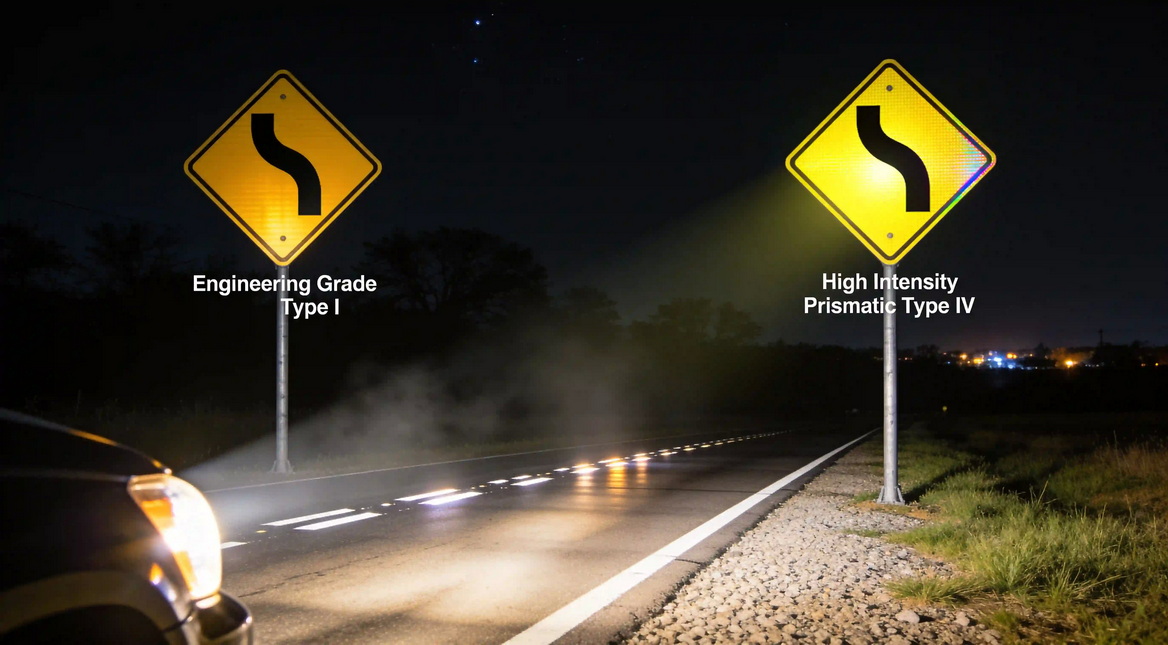
Retroreflective sheeting is a specialized material applied to the face of traffic signs. It reflects vehicle headlight illumination back toward the driver.
This function helps road users identify signs at night, during rain, in tunnels, and in other low-light conditions.
Unlike ordinary reflective surfaces, retroreflective sheeting is designed to return light close to its original source. When headlights shine on a traffic sign, the sign becomes brighter to the approaching driver.
The performance of reflective traffic signs depends on several factors:
- Reflective sheeting type
- Sign color and graphic design
- Vehicle speed
- Road alignment
- Mounting height
- Viewing distance
- Street lighting conditions
- Weather exposure
- Sign maintenance
A traffic sign may look clear during the daytime but still provide poor recognition distance at night. This is why reflective sheeting selection is a critical part of traffic safety design.
Engineering Grade Type I reflective sheeting is commonly used as an entry-level material for signs with limited nighttime visibility requirements.
Traditional Engineering Grade materials use enclosed glass bead technology. Some newer products may use prismatic structures while still meeting Type I performance requirements. Buyers should always confirm the exact technical specification rather than selecting material based only on its surface appearance.
Type I sheeting is often selected for projects where vehicles travel slowly and drivers have enough time to recognize sign information.
Engineering Grade Type I reflective sheeting is often used for:
- Parking lot direction signs
- Private-property signs
- Factory and warehouse signs
- Low-speed internal road signs
- Commercial wayfinding signs
- Basic safety signs
- Community road signs
- Real estate and property-management signs
- Temporary informational signs
- Non-critical traffic control signs
For example, a "Visitor Parking" sign installed at a factory entrance may not need the same reflective performance as a warning sign placed before a sharp highway curve.
In this type of project, Type I sheeting can provide an effective balance between cost and visibility.
- Lower initial material cost
- Suitable for basic and low-speed traffic applications
- Appropriate for many private-property sign projects
- Common option for commercial signage
- Supports customized graphics and sign sizes
- Practical for large-volume OEM orders
- Can be used for aluminum traffic signs and plastic sign panels
Type I reflective sheeting has lower nighttime retroreflective performance than higher-grade materials.
It may not provide enough recognition distance for high-speed roads, complicated intersections, severe weather areas, or dark rural routes.
When drivers need more time to react, a low-grade reflective material can become a safety concern.
Type I material should be carefully evaluated before use in:
- High-speed road projects
- Highway warning signs
- Work-zone traffic control signs
- Toll plaza lane signs
- Sharp curve warning signs
- School-zone warning signs
- Pedestrian crossing signs
- Major intersections
- High-risk industrial transportation areas
For these applications, a higher-performance material is often more appropriate.
High Intensity Prismatic Type IV reflective sheeting is a higher-performance material designed for traffic signs and road safety devices that require stronger nighttime visibility.
It is commonly known as HIP reflective sheeting.
Unlike traditional glass bead sheeting, Type IV products typically use microprismatic optical technology. The surface contains a large number of microscopic cube-corner prisms that return light toward the approaching vehicle.
This construction can improve the visibility of traffic signs when headlights illuminate the sign face.
High Intensity Prismatic Type IV sheeting is commonly used for:
- Highway traffic signs
- Road warning signs
- Permanent regulatory signs
- Construction-zone signs
- Toll station signs
- Public-road traffic signs
- Roadwork warning boards
- Traffic delineators
- Lane-control signs
- Pedestrian crossing signs
- School-zone signs
- Dangerous curve signs
- Industrial-site vehicle control signs
- Large parking facility guidance signs
For projects with high traffic volume, high vehicle speed, complex road design, or frequent nighttime operation, Type IV sheeting can provide an important visibility advantage.
- Higher nighttime retroreflective performance
- Stronger sign visibility under vehicle headlights
- Suitable for public-road and higher-risk applications
- Effective for highway and work-zone traffic signs
- Uses advanced microprismatic optical technology
- Better suited to demanding road environments
- Supports longer-distance sign recognition
- Can strengthen the overall value of safety-focused projects
Type IV High Intensity Prismatic sheeting usually has a higher initial price than Type I Engineering Grade sheeting.
It is also important to understand that Type IV is not always the highest available performance category. Some projects may require more advanced materials depending on local regulations, operating conditions, or road authority specifications.
Before ordering, buyers should confirm:
- Required reflective sheeting type
- Applicable project specifications
- Product test reports
- Color performance requirements
- Outdoor durability requirements
- Printability and overlay compatibility
- Adhesive performance
- Warranty conditions
- Finished sign inspection requirements
| Comparison Factor | Engineering Grade Type I | High Intensity Prismatic Type IV |
|---|---|---|
| Common Name | Engineering Grade | High Intensity Prismatic or HIP |
| Typical Performance Level | Basic | Higher |
| Optical Technology | Traditionally enclosed glass beads | Usually microprismatic cube-corner technology |
| Nighttime Visibility | Moderate | Stronger |
| Suitable Road Speed | Low-speed environments | Medium- and high-speed environments |
| Best Applications | Parking, private property, basic wayfinding | Highways, public roads, work zones, toll areas |
| Initial Cost | Lower | Higher |
| Safety Margin | Limited in demanding locations | Higher for complex traffic environments |
| Sign Recognition Distance | Shorter | Longer |
| Common Buyer Profile | Property managers, factories, commercial projects | Contractors, road authorities, infrastructure projects |
| Recommended Use | Non-critical signage | Safety-critical and high-visibility signage |
The main difference is straightforward: Type I is a basic reflective solution, while Type IV is designed for stronger visibility in more demanding traffic conditions.
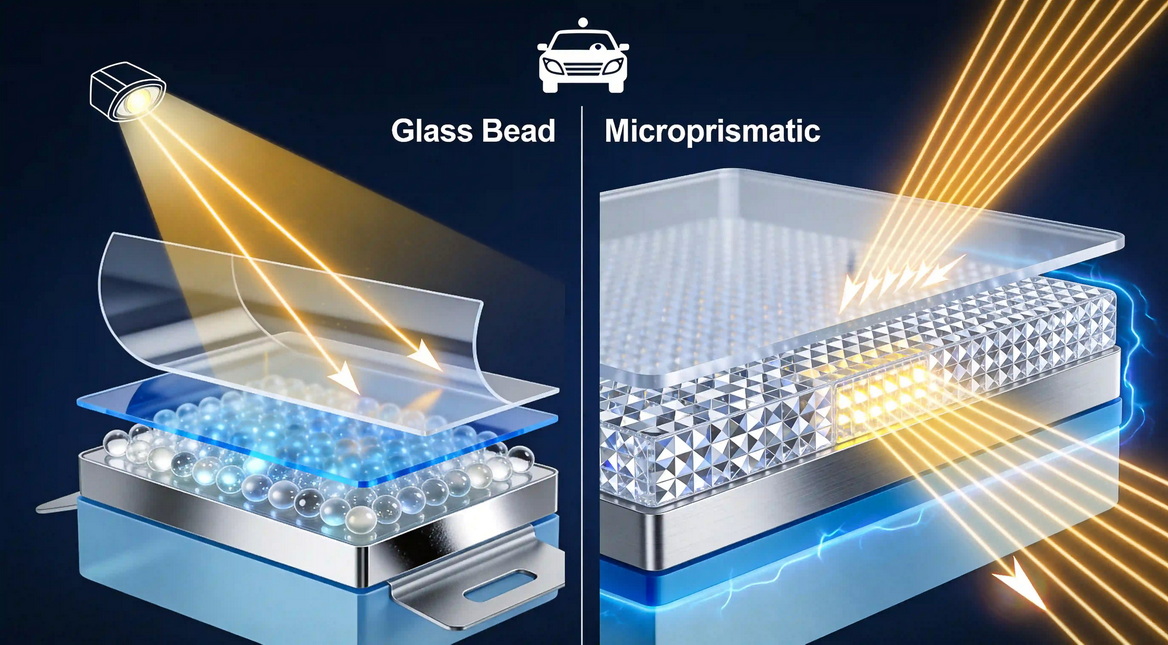
The optical construction of reflective sheeting has a direct effect on nighttime sign visibility.
Traditional glass bead sheeting uses small beads to redirect light. Microprismatic sheeting uses small cube-corner prism structures to return light more efficiently toward approaching vehicles.
This difference can be especially important for signs installed on highways, curved roads, dark roads, toll stations, and work zones.
However, the sheeting type is only one part of the full traffic sign system.
The final visibility of a sign can also be affected by:
- Sign mounting angle
- Vehicle headlight position
- Road curves and lane alignment
- Sign height
- Distance from the roadway
- Rain and fog
- Ambient lighting
- Sign-face contamination
- Sign color and legend size
- Maintenance condition
A well-designed Type IV sign can provide stronger nighttime recognition. However, poor installation, poor printing, damaged film, or an incorrect mounting position can reduce its real-world performance.
Selecting the right reflective sheeting should follow a structured evaluation process.
Start by defining the sign's role.
Is it a:
- Warning sign?
- Regulatory sign?
- Guide sign?
- Parking sign?
- Work-zone sign?
- Private-property sign?
- Directional sign?
- LED traffic sign support panel?
- Temporary safety sign?
Warning signs and regulatory signs usually require more careful material selection than basic property signs.
Review the operating conditions around the sign location.
Important questions include:
- What is the vehicle speed?
- Is the location active at night?
- Is the area exposed to rain, fog, dust, or snow?
- Is the sign installed on a public road or private property?
- Does the road include sharp curves or difficult intersections?
- Is there sufficient street lighting?
- Do drivers need to make quick lane or direction decisions?
- Is the sign part of a construction zone?
Higher speeds and more complex road conditions normally require stronger sign visibility.
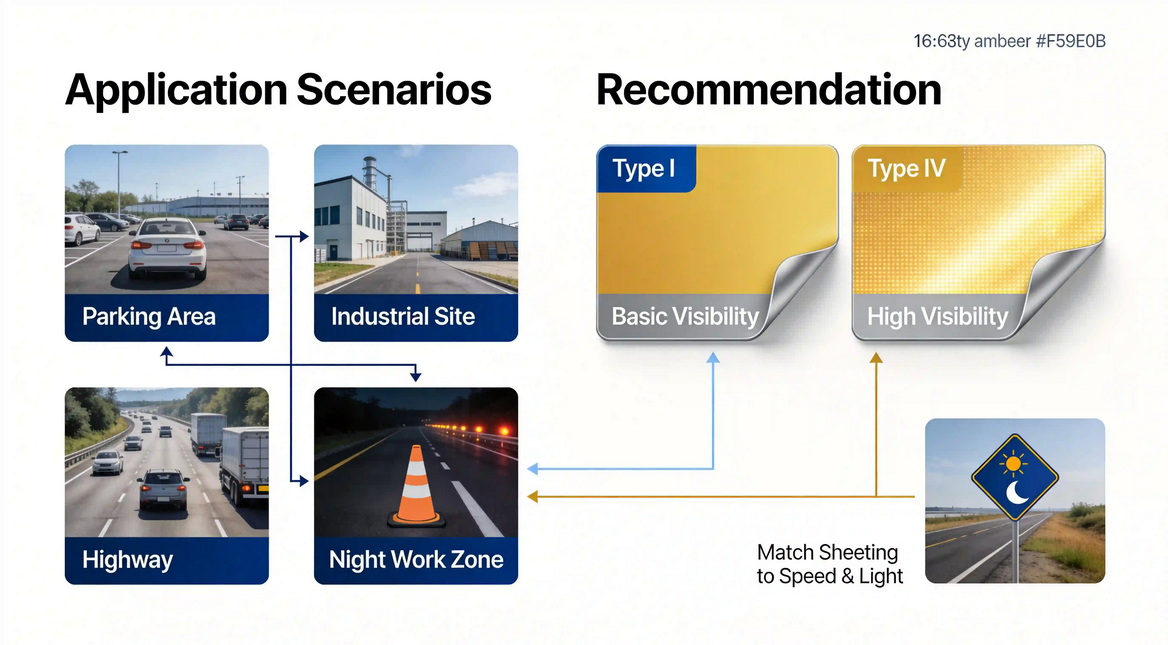
Before production, verify the project documents and the applicable technical requirements.
Buyers should confirm:
1. Required reflective sheeting category
2. Sign dimensions and substrate material
3. Required color standard
4. Legend design and printing method
5. Minimum outdoor durability
6. Applicable testing and inspection requirements
7. Packaging and shipping requirements
8. Required quantity and delivery schedule
The correct choice must match the actual project requirement. A higher-grade material is not always necessary for every sign. At the same time, a lower-grade material should never be selected when the application needs stronger visibility.
Material cost is important, but it should not be evaluated alone.
A more practical value calculation includes:
Total Project Value=Material Cost+Fabrication Cost+Installation Cost+Maintenance Cost+Replacement Risk+Visibility Performance
Type I sheeting may reduce upfront procurement cost. Type IV sheeting may deliver greater value when a sign needs stronger nighttime performance and longer-term visibility reliability.
For infrastructure buyers, selecting the wrong sheeting grade can lead to:
- Project inspection failures
- Replacement costs
- Installation rework
- Delayed project completion
- Lower nighttime visibility
- Higher maintenance requirements
- Customer complaints
- Reduced confidence in the finished traffic safety system
A commercial parking facility requires directional signs, parking-zone identifiers, exit signs, and visitor guidance panels.
Most vehicles travel at low speeds. The site has street lighting, clear lane markings, and limited nighttime traffic.
Recommended approach: Type I sheeting may be suitable for basic parking guidance and property signs. Type IV can be considered for entrances, pedestrian crossings, blind corners, emergency exits, and vehicle conflict points.
A manufacturing site requires internal traffic signs, truck-routing signs, warehouse directional signs, loading-area signs, and safety warning boards.
The project includes trucks, forklifts, employee vehicles, and visitor traffic.
Recommended approach: Type I may be used for general internal guidance. Type IV is often better for truck routes, loading zones, vehicle crossings, night-shift operations, and areas with limited lighting.
A contractor needs warning signs, lane closure boards, construction signs, and temporary traffic-control products for a night roadwork project.
Drivers approach the work zone at higher speeds and need to make decisions quickly.
Recommended approach: Type IV High Intensity Prismatic sheeting is generally the stronger starting point for this type of project. The final material should match the relevant work-zone specification.
A toll station requires lane-control signs, directional signs, safety warning boards, traffic cones, LED traffic signs, and lane status systems.
Drivers must identify the correct lane while slowing down and reacting to changing conditions.
Recommended approach: Combine LED traffic signs for real-time lane instructions with Type IV or higher-performance reflective sheeting for fixed guidance, hazard identification, and nighttime backup visibility.

Reflective sheeting selection should be considered together with complete sign manufacturing quality.
For OEM and ODM traffic sign orders, key production factors include:
- Aluminum panel thickness
- Substrate flatness
- Surface cleaning quality
- Sheeting lamination process
- Digital printing or screen-printing method
- UV-resistant ink performance
- Protective overlay film
- Edge sealing process
- Adhesive bonding strength
- Sign bracket design
- LED module integration
- Waterproof wiring protection
- Export packaging quality
A strong reflective film cannot fully compensate for poor fabrication.
For example, if an aluminum panel bends during transportation or the sheeting is incorrectly laminated, the sign face may develop bubbles, wrinkles, lifting edges, or reduced service life.
Shenzhen Xingsheng Traffic Facilities Co., Ltd. provides customized traffic safety products for streets, highways, toll stations, parking lots, industrial areas, and commercial projects. Our team can support OEM and ODM development for reflective traffic signs, LED traffic signs, aluminum sign panels, traffic safety devices, and complete project-based traffic control solutions.
Engineering Grade Type I and High Intensity Prismatic Type IV sheeting both have valuable roles in traffic safety projects.
Type I is a practical option for lower-speed and non-critical applications.
Type IV is a stronger choice for higher-speed, higher-risk, and visibility-sensitive environments.
The best material selection is based on the sign's purpose, operating environment, local project requirements, expected lifespan, and total project value.
Shenzhen Xingsheng Traffic Facilities Co., Ltd. can help buyers develop customized reflective signs, LED traffic signs, parking safety systems, highway safety products, and OEM or ODM traffic-control solutions. Share your drawings, product specifications, target market requirements, dimensions, quantities, and project conditions with our team to receive a tailored product recommendation and manufacturing proposal.
Type I sheeting is generally more suitable for low-speed and lower-risk applications. For highway signs, work zones, and other demanding road environments, Type IV or a higher-performance material is usually a more suitable option. Final selection should follow the relevant project specification.
No. High Intensity Prismatic sheeting is commonly associated with Type IV performance. Diamond Grade materials are generally positioned as higher-performance products for demanding traffic safety applications.
Yes. Type I sheeting can be suitable for many parking-lot signs, private-property signs, basic wayfinding signs, and low-speed vehicle areas. Type IV may still be beneficial for dark entrances, pedestrian crossings, emergency exits, and blind corners.
Not necessarily. Product durability depends on the exact material construction, outdoor exposure, UV resistance, installation quality, print system, adhesive performance, maintenance, and supplier warranty conditions.
Buyers should request product specifications, material samples, applicable test reports, color information, durability details, adhesive information, and finished-sign samples. It is also important to confirm that the selected sheeting matches the exact project requirement.
LED traffic signs and reflective signs serve different purposes. LED signs provide active and dynamic messages, while reflective signs provide reliable fixed information. Combining both systems can create a stronger traffic guidance solution for toll stations, highways, parking facilities, and smart traffic projects.
1. 3M. Explained: ASTM Standards for Traffic Signs https://www.3m.com/3M/en_US/road-safety-us/resources/road-transportation-safety-center-blog/full-story/?storyid=5011bc7a-64cc-4b28-93cd-84aa9707d5dd
2. Federal Highway Administration. 2014 Traffic Sign Retroreflective Sheeting Identification Guide https://highways.dot.gov/safety/other/visibility/2014-traffic-sign-retroreflective-sheeting-identification-guide
3. 3M. Comparing Type IV and Type XI Reflective Sheeting https://www.3m.com/3M/en_US/road-safety-us/products/diamond-grade-dg3-reflective-sheeting/compare/
4. Federal Highway Administration. Retroreflectivity Resources https://highways.dot.gov/safety/other/visibility
5. ASTM International. ASTM D4956 Standard Specification for Retroreflective Sheeting for Traffic Control https://www.astm.org/d4956-22.html
6. Federal Highway Administration. Manual on Uniform Traffic Control Devices https://mutcd.fhwa.dot.gov/


