
Please Choose Your Language
Views: 277 Author: XS Traffic Facilities Publish Time: 2026-08-25 Origin: Site


Content Menu
● Why Fluorescent Yellow-Green School Zone Signs Are Important
● The History of Fluorescent Yellow-Green Traffic Signs
>> Why School Zones Became a Priority
● School Zone Sign Design and Visibility Requirements
>> Essential School Zone Sign Elements
>> Passive and Active Visibility Solutions
● When LED School Zone Signs Are a Better Choice
>> Suitable Applications for LED Traffic Signs
>> Choosing the Right LED Configuration
● How to Specify a School Zone Sign Project
>> Information to Prepare Before Production
● Manufacturing Considerations for Long-Term Performance
>> Questions to Ask Before Ordering
● Installation and Maintenance Best Practices
● Summary
● FAQ
>> What is a fluorescent yellow-green school zone sign?
>> Why are school zone signs fluorescent yellow-green instead of standard yellow?
>> What is the difference between a retroreflective sign and an LED sign?
>> Can LED school zone signs be solar powered?
>> Where are LED school zone signs most useful?
Fluorescent yellow-green school zone signs are now among the most recognizable tools used to improve awareness near schools, pedestrian crossings, and child-priority road environments. Their bright appearance, retroreflective performance, and compatibility with LED warning technology help drivers identify safety messages faster in busy and changing traffic conditions.
For streets, highways, school entrances, toll stations, parking areas, and internal roads, a traffic sign is more than a printed panel. It is a critical visual instruction designed to remain noticeable in sun glare, rain, shadows, nighttime conditions, and vehicle-headlight illumination.
Shenzhen Xingsheng Traffic Facilities Co., Ltd. provides LED traffic signs and traffic-safety products for road, parking, toll, and site-safety applications. OEM and ODM options are available for customers requiring customized sign dimensions, messages, illumination systems, mounting structures, and power solutions.
> Key point: Fluorescent yellow-green sign faces can improve the conspicuity of school-related warnings, but their real-world performance depends on correct design, suitable materials, compliant installation, and proper maintenance.
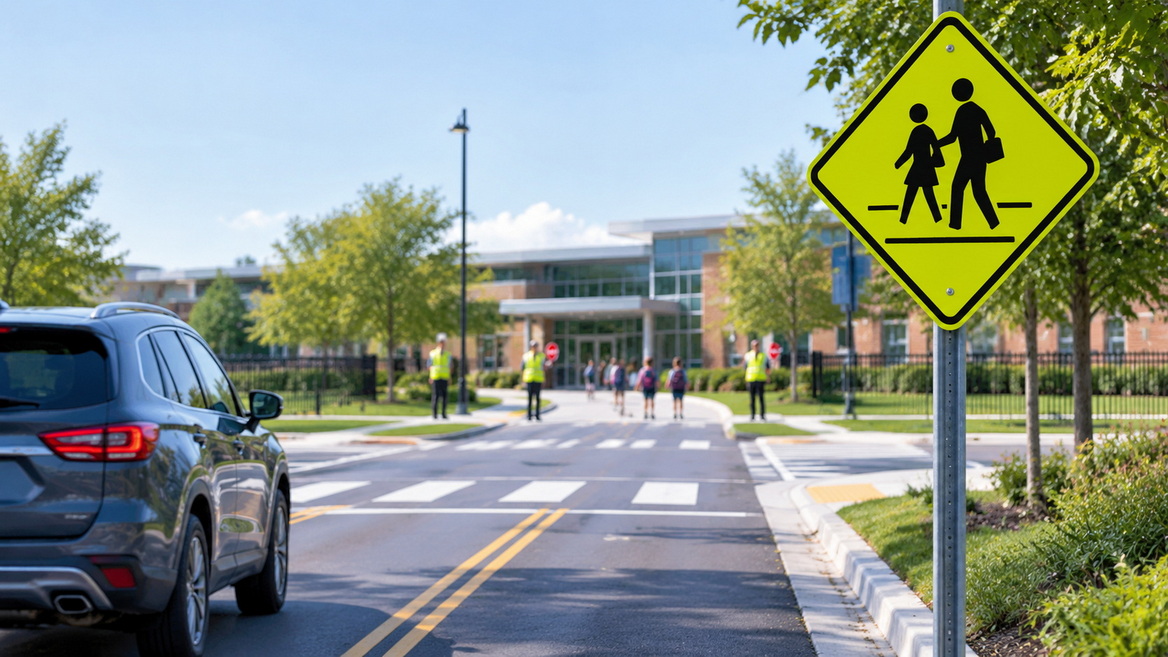
Traditional warning signs commonly use a yellow background with a black symbol, border, or message. Fluorescent yellow-green, often called FYG, provides a more visually conspicuous alternative for locations where drivers need to recognize a warning quickly.
Fluorescent materials absorb energy from daylight and re-emit portions of it as visible light. This creates a bright visual effect that can help a sign stand out against the surrounding road environment. The sign does not generate light by itself. Instead, it is designed to be more noticeable under many daytime and transition-light conditions.
This makes fluorescent yellow-green particularly suitable for school zones, pedestrian crossings, bicycle-priority areas, and other locations where drivers should reduce speed and pay closer attention.
| Feature | Standard Yellow Warning Sign | Fluorescent Yellow-Green Sign |
|---|---|---|
| Daytime visual impact | High | Typically more visually conspicuous |
| Common applications | General hazards and roadway warnings | School areas, pedestrian crossings, bicycle-related warnings |
| Retroreflective option | Available | Available |
| Nighttime visibility | Depends on retroreflective sheeting and headlights | Depends on retroreflective sheeting and headlights |
| LED enhancement | Optional | Optional and widely used for high-attention locations |
| Suitable environment | General traffic-warning conditions | School zones and vulnerable-road-user environments |
A fluorescent yellow-green sign should be treated as one part of a wider traffic-safety system. It works best when supported by suitable road markings, speed management, crossing design, lighting, and clear traffic control.
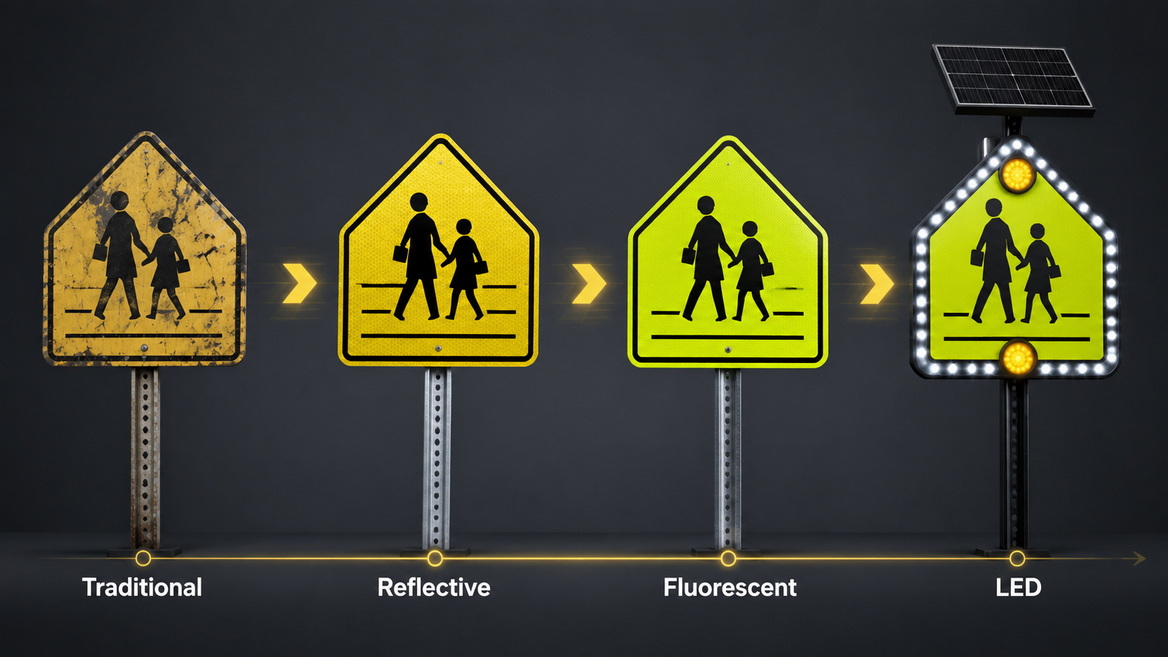
The development of fluorescent yellow-green signs is closely connected to the history of road-safety materials. Early traffic signs had limited color stability and poor nighttime visibility. Before modern retroreflective materials were widely available, signs often relied on painted surfaces, basic reflective elements, or external lighting.
As traffic volumes increased and vehicles became faster, traffic authorities needed signs that could remain visible in more demanding conditions. Improvements in pigments, sign sheeting, reflective materials, and manufacturing processes gradually changed how road signs were designed.
By the middle of the twentieth century, retroreflective materials made signs much easier to see under vehicle headlights. These materials return light toward the driver, helping important messages remain visible after dark.
Fluorescent retroreflective sheeting became more durable and practical for outdoor traffic-sign applications from the 1990s onward. This made it possible to use bright fluorescent colors for long-term road installations without sacrificing the durability expected from permanent traffic-control devices.
School zones need a higher level of visual attention because children may cross unexpectedly, walk in groups, or make decisions that are less predictable than adult pedestrian behavior. Drivers approaching a school entrance or crossing must recognize the environment quickly and adjust their speed accordingly.
Traffic-safety agencies began evaluating fluorescent yellow-green signs as a way to improve the visibility of school, pedestrian, and bicycle-related warning messages. Field evaluations found that brighter sign backgrounds could help draw attention to crossing areas and encourage more cautious driving behavior.
Over time, fluorescent yellow-green became strongly associated with school-related traffic signs. Today, it is widely used for school advance warnings, school crossings, school speed limit signs, related plaques, pedestrian warnings, and bicycle-warning applications where permitted by the governing road authority.
A school zone sign must communicate its message quickly. Drivers should be able to identify the sign, understand its meaning, and respond safely without unnecessary distraction.
A well-designed school-zone traffic sign usually combines a highly visible background, clear contrast, standardized symbols or wording, suitable retroreflective materials, and a mounting position that gives drivers enough time to react.
- Fluorescent yellow-green background for stronger daytime conspicuity
- Black legend, symbol, and border for clear contrast
- Retroreflective sheeting to improve visibility under headlights
- Standardized sign format appropriate for the intended road market
- Correct sign size based on approach speed, road type, and viewing distance
- Suitable mounting height and lateral clearance
- Clear sightlines without obstruction from trees, parked vehicles, advertising boards, or utility equipment
- Supplemental plaques where additional messages such as "AHEAD," time schedules, speed limits, or directional information are needed
> Important: A sign can appear visually similar to an approved school-zone sign but still be unsuitable if the size, sheeting type, message layout, mounting method, or illumination system does not match the project requirement.
A passive sign reflects external light, primarily daylight and vehicle headlights. A retroreflective fluorescent yellow-green sign is therefore a passive visibility solution.
An active sign uses a powered light source such as LEDs, flashing beacons, internally illuminated panels, or solar-powered warning systems. Active systems can provide additional attention in locations with higher traffic speeds, poor lighting, complex road layouts, or frequent pedestrian activity.
| Sign Type | Main Visibility Method | Typical Use |
|---|---|---|
| Retroreflective FYG sign | Reflects vehicle headlights | Standard school warning applications |
| LED border sign | Flashing or steady LEDs around sign edges | Higher-attention school approaches |
| LED-embedded sign | LEDs integrated into symbol, border, or message | Crossings with complex driver environments |
| Solar-powered warning sign | Solar energy supports flashing LEDs or beacons | Remote, temporary, or off-grid locations |
| Flashing beacon system | Active flashing warning signal | School speed-limit periods or crossing activity |
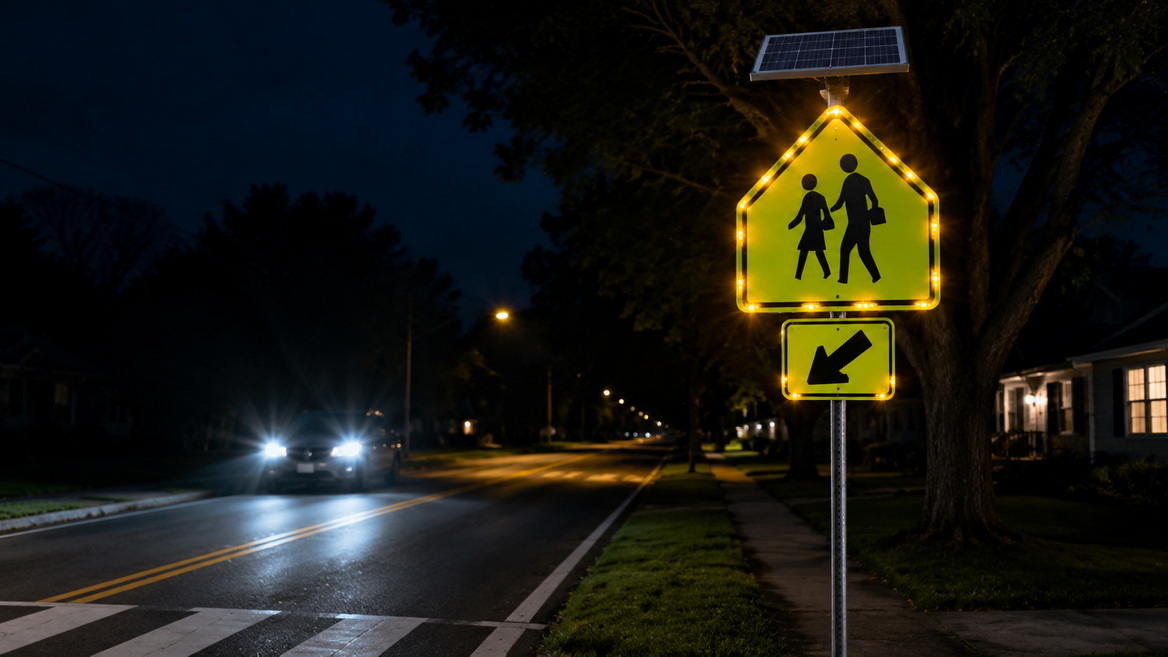
LED school zone signs are often selected when passive retroreflective signs may not provide enough visual impact. They are especially useful where drivers face multiple competing visual messages, travel at higher speeds, or approach a crossing with limited time to react.
An LED warning sign can use flashing borders, embedded LEDs, illuminated symbols, countdown displays, or scheduled operating modes. Solar-powered models can also reduce the need for trenching and grid-power installation.
- School crossings on high-speed approaches
- Roads with poor nighttime lighting
- Areas affected by rain, fog, shade, or frequent low-visibility conditions
- School entrances near intersections or traffic signals
- Locations with high pedestrian movement during arrival and dismissal periods
- Temporary traffic arrangements during school construction or roadworks
- Parking lots, campus roads, and private facilities with mixed pedestrian and vehicle traffic
- Toll stations and controlled-access facilities where warning visibility is critical
The best LED traffic sign configuration depends on local conditions, project specifications, available power, and desired operating behavior.
| Project Condition | Recommended Sign Approach |
|---|---|
| Low-speed school parking area | Retroreflective FYG warning sign |
| Standard school frontage road | FYG sign with appropriate supplemental signs and pavement markings |
| Higher-speed road approach | LED border sign or flashing warning sign |
| Complex school crossing | LED-enhanced sign combined with crossing markings and lighting |
| Remote or off-grid location | Solar-powered LED sign with battery storage |
| Time-controlled school speed zone | Programmable LED sign or flashing beacon with schedule control |
LED systems should be selected carefully. Excessive brightness, unsuitable flash patterns, poor solar design, inadequate battery capacity, or weak waterproofing can reduce performance and increase maintenance requirements.
Clear technical requirements help ensure that the final product is suitable for the installation environment. Before requesting a quotation, project owners, contractors, distributors, and engineering teams should prepare detailed information about the site and required sign configuration.
1. Sign design or artwork
Provide sign codes, technical drawings, logo files, symbols, colors, and message content.
2. Target market and standards
Confirm the country, region, road authority, and applicable traffic-sign requirements.
3. Sign dimensions
Specify the required panel size, thickness, shape, and any special edge treatment.
4. Reflective material
Identify the required fluorescent yellow-green sheeting type and performance level.
5. LED design
State whether LEDs are required around the border, inside the symbol, around the text, or across the full sign face.
6. Power supply
Select between grid-powered, solar-powered, battery-supported, or hybrid systems.
7. Operating mode
Define flashing patterns, brightness settings, working schedules, motion sensors, remote-control functions, or automatic daylight dimming.
8. Installation method
Provide pole size, bracket details, mounting location, wind-load requirements, and any site-specific constraints.
9. Quantity and packaging
Confirm order volume, shipping destination, packaging preferences, labeling, and pallet requirements.
10. Customization needs
Include OEM branding, multilingual messages, custom graphics, special enclosure colors, and project-specific product labeling.
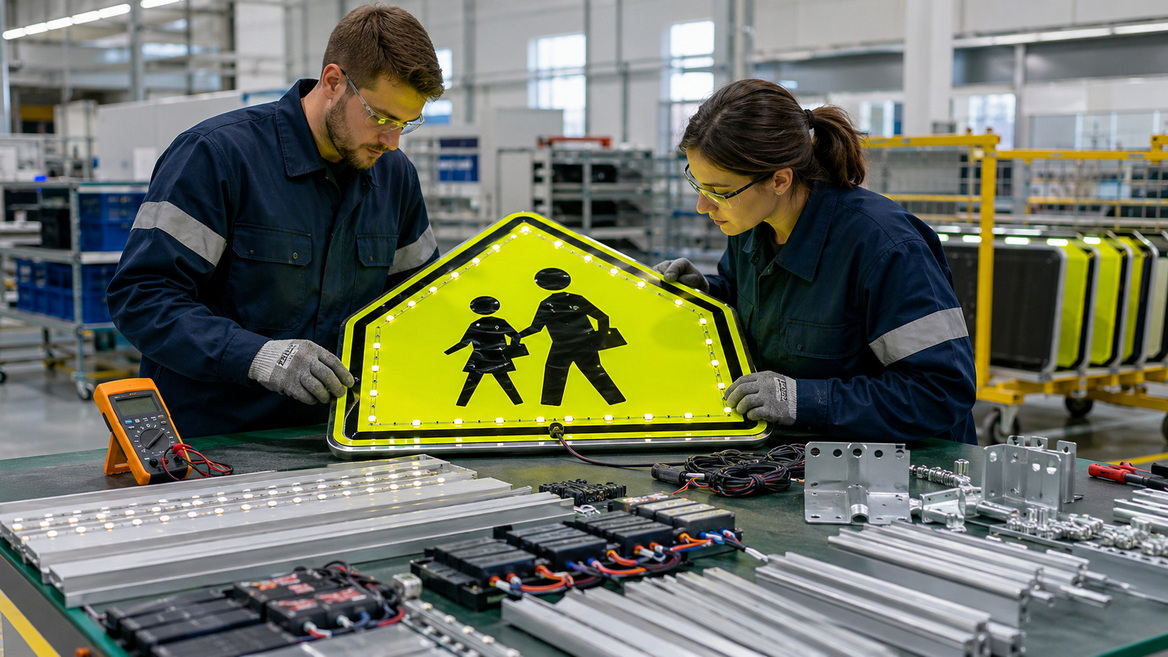
A traffic sign should be evaluated over its whole service life, not only when it is first installed. The visible surface, electrical components, housing, wiring, power system, and mounting hardware all affect long-term reliability.
For LED traffic signs, maintenance-friendly engineering is particularly important. Buyers should consider whether the sign can be repaired in the field, whether replacement parts are available, and whether the electrical system is protected against water, dust, vibration, corrosion, and temperature changes.
- Can individual LED modules be replaced?
- Is the sign enclosure sealed against water and dust?
- Are cables and connectors protected from corrosion?
- Does the controller support automatic dimming or scheduled operation?
- Is the solar panel large enough for local sunlight conditions?
- Does the battery capacity support extended cloudy periods?
- Are mounting brackets designed for the expected wind load?
- Can the sign graphics be customized for future project changes?
- Are spare parts, wiring diagrams, and technical documents available?
- Can the supplier provide OEM or ODM support for the requested market?
Shenzhen Xingsheng Traffic Facilities Co., Ltd. can develop customized LED traffic signs for streets, highways, school zones, toll stations, parking facilities, and other traffic-management environments. Product configuration can be adapted according to sign size, message content, LED position, power source, bracket design, and project-specific visual requirements.
Correct installation helps a sign achieve its intended visibility. A well-designed sign can still underperform if it is hidden, mounted at an unsuitable height, positioned too late for driver reaction, or installed with the wrong orientation.
- Install the sign where drivers have enough time to detect, understand, and respond to the warning.
- Keep the sign face clear of trees, parked vehicles, advertising boards, and temporary obstructions.
- Confirm mounting height, lateral position, orientation, and clearance before final installation.
- Use strong poles, brackets, and fasteners suited to the sign weight and local wind conditions.
- Check that solar panels receive enough sunlight during the day.
- Test LED brightness, flashing patterns, timers, sensors, and control functions before commissioning.
- Conduct both daytime and nighttime site inspections from the driver's viewing direction.
- Clean the sign face to remove dust, dirt, exhaust residue, leaves, and biological buildup.
- Inspect reflective sheeting for fading, cracking, peeling, delamination, and impact damage.
- Check LED modules, wiring, connectors, controllers, and seals.
- Inspect solar panels for dirt, shading, damage, and loose connections.
- Test battery condition and charging performance.
- Replace failed components promptly to maintain consistent visibility.
- Keep maintenance records for public-road, campus, and facility safety programs.
Fluorescent yellow-green school zone signs provide a clearer and more noticeable warning for drivers approaching areas where children, pedestrians, and bicycles may be present. Their effectiveness is strengthened when the sign uses appropriate retroreflective materials, clear graphics, suitable installation, and regular maintenance.
For demanding road environments, LED-enhanced and solar-powered school-zone signs can provide additional visual attention. The most effective solution is always based on the site's traffic speed, lighting conditions, pedestrian activity, power availability, regulatory requirements, and long-term maintenance plan.
For customized fluorescent yellow-green traffic signs, LED school zone signs, solar-powered warning signs, parking safety signs, highway warning systems, and traffic-management products, Shenzhen Xingsheng Traffic Facilities Co., Ltd. can provide OEM and ODM manufacturing support based on project drawings and technical requirements.
A fluorescent yellow-green school zone sign is a traffic-warning sign designed with a bright yellow-green background and contrasting black symbol, legend, or border. It is commonly used around schools, crossings, and areas with higher pedestrian activity.
Fluorescent yellow-green creates a stronger visual contrast in many daylight conditions. It helps the sign stand out from surrounding road elements and gives drivers a clearer warning that they are approaching an area where children may be present.
A retroreflective sign reflects vehicle-headlight illumination back toward the driver. An LED sign uses powered light sources to create active illumination or flashing. Some school-zone systems combine fluorescent retroreflective materials with LEDs for increased visibility.
Yes. Solar-powered LED school-zone signs can be suitable for locations without convenient grid electricity. The system should be designed according to local sunlight availability, battery capacity, operating schedule, LED power consumption, and expected weather conditions.
They are particularly useful at high-speed approaches, school crossings with heavy pedestrian activity, dark or poorly lit roads, complex intersections, temporary traffic-control zones, parking facilities, campus roads, and other locations where drivers need additional visual warning.
1. Carmanah. "History of Fluorescent Yellow-Green School Zone Signs."
https://carmanah.com/resources/history-of-fluorescent-yellow-green-school-zone-signs/
2. Federal Highway Administration. *Manual on Uniform Traffic Control Devices for Streets and Highways, 11th Edition, Part 7.*
https://mutcd.fhwa.dot.gov/pdfs/11th_Edition/part7.pdf
3. Federal Highway Administration. "Nighttime Visibility: Sign Retroreflectivity Frequently Asked Questions."
4. U. S. Department of Transportation, ROSA P. *Safety Impacts of Fluorescent Yellow-Green Signs.*
https://rosap.ntl.bts.gov/view/dot/78606
5. Federal Highway Administration. *Driver Yielding with LED-Embedded Pedestrian- and School-Crossing Signs.*
https://highways.dot.gov/sites/fhwa.dot.gov/files/FHWA-HRT-23-013.pdf


