
Please Choose Your Language
Views: 224 Author: XS Traffic Facilities Publish Time: 2026-09-02 Origin: Site


Content Menu
● Why Road Sign Types Matter for Traffic Safety
● The Main Types of Road Signs
>> Regulatory Signs: Signs That Set Rules and Restrictions
>> STOP Signs
>> Yield Signs
>> Speed Limit and Slow-Speed Signs
● Warning Signs: Signs That Alert Drivers to Hazards
>> Speed Hump and Speed Bump Signs
● Guide Signs: Signs That Help Drivers Find the Right Direction
>> One-Way and Directional Signs
● Temporary Traffic Control and Construction Signs
● Essential Parking Lot Safety Signs
>> Fire Lane and No-Parking Signs
>> Loading Dock and Delivery Area Signs
● How to Create an Effective Parking Lot Sign Plan
>> Step 1: Identify High-Risk Areas
>> Step 2: Match Each Risk With the Right Sign
>> Step 3: Install Signs Before Drivers Need to React
>> Step 4: Use Pavement Markings and Physical Products
>> Step 5: Inspect and Maintain the Site Regularly
● Reflective and LED Signs for Better Visibility
● Standard Signs and Customized Traffic Safety Solutions
● Build a Safer Road and Parking Environment
>> What are the main types of road signs?
>> What signs are necessary for a parking lot?
>> Why are pedestrian crossing signs important in parking lots?
>> Should parking lot signs be reflective?
>> How often should parking lot safety signs be inspected?
Road signs are a shared visual language for drivers, pedestrians, cyclists, construction crews, and facility managers. From a STOP sign at a parking lot exit to an advance warning sign on a highway, every traffic control device must communicate a clear instruction quickly—often in rain, low light, heavy traffic, or unfamiliar surroundings.
For property owners, contractors, toll-road operators, municipalities, and industrial sites, understanding the main types of road signs is not only a compliance matter. It is a practical way to improve traffic flow, reduce conflict points, protect pedestrians, and create a safer driving environment.
Shenzhen Xingsheng Traffic Facilities Co., Ltd. provides traffic safety solutions for streets, highways, toll stations, construction zones, and parking lots. With OEM and ODM service capabilities, the company supports customers who need standard or customized traffic signs, parking lot safety facilities, reflective traffic products, and site-specific safety solutions.
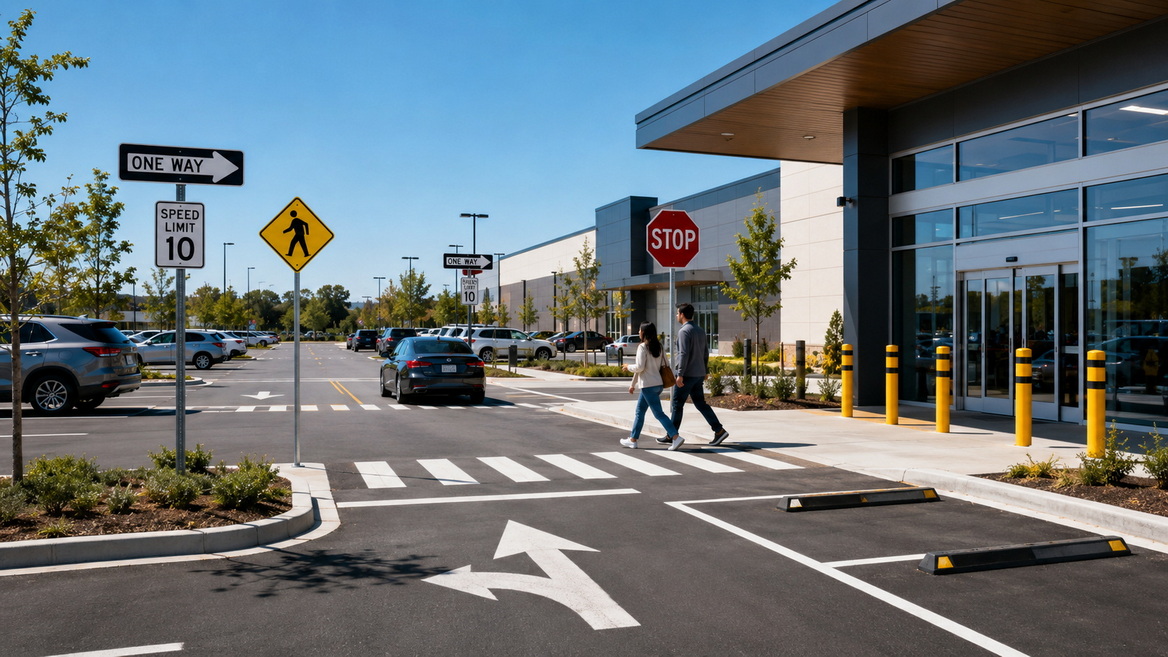
Road users often have only a few seconds to recognize a sign, understand its meaning, and react safely. This makes every part of a sign important, including its shape, color, symbol, size, mounting position, reflective surface, and viewing distance.
Effective road signs help people answer three key questions:
1. What must I do?
Examples include STOP, DO NOT ENTER, SPEED LIMIT, NO PARKING, and ONE WAY.
2. What hazard is ahead?
Examples include pedestrian crossings, speed humps, construction work, sharp curves, and truck entrances.
3. Where should I go?
Examples include EXIT, ENTRANCE, VISITOR PARKING, DELIVERY AREA, accessible parking, and toll lanes.
When traffic signs are faded, blocked, poorly positioned, or overloaded with text, drivers may miss important instructions. In busy environments, a missed message can lead to sudden braking, wrong-way driving, vehicle conflicts, property damage, or pedestrian risk.
A well-planned sign system creates a more predictable environment. It helps drivers make decisions earlier and gives pedestrians clearer guidance about where to walk safely.
Regulatory signs tell drivers what they must do, what they may not do, or which movements are allowed. These signs establish the operating rules of a road, parking lot, toll facility, or private property.
Common regulatory sign messages include:
- STOP
- YIELD
- SPEED LIMIT
- DO NOT ENTER
- WRONG WAY
- ONE WAY
- NO PARKING
- FIRE LANE—NO PARKING
- KEEP RIGHT
- NO LEFT TURN
- NO U-TURN
- ACCESSIBLE PARKING ONLY
Regulatory signs are especially important in locations where drivers must make immediate decisions. They should be clear, easy to recognize, and installed where drivers have enough time to slow down or change direction.
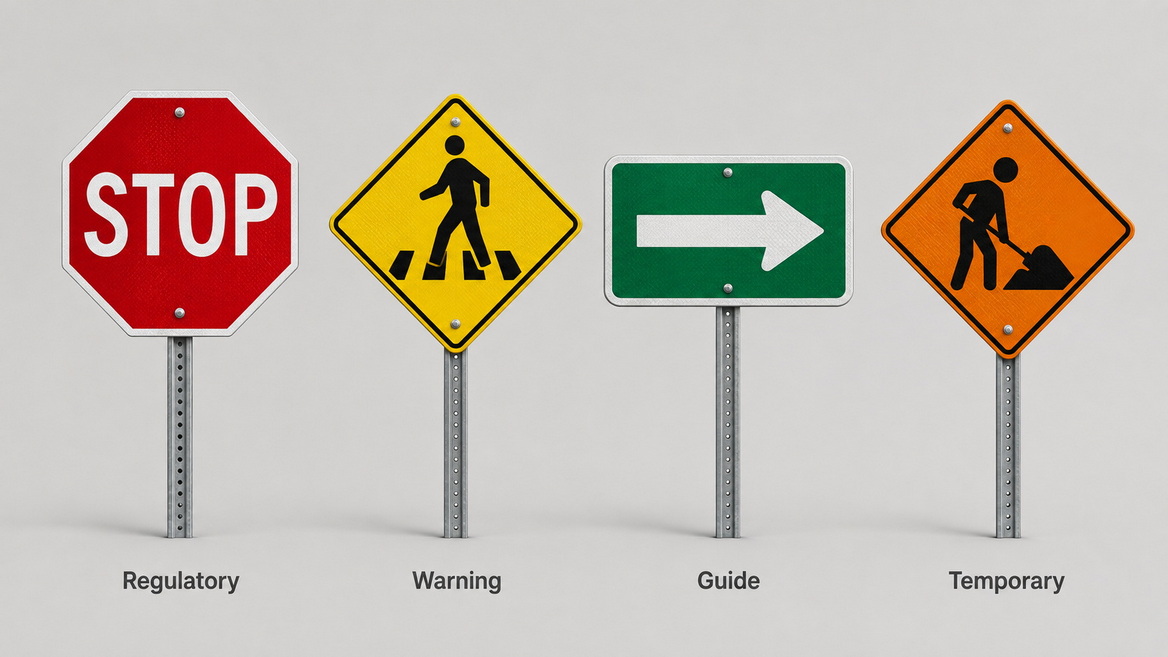
A STOP sign is one of the most recognizable traffic signs in the world. Its red octagonal shape is designed to stand out quickly, even when a driver sees the sign from a distance or at an angle.
STOP signs are commonly used at:
- Parking lot exits connecting to public roads
- Intersections within commercial parking areas
- Loading-dock access lanes
- Blind corners with restricted visibility
- Crosswalk approaches
- High-pedestrian-traffic locations
- Internal road intersections in industrial parks
- Emergency access routes
A STOP sign requires a complete stop. Drivers must check for pedestrians, bicycles, vehicles, and other hazards before proceeding.
However, adding more STOP signs is not always the best solution. Too many unnecessary STOP signs can encourage drivers to ignore them. A better approach is to evaluate the entire area, including sightlines, traffic speed, lane markings, crosswalk visibility, lighting, landscaping, and vehicle movement patterns.
A YIELD sign tells drivers to slow down and give priority to other traffic or pedestrians when necessary. Unlike a STOP sign, it does not always require a full stop.
Yield signs are useful at:
- Parking-lot aisle intersections
- Vehicle merge points
- Private-road entrances
- Roundabout approaches
- Garage exits
- Shared pedestrian and vehicle zones
- Toll-station traffic lanes
Yield signs work best in locations where drivers have a clear view of approaching traffic. If visibility is restricted, a STOP sign or other traffic-control measure may be more appropriate.
Speed control is critical in parking lots, campuses, logistics yards, hospitals, residential communities, and commercial properties. Although vehicles usually travel at low speeds in these areas, pedestrians and reversing vehicles create frequent conflict points.
Speed-related signs may include:
- SPEED LIMIT 5 MPH
- SPEED LIMIT 10 MPH
- SLOW
- DRIVE SLOWLY
- PEDESTRIANS PRESENT
- CHILDREN AT PLAY
- TRUCK CROSSING
- SPEED HUMP AHEAD
These signs should be placed at property entrances, near building entrances, before crosswalks, at parking-garage ramps, and near delivery areas. They are more effective when paired with pavement markings, speed humps, bollards, lane narrowing, or other physical traffic-calming measures.
Warning signs notify drivers about hazards, changes in road conditions, or situations that require extra attention. They help drivers prepare before they reach the danger area.
Common warning sign messages include:
- Pedestrian Crossing
- School Crossing
- Bicycle Crossing
- Speed Hump Ahead
- Bump Ahead
- Sharp Curve Ahead
- Low Clearance
- Truck Crossing
- Lane Merge Ahead
- Slippery When Wet
- Narrow Lane
- Railroad Crossing
- Deer Crossing
- Construction Ahead
Warning signs should be installed before the hazard, not directly at the point of danger. A driver needs time to read the sign, understand the message, reduce speed, and react safely.
Pedestrian safety is a major concern in parking lots. People may walk between parked vehicles, cross driving lanes unexpectedly, carry shopping bags, push carts, use mobile phones, or travel with children.
Pedestrian crossing signs are especially important near:
- Retail-store entrances
- Shopping centers
- Hospitals and clinics
- Schools and campuses
- Apartment communities
- Transit pickup points
- Office buildings
- Hotels
- Stadiums and event venues
- Parking garages
A pedestrian crossing sign becomes more effective when it is supported by visible pavement markings and a well-designed crossing area.
A safer pedestrian crossing zone may include:
- Pedestrian crossing signs
- High-visibility crosswalk markings
- Yield-to-pedestrian signs
- Advance warning signs
- Raised crossings or speed humps
- Bollards near building entrances
- Improved lighting
- Reflective pavement markers
- Directional pedestrian signs
- Barrier systems separating walkways from vehicle lanes
The goal is to make pedestrians visible and make drivers expect them.
Speed humps and speed bumps can reduce vehicle speed, but they must be clearly marked and visible. A driver who does not see a speed-control device in time may brake suddenly or drive over it too quickly.
Recommended supporting products include:
- SPEED HUMP AHEAD signs
- BUMP signs
- Reflective pavement markings
- Chevron or arrow markings
- Reflective road studs
- Flexible delineator posts
- Solar warning lights where appropriate
Speed-control warning signs are particularly useful in parking garages, schools, hospital grounds, apartment complexes, warehouses, and commercial areas with frequent pedestrian activity.
Guide signs help drivers find entrances, exits, destinations, parking zones, services, and internal routes. They are essential in large or unfamiliar facilities where visitors may not know where to go.
Typical guide sign messages include:
- ENTRANCE
- EXIT
- VISITOR PARKING
- STAFF PARKING
- CUSTOMER PICKUP
- DELIVERY ENTRANCE
- LOADING DOCK
- TRUCK ROUTE
- TAXI PICKUP
- RIDESHARE PICKUP
- EV CHARGING
- PARKING GARAGE
- BUILDING A
- BUILDING B
- RESTROOMS
- ACCESSIBLE ENTRANCE
Clear guide signage reduces driver hesitation. When drivers are unsure where to turn, they may stop unexpectedly, reverse in active lanes, make illegal turns, or enter the wrong section of a facility.
One-way traffic systems are highly effective in busy parking lots, logistics centers, industrial facilities, toll stations, and parking garages. They help prevent head-on conflicts and make traffic movement more predictable.
A one-way circulation plan should use multiple visual elements:
- ONE WAY signs
- Directional arrow signs
- Pavement arrows
- Entrance and exit signs
- Lane lines
- Curb markings
- Flexible posts or delineators
- Traffic cones during temporary changes
- Barrier systems where wrong-way driving is likely
A single ONE WAY sign at the beginning of a lane may not be enough. Large parking areas often require repeated signs so drivers can remain oriented after making several turns.
Temporary traffic-control signs guide drivers, pedestrians, and workers through construction, maintenance, resurfacing, utility work, lane closures, and emergency repairs.
These signs are commonly used for:
- Road maintenance
- Parking lot resurfacing
- Utility excavation
- Sidewalk repair
- Building construction
- Lane closures
- Pavement painting
- Drainage work
- Emergency maintenance
- Event traffic control
Typical temporary sign messages include:
- ROAD WORK AHEAD
- WORKERS AHEAD
- LANE CLOSED AHEAD
- RIGHT LANE CLOSED
- DETOUR
- FLAGGER AHEAD
- SHOULDER CLOSED
- SIDEWALK CLOSED
- TRUCKS ENTERING
- CONSTRUCTION ENTRANCE
Temporary traffic-control systems should be planned as a complete safety setup. Signs should be supported by traffic cones, barricades, warning lights, delineator posts, safety barriers, temporary lane markings, and clear pedestrian detours where required.
When work is finished, temporary signs should be removed promptly. Outdated signs can confuse drivers and reduce respect for future work-zone warnings.
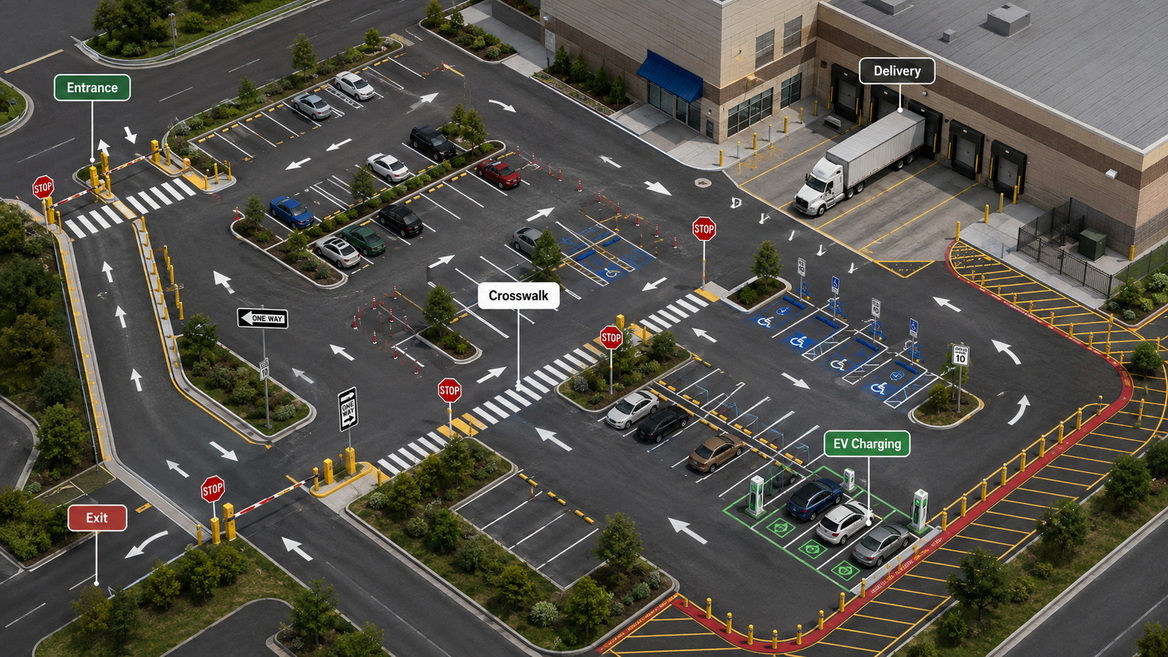
Parking lots are not simply open spaces for storing vehicles. They are active traffic environments where drivers, pedestrians, delivery vehicles, bicycles, carts, and emergency vehicles may share the same area.
The most effective parking lot safety signs focus on predictable conflict points.
| Parking Lot Area | Recommended Signs | Supporting Safety Products |
|---|---|---|
| Property entrance | STOP, YIELD, SPEED LIMIT, directional arrows | Entry markings, lighting, lane dividers |
| Main driving aisles | ONE WAY, directional arrows, SPEED LIMIT | Pavement arrows, lane lines, delineators |
| Pedestrian crossings | Pedestrian Crossing, Yield to Pedestrians, SLOW | Crosswalk markings, bollards, speed humps |
| Fire lanes | FIRE LANE—NO PARKING | Red curb paint, no-parking markings |
| Loading areas | DELIVERY ONLY, TRUCKS ENTERING, NO PEDESTRIAN ACCESS | Safety barriers, marked walkways |
| Parking garages | LOW CLEARANCE, STOP, DOWN RAMP, EXIT | Reflective strips, convex mirrors, guardrails |
| Accessible parking | Accessible Parking, Van Accessible, Tow-Away Warning | Accessible route markings, wheel stops |
| EV charging areas | EV CHARGING ONLY, Charging Instructions | Wheel stops, cable protection, bay markings |
| Reserved areas | RESERVED PARKING, VISITOR PARKING, STAFF ONLY | Space numbers, directional signs |
Fire lanes must remain clear for emergency vehicles. A blocked fire lane can delay emergency response and create serious safety consequences.
Fire-lane areas should use a combination of:
- FIRE LANE—NO PARKING signs
- Red-painted curbs where permitted
- Pavement lettering
- Tow-away notices where applicable
- Reflective signs for nighttime visibility
- Regular enforcement and inspection
Accessible parking signs help ensure that designated spaces remain available for people who need them. These signs should be visible from the driving aisle and installed with clearly marked accessible spaces and accessible travel routes.
Depending on the facility and local requirements, accessible parking areas may need:
- Accessible parking signs
- Van-accessible signs
- Reserved parking symbols
- Access aisle markings
- Directional signs to accessible entrances
- No-parking markings around access aisles
- Wheel stops positioned to protect pedestrian routes
Delivery zones often involve large trucks, reversing vehicles, pallet jacks, forklifts, and pedestrian workers. Clear signs help separate truck traffic from passenger vehicles and walking routes.
Useful signs may include:
- DELIVERY ENTRANCE
- TRUCK ROUTE
- LOADING DOCK
- TRUCKS BACKING
- NO PEDESTRIAN ACCESS
- KEEP CLEAR
- AUTHORIZED VEHICLES ONLY
- MAXIMUM HEIGHT
- MAXIMUM WEIGHT
- DO NOT BLOCK DOCK DOOR
In busy logistics environments, signs should be combined with barriers, wheel chocks, dock bumpers, floor markings, mirrors, and clearly defined pedestrian pathways.
A strong parking lot sign plan begins with observation. Before selecting products, walk through the property as a visitor, employee, delivery driver, pedestrian, parent with children, and emergency responder.
Review the site for locations where people or vehicles may conflict.
Common high-risk areas include:
- Entrances and exits
- Blind corners
- Pedestrian crossings
- Parking-garage ramps
- Reversing zones
- Truck routes
- Delivery entrances
- Crosswalks near building entrances
- Fire lanes
- Poorly lit areas
- Narrow circulation lanes
- Confusing intersections
Look for actual behavior, not only the planned layout. If drivers routinely travel in the wrong direction, park in fire lanes, ignore crossings, or cut across pedestrian paths, the site may need clearer signs and supporting traffic-control products.
Every sign should have a clear job. Avoid installing multiple signs with overlapping or conflicting messages.
Use signs to:
- Regulate traffic behavior
- Warn about hazards
- Guide users to destinations
- Inform drivers about site rules
- Separate vehicles from pedestrians
- Support traffic flow during temporary changes
For example, a pedestrian conflict near a retail entrance may require more than a single pedestrian sign. A stronger solution could include a high-visibility crosswalk, speed hump, yield sign, bollards, improved lighting, and pavement markings.
A sign must be visible before the driver reaches the decision point. Drivers need time to see the message, understand it, and respond safely.
When selecting sign locations, consider:
- Viewing distance
- Vehicle speed
- Sign size
- Mounting height
- Reflective performance
- Nearby lighting
- Sun glare
- Obstructions from trees or parked vehicles
- Building signs and advertising clutter
- Road curves and elevation changes
- Seasonal landscaping growth
A sign that is technically installed but hidden from approaching traffic does not provide effective safety value.
Traffic signs are strongest when supported by other visual and physical controls.
Examples include:
- STOP signs with stop bars
- ONE WAY signs with pavement arrows
- Pedestrian crossing signs with crosswalk markings
- Speed hump signs with reflective pavement stripes
- Fire-lane signs with curb paint
- No-parking signs with hatch markings
- Truck route signs with barriers or directional delineators
- Garage clearance signs with hanging clearance bars
This layered approach makes the traffic message easier to understand, even if a driver misses one visual cue.
Traffic signs should be inspected as part of a routine property safety program. Weather, UV exposure, vehicle impacts, construction activity, landscaping, and vandalism can reduce sign visibility over time.
A practical inspection checklist includes:
- Is the sign face faded, dirty, cracked, or damaged?
- Is the sign post secure and upright?
- Is the sign blocked by vegetation or parked vehicles?
- Is the message still appropriate for the current traffic pattern?
- Are pavement arrows and crosswalks clearly visible?
- Does the sign remain visible at night?
- Are temporary signs still needed?
- Have new buildings, parking spaces, or delivery routes changed traffic movement?
Regular maintenance helps a site remain organized, professional, and safer for every user.
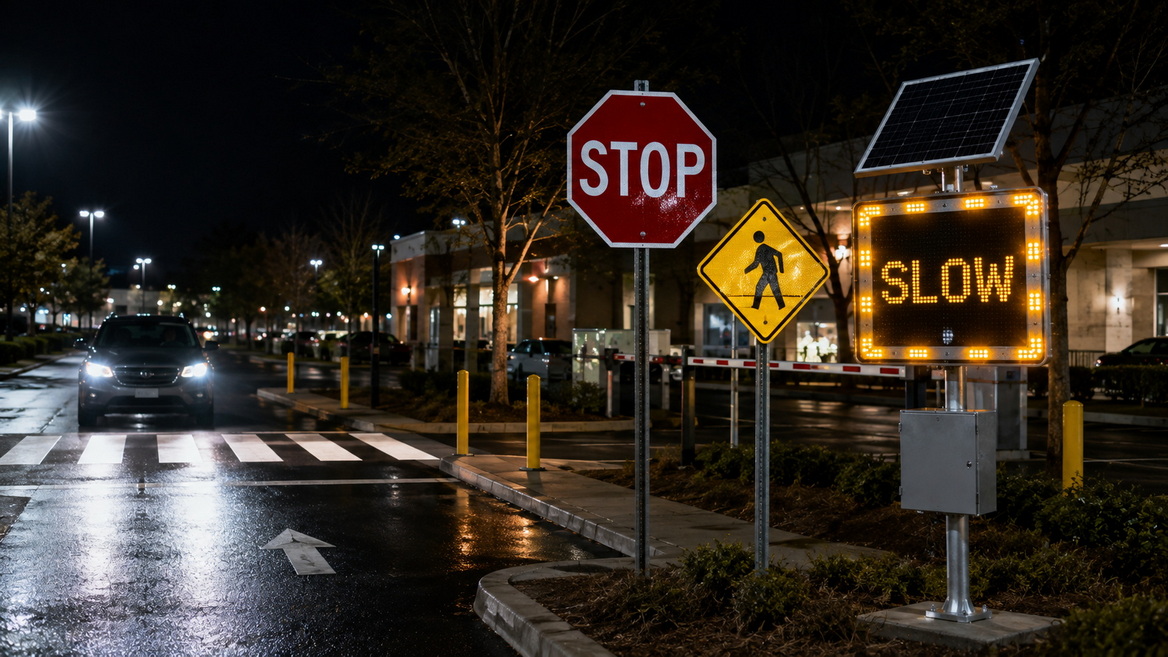
Low light, rain, fog, nighttime operation, and visual clutter can make ordinary signs difficult to notice. Reflective signs and LED-enhanced warning products can improve visibility in locations where drivers need additional notice.
Reflective or illuminated traffic signs can be useful for:
- Parking lot entrances
- Pedestrian crossings
- Parking-garage ramps
- Toll stations
- Industrial entrances
- Construction zones
- School zones
- Hospital campuses
- Dark access roads
- High-risk curves
- Truck entrances
- Emergency access points
Retroreflective sheeting returns light from vehicle headlights toward the driver, making a sign easier to see at night. Different reflective grades can be selected based on the environment, expected vehicle speed, required visibility, and project specifications.
Solar-powered LED warning signs may be a suitable option for locations with repeated safety concerns, especially where electrical wiring is difficult or expensive. Flashing LED borders or beacons can draw attention to pedestrian crossings, speed humps, sharp turns, school zones, and temporary work areas.
However, enhanced visibility products work best when they are part of a complete traffic safety plan. Clear sign placement, visible markings, appropriate lighting, well-managed vehicle speeds, and separated pedestrian routes remain essential.
Standardized sign shapes, colors, and symbols help drivers recognize messages quickly. Familiar designs reduce the time needed to understand whether to stop, yield, turn, slow down, or avoid a restricted area.
At the same time, many private facilities need customized traffic safety products to match their specific layout, operating conditions, and brand requirements.
Customized sign solutions may include:
- Custom sign dimensions
- Aluminum sign blanks
- Different metal thickness options
- Reflective sheeting selection
- Customized legends and symbols
- Directional arrows
- Company logos
- Multilingual sign content
- English, Chinese, Spanish, or other language options
- Custom mounting holes
- Brackets, clamps, and posts
- Parking-lot zone numbers
- Private-property rules
- Toll-station lane messages
- LED and solar warning solutions
- Matching bollards, wheel stops, cones, barriers, and delineator posts
For safety-critical messages, customization should preserve clear and recognizable sign conventions. The message should remain easy to understand for visitors, employees, drivers, and emergency personnel.
Road signs are more than facility accessories. They are practical safety tools that help guide behavior, reduce confusion, protect pedestrians, and support smooth traffic movement.
A well-designed traffic safety system should combine:
- Clear regulatory signs
- Advance warning signs
- Directional and guide signs
- Pedestrian crossing controls
- Pavement markings
- Reflective materials
- Lighting and LED warning products
- Traffic-calming solutions
- Physical separation between pedestrians and vehicles
- Routine inspection and maintenance
Shenzhen Xingsheng Traffic Facilities Co., Ltd. supports customers with traffic safety products for streets, highways, parking lots, toll stations, commercial facilities, construction areas, logistics centers, and industrial properties. Standard and customized OEM/ODM solutions can be developed according to the project's product specifications, installation conditions, safety goals, and market requirements.
A safer traffic environment starts with clear communication, visible guidance, and reliable traffic safety facilities designed for real-world use.
The main types of road signs include regulatory signs, warning signs, guide signs, temporary traffic-control signs, pedestrian signs, school-area signs, bicycle signs, and railroad-crossing signs. Regulatory signs establish rules, warning signs alert drivers to hazards, and guide signs help users navigate to destinations.
Most parking lots need STOP signs, YIELD signs, speed-limit signs, ONE WAY signs, pedestrian-crossing signs, accessible-parking signs, fire-lane signs, entrance and exit signs, directional signs, and parking-area identification signs. The exact sign selection should depend on the site layout, traffic volume, pedestrian activity, and facility type.
Pedestrian crossing signs remind drivers to look for people walking through the parking area. They are especially important near storefronts, schools, hospitals, apartment buildings, transit stops, and building entrances. These signs are most effective when paired with visible crosswalks, good lighting, speed-control measures, and clear pedestrian routes.
Reflective parking lot signs are recommended for areas used at night, during rain, inside parking garages, or in locations with limited lighting. Reflective materials help drivers see sign messages when headlights illuminate the sign face.
Parking lot signs should be checked regularly and after storms, vehicle impacts, resurfacing work, landscaping changes, construction projects, or traffic incidents. Replace signs that are faded, damaged, blocked, missing, or no longer suitable for the current traffic layout.
1. Federal Highway Administration. "Manual on Uniform Traffic Control Devices for Streets and Highways."
2. Federal Highway Administration. "MUTCD 11th Edition."
[https://mutcd.fhwa.dot.gov/kno_11th_Edition.htm]
3. Federal Highway Administration. "Lesson 10: Pedestrian Facility Signing and Pavement Markings."
[https://highways.dot.gov/media/73471]
4. Federal Highway Administration. "Actions to Increase the Safety of Pedestrians Accessing Transit."
5. National Safety Council. "Parking Lots & Distracted Driving."
[https://www.nsc.org/road/safety-topics/distracted-driving/parking-lot-safety]
6. Insurance Institute for Highway Safety. "Park Assist Helps Drivers Avoid Backing Crashes."
[https://www.iihs.org/news/detail/park-assist-helps-drivers-avoid-backing-crashes]
7. Traffic Safety Warehouse. "What Each Type of Road Sign Means."
[https://www.trafficsafetywarehouse.com/Resources/what-each-type-of-road-sign-means.asp]


