
Please Choose Your Language
Views: 259 Author: XS Traffic Facilities Publish Time: 2026-09-03 Origin: Site


Content Menu
● Why Event Traffic Control Needs Careful Planning
● How Police Direct Traffic During Events
>> Establishing Traffic Priorities
>> Directing Vehicles Through Controlled Intersections
>> Managing Parking-Lot Entrances and Exits
>> Protecting Pedestrian Movement
● Essential Traffic Safety Equipment for Events
>> Traffic Delineators and Flexible Bollards
>> Barricades and Crowd-Control Barriers
>> Directional Signs and Temporary Traffic Signs
>> High-Visibility Apparel and LED Traffic Batons
● Building a Safer Event Traffic Plan
>> Map the Complete Traffic Journey
>> Plan Arrival and Departure Separately
● Common Event Traffic-Control Mistakes
>> Relying Only on Officers or Parking Attendants
>> Mixing Pedestrians With Outbound Vehicles
>> Ignoring Nearby Traffic and Communities
>> Treating the End of the Event as an Afterthought
● Traffic Safety Solutions for Events and Parking Areas
● Summary
>> What equipment do police use to direct traffic at events?
>> Why are traffic cones important for event parking lots?
>> How can event organizers protect pedestrians?
>> How should emergency access be managed during an event?
>> What is the difference between event traffic ingress and egress?
Managing vehicle and pedestrian movement during a concert, parade, sports game, festival, exhibition, or large public gathering requires far more than placing an officer at an intersection. Police officers, event staff, parking attendants, security teams, and emergency responders must work from a clear traffic plan that protects people, keeps emergency routes open, and moves vehicles through the area with minimal confusion.
Effective event traffic control combines trained personnel with highly visible traffic safety equipment. Traffic cones, barricades, directional signs, flexible delineators, reflective devices, wheel stops, and LED traffic batons all help turn a busy event site into an organized and understandable traffic environment.
For venue operators, public agencies, parking-lot managers, contractors, and event organizers, the goal is not simply to make traffic move faster. The priority is to create a safer flow for vehicles, pedestrians, emergency responders, and nearby communities.
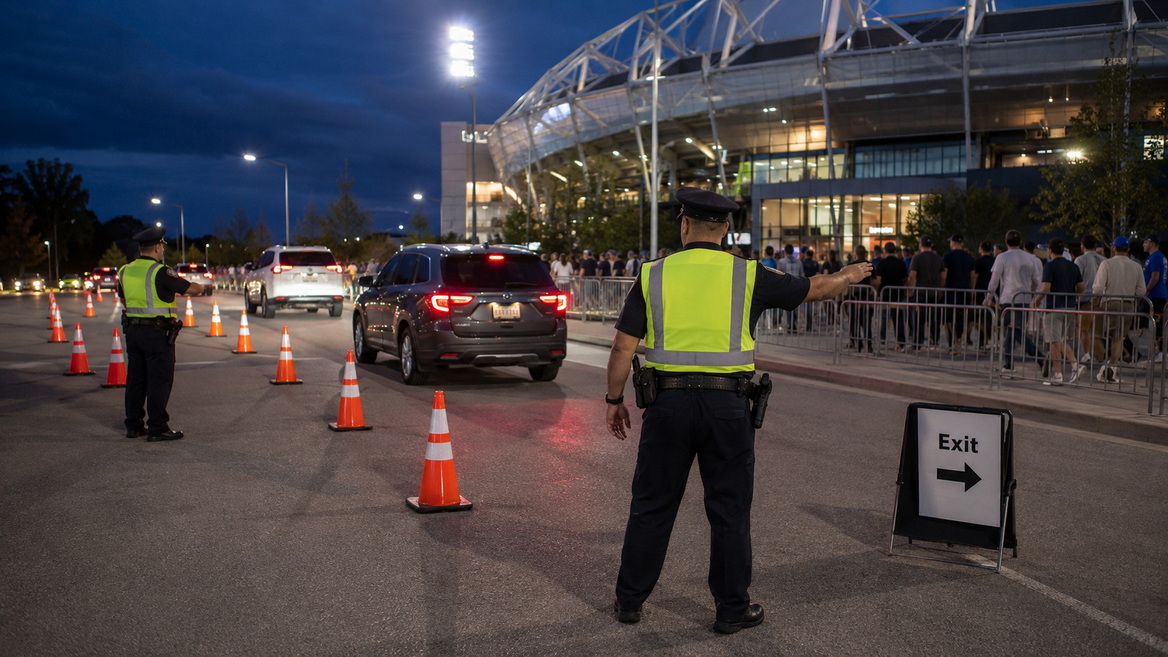
Large events can temporarily transform an ordinary road network into a high-pressure transportation environment. Roads, parking lots, venue entrances, sidewalks, shuttle zones, and nearby intersections may experience heavy demand within a short time.
A well-prepared event traffic plan considers every person and vehicle that may be affected, including:
- Event attendees arriving by private vehicle
- Vehicles leaving the venue after the event
- Pedestrians walking between parking areas and entrances
- Shuttle buses, taxis, and rideshare vehicles
- Emergency-response vehicles
- Delivery vehicles and venue-service vehicles
- Local residents and businesses
- Commuters and other non-event traffic
The strongest operations do not treat traffic as one large queue. Instead, they divide different traffic movements into clear and manageable routes.
For example, event attendees may arrive through one entrance, buses may use a dedicated access lane, pedestrians may follow a protected walking route, and emergency vehicles may use a separate route that is never blocked by parked cars or waiting vehicles.
This separation reduces uncertainty. When drivers and pedestrians can immediately understand where they need to go, they are less likely to make sudden stops, unsafe turns, or risky crossings.
Police officers play a central role in event traffic operations because they can respond to changing conditions in real time. They may temporarily stop one direction of traffic, release another movement, redirect vehicles around congestion, control pedestrian crossings, or coordinate emergency access.
Their role is especially important when event traffic exceeds the normal capacity of an intersection, parking entrance, or nearby roadway.
During a busy event, not every traffic movement can happen at the same time. Police officers may need to give priority to certain vehicles or directions based on congestion, pedestrian activity, emergency needs, and the overall traffic plan.
For example, after a major sports event, thousands of vehicles may attempt to leave parking areas within the same 30- to 60-minute period. Officers may temporarily stop traffic on nearby roads to allow outbound vehicles to exit the venue safely.
Common traffic priorities may include:
- Keeping emergency routes open
- Clearing pedestrian crossings safely
- Moving shuttle buses through dedicated access areas
- Releasing outbound parking-lot traffic after an event
- Preventing vehicles from blocking nearby intersections
- Reducing conflicts between turning vehicles and pedestrians
- Maintaining access for local residents and businesses
Officers often use hand signals, whistles, radios, high-visibility clothing, traffic batons, and portable signs to communicate with drivers. However, visible equipment should support their instructions.
A driver should understand the lane direction, parking route, closure, or required turn before reaching the officer. This reduces hesitation and helps prevent sudden braking or dangerous lane changes.
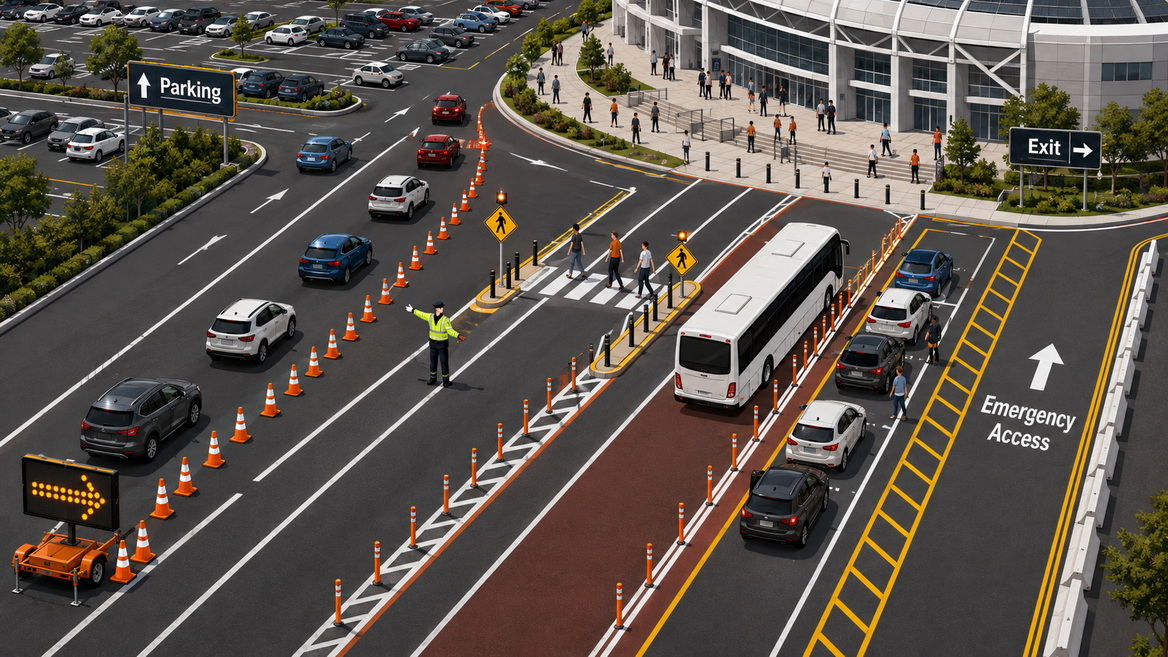
At a normal intersection, traffic signals create predictable movement patterns. During a large event, however, traffic signals may not be enough to manage the unusual volume of vehicles.
Police officers may direct traffic at intersections to:
- Hold one direction of traffic temporarily
- Give priority to parking-lot exits
- Allow buses to turn safely
- Protect large groups of pedestrians
- Prevent traffic queues from blocking intersections
- Manage a temporary road closure
- Redirect traffic away from crowded or restricted areas
At these locations, traffic cones, barricades, signs, and delineators make the officer's direction easier to follow. Equipment should create a visible path so drivers do not need to guess which lane to use.
Parking areas are often the most challenging part of event traffic management. A parking lot may contain hundreds or thousands of vehicles, pedestrians walking between parked cars, buses, rideshare vehicles, and delivery traffic.
Without a clear parking-lot traffic plan, even a well-organized road network can become congested.
Police and event teams may use several strategies to improve parking-lot safety:
- Assign separate entrance and exit lanes
- Create one-way circulation routes
- Use traffic cones to guide vehicles into parking rows
- Set up overflow parking before the main lot becomes full
- Mark pedestrian crossings with signs and barriers
- Separate bus, taxi, and rideshare zones from private vehicles
- Keep fire lanes and emergency routes clear
- Use parking attendants to direct drivers into available spaces
- Close unsafe turns during peak traffic periods
The best parking-lot plans reduce crossing movements. A vehicle leaving a row should not need to cross multiple incoming lanes, pedestrian paths, and shuttle routes before reaching the exit.
Pedestrian safety should be a central part of every event traffic plan. Large crowds often leave venues at the same time, and many people may be unfamiliar with the parking area, distracted by their phones, carrying bags, walking with children, or moving in groups.
Drivers may also be tired, impatient, unfamiliar with the area, or focused on finding the quickest exit.
The safest approach is to create a protected and continuous pedestrian route between parking areas, transit stops, venue entrances, and nearby streets.
Key pedestrian-control measures include:
- Clearly marked crosswalks
- Temporary pedestrian barriers
- Directional signs
- Cone-lined walking routes
- Lighting for evening events
- Staff or officers at major crossings
- Separate pedestrian routes near shuttle stops
- Physical barriers between foot traffic and moving vehicles
- Clearly marked accessible routes
Pedestrians should never be forced to walk through an active vehicle lane simply because it is convenient for traffic flow. A properly designed route gives people a visible and protected path from the parking area to the venue.
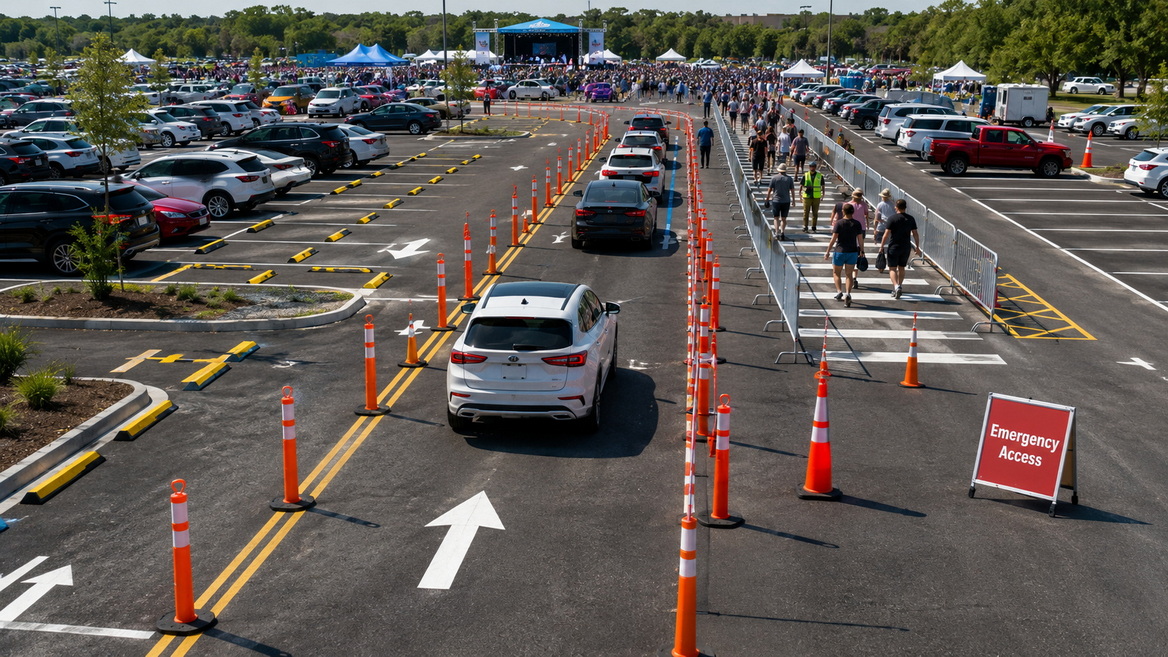
Traffic safety equipment helps police officers and event teams create order quickly. It provides visual guidance, creates physical separation, communicates restrictions, and helps drivers recognize changing traffic conditions before they reach a problem area.
The equipment needed for each event depends on the event size, road speed, weather, visibility, venue layout, pedestrian volume, and local traffic requirements.
Traffic cones are among the most practical and flexible tools for temporary traffic control. They can be deployed quickly, moved as conditions change, and used in a wide range of environments.
Traffic cones can be used to:
- Form temporary vehicle lanes
- Create a visible lane taper
- Guide vehicles toward parking entrances
- Close a parking row or roadway lane
- Separate pedestrian routes from vehicle paths
- Mark hazards or obstructions
- Reserve emergency access lanes
- Identify restricted areas
- Direct vehicles around a closure
For evening events, parking garages, low-light conditions, or roads with faster-moving traffic, reflective collars help improve visibility.
Cones should be placed in a consistent pattern. Random or uneven placement can confuse drivers and create unnecessary conflict points.
Traffic delineators and flexible bollards are useful when a stronger visual boundary is needed. They are taller than standard cones and can help drivers recognize lane edges, vehicle restrictions, parking-lot circulation routes, and pedestrian boundaries.
These products are often used in:
- Parking-lot entrances and exits
- Toll stations
- Temporary lane shifts
- Shuttle-bus lanes
- Drive-through lanes
- Restricted-access areas
- Roadway construction zones
- Event perimeter routes
Flexible bollards can be especially useful in areas where vehicles may occasionally make contact with a lane-separation device. Their flexible structure can reduce damage while maintaining a visible traffic boundary.
Barricades create a more substantial physical and visual restriction than cones. They are useful when traffic must not enter a roadway, parking lane, access gate, pedestrian zone, or closed area.
Common uses include:
- Closing a road or driveway
- Blocking unsafe parking areas
- Separating pedestrian crowds from moving traffic
- Preventing unauthorized vehicles from entering restricted zones
- Creating temporary event entrances
- Protecting queue areas
- Marking emergency-access-only routes
- Supporting detour and closure operations
Crowd-control barriers can also help guide people through orderly walking routes. This is particularly useful at festivals, outdoor exhibitions, stadiums, concerts, ticket gates, transit stops, and public celebrations.
Barricades should always be visible from a safe distance. In low-light conditions, reflective materials, warning lights, or illuminated devices can improve recognition.
Clear signs reduce hesitation and decision-making pressure for drivers. At an event, a sign should provide one immediate instruction or piece of information.
Useful signs may include:
- Event parking
- Parking entrance
- Parking exit
- Overflow parking
- Road closed ahead
- Detour
- One-way traffic
- Shuttle-bus loading
- Rideshare pick-up
- Taxi area
- Pedestrian crossing
- Accessible parking
- Emergency access only
- No parking
- Tow-away zone
Signs should be placed before the driver reaches the decision point. If a sign appears too late, drivers may stop suddenly, reverse, make unsafe turns, or block other traffic.
For larger events, portable electronic message boards can provide flexible updates, such as parking availability, route changes, closures, weather alerts, and instructions for attendees.
Police officers, traffic controllers, parking attendants, and emergency personnel need to be highly visible, especially at night or during poor weather.
High-visibility vests, reflective clothing, warning lights, and LED traffic batons help drivers see personnel sooner and understand their instructions more clearly.
LED traffic batons can be particularly useful for:
- Nighttime event exits
- Parking garages
- Tunnel approaches
- Rain or fog conditions
- Road closures
- High-volume parking-lot exits
- Shuttle-bus loading zones
- Emergency vehicle access points
These tools work best when combined with clear lane markings, cones, signs, and physical barriers. A traffic baton can communicate "stop" or "proceed," but it cannot replace a complete traffic-control layout.
A successful event traffic plan starts before equipment arrives at the site. Organizers should understand how vehicles, pedestrians, staff, suppliers, emergency responders, and local traffic will move throughout the event period.
A strong traffic plan does not begin at the venue gate. It begins where attendees first approach the event area.
Review the entire route from major roads to the final parking space, including:
- Highway and arterial-road approaches
- Local streets near the venue
- Event parking entrances
- Parking-lot circulation lanes
- Overflow parking areas
- Pedestrian routes
- Shuttle-bus stops
- Rideshare zones
- Taxi and drop-off areas
- Delivery access points
- Emergency routes
- Nearby intersections
- Residential and business access points
This full-route approach helps teams identify where traffic may queue, where pedestrians may cross unexpectedly, and where drivers may need advance guidance.
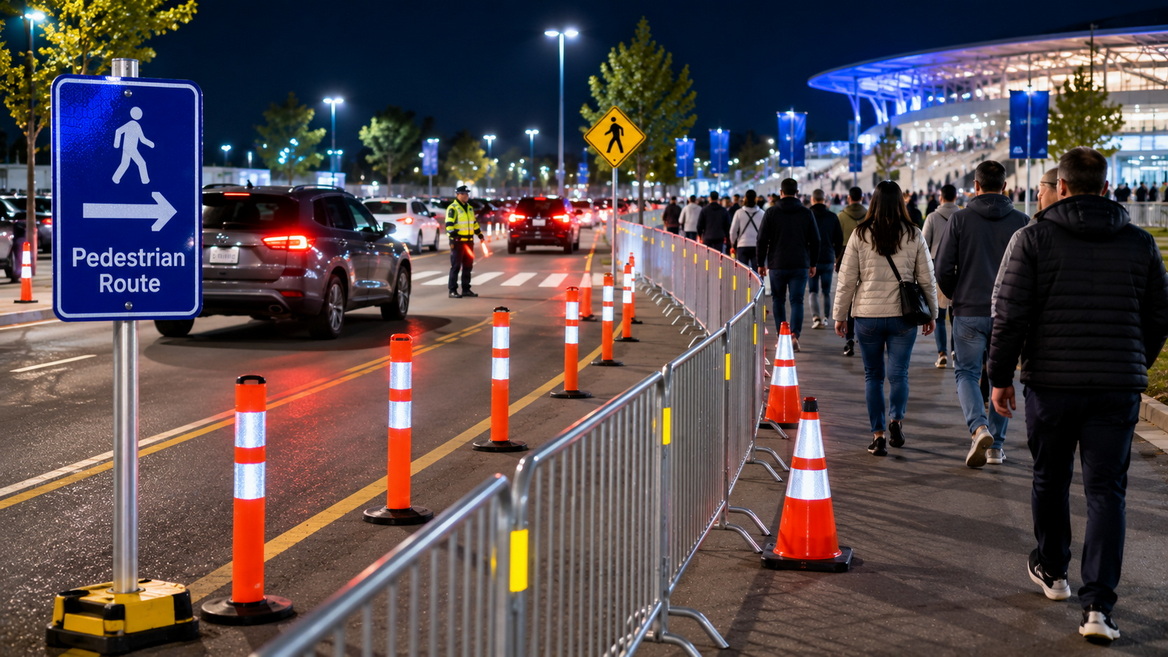
Arrival traffic and departure traffic create different operational challenges.
Arrival traffic is usually spread across several hours. Visitors may come from different directions, arrive at different times, and search for parking spaces.
Departure traffic is often more concentrated. Many attendees may leave at the same time, creating pressure at parking-lot exits, intersections, nearby roads, and transit locations.
A complete event plan should include separate procedures for:
- Normal arrivals
- Peak arrival periods
- Parking-lot overflow
- Early departures
- Mass departures after the event
- Delayed event endings
- Severe weather
- Vehicle breakdowns
- Road incidents
- Emergency evacuation
- Late-night traffic conditions
One-way outbound routes can be particularly effective after a major event. Instead of allowing vehicles to move in multiple directions, traffic teams may temporarily direct most vehicles through a controlled exit route.
This approach can reduce conflict points and help parking lots clear more efficiently.
Emergency access is not optional. Ambulances, fire vehicles, police units, and venue emergency teams must be able to enter and leave the site without delay.
A marked emergency lane is only effective if it remains physically clear throughout the event.
To protect emergency access:
- Clearly mark the route with signs and cones
- Use barriers to prevent unauthorized vehicle entry
- Keep parked vehicles away from the route
- Avoid directing normal event traffic across the emergency path
- Assign staff to critical intersections
- Brief all personnel on emergency procedures
- Ensure gate staff understand who can authorize access
- Review the route during the event for obstructions
Emergency routes should also be considered in parking-lot design. A narrow drive aisle that becomes blocked by vehicles waiting to exit can quickly become a serious operational problem.
A traffic plan may appear clear on paper but fail in the real environment. A site walkthrough helps organizers identify practical issues before event day.
During the walkthrough, look for:
- Limited sight distance
- Blind corners
- Poor nighttime lighting
- Narrow turning areas
- Uneven pavement
- Conflicting driveways
- Existing road construction
- Sign-placement limitations
- Obstacles near pedestrian crossings
- Bus and truck turning requirements
- Areas where pedestrians may take shortcuts
- Locations where traffic queues could block access
Photos, short videos, and route diagrams can help the full team understand the final layout. They are also useful for briefing parking attendants, security staff, police officers, traffic-control contractors, and venue personnel.
Even the best equipment layout will not work if field personnel receive inconsistent instructions.
Before the event begins, teams should understand:
- Their assigned locations
- Start and end times
- Radio channels and contact persons
- Parking-lot opening and closing procedures
- Emergency escalation procedures
- Pedestrian-control responsibilities
- Overflow parking triggers
- Road closure procedures
- Sign and barricade placement
- Weather-related changes
- Who can make operational decisions
A short, practical briefing before each shift can prevent confusion. Personnel should know not only what to do during normal conditions, but also what to do if parking fills early, traffic backs up unexpectedly, or an emergency vehicle needs immediate access.
Many traffic problems are preventable. The following mistakes can create unnecessary safety risks, congestion, and frustration.
Personnel are important, but they cannot safely manage every movement without physical guidance. Traffic cones, barricades, signs, and delineators show drivers where to go before they reach a control point.
A clear traffic layout reduces the need for repeated verbal instructions and makes the site safer when staffing levels are limited.
Drivers need time to see, understand, and react to instructions. A "Parking Entrance" sign placed directly at a turn may cause sudden braking or lane changes.
Use advance signs to prepare drivers before the decision point, especially near busy intersections, high-speed roads, or unfamiliar venue entrances.
This is one of the most common event safety risks. After an event, pedestrians may walk between cars, cross exit lanes, or follow the shortest path rather than the designated path.
Physical separation, clear pedestrian corridors, lighting, barriers, and staffed crossing points help reduce these conflicts.
Not everyone near the event is attending it. Local residents, businesses, commuters, delivery drivers, transit passengers, and emergency responders may all be affected.
A responsible traffic plan considers local access, business operations, public transit, neighborhood streets, and the needs of non-event traffic.
The highest traffic volume often occurs after the event ends. People leave at the same time, daylight may be limited, drivers may be tired, and pedestrians may move in large groups.
A strong departure plan should include adequate staff, clear directional signs, protected pedestrian routes, active parking-lot management, and flexible equipment that can be moved as traffic conditions change.
Reliable traffic safety equipment supports safer operations across streets, highways, toll stations, parking lots, commercial facilities, and public-event sites.
Shenzhen Xingsheng Traffic Facilities Co., Ltd. provides traffic safety and parking-lot safety solutions for distributors, contractors, project buyers, event operators, and facility-management companies. Our product range supports temporary and long-term traffic-control needs in a variety of operating environments.
Available solutions can include:
- Traffic cones and cone accessories
- Traffic delineators and flexible bollards
- Parking wheel stops and parking blocks
- Road barricades and crowd-control barriers
- Warning signs and custom traffic signs
- Reflective safety products
- Parking-lot guidance products
- Traffic-control accessories
- Customized safety products for project requirements
We provide OEM and ODM services to support customers who require customized colors, logos, materials, dimensions, reflective elements, packaging, and product configurations.
When selecting a traffic safety equipment supplier, buyers should evaluate more than price. Product durability, material quality, UV resistance, reflective visibility, production consistency, packaging protection, customization capability, and delivery reliability all affect the long-term value of a traffic-control solution.
Police-directed event traffic flow is most effective when trained personnel, clear planning, and visible traffic safety equipment work together. Officers can make real-time decisions, but cones, barricades, signs, delineators, pedestrian barriers, and high-visibility tools create the structure that drivers and pedestrians need to follow safely.
A successful event traffic operation separates vehicle and pedestrian movements, protects emergency access, prepares for arrival and departure conditions, and provides clear guidance at every decision point.
For streets, parking lots, toll stations, public venues, commercial facilities, and large events, the right traffic safety products can help transform a complicated traffic environment into a more organized, visible, and safer operation.
Shenzhen Xingsheng Traffic Facilities Co., Ltd. is ready to support traffic safety product sourcing, custom manufacturing requirements, and project-specific parking-lot or roadway safety solutions for global customers.
Police officers may use traffic cones, barricades, temporary traffic signs, LED traffic batons, high-visibility vests, warning lights, radios, portable message boards, and lane delineators. The required equipment depends on the event location, traffic volume, road speed, lighting conditions, and local requirements.
Traffic cones help create temporary vehicle lanes, guide drivers toward parking areas, separate pedestrians from moving vehicles, mark hazards, reserve emergency routes, and manage parking-lot entrances and exits. Reflective cones are especially useful during nighttime events or low-visibility conditions.
Event organizers can protect pedestrians by creating dedicated walking routes, using barriers and cones to separate people from vehicles, adding directional signs, improving lighting, assigning staff to crossings, and preventing pedestrians from walking through active vehicle lanes.
Emergency routes should be clearly marked, protected with cones or barriers, kept free of parked vehicles, monitored by staff, and separated from regular event traffic whenever possible. All event personnel should know how to clear the route immediately if emergency responders need access.
Ingress refers to traffic arriving at the event, while egress refers to traffic leaving after the event. Arrival traffic is usually spread over a longer period, while departure traffic often occurs at the same time and requires more active traffic control.
1. [TrafficConesForLess: How Police Direct Event Traffic Flow with Traffic Safety Equipment]
2. [Federal Highway Administration: Managing Travel for Planned Special Events—Traffic Management Plan]
3. [Federal Highway Administration: Managing Travel for Planned Special Events—Traffic Flow Plan]
4. [Federal Highway Administration: Planned Special Events Preparedness]
5. [U.S. Department of Homeland Security: Resources for Responder Roadside Safety]
6. [Missouri Department of Transportation: Control of Traffic Through Traffic Incident Management Areas])
7. [CDC/NIOSH: Officer Struck While Assisting with Temporary Traffic Control]


