
Please Choose Your Language
Views: 269 Author: XS Traffic Facilities Publish Time: 2026-09-04 Origin: Site


Content Menu
● How to Evaluate LED Stop Sign Suppliers
>> Factory and Production Capability
>> Product Engineering and R&D Capability
● LED Stop Sign Technical Requirements
>> LED Modules
● Top LED Stop Sign Manufacturers and Suppliers in UAE
>> 1. Shenzhen Xingsheng Traffic Facilities Co., Ltd.
>>> Core Strengths
>> 2. Giffin Al Jazira / G – Home of Traffic
>>> Core Strengths
>> 3. Joseph Projects & Traffic Signs
>>> Core Strengths
>>> Core Strengths
>>> Core Strengths
>> 6. SAB Safety / Safety Middle East
>>> Core Strengths
● Common Buying Risks and How to Avoid Them
>> Risk 1: Low-Grade Reflective Material
>> Risk 2: Thin Aluminum or Weak Rear Structure
>> Risk 3: Overstated Solar Performance
>> Risk 4: "Waterproof" Without Real Evidence
>> Risk 5: Generic Certificates
>> Risk 6: Unclear Warranty Responsibility
● Internal Purchasing Insight: Check the "Off-State Visibility"
● Recommended Sample Approval Process
>> Step 1: Confirm Product Drawings
>> Step 2: Approve the Material Specification
>> Step 4: Approve a Golden Sample
>> Step 5: Conduct Pre-Shipment Inspection
>> What is the difference between an LED stop sign and a standard reflective stop sign?
>> How can I verify whether an ISO certificate is still valid?
>> What MOQ should I expect for customized LED stop signs?
>> Should I choose solar-powered or wired LED stop signs?
>> What spare parts should I order with LED stop signs?
The UAE continues to invest in road networks, smart-city infrastructure, logistics parks, commercial developments, toll facilities, parking systems, and pedestrian-safety projects. These investments create steady demand for durable, highly visible traffic-control products—including LED stop signs for roads, intersections, gated communities, warehouses, schools, parking areas, construction sites, and private developments.
Choosing an LED stop sign supplier is not simply a matter of comparing unit prices. A stop sign is a safety-critical product that must remain readable during daytime glare, nighttime driving, dust exposure, heavy rain, high temperatures, and long operating hours. Buyers need to evaluate the complete system: sign face, reflective material, LED modules, power supply, solar components, mounting hardware, enclosure protection, quality controls, documentation, and replacement-part availability.
The UAE market includes capable local traffic-sign manufacturers, regional project contractors, safety-equipment distributors, and overseas OEM/ODM factories. Local suppliers can provide faster site coordination and installation support, while specialized overseas manufacturers may offer more flexible customization, broader product ranges, lower production costs, and stronger private-label support.
This guide introduces several manufacturers and suppliers worth considering when sourcing LED stop signs for UAE applications.
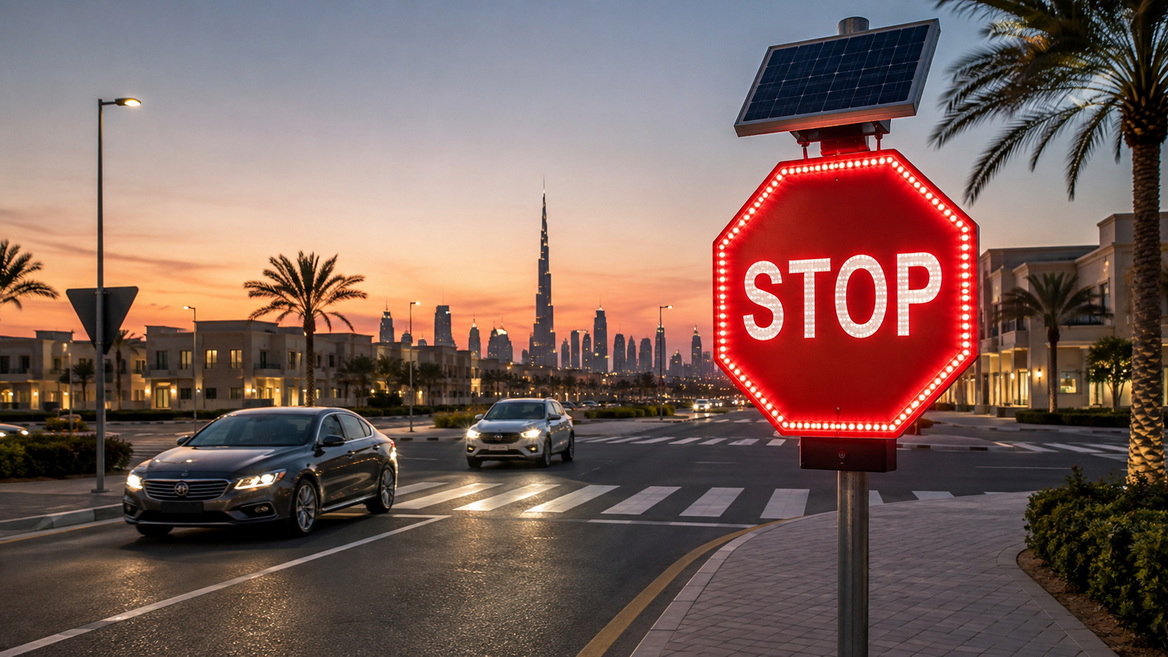
A reliable LED stop sign supplier should be assessed using measurable criteria rather than general sales claims. Before shortlisting a manufacturer or supplier, buyers should compare the following factors.
The supplier should be able to explain whether it manufactures the product directly, assembles imported components, or acts as a distributor. This distinction matters because it affects customization flexibility, lead time, spare-parts availability, and responsibility for quality problems.
A qualified supplier should be able to provide:
- Factory address and company registration details
- Production photos or video walkthroughs
- Equipment lists for sign fabrication and LED assembly
- Product drawings and bill of materials
- Sample-production lead time
- Monthly production capacity estimates
- Quality-control process documentation
- Packaging and export experience
For large projects, ask whether the supplier can maintain output consistency across multiple production batches. A supplier that can make ten samples may not be able to deliver 2,000 identical LED stop signs within a fixed project deadline.
LED stop signs require more than standard sign fabrication. The supplier should understand the relationship between optical visibility, electrical performance, environmental durability, and traffic-sign requirements.
Important engineering questions include:
- What LED type is used?
- How many LEDs are installed on each sign?
- Is the flash pattern simultaneous, alternating, continuous, or programmable?
- What is the viewing angle?
- Can the sign be supplied with solar power, battery power, AC power, or DC power?
- What type of controller is installed?
- How is heat managed inside the enclosure?
- What protection is used against dust and water ingress?
- Are replacement LED modules available?
- Can the supplier customize Arabic and English sign layouts?
Suppliers with real product-development capability are better positioned to support project-specific requirements, including custom flashing patterns, solar-panel sizing, non-standard dimensions, private-label packaging, and specialized mounting brackets.
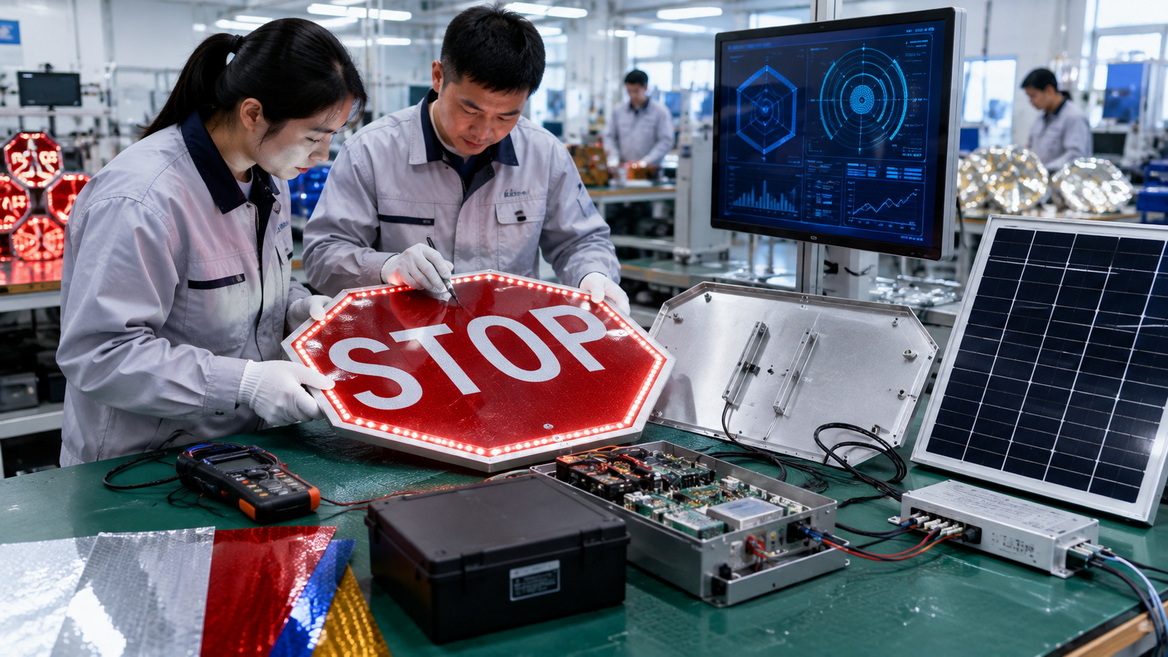
A professional supplier should have a documented inspection process rather than relying only on visual checks.
The quality-control process should cover:
- Incoming inspection of aluminum sheet, reflective sheeting, LEDs, batteries, controllers, and solar panels
- Sign-face printing or film application inspection
- Aluminum thickness measurement
- LED illumination and flash-pattern testing
- Cable and connector inspection
- Solar charging verification
- Battery runtime testing
- Waterproof or enclosure-sealing checks
- Finished-product appearance inspection
- Packaging inspection before shipment
For projects requiring repeat supply, buyers should ask whether the supplier keeps production records by batch. Batch traceability makes it easier to identify the cause of a field failure and arrange replacement parts.
Lead time becomes especially important for infrastructure, construction, and developer projects. A late delivery of traffic signs can delay road opening, project handover, inspection, or site commissioning.
Before placing an order, confirm:
- Sample lead time
- Mass-production lead time
- Availability of standard materials
- Availability of customized reflective sheeting
- Production schedule during peak seasons
- Shipping method and transit time
- Packaging method for long-distance transport
- Spare-parts production lead time
- Warranty-response procedure
A supplier should be able to explain clearly which parts are stocked and which parts require custom production.
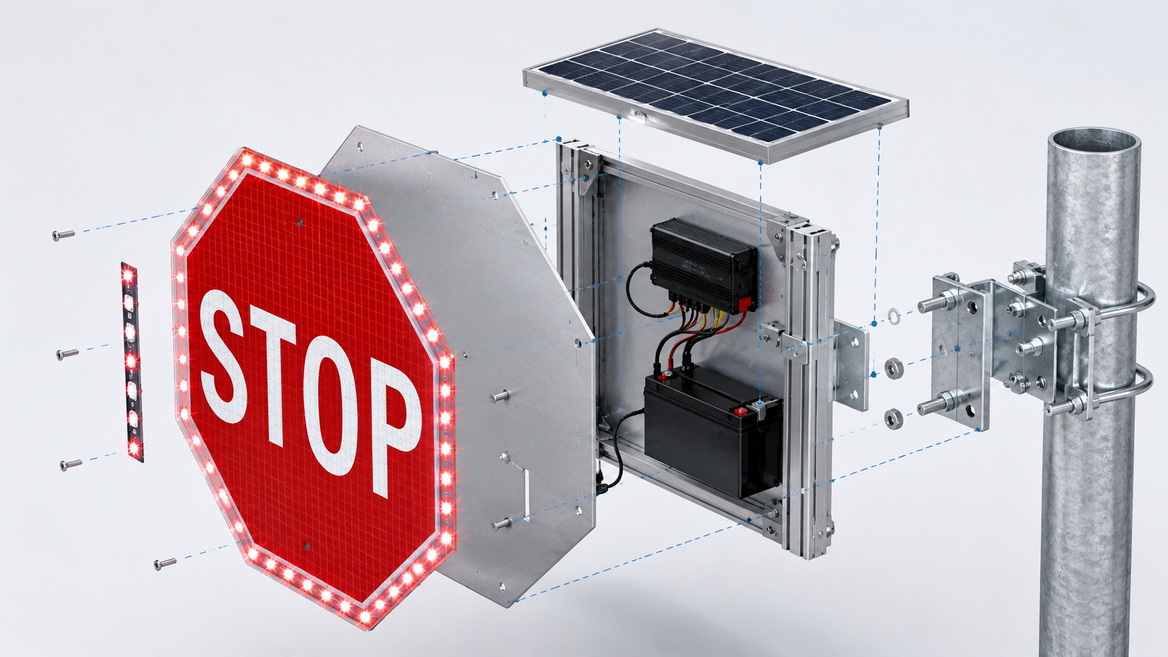
A high-quality LED stop sign combines a conventional traffic sign with active illumination. The underlying sign must remain visible even when the LED system is not flashing, which means reflective performance is still essential.
Most outdoor LED stop signs use an aluminum sign plate because aluminum provides a practical balance of corrosion resistance, weight, rigidity, and fabrication flexibility.
Common factors to specify include:
- Aluminum alloy grade
- Aluminum thickness
- Edge treatment
- Rear reinforcement
- Surface coating
- Reflective film grade
- Sign diameter or face dimensions
- Arabic and English layout
- Mounting-hole configuration
For standard regulatory stop signs, common diameters include 600 mm, 750 mm, and 900 mm. However, the final size should be determined by viewing distance, vehicle speed, location, project drawings, and local requirements.
A sign used at a warehouse gate may need a different size and lighting configuration than one used at a road intersection or toll approach.
Reflective sheeting is one of the most important parts of a traffic sign, even when the sign includes LEDs. At night, drivers rely on vehicle headlights, and a high-quality reflective sign face provides a passive safety layer if the LED system is switched off, damaged, or under maintenance.
Buyers should specify:
- Reflective sheeting brand
- Reflective grade
- Color consistency
- Film batch number
- Adhesion performance
- UV resistance
- Expected outdoor service life
- Compatibility with sign-face printing or overlay film
Do not accept vague descriptions such as "high-quality reflective sticker" or "equivalent reflective material." These phrases create room for lower-grade substitutions during mass production.
LEDs should be bright enough for the intended viewing distance but not so intense that they create glare or obscure the stop-sign message.
Key LED factors include:
- LED color and wavelength
- LED brightness
- LED spacing
- Flash frequency
- Flash mode
- Viewing angle
- Circuit-board quality
- Heat dissipation
- Waterproof sealing
- Service life
- Replaceable module design
A common configuration is a red LED border around the stop-sign face. Other designs may include internal LEDs, illuminated lettering, or alternating flash zones. The correct design depends on the project environment and the desired level of attention.
LED stop signs can be supplied in several power configurations.
| Power Option | Suitable Applications | Main Considerations |
|---|---|---|
| Solar powered | Remote roads, school zones, work zones, temporary sites, rural applications | Solar-panel size, battery capacity, dust accumulation, autonomy days, heat resistance |
| AC powered | Parking garages, toll plazas, urban roads, permanent installations | Cable routing, electrical safety, voltage stability, maintenance access |
| DC powered | Integrated traffic systems, security gates, access-control systems | System voltage compatibility, controller requirements, wiring design |
| Rechargeable battery powered | Portable signs, emergency operations, temporary construction use | Runtime, charging method, battery replacement, portability |
For solar-powered signs, buyers should request a complete energy calculation. The supplier should be able to estimate the expected daily energy use based on LED wattage, operating hours, flashing pattern, controller efficiency, and battery capacity.
The basic energy-balance principle is:
Daily Solar Energy Input≥Daily Sign Energy Consumption+System Losses
A solar sign that works during a short demonstration may still fail after several dusty days, cloudy days, or long nighttime operating periods. Battery capacity and solar-panel sizing should match the actual application, not just the lowest possible cost.
The UAE environment can be demanding for outdoor electronic traffic products. LED stop signs may face high daytime temperatures, strong UV exposure, windblown dust, coastal humidity, and salt-laden air.
Buyers should confirm:
- Outdoor operating-temperature range
- UV-stabilized lens material
- Aluminum corrosion resistance
- Stainless-steel fasteners
- Powder-coated brackets or poles
- Enclosure sealing
- Cable-gland protection
- Battery housing design
- Solar-panel mounting strength
- Dust and water protection level
For coastal installations, corrosion-resistant hardware becomes particularly important. Low-quality screws, exposed electrical terminals, thin coating, and unprotected connectors can create premature failures.
Location: Shenzhen, China
Suitable for: OEM/ODM buyers, private-label distributors, project contractors, traffic-safety brands, parking-system suppliers, and international wholesalers.
Shenzhen Xingsheng Traffic Facilities Co., Ltd. is a traffic-safety product manufacturer serving overseas customers with a product range that includes traffic signs, LED traffic signs, reflective signage, solar road markers, road studs, push-button systems, solar radar speed signs, LED traffic signal lights, and related traffic-safety products.
Although the company is based in Shenzhen rather than the UAE, it is a practical option for UAE buyers that require customized LED stop signs, flexible order quantities, export-ready packaging, and broader product sourcing from one manufacturing partner.
Shenzhen has a well-developed electronics and supply-chain ecosystem. This can be valuable for LED traffic products because manufacturers can source LED components, solar modules, battery systems, controllers, metal housings, cables, mounting accessories, and customized packaging more efficiently than suppliers relying on fragmented sources.
Shenzhen Xingsheng Traffic Facilities Co., Ltd. is particularly suitable for small and medium-sized brands that may not require large infrastructure-scale procurement but still need professional customization and dependable communication.
- Flexible LED stop-sign customization
- Support for Arabic, English, and customer-specified sign layouts
- Solar-powered, battery-powered, AC-powered, and DC-powered sign options
- Custom flashing modes and LED arrangements
- Support for private-label cartons, labels, manuals, and packaging
- Wider traffic-safety product range for consolidated procurement
- Flexible support for distributors and small-to-medium project buyers
- Responsive communication during drawing confirmation and sample approval
- Custom pole brackets, wall brackets, portable stands, and anti-theft mounting options
- Ability to combine LED stop signs with solar road studs, reflective signs, road markers, traffic lights, and parking-safety products
The company can support customized projects involving:
- Sign diameter and shape
- Arabic and English message layouts
- Custom stop-sign artwork
- LED border arrangement
- Flashing sequence and flash speed
- Solar-panel size
- Battery capacity
- Controller specification
- Pole and bracket design
- Product color and housing design
- Private-label branding
- Export carton design
- Installation manuals
- Spare-parts kits
For buyers seeking a long-term private-label product line, it is important to confirm component specifications at the start of the cooperation. A detailed approved drawing, reflective-sheet specification, LED layout, battery requirement, and packaging standard should be included in the purchase order.
Shenzhen Xingsheng Traffic Facilities Co., Ltd. is most suitable for:
- Traffic-safety product distributors
- Road-safety equipment importers
- Parking-management system providers
- Construction contractors
- Private-development projects
- Warehouse and logistics-park safety suppliers
- School-zone safety projects
- OEM traffic-sign brands
- Buyers requiring mixed product containers
- Customers seeking flexible customization rather than only standard items
For a first cooperation, buyers should begin with a technical sample or pilot order. This allows them to verify brightness, flash pattern, reflective material, solar performance, mounting compatibility, and packaging before confirming larger quantities.
Location: United Arab Emirates
Suitable for: Highway projects, government infrastructure, urban-development projects, traffic-sign systems, road furniture, gantries, and large civil works.
Giffin Al Jazira, operating as G – Home of Traffic, is one of the UAE's established traffic-signage and road-infrastructure manufacturers. The company traces its history to Giffin Traffiks, founded in 1976, and has developed into a major provider of traffic signage, road-safety systems, guardrails, bus shelters, urban fixtures, gantries, and related infrastructure products.
The group is particularly relevant for major projects where LED stop signs form only one part of a broader traffic-management or urban-infrastructure package.
Its strengths are likely to be most valuable for buyers needing local project experience, large-scale fabrication, traffic-sign structures, authority-oriented design coordination, and installation support.
- Long operating history in UAE traffic and road-safety infrastructure
- Experience with highways, national roads, municipal projects, and urban developments
- Broad product range covering signs, gantries, guardrails, road-safety systems, and urban fixtures
- Suitable for project-based procurement
- Stronger fit for public-sector and civil-infrastructure work than low-volume private-label orders
- UAE-based capability for local coordination and site-related requirements
Giffin Al Jazira is likely most suitable for:
- Major highway projects
- Road upgrades
- Government infrastructure programs
- Large property developments
- Smart-city installations
- Traffic-sign replacement programs
- Road furniture and urban-infrastructure packages
- Contractors requiring signage together with support structures and installation
Buyers should confirm the exact LED stop-sign configuration, local approval documentation, and electronic-component responsibility during technical discussions.
Location: Dubai, United Arab Emirates
Suitable for: Road-sign fabrication, project signage, gantries, structural supports, commercial developments, airports, and installation-led projects.
Joseph Projects & Traffic Signs operates as part of Joseph Group, a Dubai-headquartered signage and graphics business established in 1978. The group has developed extensive experience in signage, traffic-sign systems, structural works, wayfinding, airport signage, fuel-station rollouts, and large commercial signage projects.
For buyers requiring local production coordination, site surveys, installation support, or integration with structural works, Joseph Projects & Traffic Signs can be a relevant supplier to evaluate.
The company is especially suitable where an LED stop sign is one component in a wider package that includes road signs, gantry structures, directional signs, safety signs, poles, mounting systems, or site-installation services.
- Long-established Dubai signage group
- Broad experience in traffic signs and structural works
- Ability to support project design, fabrication, and installation
- Suitable for developers, contractors, consultants, and commercial-property operators
- Stronger fit for UAE project execution than simple product-only purchases
- Potential capability to coordinate signs, supports, installation, and related wayfinding systems
Joseph Projects & Traffic Signs may be most suitable for:
- UAE development projects
- Road-sign replacement programs
- Airport and aviation-related signage
- Fuel-station and forecourt projects
- Commercial complexes
- Industrial zones
- Directional signage packages
- Parking and access-control environments
- Projects requiring surveys and installation
Buyers should request detailed confirmation regarding LED module origin, power-system design, warranty coverage, replacement modules, and maintenance arrangements.
Location: Abu Dhabi, United Arab Emirates
Suitable for: Abu Dhabi projects, custom road signs, solar signage, construction sites, private developments, and traffic-safety supply packages.
Golden Falcon Group supplies traffic-safety products, road-sign boards, custom traffic signs, LED traffic signs, solar-powered signage solutions, and related road-safety equipment in the UAE.
Its local Abu Dhabi presence can be beneficial for buyers that need customized road signs, standard traffic-safety products, local delivery, or project support in the Abu Dhabi market.
The company is particularly relevant for construction companies, private developers, facility-management providers, and contractors that need practical road-signage solutions without necessarily requiring a large highway-infrastructure supplier.
- UAE-based traffic-safety supply
- Custom road-sign manufacturing capability
- LED and solar-signage product availability
- Suitable for private developments and construction projects
- Practical option for regional project coordination
- Broad traffic-safety product sourcing
Golden Falcon Group may be suitable for:
- Abu Dhabi construction sites
- Private communities
- Commercial facilities
- Warehouses and logistics sites
- Parking areas
- Temporary traffic-management needs
- Local road-safety replenishment
- Standard and customized traffic signs
For customized LED stop signs, buyers should request product drawings, sign-face material data, LED-module details, power-system specifications, and warranty terms before placing the order.
Location: Dubai, United Arab Emirates
Suitable for: Traffic-safety product packages, road studs, speed humps, reflective signs, cones, barriers, and routine local supply.
BIRI Group provides traffic-safety products in the UAE, including road studs, traffic cones, barriers, speed humps, warning signs, reflective sheets, traffic signs, and related equipment.
The company may be a useful local source for buyers that need LED stop signs as part of a broader order covering multiple road-safety and site-safety categories.
Instead of sourcing separate suppliers for cones, road studs, barriers, signs, wheel stops, and warning products, buyers may be able to consolidate standard purchases through a supplier with a wider local inventory.
- Broad traffic-safety product range
- Local Dubai market presence
- Suitable for standard safety-equipment procurement
- Practical for construction, warehouse, parking, and facility-safety applications
- Can support bundled purchasing across multiple categories
BIRI Group may be suitable for:
- Construction projects
- Warehouse facilities
- Parking areas
- Industrial sites
- Property-management companies
- Temporary safety requirements
- Routine traffic-safety maintenance
- Road-safety product replenishment
Buyers should confirm whether the requested LED stop sign is produced in-house, imported, or supplied through another manufacturer. This helps clarify the warranty process, replacement-part availability, and technical documentation source.
Location: Dubai, United Arab Emirates
Suitable for: Work zones, portable traffic control, solar safety equipment, contractor supply, and temporary road-safety applications.
SAB Safety, operating through Safety Middle East, supplies a broad range of road-safety products in the UAE. Its product categories include solar signs, solar road studs, warning lamps, LED light wands, flashing arrow boards, barriers, bollards, reflectors, and other temporary or permanent traffic-safety products.
This broad product coverage makes the company relevant for contractors, maintenance teams, and site-safety managers who need portable or temporary traffic-control equipment.
- Wide traffic-safety equipment catalog
- Solar-signage and warning-device categories
- Suitable for construction and maintenance operations
- Practical for temporary traffic control
- Local product availability for contractors and site operators
- Potential to combine multiple safety-product categories in one purchase
SAB Safety may be suitable for:
- Roadworks
- Construction zones
- Maintenance operations
- Emergency traffic management
- Temporary work zones
- Contractor safety packages
- Portable warning-device procurement
- Solar safety-product orders
Buyers should request clear documentation on the actual manufacturer, LED specifications, enclosure protection, solar-system performance, battery replacement process, and spare-part availability.
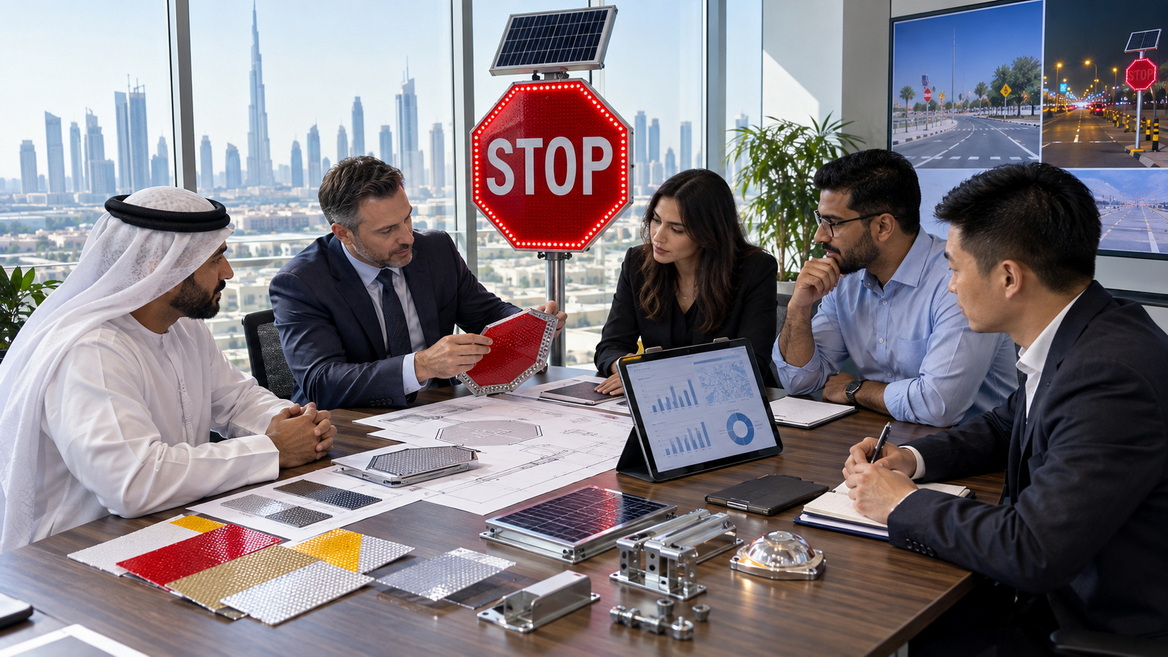
| Supplier | Location | Main Strength | Typical Buyer Type | OEM/ODM Flexibility | MOQ Expectation | Suitable Applications |
|---|---|---|---|---|---|---|
| Shenzhen Xingsheng Traffic Facilities Co., Ltd. | Shenzhen, China | Custom LED traffic signs and multi-product traffic-safety sourcing | Distributors, brands, contractors, importers | High | Flexible depending on configuration | Private label, parking, roads, school zones, custom export projects |
| Giffin Al Jazira / G – Home of Traffic | UAE | Large traffic-infrastructure and road-signage capability | Government projects, civil contractors, developers | Project-focused | Usually project-based | Highways, urban roads, public infrastructure, gantries |
| Joseph Projects & Traffic Signs | Dubai, UAE | Local fabrication, structural works, design, and installation | Developers, consultants, contractors | Project-focused | Usually project-based | Road signs, site signs, airport projects, commercial developments |
| Golden Falcon Group | Abu Dhabi, UAE | Custom road signs, LED signs, and local traffic-safety supply | Contractors, property developers, local buyers | Medium | Quote-dependent | Construction, private sites, commercial facilities, parking areas |
| BIRI Group | Dubai, UAE | Broad traffic-safety product categories | Facility managers, contractors, project buyers | Low to medium | Often suitable for standard orders | Road-safety packages, warehouses, parking, temporary sites |
| SAB Safety / Safety Middle East | Dubai, UAE | Solar and portable road-safety equipment | Contractors, maintenance teams, safety managers | Low to medium | Often suited to stock or standard orders | Work zones, temporary traffic control, solar safety products |
One of the most common quality problems is the substitution of low-grade reflective sheeting. The sample may use premium material, while the mass-production order uses a lower-cost film with weaker brightness, lower UV resistance, and a shorter service life.
This can be difficult to detect during a daytime warehouse inspection because the sign may still look acceptable under indoor lighting.
To avoid this issue:
- Specify the reflective-sheet brand and grade in writing
- Require a sample of every reflective color
- Request batch photos and material labels during production
- Include "no material substitution without written approval" in the purchase order
- Compare the final product with the approved sample
- Inspect signs under vehicle headlights at night
- Retain one approved sign as a reference sample
A supplier may reduce cost by using thinner aluminum, weak reinforcement, or low-quality brackets. This can cause sign deformation, vibration, loose mounting, and reduced service life.
To reduce this risk:
- State aluminum thickness in the quotation and purchase order
- Request thickness measurements during production
- Ask for rear-side photos before shipment
- Confirm bracket thickness and fastening method
- Specify stainless-steel or corrosion-resistant fasteners
- Consider wind-load conditions for outdoor installations
Solar LED signs are often marketed as maintenance-free, but real performance depends on energy consumption, solar-panel output, battery capacity, dust accumulation, heat, and flash duration.
To avoid unrealistic solar claims:
- Ask for panel wattage
- Ask for battery capacity in Ah or Wh
- Ask for daily operating-hour assumptions
- Ask for flash-duty-cycle calculations
- Confirm the number of autonomy days
- Request testing videos showing solar charging
- Confirm battery replacement access
- Consider high-temperature battery performance
"Waterproof" is not a technical specification. Buyers should ask for the claimed enclosure-protection level and the relevant test report.
Important questions include:
- What protection level is claimed?
- Does the rating apply to the complete sign or only one component?
- Does the test report match the quoted model?
- Are cable glands and connectors included in the tested design?
- Is the solar battery box protected to the same level?
- Can the supplier provide photos of the sealing method?
Some suppliers provide generic certificates that do not match the actual product model. A certificate for an LED light may not cover a solar LED stop sign with a different controller, battery, cable system, housing, or electrical design.
To reduce risk:
- Match every certificate to the exact product model
- Check the company legal name and factory address
- Review the test date and report number
- Ask for the testing standard
- Confirm the issuing laboratory
- Check whether the document covers the complete product or only a component
- Verify the ISO certificate through the issuing certification body
When sourcing through a local distributor, the LED module, solar panel, battery, sign face, and mounting hardware may come from different sources. If a failure occurs, responsibility can become unclear.
Before confirming the order, define:
- Warranty duration
- Warranty start date
- Warranty exclusions
- Replacement-part cost
- Replacement-part lead time
- Who pays shipping for replacements
- Whether local service is available
- Whether spare parts should be included in the original shipment
- Whether the supplier can provide troubleshooting support remotely
A practical but often overlooked check is to inspect the LED stop sign when the LEDs are switched off.
Some low-cost products rely too heavily on the LED border and use weak reflective material underneath. When the battery is depleted, the solar system is dusty, the controller fails, or maintenance is delayed, the sign becomes difficult to recognize at night.
A properly specified LED stop sign should still function as a clear passive traffic sign without active lighting. The reflective face should remain visible under vehicle headlights, and the message should remain recognizable from the required distance.
During sample testing, buyers should inspect the product in three modes:
1. Daytime with LEDs switched on
2. Nighttime with LEDs switched on
3. Nighttime with LEDs switched off and vehicle headlights directed toward the sign
This simple test can reveal whether the supplier has designed a genuine traffic-safety sign or only an illuminated decorative sign.
Before placing a large order, buyers should follow a structured sample-approval process.
The supplier should provide a drawing that includes:
- Overall dimensions
- Sign-face layout
- LED position
- Mounting-hole location
- Aluminum thickness
- Bracket design
- Solar-panel position
- Battery-box dimensions
- Cable-routing details
- Sign weight
- Packaging dimensions
Confirm the exact material details before production:
- Aluminum grade and thickness
- Reflective-sheet brand and grade
- LED type and quantity
- Lens material
- Controller specification
- Battery capacity
- Solar-panel wattage
- Fastener material
- Coating specification
- Packaging materials
Inspect the sample for:
- Sign-face appearance
- Arabic and English text accuracy
- Color accuracy
- LED brightness
- Flash pattern
- Viewing angle
- Solar charging
- Battery runtime
- Water protection
- Bracket stability
- Cable quality
- Packaging protection
Keep one approved sample as the reference standard for production. The supplier should also retain an approved sample or signed drawing.
The production order should state that all products must match the approved sample and specification.
For larger orders, arrange inspection before final payment or before shipment.
The inspection should cover:
- Quantity verification
- Dimensions
- Aluminum thickness
- Reflective-sheet specification
- LED function
- Flash mode
- Solar function
- Battery labels
- Controller labels
- Bracket strength
- Packaging
- Carton markings
- Spare-parts quantity
- Random functional testing
Selecting an LED stop sign supplier for UAE applications requires more than comparing quotations. Buyers should evaluate material quality, reflective performance, LED visibility, solar-system design, weather resistance, product documentation, production consistency, warranty support, and project compatibility.
For large UAE infrastructure projects, established local suppliers such as Giffin Al Jazira and Joseph Projects & Traffic Signs can be valuable because of their experience with traffic signage, structural works, urban infrastructure, and project execution. Golden Falcon Group offers a relevant local option for custom traffic signs and safety products in Abu Dhabi, while BIRI Group and SAB Safety may be practical choices for bundled road-safety procurement, temporary traffic-control equipment, and local product availability.
For distributors, importers, contractors, and private-label brands seeking flexible customization and broader traffic-safety sourcing, Shenzhen Xingsheng Traffic Facilities Co., Ltd. offers an export-oriented manufacturing option. Its ability to support OEM and ODM projects, customized LED stop-sign layouts, solar and electrical configurations, private-label packaging, and mixed traffic-safety product orders can make it a suitable partner for buyers requiring tailored solutions.
The most reliable purchasing approach is to issue a detailed specification, compare several technically equivalent quotations, request samples, inspect the product in real operating conditions, approve a reference sample, and maintain clear written control over materials, testing, delivery, and warranty responsibilities.
A standard reflective stop sign depends mainly on vehicle headlights and ambient lighting for nighttime visibility. An LED stop sign adds active illumination through LED modules, making the sign more noticeable in low-light conditions, high-risk locations, school zones, parking areas, work zones, and intersections.
However, the LED system should complement—not replace—a high-quality reflective sign face.
Ask for the certificate number, issuing certification body, legal company name, factory address, scope, issue date, and expiry date. Verify the certificate through the issuing body's online database or by contacting the certification body directly.
Make sure the certificate belongs to the factory that will produce the signs, not only to a trading company or unrelated affiliate.
MOQ depends on sign size, LED layout, solar configuration, battery capacity, reflective material, mounting method, packaging, and private-label requirements.
Standard products may have lower minimum quantities, while custom designs with unique tooling, special electronics, branded packaging, or non-standard artwork may require larger orders. Buyers should ask for MOQ separately for samples, trial orders, repeat orders, and fully customized models.
Solar-powered signs are useful where grid power is unavailable or expensive to install. They are commonly used for remote roads, temporary traffic areas, school zones, and standalone safety installations.
Wired signs may be more suitable for permanent locations such as toll plazas, parking garages, access-control gates, and urban intersections where electrical infrastructure already exists.
The decision should be based on installation conditions, maintenance access, operating hours, solar exposure, and project budget.
For long-term maintenance, buyers should consider ordering spare LED modules, controllers, batteries, solar panels, cable connectors, brackets, lenses, and fasteners.
The exact spare-parts quantity depends on project size and expected maintenance conditions. For larger installations, a spare-parts package can reduce downtime and avoid expensive urgent shipping later.
- [Road Signs in the United Arab Emirates]
- [Dubai Traffic Sign Guidance and Retroreflective Sheeting Requirements]
- [3M UAE Reflective Road Sign Materials]
- [Giffin Al Jazira / G – Home of Traffic]
- [Joseph Group]
- [Golden Falcon Group Traffic Safety Products]
- [BIRI Group Traffic Safety Products]


