
Please Choose Your Language
Views: 222 Author: XS Traffic Facilities Publish Time: 2026-05-25 Origin: Site


Wireless RF communication offers faster, easier deployment and higher flexibility for multiple LED traffic signs, while wired sync still delivers the most predictable reliability and tightest timing for mission‑critical intersections. The most future‑proof strategy for streets, highways and parking lots is usually a hybrid design that combines wired backbones with wireless RF clusters around each pole or gantry.
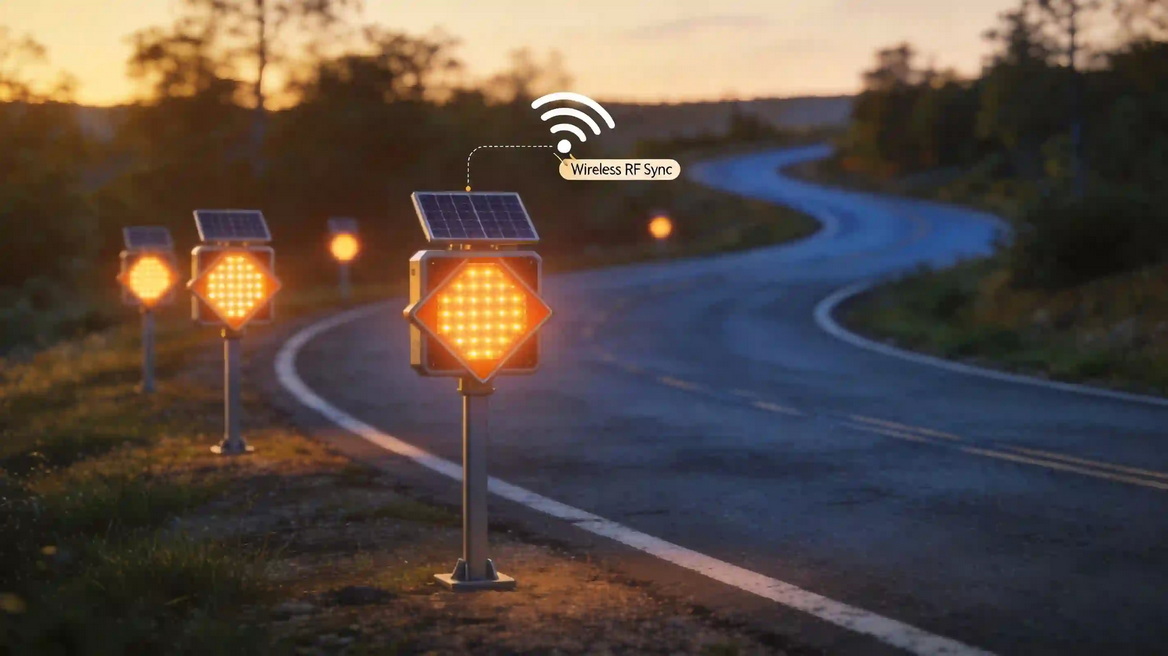
In the context of multiple LED traffic signs, "wireless RF communication" usually means using short‑range radio (often sub‑GHz or 2.4 GHz) to send sync and control signals between signs, controllers and sensors without data cables. "Wired sync" uses physical cabling (often twisted pair, Ethernet, or dedicated sync lines) to distribute timing pulses and control frames to each sign in the network.
For a manufacturer like Shenzhen Xingsheng Traffic Facilities Co., Ltd., which supplies LED traffic signs, solar road studs and parking safety systems, both architectures must work in harsh roadside environments with dust, vibration and extreme temperature swings. From an engineering and buyer perspective, the key question is not "which is absolutely better", but which mix fits each project's risk, budget and maintenance model.
Synchronization means that multiple signs or beacons change state in a coordinated way—flashing in phase, sequencing messages, or aligning with traffic signals on a corridor. On highways and arterial roads, synchronization improves driver expectancy, reduces sudden braking, and can cut delays and fuel use when integrated with signals.
With wired sync, a central controller sends periodic timing frames; all connected LED signs lock to that reference, similar to synchronized traffic light controllers using the same signal cycle length. With RF wireless, each sign typically contains a radio module; a master device broadcasts timing packets, and slaves adjust their internal clocks, sometimes forming a mesh to extend coverage.
The table below summarizes key technical trade‑offs for LED traffic signs and solar traffic products.
| Dimension | Wired Sync LED Signs | RF Wireless LED Signs |
|---|---|---|
| Installation Effort | Requires trenching, conduits, and cabling; slower deploy. | Minimal trenching if power is local/solar; rapid deployment. |
| Signal Reliability | Very high under all conditions; low interference risk. | Can be affected by RF noise, obstacles, and weather. |
| Timing Accuracy | Deterministic latency; ideal for precise sync. | Depends on RF protocol and link quality; small jitter possible. |
| Lifecycle Cost | Higher CAPEX (trenching, cables), lower OTA maintenance. | Lower civil work cost, but radio maintenance and upgrades needed. |
| Flexibility | Fixed topology; relocation is expensive. | Easy to add or move signs; suits evolving layouts. |
| Cybersecurity | Physical access required; easier to segment. | Needs robust encryption and key management. |
| Power Integration | Often shares conduits with power lines. | Still needs power: grid or solar/micro‑grid. |
In practice, permanent highway corridors and critical signalized intersections still tend to favor wired synchronization for maximum determinism. By contrast, temporary work zones, remote solar warning signs and parking lot retrofits often benefit more from RF wireless networks that avoid trenching and simplify deployment.

For LED traffic warning lights and solar road markers, RF wireless networking is especially valuable in locations where grid power is unavailable or civil works are restricted. Solar‑powered systems can be installed on existing posts or embedded in the pavement, using RF to synchronize flashing without any buried cable.
In urban corridors, traffic engineers use synchronized signals to increase throughput and cut delays, often tying controllers together via fiber or copper networks. In these environments, adding RF‑enabled LED signs as peripheral devices—such as crosswalk beacons or curve warning signs—lets agencies integrate new equipment without reopening roads for new conduits.
From an industry‑expert perspective, safety‑critical applications (for example, tunnel exits, steep downhill approaches, toll plazas) should prioritize predictable behavior over installation convenience. Wired sync still provides the most consistent latency and immunity to RF interference, which supports strict timing requirements and certification processes.
Wireless RF networks can achieve high reliability using techniques like frequency hopping, redundant paths and robust acknowledgements, but they must also account for interference from other infrastructure and vehicles. A hybrid design—with wired backbone controllers and RF satellite nodes—balances this by keeping core timing deterministic while allowing flexible peripheral signage.
Civil works often dominate total project cost for LED traffic systems. Trenching, permitting and reinstatement for new conduits can push traditional grid‑tied installations to 3,000–5,000 USD per fixture, while solar versions that avoid trenching may reach 2,500–4,000 USD instead.
When RF wireless is paired with solar, contractors can retrofit multiple flashing signs in hours instead of days, which reduces lane closures and labor costs. For agencies managing long corridors, this translates into faster ROI and less disruption to traffic, especially when replacing or augmenting legacy signage with new LED solutions.

Modern digital signage and smart traffic infrastructure must address cybersecurity and RF spectrum management. Wired networks can be segmented and monitored using established IT security practices, while physical access to conduits is typically controlled.
RF wireless networks introduce additional attack surfaces, so they should use strong encryption, device authentication and over‑the‑air key rotation. Engineers must also consider RF coexistence with Wi‑Fi, cellular and other roadway systems, selecting bands and modulation schemes that minimize mutual interference in dense urban environments.
From the perspective of a traffic safety manufacturer and solution provider, a layered architecture usually delivers the best long‑term results. One effective pattern is:
1. Wired backbone for signal controllers and critical intersections, often via fiber or shielded copper.
2. RF wireless clusters of LED signs, solar warning lights and parking lot devices connected to local gateways.
3. Remote monitoring through a central platform that supervises both wired and wireless segments.
This approach lets agencies and facility owners gradually modernize existing road networks while keeping options open for future IoT sensors, AI‑driven control and integration with connected vehicles.
Below is a practical high‑level process that procurement teams and engineers can follow when deciding between RF wireless and wired sync for multiple LED signs.
1. Define safety and timing requirements
Identify whether the project is safety‑critical, the required synchronization accuracy and any regulatory standards involved.
2. Assess site constraints
Map underground utilities, pavement conditions and any restrictions on trenching or new conduits.
3. Evaluate power strategy
Decide between grid‑tied, solar or hybrid; solar favors wireless when cabling costs are high.
4. Model lifecycle cost and maintenance
Include not only CAPEX but also expected service intervals, component replacement and firmware update paths.
5. Consider cybersecurity and IT integration
Engage IT and OT teams early to align RF security, network segmentation and monitoring.
6. Pilot and validate in the field
Test a small cluster of LED signs under real traffic and weather conditions to validate timing, reliability and RF performance.
With a structured process, decision‑makers can justify their choice to stakeholders and align technologies with long‑term smart‑city or smart‑facility strategies.

Although specific deployments differ, industry experience shows recurring patterns across typical scenarios.
- Remote rural curves and school zones
Solar LED warning signs linked by RF are often the only practical option where grid power and cable conduits are unavailable.
- Urban signalized corridors
Cities synchronize signals via wired networks while adding RF‑linked crosswalk and speed feedback signs as extensions.
- Toll plazas and parking facilities
Operators use wired networks for revenue‑critical systems but add wireless LED indicators in lanes or bays that may be reconfigured frequently.
These patterns highlight that context, not technology fashion, should drive the RF vs wired decision.
Successful projects treat wired and wireless as complementary rather than competing technologies. Key best practices include:
- Standardize protocols: Use open or widely adopted protocols for controllers, gateways and LED signs to simplify integration.
- Segment networks: Separate safety‑critical traffic from non‑critical data, even within RF networks, to reduce risk.
- Plan for over‑the‑air updates: RF‑capable devices should support secure firmware updates to address bugs and security issues over time.
- Design for maintainability: Enclosures, connectors and mounting hardware must support easy replacement while maintaining IP and IK ratings.
For a manufacturer offering OEM and ODM services, these practices also shape product roadmaps and customization options for international partners.
Shenzhen Xingsheng Traffic Facilities Co., Ltd. is a China‑based manufacturer focused on LED traffic signs, LED warning lights, solar road markers, road reflectors, solar traffic lights and parking safety facilities. The company provides OEM and ODM services, delivering integrated traffic safety solutions for streets, highways, toll stations and parking lots worldwide.
By combining RF wireless and wired synchronization options in its product portfolio, the company can tailor solutions to the specific constraints and safety requirements of each project.
If you are planning a new LED traffic safety project or upgrading existing infrastructure, consider engaging early with a manufacturer that can model both RF and wired scenarios for your site. Share your traffic volumes, power constraints and layout drawings so they can propose a hybrid architecture that balances safety, cost and deployment speed for your streets, highways or parking facilities.
For detailed design support, you can collaborate on custom OEM or ODM LED signs, wireless controllers and solar solutions that align with your standards and long‑term smart‑city roadmap.
1. Can RF wireless LED signs achieve the same synchronization accuracy as wired systems?
In many applications, modern RF systems can achieve near‑wired synchronization using robust protocols and timing algorithms, but wired still offers the most deterministic latency for the strictest requirements. For safety‑critical intersections, engineers often keep a wired core while adding RF for less critical devices.
2. Are solar‑powered LED signs always wireless?
Not always, but solar signs frequently use RF because they are installed where trenching for cables is impractical or too expensive. Some projects still combine solar power with limited cabling when specific regulatory or timing requirements demand it.
3. How do agencies secure RF wireless traffic sign networks?
They typically use strong encryption, authenticated devices, and network segmentation, combined with regular firmware updates and RF planning. This reduces the risk of unauthorized control or interference while maintaining operational flexibility.
4. When is a fully wired solution still the best choice?
Fully wired synchronization remains common for dense urban corridors, tunnels and high‑value intersections where timing precision and long‑term stability outweigh installation cost. In these cases, fiber or high‑grade copper networks integrate directly with traffic control cabinets.
5. How can manufacturers support OEM and ODM partners in choosing between RF and wired sync?
Manufacturers can offer configurable controllers, different RF modules and cabling options, plus engineering support to model performance and lifecycle cost under various scenarios. This helps integrators and contractors select the most suitable architecture for each project.
1. DisplayNow – *Wired vs. Wireless Digital Signage Technology Solutions* – https://displaynow.io/blog/comparing-wired-vs-wireless-digital-signage-technology-solutions
2. City of Monterey Park – *Traffic Signal Synchronization* – https://www.montereypark.ca.gov/1512/Traffic-Signal-Synchronization
3. Solar Traffic Systems – *Solar-Powered Flashing Traffic Signs* – https://ustrafficsystems.com
4. Shenzhen traffic products manufacturer (Chinese) – *LED traffic signal lights and solar-powered transportation products* – http://www.szslr.com/en/
5. PTC LED – *Wired vs. Wireless LED Display Connection* – https://www.ptcled.com/academy/wired-vs-wireless-led-display-connection.html
6. Reason Foundation – *Traffic Light Synchronization is a Cost-Effective Method for Reducing Congestion* – https://reason.org/commentary/traffic-light-synchronization-is-a/
7. Beyond Solar – *Solar Street Lights vs Traditional: Cost, ROI & Efficiency* – https://beyondsolar.net/blogs/news/solar-vs-traditional-street-lights-cost-performance-comparison
8. Security Industry Association – *Balancing Wireless Innovation With Wired Reliability* – https://www.securityindustry.org/2024/03/19/balancing-wireless-innovation-with-wired-reliability/
9. City of Laguna Niguel – *Traffic Signal Synchronization* – https://cityoflagunaniguel.org/1607/Traffic-Signal-Synchronization


