
Please Choose Your Language
Views: 222 Author: XS Traffic Facilities Publish Time: 2026-05-15 Origin: Site


Choosing between MUTCD compliant LED signs and non-standard warning signs is no longer just a design or budget decision; it directly impacts legal risk, crash rates, and public trust in your road network. As a manufacturer of LED traffic signs serving highways, toll stations, and parking facilities worldwide, I see every week how compliance decisions made today show up tomorrow in safety KPIs, claims statistics, and maintenance budgets.
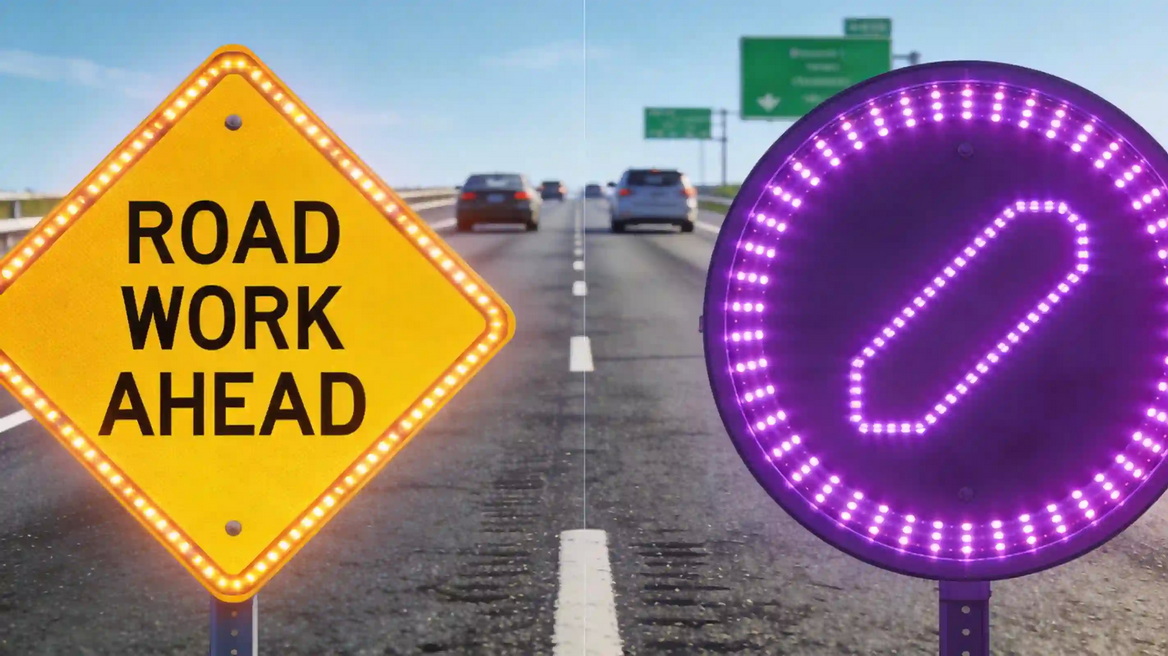
The Manual on Uniform Traffic Control Devices (MUTCD) is the core federal standard that defines how official traffic signs in the United States must look, perform, and be installed. MUTCD-compliant LED signs follow strict rules on shape, legend, color, brightness, and LED behavior so drivers receive consistent messages anywhere they drive.
By contrast, non-standard warning signs are any visual devices that do not follow MUTCD rules, even if they use LEDs or reflective materials. These may use non-approved icons, unusual colors, custom LED patterns, or non-standard formats that look "innovative" but are not recognized as official traffic control devices.
> Key takeaway: MUTCD compliance is not only about "passing an inspection"; it is about speaking the same visual language to drivers in every city and on every highway.
To understand the difference, we first need to clarify what MUTCD-compliant LED signs must do.
Core MUTCD requirements for LED-enhanced signs include:
- Approved colors only:
- White or red LEDs for STOP, YIELD, DO NOT ENTER, WRONG WAY.
- White or yellow LEDs for warning signs.
- White or green LEDs for guide signs.
- Consistent flash pattern: All LEDs must flash together at 50–60 flashes per minute; no chasing or sequential patterns.
- LED placement: LEDs must not be clustered inside the sign field; they are typically used as border enhancements or controlled elements around the legend.
- Standard sizes and shapes: Diamond for warning, rectangular for regulatory and guide signs, with defined dimensions and fonts.
These rules ensure predictable behavior, prevent distraction, and maintain uniformity across jurisdictions. Our own engineering team at Shenzhen Xingsheng Traffic Facilities Co., Ltd. designs LED traffic signs around these constraints so that OEM and ODM customers can install them directly into MUTCD-based systems without redesign.
Non-standard warning signs often appear in private roads, parking facilities, industrial sites, and international markets with looser regulations. They might use:
- Non-MUTCD colors, such as blue or purple warning backgrounds.
- Custom pictograms, such as company logos or creative icons not found in MUTCD tables.
- Dynamic or animated LED sequences that chase, rotate, or strobe at non-permitted frequencies.
- Non-standard shapes or sizes, such as circular warning displays or oversized message boards without MUTCD legends.
Some of these devices can still improve driver attention in private environments (e. g., parking garages or industrial yards), but they cannot be treated as official MUTCD traffic control devices on public roads.
Below is a practical comparison from a road owner's perspective.
Even when non-standard devices look brighter or more "innovative," standardization usually wins in high-speed and high-risk environments.
From a human factors perspective, driver recognition time and sign legibility are critical.
Research summarized within MUTCD development shows that consistent shapes and colors let drivers identify sign type in fractions of a second, even before reading text. LED-enhanced MUTCD signs build on this by providing enhanced conspicuity—for example, flashing borders around STOP or pedestrian signs—without changing the fundamental pattern.
Non-standard warning signs may:
- Use more aggressive flash rates or mixed colors that draw attention but also cause distraction.
- Create visual clutter, especially in complex intersections or work zones.
- Trigger inconsistency: a meaning understood in one city may be unknown in another.
In my work with municipal and toll-road customers, we consistently see better nighttime and low-visibility performance when LED upgrades stay within MUTCD guidance rather than reinventing visual language.
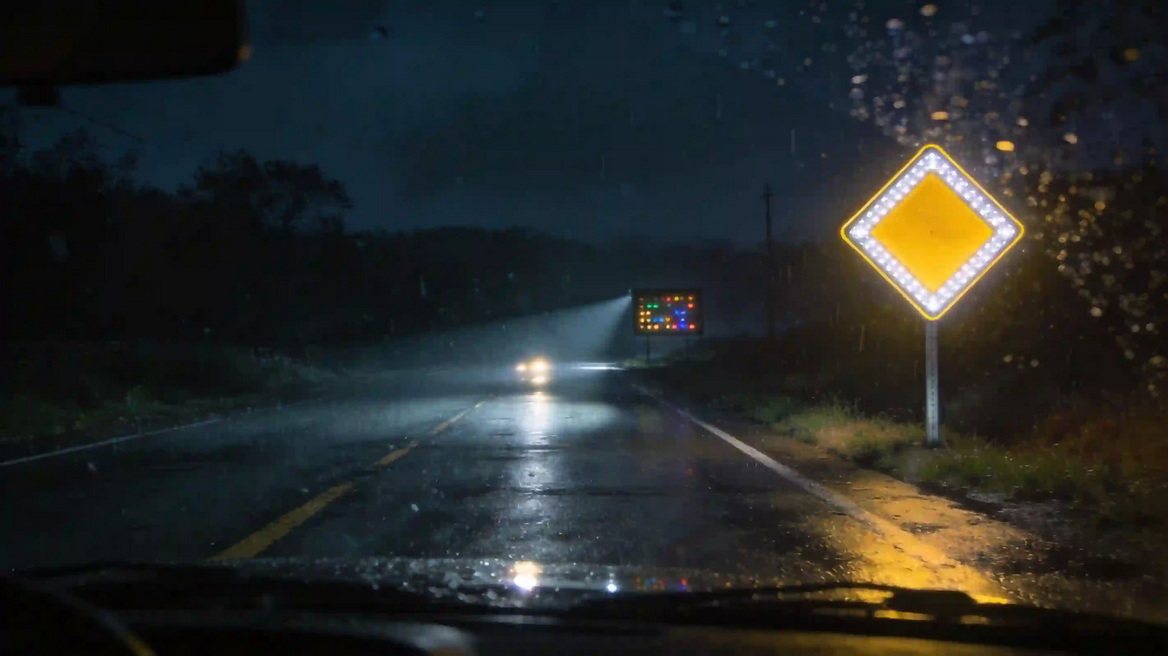
Total cost of ownership is a major factor in any traffic safety program.
MUTCD-compliant LED signs typically offer:
- Standardized components, such as aluminum substrates, high-intensity reflective sheeting, and solar or mains-powered LED modules.
- Predictable replacement cycles for LED drivers, controllers, and batteries.
- Easier spare parts management because sign modules share standard sizes and legends.
Non-standard warning systems may involve:
- Custom LED controllers and animations, increasing maintenance complexity.
- Proprietary housings or shapes that require custom replacement parts.
- Difficulty in predicting performance under long-term UV exposure or salt spray.
In many tenders, especially for highways and toll facilities, asset managers now specify MUTCD-compliant LED solutions precisely to simplify maintenance and auditing across large networks.
Compliance for LED signs is not limited to MUTCD. For electronics, technical emission and safety standards also matter.
- MUTCD defines visual design and placement on roadways.
- The U. S. Federal Communications Commission (FCC) establishes rules for radio frequency emissions of electronic equipment, including LED signs.
- Devices must follow FCC Part 15 rules to avoid interference with emergency services, train control, and other vital communication systems.
A MUTCD-style LED sign that is not FCC compliant could still expose operators to enforcement actions if it causes interference. On the other hand, non-standard warning devices sold outside regulated markets may skip such certifications entirely.
As a manufacturer offering OEM and ODM services, we work with clients to align both visual compliance (MUTCD) and electronic compliance (FCC or equivalent) so that their deployments pass inspections and avoid unexpected downtime.
There are legitimate scenarios where non-standard warning signs deliver value:
- Private sites such as industrial plants, campuses, ports, or large parking structures where MUTCD is not strictly enforced.
- Brand-specific guidance, such as warehouse lane warnings, dock indicators, or access control messages not covered by MUTCD legends.
- Experimental or pilot projects where agencies test new symbol designs before formal adoption.
In these contexts, operators can flexibly design custom pictograms and dynamic LED effects—for example, countdowns, directional chevrons, or brand-specific icons—provided they do not conflict with public road signage.
The key is to clearly separate internal site wayfinding from public traffic control, and to ensure that non-standard devices are not mistaken for official MUTCD signs when drivers transition between environments.
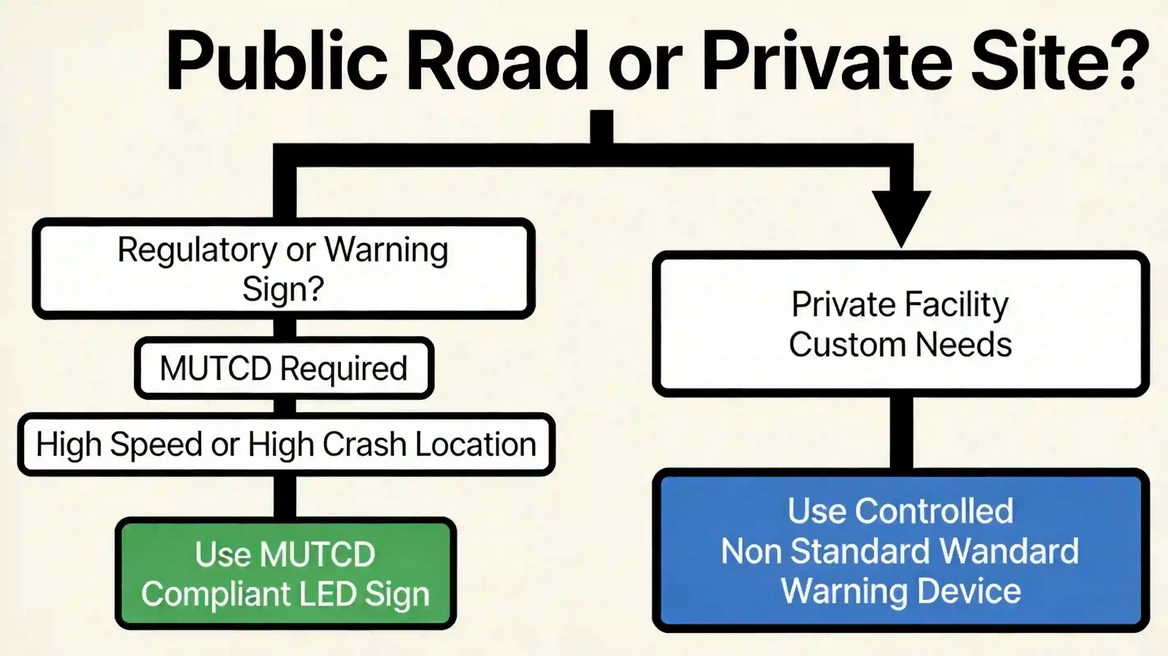
From a practitioner's standpoint, here is a simple decision process we often recommend:
1. Identify the road type and jurisdiction.
- Public roads, highways, school zones, and tollways should default to MUTCD-compliant LED signs.
2. Define the sign function.
- Regulatory, warning, and guide signs almost always require MUTCD conformity.
3. Check applicable standards.
- Confirm MUTCD version, state DOT supplements, and RF/emission rules like FCC Part 15.
4. Evaluate risk exposure.
- Consider traffic volume, crash history, speed limits, and legal risk.
5. Use non-standard signs strategically.
- Reserve custom LED devices for private areas, experimental projects, or non-critical guidance.
By applying this framework, agencies and facility managers can optimize safety and cost while maintaining compliance and avoiding enforcement issues.
Consider a school zone corridor along a suburban collector road:
- Existing condition: Standard retro-reflective warning signs with static speed limit plaques.
- Issue: High incidence of speeding and low driver compliance at dawn and dusk.
A typical upgrade path we see agencies adopt is:
- Install MUTCD-compliant LED school zone warning signs with flashing borders and clear legends.
- Integrate time-of-day or calendar-based actuation so LEDs activate only during school hours.
- Maintain standard yellow or fluorescent yellow-green colors and diamond shapes as specified by MUTCD.
In parallel, some sites add internal non-standard warning displays inside school parking lots (e. g., "SLOW – PICKUP LANE ONLY" with custom icons), but keep roadway-facing signs fully MUTCD-compliant.
The outcome is visible improvement in driver compliance without confusing drivers or creating inconsistent sign vocabularies across communities.

As a Chinese manufacturer of LED traffic signs and related safety products, we serve both MUTCD-focused markets (such as North America) and global regions with varying standards.
Our approach includes:
- MUTCD-ready product lines: LED border-enhanced warning signs, solar-powered regulatory signs, and guide signs sized and colored to MUTCD specifications.
- OEM and ODM services: Co-developing custom legends, housing designs, and control systems that meet local regulations while reflecting each customer's branding and integration needs.
- Flexible power options: Solar, mains, or hybrid configurations designed for highways, toll plazas, tunnels, and parking structures.
For global clients managing both public roads and private facilities, we often design dual strategies: MUTCD-compliant LED signs for public-facing corridors and non-standard but harmonized warning systems for private yards, plants, and parking garages.
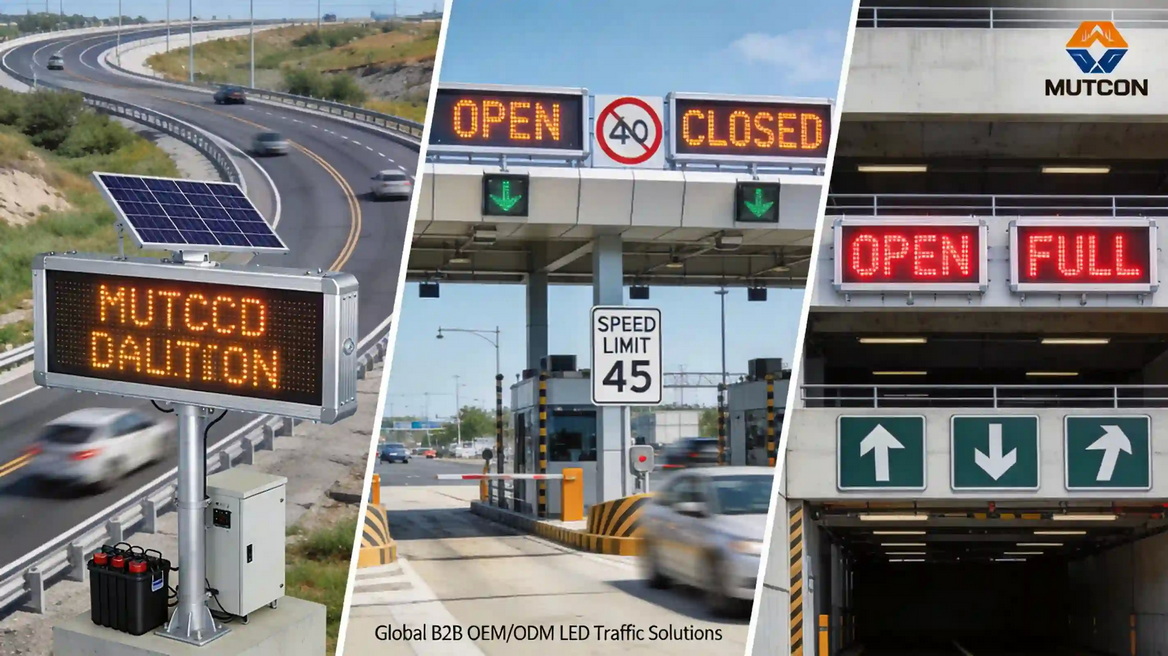
If you manage highways, city streets, toll plazas, or parking operations, now is the right time to audit your sign inventory and plan a gradual transition to MUTCD-compliant LED solutions where required.
- Start with high-risk locations: school zones, sharp curves, high-crash intersections, and pedestrian crossings.
- Replace outdated or non-standard devices with tested, compliant LED signs that align with your jurisdiction's standards.
- For private or special-purpose areas, partner with a manufacturer who can provide both MUTCD-compliant and custom non-standard warning solutions under a single OEM or ODM framework.
By working with a specialist LED traffic sign manufacturer, you can balance compliance, innovation, and cost, and ensure your road users see clear, consistent messages every time they drive.
In most U. S. jurisdictions, official signs on public roads must follow MUTCD rules; non-standard devices may be restricted or removed if they create safety or legal concerns.
No. LED-enhanced signs must follow MUTCD requirements on colors, flash rate, placement, and overall design; decorative or animated LED effects often violate those rules.
For electronic signs in the U. S., FCC Part 15 rules typically apply to ensure they do not interfere with radio and communication systems; reputable manufacturers design and test products for these requirements.
Unit price may be comparable, but MUTCD-compliant signs usually reduce long-term risk, simplify maintenance, and improve acceptance by regulators, lowering lifecycle cost.
Manufacturers experienced in export markets design product families around major frameworks like MUTCD and work with clients to meet state, regional, and electronic standards while offering custom OEM/ODM options.
1. Federal Highway Administration – Manual on Uniform Traffic Control Devices (MUTCD), Part 2A: General. mutcd. fhwa. dot (https://mutcd.fhwa.dot.gov/htm/2009/part2/part2a.htm)
2. Trafficconesforless – "Understanding MUTCD Traffic Signs for Safety and Compliance." trafficconesforless (https://www.trafficconesforless.com/blog/post/understanding-mutcd-traffic-signs-safety-and-compliance)
3. Carmanah – "LED Enhanced Signs: Frequently Asked Questions." carmanah (https://carmanah.com/articles/led-enhanced-signs-faq/)
4. Alert Lighting Co. – "Now Available: All MUTCD W-Series LED Warning Signs." alertlightingco (https://alertlightingco.com/blogs/news/now-available-all-mutcd-w-series-led-warning-signs-w-series)
5. LED Lighting Solutions – "MUTCD Compliant Traffic Control Signs." ledlighting-solutions (https://ledlighting-solutions.com/regulatory-signs.html)
6. U. S. FCC – "Why FCC Compliance Is Important for an LED Sign." stewartsigns (https://www.stewartsigns.com/blog/why-fcc-compliance-is-important-for-an-led-sign)
7. Signal-Tech – "What's the Latest on Illuminating MUTCD Traffic Signs?" signal-tech (https://www.signal-tech.com/information-center/news-and-articles/What-s-the-Latest-on-Illuminating-MUTCD-Traffic-Signs)
8. Mutcd Certified Solar LED Signs for Traffic Safety Awareness – product specification overview. fzmoons. en. made-in-china (https://fzmoons.en.made-in-china.com/product/DOvASiWHbQRL/China-Mutcd-Certified-Solar-LED-Signs-for-Traffic-Safety-Awareness.html)
9. Topsafe Traffic – About Us, OEM/ODM traffic safety products. topsafetraffic (https://www.topsafetraffic.com/about-us)


