
Please Choose Your Language
Views: 222 Author: XS Traffic Facilities Publish Time: 2026-05-07 Origin: Site


For traffic safety projects, visibility is non-negotiable. But the most visible sign is not always the most efficient one. In many street, highway, toll station, and parking lot applications, project owners now compare automatic dimming LED signs and fixed brightness signs not only by brightness, but by energy use, operating cost, and long-term performance.
As a manufacturer of LED traffic signs and traffic safety solutions, Shenzhen Xingsheng Traffic Facilities Co., Ltd. understands that the best sign is the one that matches the environment, the lighting conditions, and the budget.
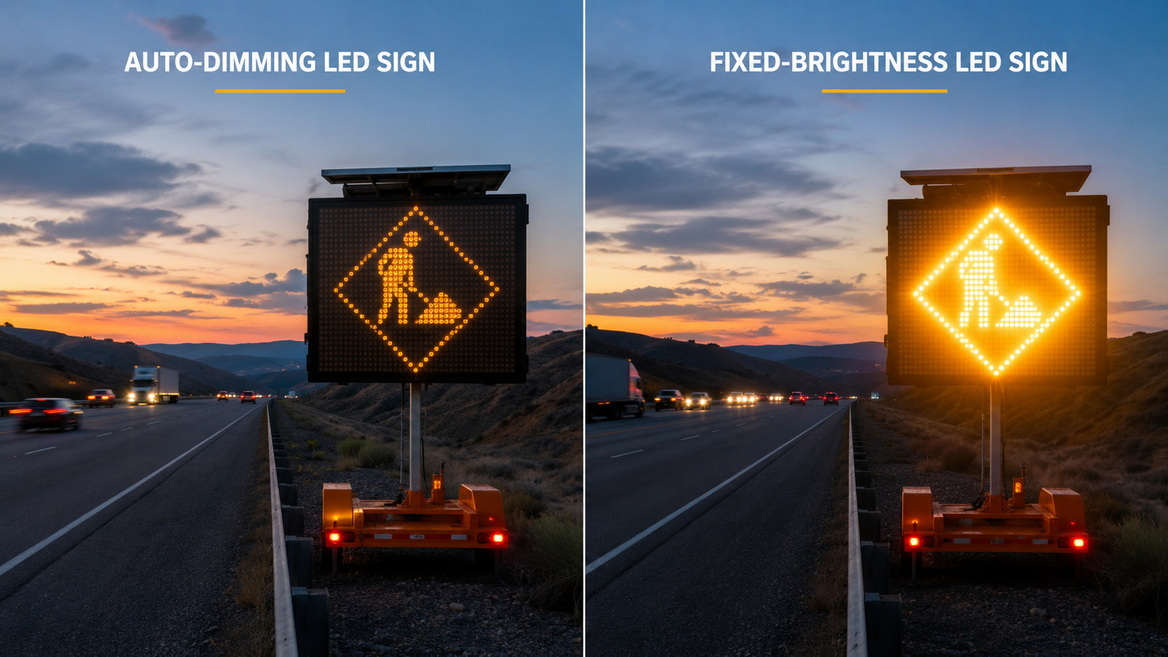
Automatic dimming LED signs use sensors or control logic to adjust brightness based on ambient light or operating conditions. At night, in fog, rain, or low-light environments, they increase output for better visibility. During daylight or bright conditions, they reduce brightness to save power.
Fixed brightness signs operate at one preset illumination level all the time. They are simpler in design and often easier to specify, but they do not adapt to changing light conditions. That means they may use more power than necessary in some settings, or fail to deliver enough visibility in others.
Automatic dimming signs usually have the advantage in energy efficiency because they avoid running at full power when full brightness is not needed. This can reduce electricity consumption, especially on 24/7 installations where ambient light changes significantly over the day.
Fixed brightness signs, by contrast, consume a constant amount of power regardless of weather, time, or traffic conditions. In projects where uniform visibility matters more than energy savings, that can still be acceptable. But from a lifecycle cost perspective, fixed brightness systems often spend more energy than necessary.

- Automatic dimming is better when energy costs, sustainability goals, or large-scale deployments matter.
- Fixed brightness is better when simplicity, consistency, or lower upfront complexity is the priority.
Energy efficiency matters, but traffic signs exist for one main reason: to be seen quickly and clearly. In low-light and poor-weather conditions, automatic dimming signs can improve legibility because they adapt to the environment rather than forcing a one-size-fits-all output.
Fixed brightness signs can still be effective, especially in controlled environments such as parking lots or short-range guidance zones. However, if the brightness level is set too low, the sign may lose impact at night. If it is set too high, it can create glare, wasted energy, or visual discomfort.
- Highways with changing ambient light.
- Urban roads with mixed lighting conditions.
- Toll stations with day-night traffic variation.
- Parking lots that operate across long hours.
The cheapest sign to buy is not always the cheapest sign to own. A full lifecycle view should include:
- Electricity consumption.
- Maintenance frequency.
- Control system complexity.
- Replacement risk.
- Visibility-related safety value.
Automatic dimming systems often have a higher initial cost because they may include sensors, controllers, or smarter power-management components. However, they can deliver lower operating costs over time. Fixed brightness signs usually cost less upfront, but they may require higher energy input across years of operation.
If your project runs:
1. 24 hours a day,
2. in a location with variable daylight, and
3. across many signs,
then automatic dimming often delivers a stronger return on investment.
| Factor | Automatic Dimming LEDs | Fixed Brightness Signs |
|---|---|---|
| Energy use | Lower in many conditions | Constant and usually higher |
| Visibility control | Adaptive | Static |
| Upfront cost | Higher | Lower |
| Long-term operating cost | Often lower | Often higher |
| Installation complexity | Moderate | Lower |
| Best for | Highways, streets, toll stations, parking lots | Simple or controlled environments |
| Sustainability value | Strong | Limited |
- The sign is exposed to changing daylight.
- The project prioritizes energy saving.
- The installation is large-scale.
- The client wants smart traffic safety infrastructure.
- The application requires better night-day adaptability.

- The site is small and stable.
- The budget is tight.
- The lighting environment is predictable.
- Simplicity is more important than optimization.
One common mistake is comparing brightness levels without considering actual operating conditions. A sign that looks impressive in a product sheet may not be the most efficient choice in real use. In our experience, the correct question is not "Which is brighter?" but "Which brightness profile best fits this location?"
For example, a highway warning sign at a shaded curve may benefit from automatic dimming because the sign must stay highly legible at night without wasting energy during the day. A fixed brightness sign in the same location might still work, but it is less adaptive and may cost more to run over time.
A growing trend in traffic safety procurement is the move toward adaptive illumination. Buyers increasingly want products that support energy-saving goals, reduce maintenance burden, and improve nighttime compliance. That is especially true in smart city projects, transportation upgrades, and public infrastructure bids where efficiency is part of the evaluation criteria.
In other words, the market is shifting from "bright enough" to smart enough.

Before choosing a sign type, ask these five questions:
1. Is the sign exposed to changing ambient light?
2. Does the project need to reduce power consumption?
3. How many signs will be installed?
4. Is the site a highway, street, toll station, or parking lot?
5. What matters more: lower upfront cost or lower lifetime cost?
If the answer to most of these points suggests variable conditions and long operating hours, automatic dimming is usually the stronger choice.

If your project needs better energy efficiency, smarter visibility control, and lower lifecycle cost, automatic dimming LED signs are often the stronger option. For OEM and ODM traffic safety solutions tailored to your road, highway, toll station, or parking lot project, contact Shenzhen Xingsheng Traffic Facilities Co., Ltd. for a customized recommendation.
Not always. Automatic dimming is usually better for energy savings and variable lighting, but fixed brightness can be enough for simple, controlled environments.
They can improve visibility by matching output to ambient conditions, which helps drivers recognize signs more clearly in changing light.
Usually yes, at least upfront. However, they may cost more over time because they do not reduce power use when full brightness is unnecessary.
Automatic dimming is often better for highways because lighting conditions change more dramatically and visibility requirements are higher.
Both can work, but automatic dimming is often more efficient for parking lots that operate day and night with changing light.
1. LED active light-emitting signs project case, Victory Traffic.
https://www.trafficsignallight.com/projects/led-active-light-emitting-signs/
2. LEDSigns "bright solution" article, Global Highways.
https://www.globalhighways.com/wh12/products/ledsigns-has-bright-solution


