
Please Choose Your Language
Views: 222 Author: XS Traffic Facilities Publish Time: 2026-05-13 Origin: Site


Synchronized Flashing Signs Vs. Independent Flashing Units is a practical comparison for traffic-safety stakeholders and procurement managers seeking the optimal LED traffic sign strategy for visibility, compliance, and lifecycle cost. Synchronized flashing signs and independent flashing units differ in operation, control, reliability, and use cases; this article evaluates both to maximize safety and ROI while meeting MUTCD and recent industry guidance.

- Synchronized flashing signs: LED signs or beacons whose flash patterns, timing, and phase are centrally coordinated across multiple signs to present a consistent, harmonized signal to road users (useful for corridors, pedestrian networks, and work zones).
- Independent flashing units: Standalone LED sign modules or beacons that flash on their own schedule or in response to local triggers (pushbutton, sensor, or timer) without coordination with neighboring units.
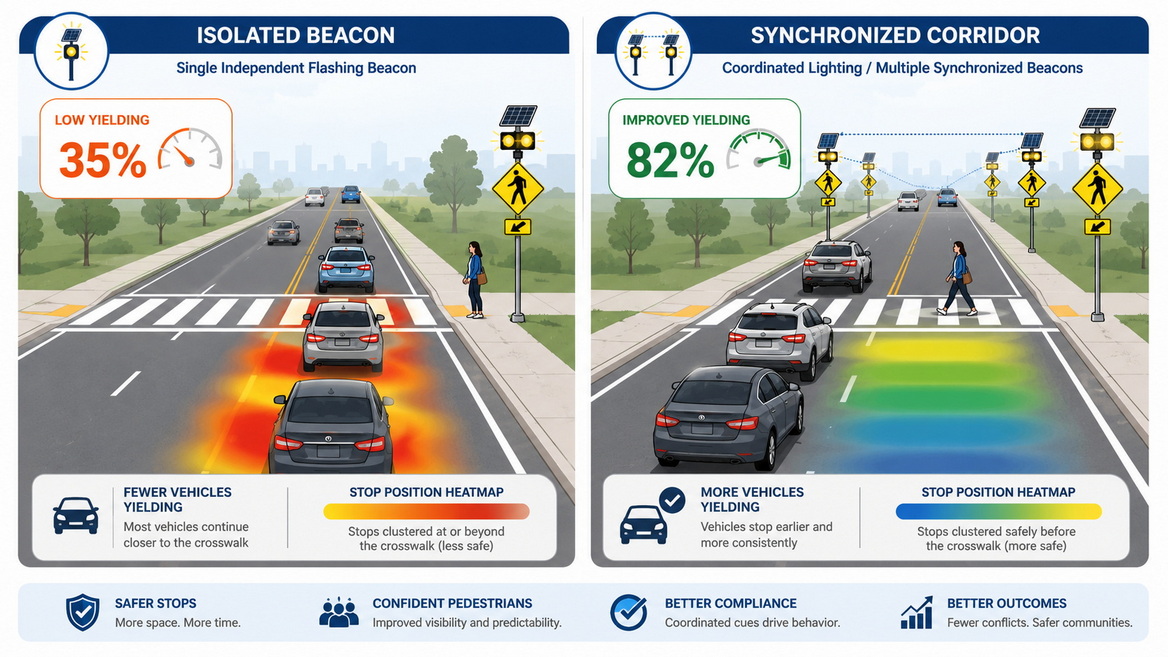
Synchronized systems increase predictability and reduce driver confusion on multi-sign corridors by presenting a continuous visual flow, which can improve driver compliance at crosswalks and speed transitions.
Independent units are highly effective at local hazard highlighting (e. g., isolated crosswalks or a single stop sign), and studies show flashing beacons and RRFBs substantially increase driver yielding when combined with good lighting.
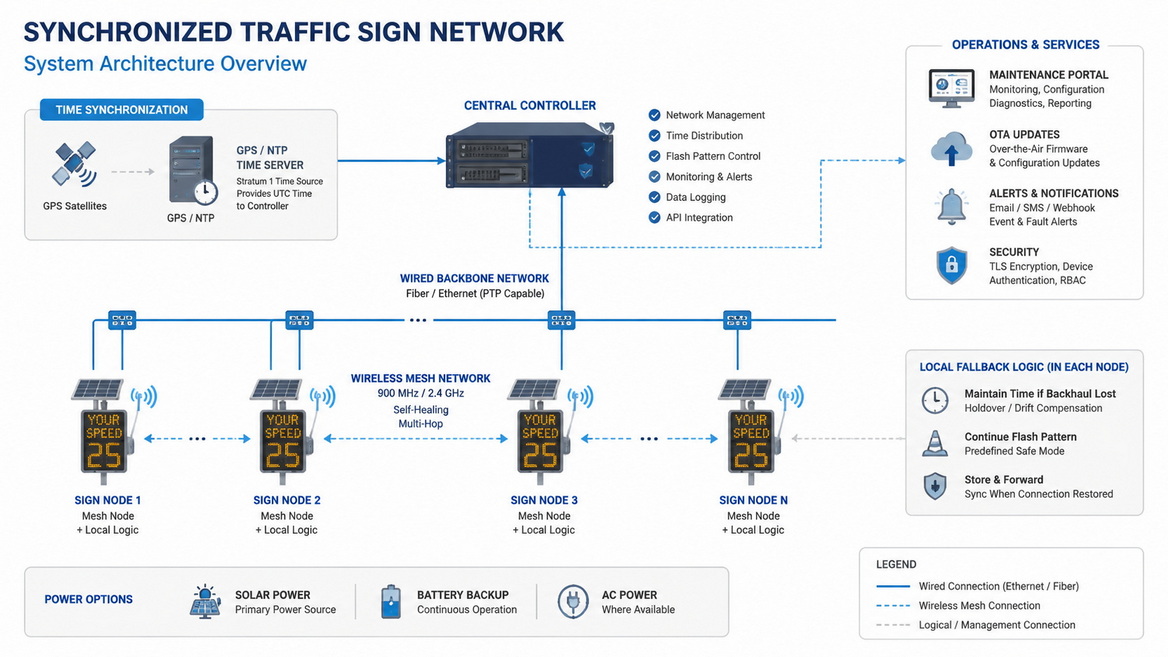
- Control & communications: Synchronized signs require a communication backbone (wired/daisy-chain, cellular, or mesh radio) and a controller for timing and monitoring; independent units often need only a local controller or sensor. Synchronized fields support remote diagnostics and OTA updates.
- Power & energy: Both can be solar or mains powered; synchronized networks may increase peak load coordination needs but also permit power-aware scheduling to conserve energy across many nodes. Independent solar-powered units simplify energy design per location.
- Timing and patterns: Synchronized systems allow unified flash frequency and phase (reducing optical clutter), while independent units can use tailored patterns responsive to local conditions. MUTCD gives functional definitions and allowed beacon types but coordination must respect local traffic control rules.

- Installation complexity: Synchronized networks need planning for communications, cabinet space, and commissioning of timing sequences, raising initial project cost and lead time.
- Maintenance & troubleshooting: Centralized systems simplify firmware updates and remote fault detection, lowering long-term maintenance labor; however, a network fault can affect many signs at once. Independent units localize failures but increase the number of individual service calls.
- Total cost of ownership: For corridors with many devices, synchronization often reduces per-unit O&M cost over time; for few isolated locations, independent units are usually more cost-effective. Recent vendor analyses show flashing signs reduce angle and injury crashes, supporting the business case for higher upfront spend in high-risk corridors.
Follow national standards (e. g., MUTCD) for beacon types, placement, and activation logic; synchronization must still conform to signal timing and signage rules. When procuring, require OEM/ODM documentation for IP rating, luminous intensity, flash frequency ranges, warranty terms, and firmware update policies.
Procurement checklist (bullet points):
- Confirm MUTCD or local standard compliance.
- Ask for communications protocol details (NTP time sync, MQTT/Web API, cellular fallback).
- Verify solar sizing, battery specs, and autonomy hours for location-specific insolation.
- Request a network resilience and fail-safe plan (e. g., default flash patterns on comms loss).
1) Corridor Activation Strategies — expert operational steps (new)
- Step 1: Map hazard sequence and sight-distance to determine sign spacing and lead-time.
- Step 2: Define flash phase relationships so upstream signs give adequate reaction time (use speed-based lead time).
- Step 3: Commission with vehicle detection or schedule-based triggers; validate with field driver behavior observations.
These steps reduce false activations and tune synchronized timing for real-world traffic speeds.
2) Case snapshot: Why sync helped a multi-crosswalk corridor (new)
- Several municipal pilots showed synchronized beacons across a school corridor improved driver yielding and reduced approach speeds compared with isolated RRFBs alone; integrated lighting plus synchronized flash yielded the best compliance in darker conditions.
(This is a representative synthesis from recent RRFB and crosswalk lighting studies that show combined measures outperform single interventions).
3) Expert troubleshooting and resilience tactics (new)
- Use time-synchronized NTP or GPS clocks to prevent drift across network nodes.
- Implement local fallback flash patterns if comms fail, and schedule staggered firmware rollouts to reduce systemic risk.
- Choose Synchronized Flashing Signs when: multiple sequential hazards exist, corridor-wide driver expectancy matters, remote management is desired, or pedestrian-heavy corridors require consistent upstream warning.
- Choose Independent Flashing Units when: budget is constrained, the hazard is isolated, solar standalone operation is preferred, or rapid deployment is required.
- Provide MUTCD compliance documentation and local approvals.
- Offer communications options (PoE, RS485, cellular, LoRa, mesh) and fallback modes.
- Include commissioning services: site survey, spacing plan, timing presets, and post-install validation.
- Supply maintenance contracts and remote-monitoring portals for synchronized installs.
For corridor projects or mixed fleets of isolated hazards, contact Shenzhen Xingsheng Traffic Facilities Co., Ltd. to request a tailored proposal, system design, or OEM/ODM sample kit — include site photos and expected traffic speeds to get a fast, customized assessment.
A: They must meet national/local standards such as the MUTCD and local authority approvals; legal acceptance varies by jurisdiction.
A: Not necessarily; synchronization can enable energy-aware scheduling, though networked control adds electronics; solar sizing should be assessed per deployment.
A: Best practice is local fallback flash patterns so individual signs continue to operate safely if communications are lost.
A: Both reduce crashes; synchronized systems perform best on corridors, while RRFBs and standalone beacons strongly improve yielding at isolated crossings when combined with lighting.
A: Yes — many LED modules and controllers are designed for retrofit, but plan for mounting, power, and communications integration.
- Manual on Uniform Traffic Control Devices (MUTCD) — Chapter on Flashing Beacons and 11th Edition guidance. https://mutcd.fhwa.dot.gov/pdfs/11th_Edition/mutcd11thedition.pdf
- Industry overview: Flashing Warning Signs and LED traffic signs product pages and guidance. https://www.radarsign.com/flashing-warning-signs/
- Vendor analyses on visibility and accident reduction from flashing signs. https://optsigns.com/flashing-traffic-signs-visibility-accident-reduction-safety/


