
Please Choose Your Language
Views: 222 Author: XS Traffic Facilities Publish Time: 2026-05-10 Origin: Site


Stop signs look simple, but they sit at the heart of modern road safety and crash prevention. As a Chinese LED traffic sign manufacturer working with highways, city streets, and parking facilities worldwide, I see every day how a correctly designed, correctly lit STOP sign can mean the difference between a near‑miss and a serious collision.

A stop sign is a red, octagonal regulatory traffic sign that instructs drivers to come to a complete halt, check for other road users, and proceed only when it is safe. It is one of the few road signs that is instantly recognized across borders and languages, which is why standards bodies treat it as a critical safety device, not just a metal plate by the roadside.
From our perspective as an OEM/ODM supplier for LED traffic signs, stop signs are often the first regulatory sign that road agencies upgrade when they want fast, measurable safety improvement at intersections, toll plazas, school zones, and parking exits.
In most jurisdictions, a stop sign legally requires drivers to:
- Come to a full stop before the stop line, crosswalk, or intersection entry
- Yield to pedestrians already in the crosswalk
- Yield to traffic on the intersecting road, following priority rules
- Proceed only when the way is clear and it is safe to do so
Failing to obey a stop sign is usually treated as a moving violation, with fines, license points, and potential liability if a crash occurs.
On the safety side, a stop sign communicates three core messages:
- Risk ahead – an intersection, pedestrian crossing, or conflict point
- Shared responsibility – all road users must cooperate and yield as needed
- Zero‑tolerance for assumptions – you must check, not guess, whether it is safe
Modern crash studies consistently show that installing properly placed, highly visible stop signs at dangerous intersections reduces angle (T‑bone) crashes and severe injuries.
A stop sign's unique eight‑sided shape is no accident. It is the only regulatory sign shape that is octagonal, so drivers can recognize it even from the back or in poor visibility.
Key functions of the octagon:
- Visual uniqueness: No other sign shares this silhouette, which cuts reaction time.
- Recognition from behind: Even if the front is obscured, the shape signals "STOP" to drivers approaching the intersection from the other direction.
- Robust in bad conditions: When text is obscured by snow, dust, or glare, the shape still communicates the message.
Traffic engineers standardized the octagon for stop signs as early as the 1920s, when they discovered that shape is processed faster than text at driving speeds.
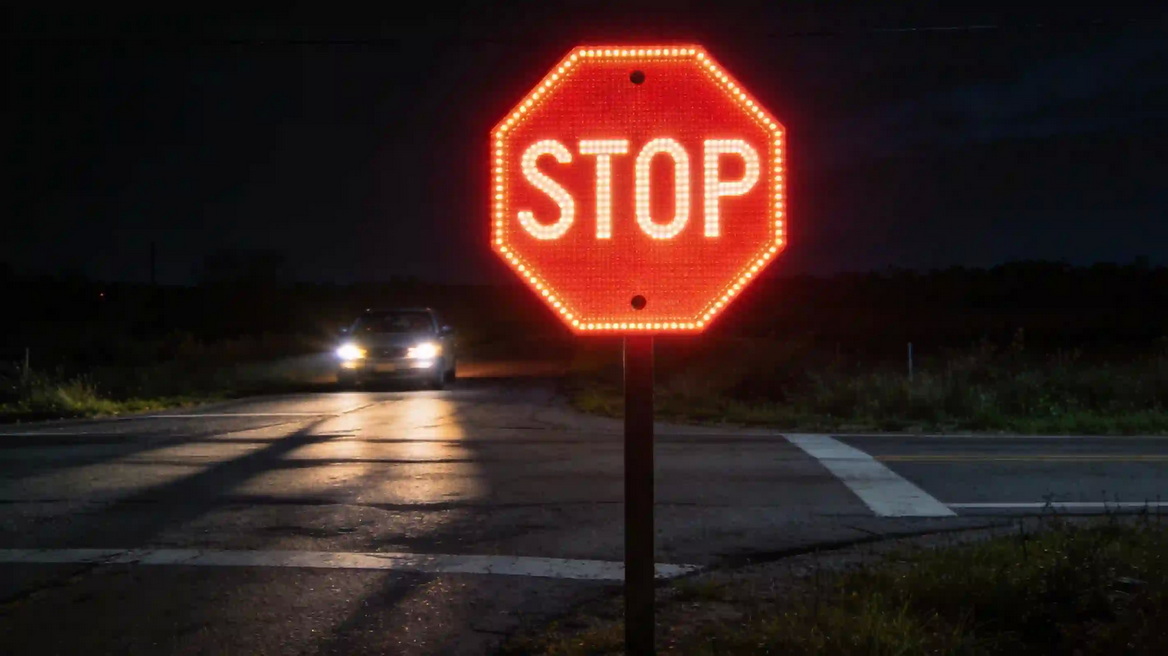
Over time, drivers have come to associate the octagon with:
- Urgency – this is not a gentle suggestion
- Non‑negotiable behavior – you must stop, not just slow down
- Universal meaning – recognized regardless of language or driving culture
This is why, even when we design LED stop signs with dynamic elements, we never alter the octagon. The geometry itself is part of the safety message.
A standard stop sign uses a red background with a white border and white "STOP" legend. This combination provides high contrast both in daylight and at night under headlights.
- Red communicates danger, prohibition, and the need to stop
- White ensures crisp, readable lettering and border
- Retroreflective sheeting or LEDs make the sign visible from longer distances
International standards and many national codes strictly regulate these colors, reflectivity grades, and minimum luminance levels to ensure consistency.
Most regulations require:
- The word "STOP" in uppercase letters
- A specific font or "highway" typeface for readability
- Clear margins around the text to keep it legible at speed
In our manufacturing experience, small deviations in font thickness, spacing, or border width can significantly impact how quickly a driver can read and react to the sign—especially in complex urban environments.
These are the traditional reflective metal signs without active illumination. When produced with high‑intensity retroreflective sheeting and installed correctly, they remain effective for many years.
LED stop signs integrate light‑emitting diodes into the border, legend, or background to dramatically improve conspicuity, especially at:
- Rural or poorly lit intersections
- High‑speed approaches
- Areas with frequent stop‑sign violations
Recent market research shows that LED traffic signs and signals are growing steadily, supported by investments in road infrastructure and a shift to energy‑efficient, long‑life signaling. With projected compound annual growth rates above 4%–12% in various segments between 2026 and 2033, LED signs are becoming the new standard for critical locations.

Solar stop signs pair LEDs with photovoltaic panels and battery storage. This eliminates the need for trenching and cabling while allowing rapid deployment at high‑risk intersections and temporary work zones.
The latest generation of smart LED stop signs can:
- Adjust brightness based on ambient light
- Flash or change patterns when traffic sensors detect approaching vehicles
- Communicate with central traffic management systems as part of smart city projects
This is where our OEM/ODM work increasingly focuses: integrating hardware, power systems, and communication modules into a compact, robust sign package.
1. Approach and scan
Begin slowing down as soon as you see the stop sign, and scan for pedestrians, cyclists, and cross‑traffic.
2. Come to a complete stop
Stop before the stop line, crosswalk, or intersection edge—your wheels must fully stop moving.
3. Check all directions
Look left, right, and ahead. If your view is obstructed, creep forward slightly and stop again where you can see clearly.
4. Yield as required
Give way to pedestrians in the crosswalk and vehicles with the right of way, following local rules.
5. Proceed when safe
Accelerate smoothly, keeping an eye out for late‑entering traffic or vulnerable road users.

From our discussions with transport authorities and end users, several recurring driver errors appear:
- "Rolling stops" – slowing but never fully stopping
- Failing to check for pedestrians or cyclists before turning
- Assuming "no one is there" because visibility is poor
- Misjudging gaps at multi‑lane intersections
Engineering can compensate for some of these behaviors—through better visibility, LED flash patterns, or larger sign faces—but correct driver training and enforcement remain essential.
Stop signs are normally placed at:
- Intersections with crash history or poor visibility
- Minor roads joining major roads, where priority is clear
- School zones and residential neighborhoods
- Parking lot exits and private facility access roads
Codes such as national standards for the layout of urban road traffic signs and markings define in detail where stop signs are appropriate, how far in advance they must be visible, and what complementary markings (lines, rumble strips, advance warning signs) are needed.
As a manufacturer, we often work directly from these standards or from project‑specific drawings provided by engineering firms, adapting the sign design (size, LED configuration, power options) to match the site conditions.
LED stop signs dramatically increase daytime and nighttime visibility through active illumination. This has three direct benefits:
- Drivers detect the sign earlier
- Reaction time improves, especially at higher speeds or in complex visual environments
- Violations tend to drop, particularly at chronic problem intersections
Field studies referenced by our clients often report measurable reductions in red‑light running and stop‑sign violations after LED upgrades, though the exact numbers vary by site.
Modern high‑efficiency LEDs consume very little power and can operate for tens of thousands of hours, significantly reducing maintenance calls.
When combined with solar panels:
- Operating costs are close to zero
- Installation avoids expensive trenching and wiring
- Rural and remote locations become viable deployment sites
For municipal buyers and highway operators, this cost profile is a major reason for the global LED traffic sign market's strong projected growth in the coming years.
As smart cities evolve, LED stop signs can:
- Integrate with adaptive traffic control platforms
- Respond to weather, congestion, or incident alerts
- Share data about power status and performance in real time
This allows traffic managers to treat critical intersections as part of a living system instead of static hardware.
If you are responsible for traffic safety on streets, highways, toll stations, or parking facilities, choosing the right stop sign specification matters. Below is a concise checklist we use when advising clients.
- Regulatory compliance
Confirm that the sign design meets relevant national or regional standards for size, color, legend, and reflectivity.
- Illumination type
Decide between non‑illuminated, edge‑lit, or fully back‑lit LED designs based on ambient lighting and speed environment.
- Power system
Choose mains‑powered, solar, or hybrid based on local infrastructure, reliability requirements, and maintenance capability.
- Durability and materials
Specify corrosion‑resistant housings, high‑grade LEDs, and weather‑resistant controllers suitable for your climate.
- Integration options
For smart projects, consider communication interfaces (e. g., wireless modules) that allow remote monitoring and control.
| Application scenario | Recommended stop sign type |
|---|---|
| Rural, unlit intersection | Solar LED octagonal stop sign with flashing border |
| Urban low‑speed residential street | Standard reflective stop sign, high‑intensity sheeting |
| High‑speed arterial intersection | Large‑format mains‑powered LED stop sign, high output |
| School zone or campus access | LED stop sign with enhanced flash pattern during peak times |
| Parking garage exit | Compact LED stop sign integrated with access control system |
Drawing on feedback from transport agencies and our own project experience, several best practices consistently improve stop sign performance:
- Align sign size with speed – Higher speeds require larger sign faces for adequate legibility distance.
- Avoid visual clutter – Keep stop signs free from competing advertising, foliage, or non‑critical signage nearby.
- Use advance warning signs where needed – On fast roads or where visibility is limited, add "Stop Ahead" signs or pavement markings.
- Maintain reflectivity and LED performance – Periodically check retroreflective sheeting, lens cleanliness, and LED function.
- Pair with markings – Clear stop lines and, where appropriate, rumble strips make the requirement unmistakable.
From a manufacturer's standpoint, we also recommend specifying easily serviceable power modules and controllers so maintenance teams can perform quick repairs without specialized tools.
As a China‑based manufacturer specializing in LED traffic signs and other traffic safety equipment, we work with distributors, contractors, and government buyers around the world who need:
- OEM production to their drawings and standards
- ODM development of new LED stop sign models
- Customized solutions for toll stations, smart parking, or highway interchanges
Typical collaboration steps include:
1. Reviewing your technical specifications, drawings, and local standards
2. Proposing a tailored sign structure, LED configuration, and power solution
3. Producing samples for testing and certification
4. Scaling to mass production with consistent quality control
If you are planning an upgrade to LED stop signs or a new road safety project, partnering directly with a specialized manufacturer ensures that design, performance, and cost are optimized from the start.

If you manage streets, highways, toll stations, or parking facilities, your stop signs are frontline safety devices, not just standard accessories. By upgrading to properly designed LED stop signs and aligning them with current standards and smart city requirements, you can significantly reduce risk and improve user confidence.
Talk with a professional LED traffic sign manufacturer today to review your current intersections, identify critical locations, and design a tailored stop sign solution that fits your regulations, budget, and long‑term maintenance strategy.
A stop sign is octagonal, with eight equal sides, making it unique among traffic sign shapes and instantly recognizable—even from behind or when partially covered.
Standard stop signs use a red background with white letters and a white border, a combination chosen for maximum contrast and recognition during both day and night driving.
Yes. In most jurisdictions, you are legally required to come to a complete stop, yield to pedestrians and cross traffic, and only proceed when it is safe, even if no other vehicles appear to be present.
LED stop signs are increasingly accepted and specified in many countries, but exact rules vary, so road authorities and project owners must ensure that LED designs comply with local traffic sign standards and certification requirements.
Solar stop signs are ideal for rural or remote intersections because they require no grid connection, reduce installation costs, and still provide high visibility through LED illumination powered by integrated panels and batteries.
1. Jackwin Safety. "Ultimate Guide to Stop Sign: Meanings, Shapes, and Symbols." https://jackwinsafety.com/stop-sign-meanings-shapes-and-symbols/
2. DMV Permit Test. "Stop Sign (What To Do, Meaning, Shape, Color)." https://dmv-permit-test.com/road-signs/stop-sign
3. RoadTrafficSigns. "What Are Stop Signs? Complete Guide to Traffic Stop Signs." https://www.roadtrafficsigns.com/blog/what-are-stop-signs-complete-guide-to-traffic-stop-signs/
4. Data Insights Market. "LED Traffic Signs Strategic Market Opportunities: Trends 2026–2034." https://www.datainsightsmarket.com/reports/led-traffic-signs-800846
5. Precision Business Insights. "LED Traffic Signs and Signals Market Size, Growth, Analysis 2026–2032." https://www.precisionbusinessinsights.com/market-reports/led-traffic-signs-and-signals-market
6. LinkedIn. "LED Traffic Signs Market Growth 2026 to 2033." https://www.linkedin.com/pulse/led-traffic-signs-market-growth-2026-2033-factors-behind-its-0ugde
7. GB 51038‑2015. "Code for Layout of Urban Road Traffic Signs and Markings." Ministry of Housing and Urban‑Rural Development of the PRC. https://zc.chd.edu.cn/_mediafile/zhangchi/2018/06/29/1wjmdrxkd6.pdf
8. Highways Department, Hong Kong. "Code of Practice for Lighting, Signing and Guarding of Road Works." https://www.hyd.gov.hk/en/technical_references/technical_document/code_of_practice/doc/COP_202202.pdf
9. Wistron Technology. "China Traffic Cone Manufacturers, Suppliers." https://www.wistronchina.com/traffic-cone/
10. Hangzhou Safer Traffic Facilities Co., Ltd. Company Profile. https://www.topsafetraffic.com


