
Please Choose Your Language
Views: 222 Author: XS Traffic Facilities Publish Time: 2026-05-24 Origin: Site


Pedestrian crossings are no longer just painted lines on asphalt—they are increasingly intelligent, solar‑powered, and tailored to the people and vehicles that use them every day. As a Chinese manufacturer working hands‑on with solar traffic lights and road safety hardware, I see how the right combination of crossing design and signaling can dramatically cut crashes on streets, highways, toll stations, and parking lots.
Pedestrian crossings are designated areas where people, cyclists, and sometimes horse riders and vehicles interact under specific rules, markings, and signals. They are critical because most serious pedestrian crashes occur at or near crossing points, especially when visibility, speed control, or driver compliance are poor.
From an industry perspective, we see cities moving from simple painted crosswalks to engineered safety systems that combine markings, raised tables, refuge islands, LED signs, and increasingly, solar‑powered flashing beacons or traffic lights. This trend is accelerated by tighter safety regulations and by the rapid growth of the global solar lighting market, which is projected to exceed USD 33 billion by 2034.
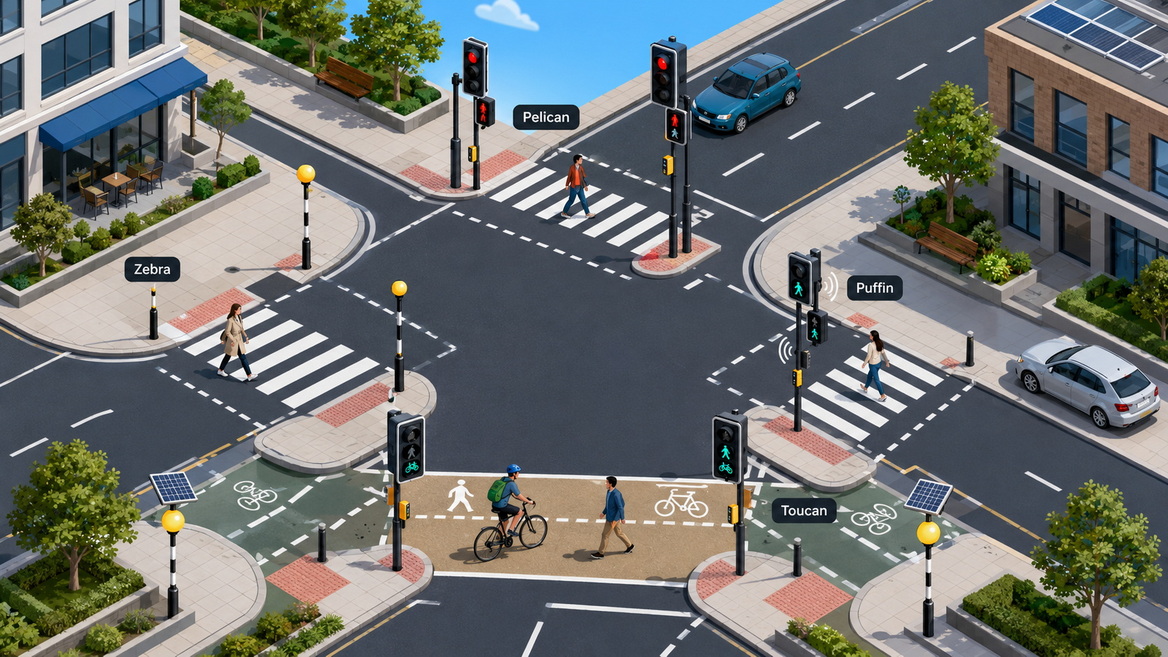
Below is a structured overview of the key crossing types that road users encounter, expanded and clarified from the original article with practical, field‑based insights.
A zebra crossing uses bold white (and sometimes black) stripes across the road to show where pedestrians should cross and where drivers must yield. In practice, drivers should slow down well before the stripes and be prepared to stop, even if no one is yet on the crossing, because pedestrians can appear suddenly.
From a safety engineering standpoint, zebra crossings work best when combined with advance signage, good lighting, and, on higher‑risk roads, flashing beacons or raised tables to reduce approach speeds.
A pelican crossing is a signal‑controlled crossing operated by pedestrians via a push button, with red/amber/green lights visible to drivers. After a pedestrian presses the button, the signals change sequence, giving a green man to walk and then a flashing amber phase to warn drivers that pedestrians may still be in the crosswalk.
Many drivers misunderstand the flashing amber as permission to move quickly, but in fact they must proceed only if the crossing is clear. In our experience, adding high‑intensity LED signal heads or solar‑powered flashing signs right at the stop line significantly improves driver compliance on busy urban corridors.
A puffin crossing upgrades the pelican concept with smart sensors. It keeps the pedestrian signal on the near side of the road, and uses two key detectors built into the signal poles or heads:
- PCD (Pedestrian Crossing Detector): Tracks pedestrian speed and adjusts the crossing time so slower users are not caught in the middle.
- PKD (Pedestrian Kerb Detector): Cancels the demand if someone presses the button and then walks away, preventing wasted red time for vehicles.
From an operations point of view, puffin crossings are ideal on high‑volume arterials where adaptive timing and reduced delay are essential. When combined with solar traffic signal systems, they help cities save energy and installation costs, especially where grid power is limited or expensive to extend.
A toucan crossing (from "two‑can") allows both pedestrians and cyclists to cross together on a shared surface. Signals show a walking person and a bicycle, and the crossing is typically wider—around 4 m—to safely accommodate mixed users.
Toucan crossings are particularly effective along shared‑use paths, greenways, and school or campus routes, where cyclists would otherwise be tempted to ride illegally through pedestrian‑only crossings. In our projects, we often pair toucan crossings with solar‑powered warning lights upstream to give drivers early notice that vulnerable users may be entering the road.
A Pegasus crossing serves pedestrians and horse riders, with two separate push‑button panels—one at a standard height and another positioned higher for riders on horseback. The crossing width is usually greater and may be protected with fences or barriers to keep animals separated from general foot traffic and vehicles.
These are more niche but important near riding schools, bridleways, or rural roads where equestrian activity is common. From a design point of view, reliable, low‑glare lighting and non‑slippery surfaces are essential to avoid spooking animals.
A parallel crossing, also called a tiger crossing, combines a zebra‑style pedestrian crossing with a marked cycle crossing running parallel to it. Pedestrians use the striped section, while cyclists use an adjacent lane marked with cycle symbols or dashed lines.
These crossings are increasingly used near schools, parks, and cycle networks to formalize right of way for both modes and reduce conflict. When we supply systems for these sites, clients often request bimodal LED signage (pedestrian plus cyclist icons) integrated into solar flashing signs for high visibility without trenching for power.
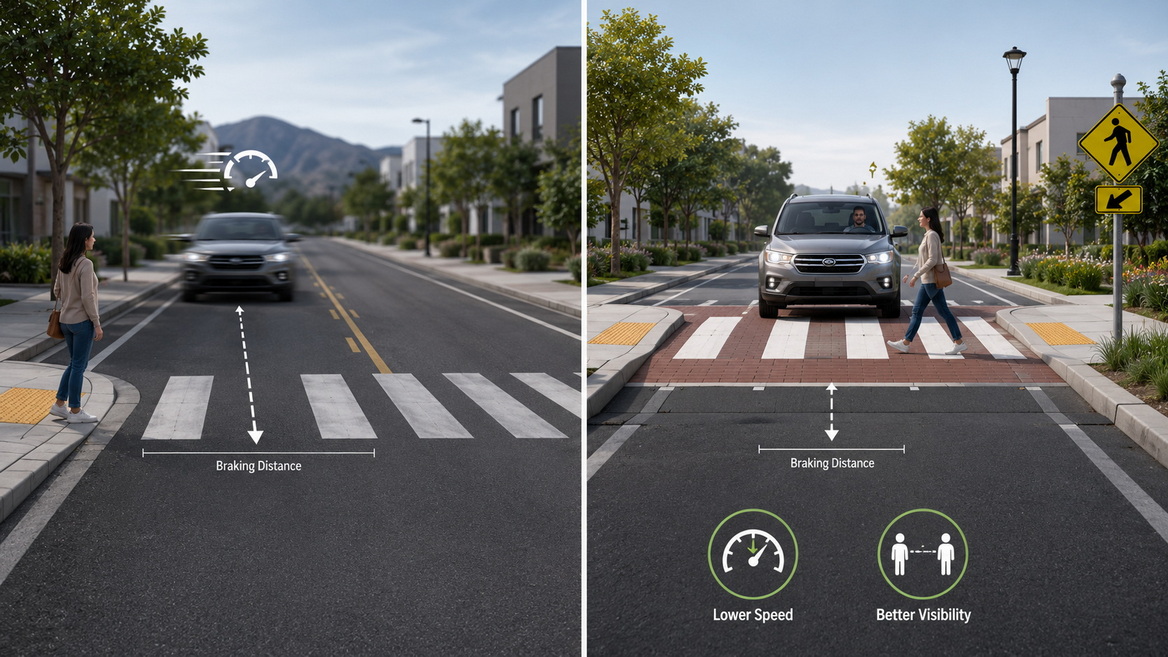
A raised crosswalk or raised intersection elevates the crossing area, effectively combining a speed table with a crosswalk. The vertical deflection makes approaching drivers slow down and improves eye contact between drivers and pedestrians because they are more level.
Studies have shown that raised treatments and speed control elements can reduce pedestrian crash rates and conflict severity significantly, with some sites reporting reductions of around 45% in crashes. As an equipment supplier, we often see raised crossings specified together with LED‑enhanced signs, solar street lights, and edge lighting to keep the feature visible at night and in bad weather.
A level crossing is where a roadway and railway intersect at the same grade, without a bridge or tunnel. Users—drivers, cyclists, and pedestrians—cross directly over the tracks, guided by markings, signs, and sometimes gates and warning lights.
There are generally two types:
- Passive crossings: No active warning devices; users rely solely on signs and markings.
- Active crossings: Equipped with automatically operated lights, bells, and/or barriers that activate when a train is approaching.
In practice, active crossings with high‑visibility LED warning signals and boom barriers dramatically improve safety, especially in rural or suburban areas where train speeds are high but visibility is limited.
A courtesy crossing is an informal crossing point, often with markings or paving changes, but without traffic signals or a legally enforced requirement to stop. Drivers are encouraged—but not compelled by law—to yield, so both parties must rely on mutual awareness and respect.
Because there is no legal priority, we advise clients not to use courtesy crossings on high‑speed or high‑volume roads. Instead, we recommend upgrading to zebra crossings with additional traffic calming or to signalized solutions in locations with higher risk or vulnerable users.
A staggered crossing splits a wide or busy road into two separate crossings with a pedestrian refuge island in the middle. Pedestrians cross one direction of traffic, wait safely on the island, then cross the other direction when safe.
Refuge islands are often raised and may be illuminated with beacon lights (for example, 300 mm beacons mounted on posts) so they are visible at night. This design is especially helpful for slower pedestrians, older adults, or people with mobility challenges who may not be able to cross multiple lanes in a single signal phase.
School crossings use clear signs, often with "SCHOOL" markings on the pavement, and sometimes school crossing guards or flashing beacons to protect children. Many authorities now specify solar‑powered school zone beacons with time‑based or remote control for flexible operation and lower running costs.
At roundabouts, pedestrian crossings are usually set back from the circulating lanes and marked with white lines, but they still present risk due to the complex vehicle paths and limited sight lines. Speed reduction, adequate lighting, and, where volumes are high, the use of raised crossings or flashing beacons can significantly improve safety at these locations.
From our experience as a solar traffic light and safety system manufacturer serving highways, toll stations, and parking facilities, solar‑powered solutions are becoming a core component of modern crossing design.

Several market and technical factors are driving adoption:
- Energy independence: Solar crossings operate off‑grid, ideal for highways, rural crossings, or new developments where extending power is costly.
- Lower lifecycle cost: Reduced cabling, trenching, and electricity bills make total cost of ownership extremely competitive over several years.
- Sustainability goals: Many governments now prioritize low‑carbon public infrastructure, boosting demand for solar street and traffic lighting.
- Deployment speed: OEM/ODM solar systems can be pre‑assembled and installed quickly with minimal traffic disruption.
Industry reports show solar lighting systems are growing at double‑digit annual rates globally, with some forecasts suggesting the market will more than double between 2025 and 2034.
Based on projects we support, here is how solar systems typically match crossing types:
| Crossing type | Recommended solar solution | Practical benefit |
|---|---|---|
| Zebra / school | Solar flashing beacons on both sides, optional overhead sign | Strong driver awareness at low cost and easy retrofit |
| Toucan / parallel | Solar traffic heads with pedestrian + cyclist icons | Clear priority for both modes, supports cycle networks |
| Raised crosswalk | Solar edge lighting + warning beacons | Highlights vertical deflection day and night |
| Refuge island / staggered | Solar beacons on refuge posts | Helps drivers see the island and waiting pedestrians |
| Level crossing | High‑intensity solar LED warning lights (where grid unstable) | Maintains safety where power reliability is an issue |
| Courtesy crossing upgrade | Retrofit solar beacons and signs | Converts ambiguous crossing into a clearer safety feature |
When we design OEM and ODM solutions, we adapt lens angles, LED intensity, battery capacity, and pole heights to match each crossing's environment—city streets, multilane highways, toll booths, or large parking lots.
As someone who spends a lot of time working with road safety engineers, I see the same behavioral issues repeatedly, regardless of how good the infrastructure is.
- Slow early when you see crossing signs, zig‑zag lines, or flashing beacons.
- Stop behind the line, not on it, especially at zebra and pelican crossings.
- Avoid parking near crossings, which blocks sight lines and increases risk.
- At flashing amber on a pelican crossing, move only when the crossing is fully clear.
- In bad weather or at night, expect pedestrians to be harder to see even at lit or signalized crossings.
- Always check both directions, even if you legally have right of way.
- Make eye contact with drivers where possible before stepping out.
- Use the correct part of the crossing—cycle sections for bikes, zebra stripes for walking—at parallel or toucan crossings.
- At staggered crossings, never try to cross all lanes in one go; use the refuge island.
- Near schools and roundabouts, be extra cautious: vehicle movements are more complex and less predictable.
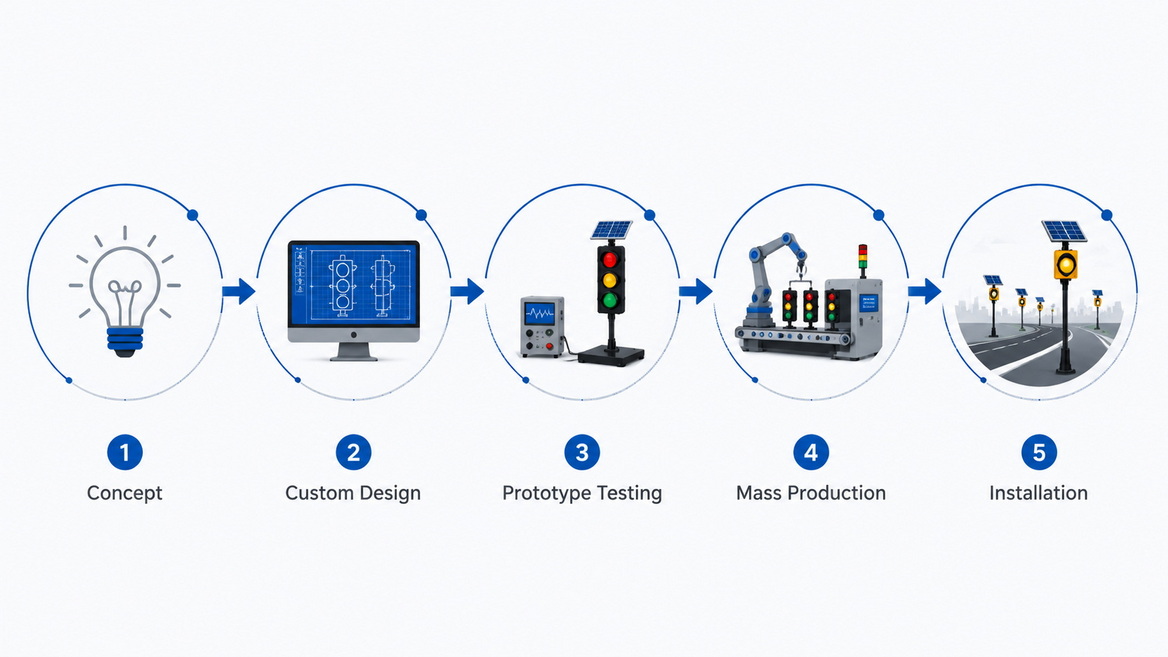
In the global road safety supply chain, OEM and ODM services are key to delivering solutions that match each authority's standards, climate, and regulations.
- As an OEM partner, we manufacture solar traffic lights, beacons, and related hardware to your specifications—signal aspects, controller logic, materials, colors, and branding.
- As an ODM partner, we also support concept design and R&D, helping you select optics, battery configurations, and communication interfaces (such as remote monitoring) that suit local road and climate conditions.
For example, on a high‑speed rural road with several staggered crossings, we might recommend high‑mast solar beacons, radar‑activated warning signs, and robust housings designed for dust or coastal environments. In a dense urban school zone, we might design compact solar flashing units integrated with time‑based controllers that operate only during school arrival and departure windows.
Whether you manage city streets, national highways, toll stations, logistics parks, or parking facilities, upgrading your crossings with well‑designed infrastructure and reliable solar traffic lights can deliver immediate safety and energy benefits.
If you are planning a new project or retrofitting existing crossings, consider working with a manufacturing partner that can provide OEM and ODM solar traffic solutions tailored to your standards, climate, and budget. Our engineering team can help you select the right product mix—flashing beacons, signal heads, school zone lights, or integrated systems—to make every crossing more visible, predictable, and forgiving.
Contact us to get more information!
Not everywhere. In many jurisdictions, pedestrians have priority at marked crosswalks and signalized intersections, but rules vary by country and road type, so users must still check for traffic and obey local signs and signals.
Modern solar traffic systems use high‑efficiency panels, smart charge controllers, and batteries sized for multiple days of autonomy, which means they can operate reliably even through periods of low sunlight when correctly specified.
Where traffic speeds are high, pedestrian volumes are heavy, or driver yield rates are low, guidelines often recommend moving from simple markings to signalized crossings or crossings with flashing beacons and speed control features.
Pelican crossings use far‑side pedestrian signals and a fixed timing sequence, including a flashing amber phase, while puffin crossings place signals on the near side and use sensors to extend or cancel the pedestrian phase based on actual demand.
OEM manufacturing lets agencies standardize quality and performance, while ODM services enable custom design that aligns equipment with local standards, climate conditions, and integration requirements, reducing project risk and long‑term maintenance costs.
1. Jackwin Safety. "Types of Crossings: Toucan, Pegasus, Puffin, Pelican, Zebra." https://jackwinsafety.com/types-of-crossings/
2. Global Designing Cities Initiative. "Crossing Types." https://globaldesigningcities.org/publication/global-street-design-guide/designing-streets-people/designing-for-pedestrians/pedestrian-crossings/crossing-types/
3. ScienceDirect. "Safer pedestrian crossing facilities on low-speed roads." https://www.sciencedirect.com/science/article/pii/S0001457522003438
4. Fortune Business Insights. "Solar Lighting System Market Size, Industry Share, Forecast 2026–2034." https://www.fortunebusinessinsights.com/solar-lighting-system-market-105523
5. ADN Solar Street Light. "Demand Trends in the American Solar Street Light Market." https://adnsolarstreetlight.com/blog/what-are-the-demand-trends-in-the-american-solar-street-light-market
6. CNSourcelink. "OEM/ODM Services Explained." https://cnsourcelink.com/oem-odm-service/
7. GlobalSpec. "Traffic Safety Equipment Suppliers in China." https://www.globalspec.com/local/3900/C_CN


