
Please Choose Your Language
Views: 222 Author: XS Traffic Facilities Publish Time: 2026-05-22 Origin: Site


A two-way traffic sign is a critical warning sign that tells drivers they are leaving a one-way section and entering a road where vehicles travel in both directions, so they must watch for oncoming traffic and stay strictly in their lane. For road owners, traffic engineers and safety managers, getting this one sign wrong can significantly increase the risk of head‑on collisions, especially on highways, work zones and toll plazas.
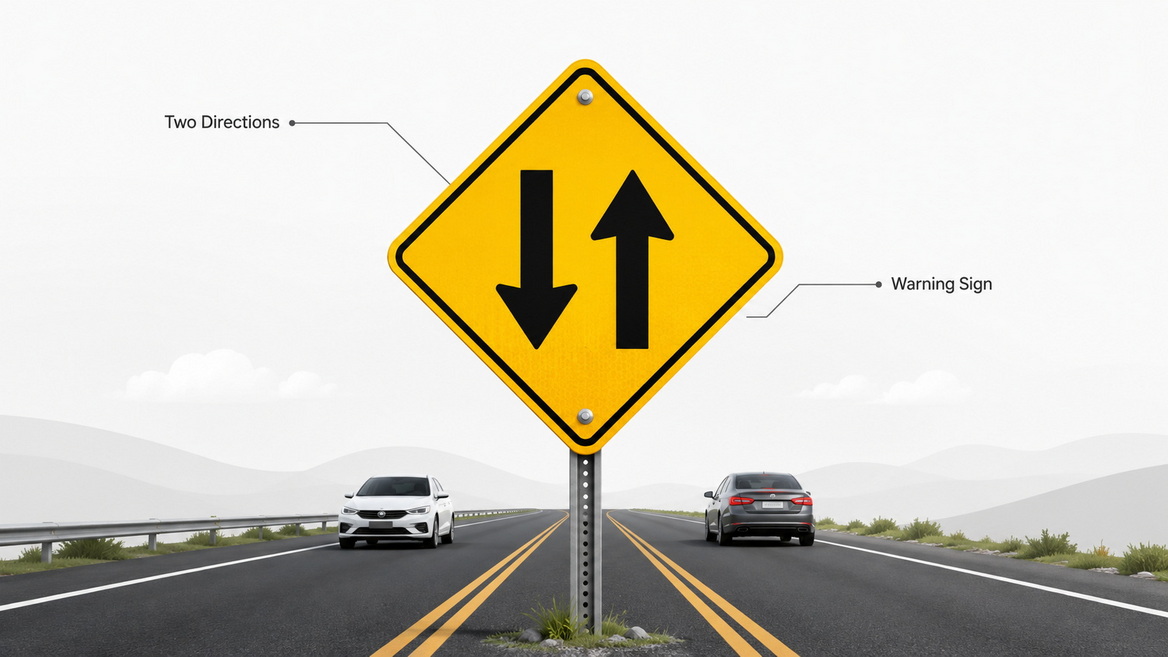
A two-way traffic sign is a diamond-shaped, yellow warning sign with two vertical black arrows pointing in opposite directions, indicating bidirectional traffic ahead. It is usually installed where drivers move from a separated one-way roadway to a two-way road, giving them time to adjust their driving and speed.
You will commonly see this sign on transition zones between divided highways and undivided roads, in construction work zones where traffic patterns have changed, or near intersections where multi-lane one-way streets meet two-way streets. Its main purpose is to warn drivers early so they can reduce speed, keep to the correct side and avoid head‑on conflicts.
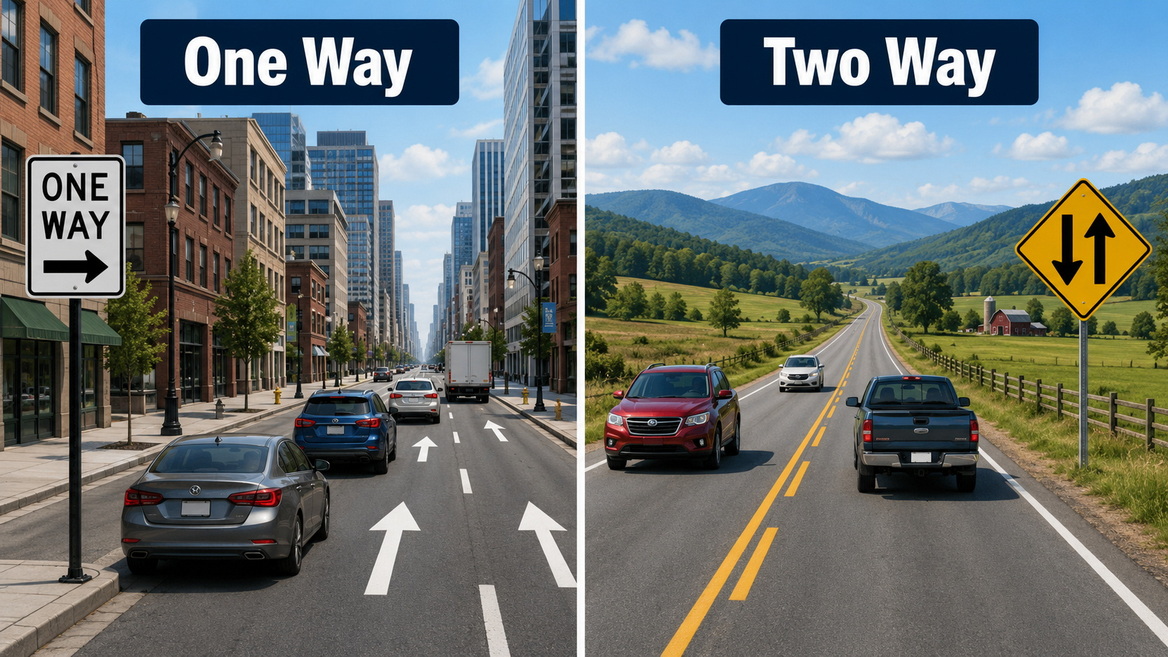
Understanding the difference between two-way and one-way traffic is essential for both drivers and traffic infrastructure planners.
- In two-way traffic, vehicles move in opposite directions on the same roadway, usually separated by a center line or raised median.
- In one-way traffic, all vehicles move in a single direction, often in urban cores or controlled-access highway segments.
A simplified comparison:
| Aspect | Two-Way Traffic Sign | One-Way Sign |
|---|---|---|
| Main meaning | Traffic moves in both directions on the road ahead | Traffic allowed in one direction only |
| Sign type | Warning sign (yellow, diamond) | Regulatory sign (usually rectangular) |
| Driver action | Watch for oncoming traffic, stay in lane | Follow indicated direction only, no opposite movement |
| Typical location | Transition from one-way to two-way roads | City grids, ramps, narrow streets, complex intersections |
From a safety management perspective, the two-way traffic sign is about risk awareness, while the one-way sign is about direction control.
For learners preparing for driving tests and fleets training new drivers, it helps to memorize the standard characteristics of the two-way traffic sign.
- Type: Warning sign.
- Shape: Diamond.
- Colors: Yellow background with black symbols.
- Symbol: Two vertical arrows, one pointing up and one pointing down.
Each element carries meaning: diamond shape signals "warning," the yellow color indicates caution, and the arrows clearly show that traffic flows towards and away from you on the same road. This standardized design ensures drivers in different countries can interpret the message quickly, even when they do not speak the local language.
From my work with traffic safety projects, I see two-way traffic signs most frequently in transition and high-risk zones rather than on every two-way road.
Typical locations include:
- Ends of divided highways where a central barrier disappears and the road becomes undivided
- Construction zones where a separated carriageway has been temporarily converted to two-way operation
- Rural roads where drivers leave a one-way ramp or slip road and rejoin a two-way highway
- Intersections where one-way city streets feed into suburban two-way roads
Road authorities place these signs before or at the start of the two-way section so drivers have time to adapt, change lane position, and reduce speed. Proper placement reduces abrupt maneuvers and confusion, especially at night or in bad weather.
When you see a two-way traffic ahead sign while driving, you should treat it as an early warning and adjust your behavior immediately. From an instructor's perspective, I recommend a simple four‑step mental checklist:
1. Recognize the transition – You are leaving a separated one-way roadway and entering a two-way roadway.
2. Reduce speed slightly – Give yourself margin for oncoming vehicles and possible hazards.
3. Keep right (or left in left‑hand countries) – Stay on the correct side according to local rules, maintaining lane discipline.
4. Increase scanning – Look further ahead for headlights, center line markings and any roadside warnings.
These actions are especially important on narrow roads, where there is less room for error and the risk of head‑on collisions is much higher. Fleet safety managers often include this scenario in defensive driving training because many serious crashes occur exactly at these transition points.
Traffic safety research and field experience consistently show that clear advance warning reduces crash rates at transition zones. The two-way traffic sign plays several roles:
- Early warning for drivers: It alerts drivers before they reach two-way traffic so they can adjust behavior calmly instead of reacting at the last second.
- Head-on collision prevention: By marking where oncoming traffic is possible, it helps prevent lane encroachment and wrong‑side positioning.
- Lane discipline reinforcement: The symbol acts as a visual reminder to "stay in your lane," particularly on roads without clear pavement markings.
- Traffic flow management: On busy or narrow routes, proper signage supports smoother, more predictable traffic patterns.
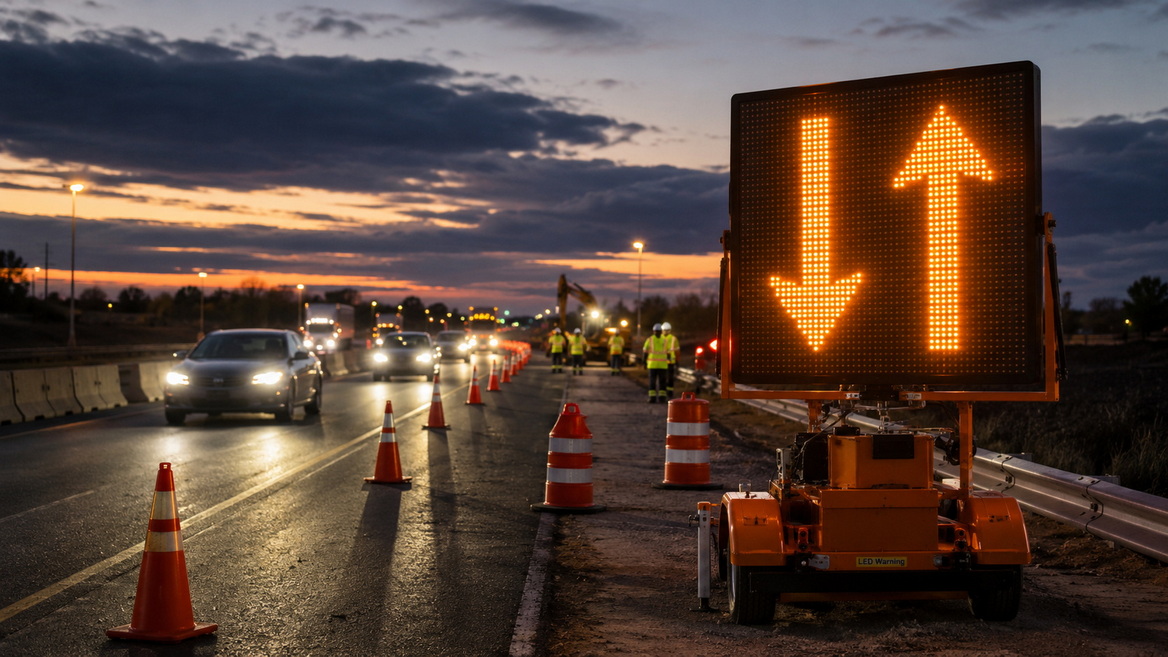
In construction zones, temporary two-way traffic signs and portable LED displays further reduce confusion when lanes are shifted or narrowed. For project owners, investing in good signage is often one of the lowest-cost ways to reach significant safety gains.
In real projects, two-way traffic signs are not limited to permanent road layouts; they are widely used in work zones and temporary detours. During resurfacing or bridge work, for example, one carriageway may carry both directions of traffic for several weeks.
In these cases, safety teams often install:
- Static two-way traffic warning signs at entry points
- Portable LED signs repeating the warning for better visibility at night and in bad weather
- Additional regulatory signs like speed limit reductions and lane merging arrows
The aim is to prevent confusion and keep drivers informed during every stage of the work. When signs are combined with flaggers, channelizing devices and proper lighting, overall incident rates in work zones can drop significantly, according to industry case studies.
Traditional retroreflective plates rely entirely on vehicle headlights, which can be inadequate during heavy rain, fog, or in bright backlighting conditions. As LED technology has matured, more road agencies and parking operators are adopting LED-based traffic signs for critical warnings.
From an industry perspective, the benefits of LED two-way traffic or "two-way traffic ahead" signs include:
- High visibility in all conditions: Built‑in LEDs ensure the sign is visible at long distances, even in low light or glare.
- Dynamic operation: Flashing patterns can be used at particularly dangerous points like sharp curves, tunnels and toll plazas.
- Lower life-cycle cost: Modern LED modules offer long service life and low power consumption compared with older technologies.
- Remote monitoring: Integrated controllers allow operators to monitor sign status and adjust brightness or patterns remotely (when paired with ITS systems).
These advantages make LED signs especially attractive for high‑speed roads, mountain routes, urban expressways and smart parking facilities where safety and uptime are critical.
As a Chinese manufacturer of LED traffic signs and road safety products based in Shenzhen, we specialize in providing customized solutions for streets, highways, toll stations and parking facilities worldwide. Drawing on our experience and industry best practices, we design and produce LED traffic signs that meet strict performance and regulatory standards while supporting OEM and ODM cooperation.
Typical traffic safety products we supply include:
- LED two-way traffic and other warning signs
- LED speed limit signs and variable speed limit displays
- LED lane control signs for tunnels, bridges, and reversible lanes
- LED parking guidance signs and directional signs
- Integrated traffic signal lights and control systems
For OEM partners, we can manufacture to your existing drawings, specifications and brand requirements. For ODM clients, our engineering team can assist with product design, layout, photometric performance and housing customization to meet local regulations and environmental conditions.
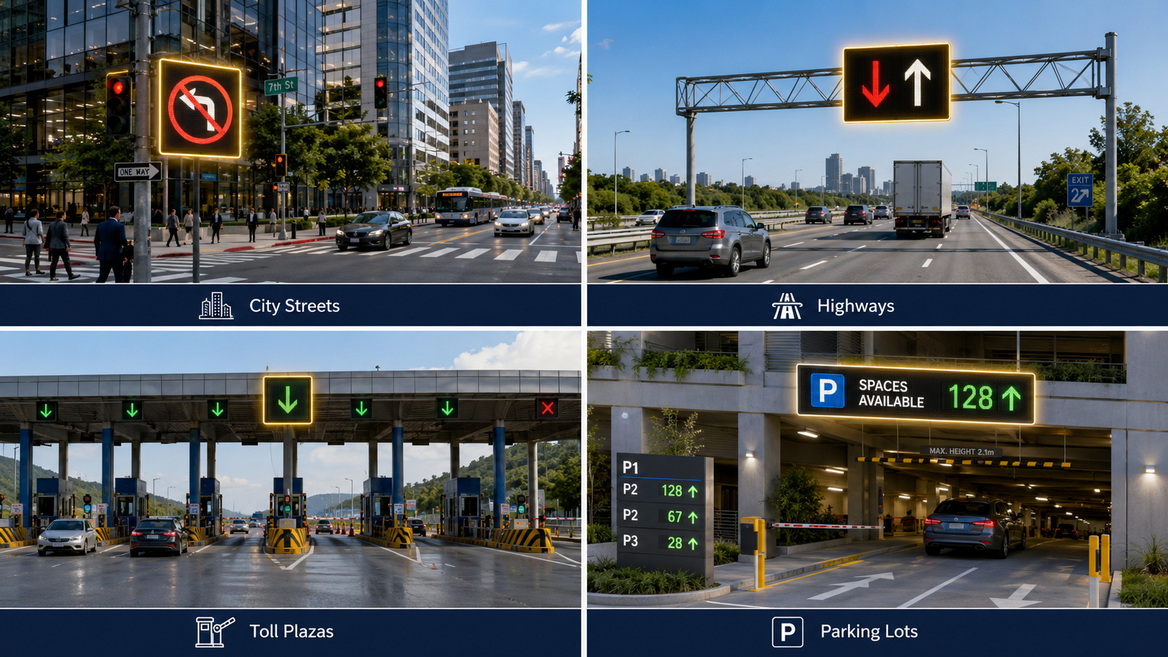
From global customer projects and industry benchmarks, we see LED two-way traffic and related signs used in four main environments:
1. Urban streets and intersections
- Transition points between one-way and two-way streets
- School zones and residential areas with traffic-calming measures
2. Highways and expressways
- End of separated sections, where divided highways merge into undivided roads
- Long curves, tunnels and bridges with limited sight distance
3. Toll stations and ramps
- Entrance and exit lanes with complex traffic patterns
- Interchange ramps where wrong-way entry risks are high
4. Parking lots and private sites
- Narrow access roads where shuttle buses, trucks and passenger cars share space
- Parking structure ramps where two-way flow increases collision risk
In each scenario, combining static reflective boards with LED-enhanced warnings significantly improves driver comprehension and reduces incident rates, particularly during night-time and low-visibility conditions.
When specifying or purchasing two-way traffic signs, especially LED versions, professional buyers should check a few essential design and compliance factors.
Key points to consider:
- Standard symbol and dimensions: Ensure the sign artwork and size align with relevant standards or local road authority guidelines.
- Optical performance: For LED signs, check brightness, viewing angle, and night/day automatic dimming capability.
- Durability: Enclosures should offer adequate weather resistance, impact resistance and UV protection for long-term outdoor use.
- Power and control: Confirm compatible power supply options (AC, DC, solar), control interfaces and integration with existing ITS or traffic signal systems.
As a manufacturer, we regularly work with clients to align design details with national standards, EN/IEC norms and specific highway agency requirements, helping them avoid costly redesign or late-stage compliance issues.
From customer discussions and public user comments on traffic safety forums, several recurring themes emerge about two-way traffic signs and LED traffic warnings.
Drivers most often highlight that:
- Two-way traffic signs are especially useful when road layouts change unexpectedly, such as after intersections or in construction zones.
- Poorly maintained or faded signs significantly reduce trust and can make drivers misjudge whether they are on a one-way or two-way section.
- LED warning signs near dangerous spots (for example, sharp curves or downhill sections with no median) feel more reassuring, especially at night.
From the buyer side, traffic engineers and facility managers stress that they value reliable suppliers who can deliver consistent quality, documentation and after‑sales support. OEM/ODM flexibility and the ability to integrate signage into larger intelligent transportation systems are also frequently mentioned as decision factors.
For procurement teams and project owners, the following checklist can help structure purchase decisions, based on our experience and open industry resources.
1. Clarify the application scenario
- Highway, city street, toll plaza, parking facility or industrial site
- Permanent installation vs temporary work zone deployment
2. Define technical requirements
- Required sign size and symbol according to local standards
- LED brightness, color and viewing distance
- Power source (grid, solar, hybrid) and control method
3. Evaluate environmental conditions
- Temperature range, humidity, dust and corrosion exposure
- Risk of vandalism or accidental impact
4. Assess supplier capability
- Experience in LED traffic signage and ITS projects
- OEM/ODM support, certification coverage and test reports
- Lead time, logistics and after‑sales service
By working through these steps with a knowledgeable manufacturer, buyers can ensure that their two-way traffic signs not only satisfy regulations but also deliver long-term safety and reliability.
If you are planning a new road project, upgrading a highway, or equipping a parking or toll facility, choosing the right two-way traffic signage is a small decision with a big safety impact. As a Shenzhen-based manufacturer focused on LED traffic signs and road safety solutions, we offer custom OEM and ODM services that align with your standards, branding and deployment timelines.
You can contact our team to:
- Discuss your specific highway, street or parking project
- Get engineering input on LED two-way traffic signs and related safety products
- Request tailored OEM/ODM proposals, samples and documentation
Together, we can help create safer, clearer and more efficient traffic environments for drivers and road users in your region.
A two-way traffic sign warns drivers that they are entering a road where vehicles travel in both directions, often after leaving a separated one-way roadway.
It is classified as a warning sign, because it alerts drivers to a potential hazard or road condition requiring special attention, rather than directly regulating behavior.
They are typically installed before or at the start of a two-way roadway, especially where drivers transition from a one-way section, as well as in work zones and on narrow or high‑risk roads.
LED-enhanced signs offer better visibility in low light and poor weather, allow flashing or dynamic patterns, and can integrate with ITS systems for remote monitoring and control.
Yes, manufacturers offering OEM/ODM services can adjust sign size, symbol details, language, mounting and electrical specifications to meet different national standards and project requirements.
1. Jackwin Safety – "Two Way Traffic Sign Meaning: Symbol, Purpose and Rules."
https://jackwinsafety.com/two-way-traffic-sign-meaning/
2. DMV Permit Test – "Two-Way Traffic Sign (Meaning, Color, Shape)."
https://dmv-permit-test.com/road-signs/two-way-traffic-sign
3. WorkSafe TCI – "Two-Way Traffic Signs & Their Meaning."
https://worksafetci.com/2020/10/two-way-traffic-signs-their-meaning/
4. ZGSM – "LED Traffic Light | Manufacturer."
https://www.zgsm-china.com/led-products/led-traffic-light
5. Sinowatcher – "Professional Traffic Signals Lights Supplier."


