
Please Choose Your Language
Views: 292 Author: XS Traffic Facilities Publish Time: 2026-09-26 Origin: Site


Content Menu
● How We Selected These Suppliers
● Top 10 Rubber Wheel Stop Manufacturers
>> 1. Shenzhen Xingsheng Traffic Facilities Co., Ltd.
>> 2. Nanjing Roadsky Traffic Facility Co., Ltd.
>> 3. Wuhan Jackwin Industrial Co., Ltd.
>> 4. Allroads Safety Co., Ltd.
>> 5. Zhejiang Sanmen Eastsea Rubber Factory
>> 6. Kington Rubber Technology (Taizhou) Co., Ltd.
>> 7. Grandchess Daoan Co., Ltd.
>> 8. Beijing Wistron Technology Ltd.
>> 10. Sanmen Tongling Rubber Factory
>> Supplier Comparison: What Is Public?
● Buyer's Guide to Rubber Wheel Stops
>> Start With a Reproducible Specification
>> The Overlooked Risk: Sample-to-Batch Substitution
>> Verify Claims Without Collecting Irrelevant Certificates
>> Compare Landed Cost and Repeat-Order Risk
>> 1. How can I check whether a manufacturer's ISO 9001 certificate has expired?
>> 2. What should I do if a supplier offers a "CE certificate" for a passive wheel stop?
>> 3. How can I tell whether mass production uses the same rubber as the approved sample?
>> 4. What production-capacity number is meaningful for a long-term supply agreement?
>> 5. Is the lowest MOQ or lowest unit price the better choice?
A rubber wheel stop is a relatively simple product to purchase once. It is much harder to source consistently across hundreds or thousands of parking spaces. Two units can share the same dimensions and black-and-yellow appearance yet differ in rubber formulation, internal density, reflector adhesion, mounting-hole accuracy, and performance after prolonged outdoor exposure.
For professional buyers, the right supplier is therefore not necessarily the one with the lowest unit price. It is the one that can reproduce an approved specification, document its quality controls, communicate production changes, and deliver on schedule.
China provides a broad sourcing base for traffic-safety products. Its manufacturers offer molded rubber components, parking-lot equipment, reflective accessories, and export-oriented customization. Sanmen County and the wider Taizhou area in Zhejiang are particularly visible in public supplier listings for wheel stoppers and related traffic products; companies in Shenzhen, Nanjing, Wuhan, Beijing, and Qingdao provide additional sourcing options.
China Rubber Industry Association data offers useful industry context, though not a wheel-stop-specific market size. Among 396 key member companies surveyed for January–May 2025, rubber-industry export delivery value reached RMB 83.511 billion, up 9.18% year on year. Buyers should not interpret that figure as demand for rubber wheel stops alone.
The ten companies below form a procurement shortlist, not an independently audited ranking of production capacity or product quality. Shenzhen Xingsheng Traffic Facilities Co., Ltd. appears first as the company behind this article; its position does not imply that an independent audit found it superior to the others.

Each company has a publicly identifiable rubber wheel stop, wheel stopper, or parking-block offering. We then considered whether its published information gave buyers a useful starting point for evaluating manufacturing responsibility, product range, customization, and export suitability.
A shortlist is only the first stage. Before awarding a contract, apply the same checks to every candidate:
- Factory identity: Confirm the registered company, production address, invoicing entity, and any outsourced manufacturing.
- Product capability: Request drawings, material descriptions, molding details, reflector specifications, and mounting instructions.
- Quality control: Ask how incoming materials, production batches, finished dimensions, and visible defects are checked.
- Delivery reliability: Verify output for the exact model, current production loading, mold availability, and realistic lead time.
- Customization: Define which changes are possible without new tooling and who owns any paid mold.
- Documentation: Check certificate validity and whether test reports cover the product, material, and facility being quoted.
Many suppliers do not publish dependable model-specific monthly capacity or a universal minimum order quantity (MOQ). Those figures vary by size, material, packaging, and customization. Rather than invent comparable numbers, this guide identifies what buyers must request in writing.
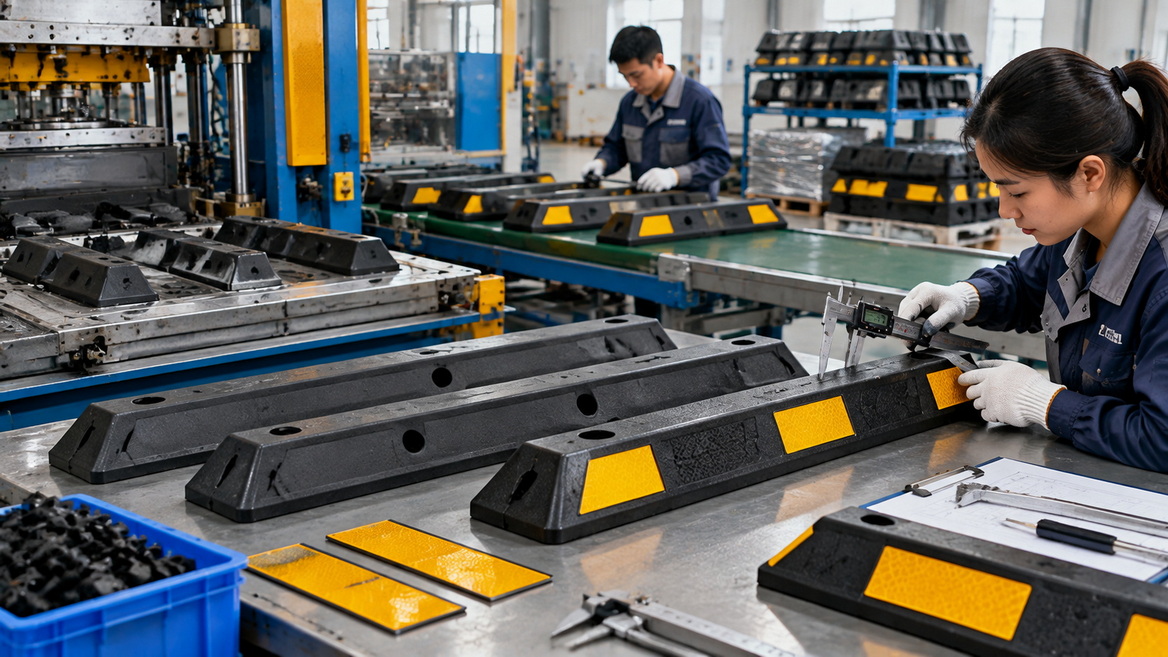
Established: 2014
Location: Shenzhen, Guangdong
Published focus: Traffic-safety products for streets, highways, toll stations, and parking facilities
Export-market information: Export-oriented company; request current destination-market references
OEM/ODM scope to discuss: Wheel stop dimensions, reflective details, branding, packaging, and coordinated parking-safety products
Shenzhen Xingsheng Traffic Facilities Co., Ltd. is a useful candidate for buyers developing a broader parking-lot safety range rather than sourcing a single isolated item. Alongside wheel stops, its portfolio covers other traffic-safety equipment, making consolidated inquiries practical for distributors and project suppliers.
The company presents research and development, customization, and export service as core capabilities. For a small or midsize private-label brand, the potential advantage is flexibility: a buyer can discuss a product specification and the related labeling or packaging within one sourcing conversation. Communication efficiency, however, should be judged through the actual quotation process—not assumed from a company profile.
Ask Xingsheng for a wheel-stop-specific MOQ, sample lead time, material declaration, model-level production capacity, and a written list of changes it can make without a new mold. The company states that it has ISO 9001 certification, but buyers should verify the current certificate, covered legal entity, address, and scope before relying on that claim.
Established: 2000
Location: Nanjing, Jiangsu
Published focus: Road-safety and parking-safety products, including rubber wheel stoppers
Published markets: Regions across the Americas, Europe, Africa, Asia, the Middle East, and Oceania
OEM/ODM scope to confirm: Project-specific dimensions, mounting arrangements, reflective components, and related safety products
Roadsky is worth considering for contractors or importers purchasing several types of road and parking equipment together. Its long-established company profile and broad safety-product offering give buyers a basis for discussing project requirements beyond a standard catalog item.
The main diligence question is manufacturing responsibility for the exact wheel stop quoted. Ask which operations take place at the named facility, which are outsourced, and how the supplier controls compound selection and finished-unit inspection. A broad catalog is useful, but it does not by itself establish capacity for a particular molded product.
Established: 2008
Location: Wuhan, Hubei
Published focus: Road-safety equipment and wheel stoppers in rubber, recycled-rubber, and composite variants
Published markets: International distribution
OEM/ODM scope: Advertised by the company; confirm options for the selected model
Jackwin's wheel-stopper catalog is useful for an early technical comparison because it distinguishes multiple sizes and material approaches. This matters when buyers are comparing a short stop for passenger vehicles with a longer unit or a different composite construction.
Its product information also describes stages such as mixing, molding, vulcanization, and inspection. Before ordering, request a specification for the precise model: dimensions, finished weight, material type, reflector construction, and recommended anchors. Do not assume that a performance or material description for one catalog item applies to every variant.
Established: 2010
Location: Sanmen County, Taizhou, Zhejiang
Published focus: Wheel stoppers and other rubber and plastic traffic-safety products
Published markets: The Americas, Europe, the Middle East, Africa, Australia, and New Zealand
OEM scope: Advertised for rubber and plastic safety products
Allroads may suit a buyer consolidating wheel stops with speed humps, cones, barriers, or corner guards. Its company materials describe multiple production lines and a workforce of more than 100, offering a starting point for a capacity discussion.
That company-wide description is not a monthly output figure for your wheel stop. Ask how many units the specific mold can produce under the current schedule, whether production shares equipment with other products, and what delivery buffer is available for repeat orders.
Established: An older company profile reports 1981; confirm the current legal entity and its operating history
Location: Sanmen County, Zhejiang
Published focus: Parking blocks, wheel stops, speed humps, and other rubber traffic products
Published markets: Request current destination-market references
OEM/ODM scope to confirm: Dimensions, compound, reflectors, private labeling, and packaging
Eastsea is a candidate for buyers who want to compare several molded parking and traffic products from a rubber-focused supplier. Its public product range is broad enough to support a discussion about standard models versus modified designs.
An older website page mentions ISO 9001. It should be treated as a historical statement, not evidence that a certificate remains valid in 2026. Ask for the current certificate number, issuing body, covered production site, and scope. Apply the same check to product test reports: their sample descriptions must match the unit being quoted.
Established: 2014, according to its supplier profile
Location: Sanmen County, Taizhou, Zhejiang
Published focus: Rubber wheel stoppers, wheel chocks, speed humps, and cable protectors
Published markets: Request current export references
OEM/ODM scope: Advertised in its supplier profile; confirm mold, logo, reflector, and packing options
Kington is a useful comparison point for buyers sourcing several types of molded traffic-rubber product. Its listings also highlight a distinction that should never be overlooked in an inquiry: a permanently installed wheel stop and a portable wheel chock have different uses. Specify which product you need.
Its public information describes a sales office and a separate factory location. Before payment, verify the relationship among the registered company, factory, quotation, invoice, and export documents. For a customized order, confirm who owns the mold and who is responsible for approving production revisions.
Established: 2018, according to company materials
Location: Jinyun, Zhejiang
Published focus: Wheel stoppers, traffic cones, cable protectors, and related safety products
Published markets: Request current destination-market references
OEM/ODM scope to confirm: Profile design, mold development, reflector layout, and packaging
Grandchess lists multiple wheel-stop and parking-block products. It is worth including when the application calls for a specific length, profile, or layout rather than accepting a generic parking curb.
Request a dimensioned drawing for the quoted model and compare it with the physical sample. Product names such as "rubber wheel stopper" can cover different formulations or constructions. Record the approved material and finished-unit weight in the purchase specification so a later batch can be compared against the first.
Established: 2012
Location: Beijing; confirm the production site for the selected wheel stop
Published focus: Solar and conventional traffic-safety equipment, including rubber and rubber–plastic wheel stoppers
Published markets: More than 70 countries and regions, according to company materials
OEM/ODM scope: The company advertises customized traffic-safety solutions
Wistron may be relevant to distributors combining parking products with road studs, signs, or other traffic equipment. Its wheel-stopper catalog contains multiple styles, including products described as rubber or rubber–plastic.
For this buyer profile, the essential question is whether a company-wide capability applies to the exact product and facility in the quotation. Ask for the manufacturing address, model-specific inspection plan, and documentation applicable to a passive wheel stop. Certificates associated with electrical traffic products should not be presented as proof of compliance for a rubber parking block.
Established: The company website states 2013
Location: Qingdao, Shandong
Published focus: Parking wheel stops in recycled-rubber, plastic, and composite options
Published markets: Worldwide supply is described; request references for your region
OEM/ODM scope: Custom products, drawings, and prototypes are advertised
A specialist-looking catalog can make initial model selection easier. Wheel Stops Factory presents several parking-stop sizes and discusses customized designs, which may be useful when a project has fixed bay dimensions or mounting constraints.
Its website uses a CE-related claim. Buyers should request the exact product documentation and the legal basis for applying CE marking. CE is not a general quality grade, and the presence of a logo or certificate image does not establish that a passive rubber wheel stop is subject to a CE-marking requirement.
Established: 2011
Location: Sanmen County, Zhejiang
Published focus: Rubber and plastic products for traffic safety and parking facilities, including custom wheel stoppers
Published markets: The company describes international customers; request recent references for the destination market
OEM/ODM scope: Custom wheel stoppers are advertised; confirm drawing, mold, branding, and packing requirements
Sanmen Tongling Rubber Factory provides a distinct tenth supplier for this shortlist. Its website describes both wheel-stopper production and an in-house international trade department, a potentially useful arrangement for buyers who want to discuss manufacturing and export details with the same company.
For an inquiry, ask it to separate established models from genuinely new designs. A changed logo or carton may be straightforward; a new profile, anchor location, or mold can affect tooling cost, sample approval, and delivery time. Request each item as a separate line in the quotation.
The table is intended to guide follow-up questions. "Request figure" means that a comparable, dependable number was not established from the reviewed public information; it is not a claim that the supplier lacks capacity.
| Supplier | Useful starting point | Capacity for selected model | MOQ for selected model | Certification and document check |
|---|---|---|---|---|
| Xingsheng | Coordinated parking-safety sourcing and customization | Request monthly output and available production slots | Request by model and packaging version | Verify current ISO 9001 claim and product-specific reports |
| Roadsky | Broader road-safety project supply | Request model-specific figure | Request written quote | Request current, applicable documents |
| Jackwin | Detailed wheel-stopper catalog | Request model-specific figure | Request written quote | Match reports to the selected material |
| Allroads | Combined rubber and plastic safety products | Request model-specific figure | Request written quote | Verify legal entity, scope, and test samples |
| Eastsea Rubber | Rubber-focused traffic-product range | Request model-specific figure | Request written quote | Recheck historical ISO claim |
| Kington | Molded traffic-rubber range | Request model-specific figure | Request written quote | Confirm factory, invoice entity, and scope |
| Grandchess Daoan | Range of wheel-stop profiles | Request model-specific figure | Request written quote | Request model-specific evidence |
| Wistron | Mixed traffic-equipment procurement | Request model-specific figure | Request written quote | Separate wheel-stop documents from electrical-product claims |
| Wheel Stops Factory | Wheel-stop-focused selection | Request model-specific figure | Request written quote | Check the legal basis of CE claims |
| Sanmen Tongling | Custom rubber and plastic wheel stoppers | Request model-specific figure | Request written quote | Verify current certificates and test reports |
A request for "a 1.65 m rubber wheel stop with yellow strips" leaves too much room for interpretation. Send a drawing that states the length, width, height, profile, hole centers, and permitted tolerances. Add the intended vehicle types, installation surface, weather exposure, and whether anchors must be supplied.
Then define the material. New rubber, recycled rubber, and rubber–plastic composites should not be treated as interchangeable merely because finished products look similar. Ask the supplier to identify the proposed construction and explain how it controls variation between batches. If a particular hardness, unit-weight range, or recycled-content claim matters, agree on the test method and acceptance limits before sample production.
Specify the reflector as well. The purchase order should say whether visibility comes from inset reflective elements, adhesive strips, or another design. Check adhesion, placement, and resistance to the cleaning and weather conditions expected at the installation site.
Finally, define what "pass" means. Appropriate checks may include dimensions, finished-unit weight, visible molding defects, mounting-hole condition, reflector attachment, and any project-specific performance tests. ISO 9001 describes a quality-management system; it does not, on its own, certify the service life or impact performance of a particular wheel stop.
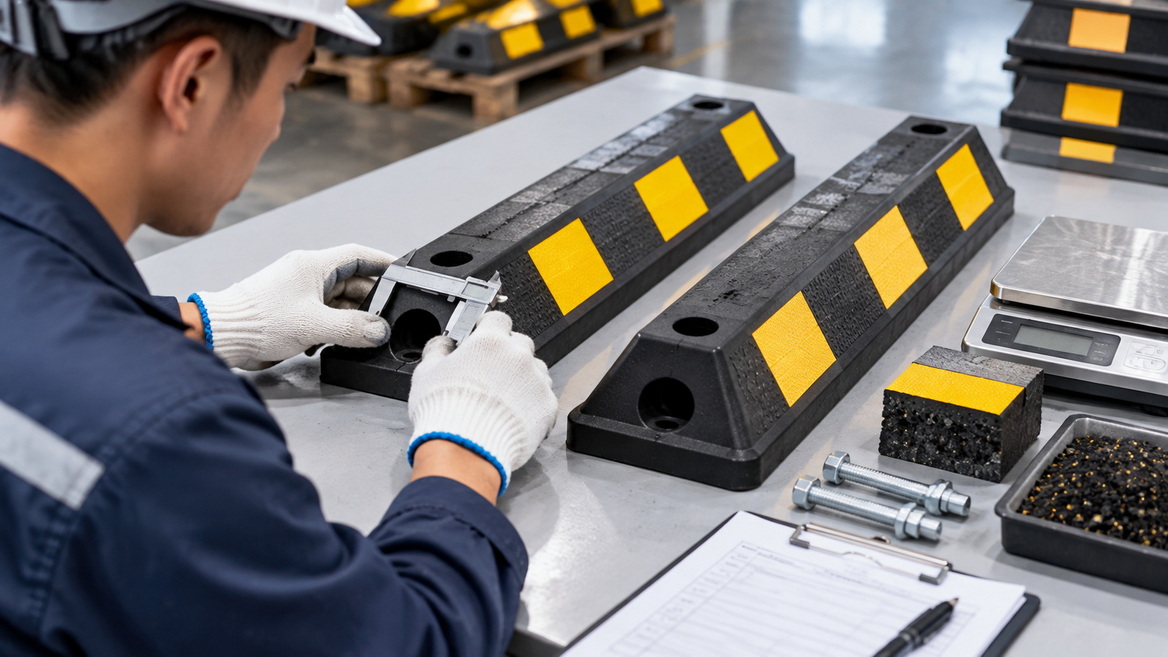
One of the most expensive sourcing mistakes is approving an excellent sample without controlling what must remain unchanged in mass production. A darker finish, fresh paint, or neatly applied reflector can make a later batch appear identical even when its compound, internal density, or molding quality has changed.
Use three connected controls: a signed reference sample, an approved written specification, and a batch inspection record. Take units from different cartons across the shipment, not only from the easiest pallet to reach. Record their weights and dimensions, and inspect a cut section when hidden voids or material consistency are a serious concern.
Weight is a useful warning signal, not a chemical analysis. If the average changes outside the agreed range, hold the shipment while the supplier investigates. Put material or mold substitutions under written change control, so a cheaper formulation cannot be treated as an informal production adjustment.
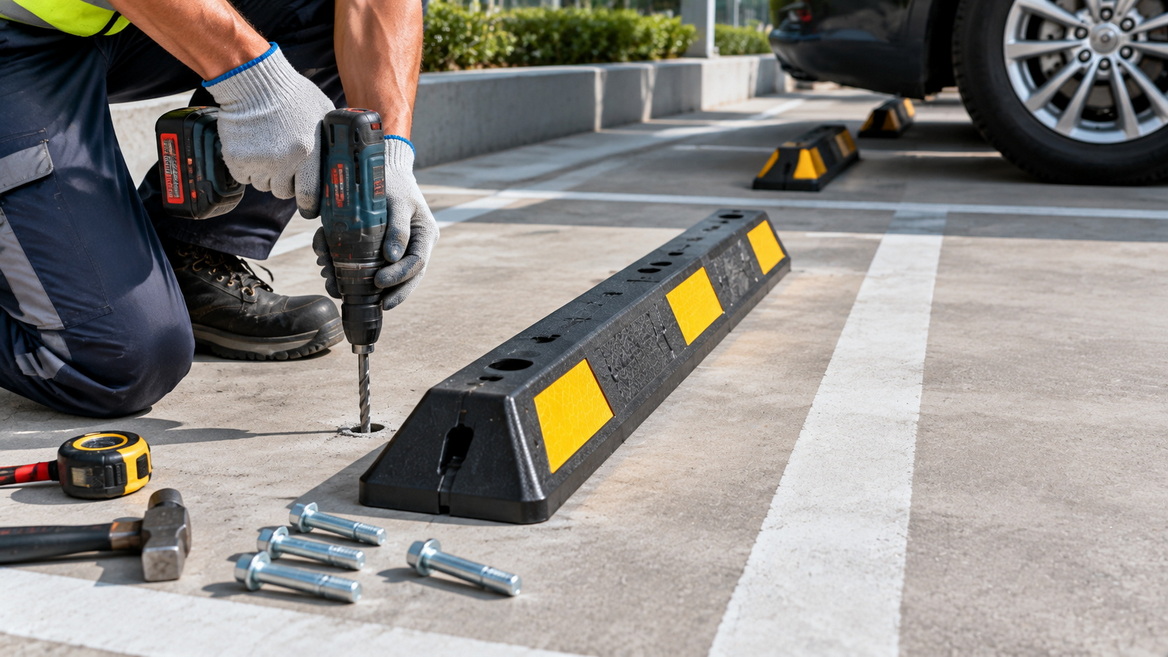
The mounting system deserves equal attention. A sound block may still fail in use if its holes are misplaced, anchors are inappropriate for asphalt or concrete, or the installation drawing does not match the site. Test-fit the sample with the actual proposed hardware before approving bulk production.
For an EU-bound order, ask what rules apply to the exact product. CE marking is required only where applicable EU harmonized legislation mandates it; it is not a general mark of product quality. Likewise, the EU RoHS Directive addresses electrical and electronic equipment. A passive rubber wheel stop should not be marketed as "RoHS-certified" simply because a substance test exists.
Instead, request documentation relevant to the material and destination market. Depending on the project, that may include substance declarations, appropriate chemical tests, installation information, and customer-specified performance testing. Check each report's sample name, composition, date, testing body, and connection to the goods you will actually receive.
To check ISO certification, compare the certificate's legal name, site, scope, number, and dates with the supplier's quotation and production address. Where a searchable record is available, check it through an accreditation or certification-body channel rather than relying solely on a PDF sent by a salesperson.
A low ex-works price can become expensive after anchors, export cartons, pallets, inspection, freight, duties, and local delivery are added. Wheel stops are heavy and bulky enough that packing efficiency can materially affect the landed cost per parking space.
Request carton dimensions, pieces per carton, pallet configuration, net and gross weights, and loading photographs. Compare quotations at the same product specification, order volume, delivery destination, and Incoterm. Do not compare one supplier's bare unit price with another supplier's price including anchors and retail packaging.
For repeat purchases, settle mold ownership and revision control early. Retain an approved sample from the first shipment, and decide in advance how the supplier will handle a defective batch, a changed reflector, or a missed delivery window.
A reliable rubber wheel stop program begins with a specification that can be inspected and repeated—not a supplier name alone. Use this shortlist to request comparable samples and quotations, verify each company's manufacturing and document claims, and confirm that its capacity matches your replenishment needs.
If your project also includes other parking-lot safety facilities or a private-label product range, invite Shenzhen Xingsheng Traffic Facilities Co., Ltd. to quote against the same written brief as the other shortlisted suppliers. Share your drawing, target quantity, destination, and packaging requirements, then choose the partner whose documented response best fits your quality, delivery, and total-cost targets.
Request the certificate number, certified legal entity, manufacturing-site address, issuing body, scope, and validity dates. Compare them with the supplier's business and quotation documents. Use a recognized certificate-search service when the record is available, or confirm directly with the issuing certification body or its accreditation body. A certificate image alone is insufficient.
Ask which specific EU legislation requires CE marking for that exact product and request the supporting conformity documentation. If the supplier cannot identify an applicable CE-marking rule, do not treat the claim as a purchasing advantage. Evaluate the wheel stop against the actual legal and project requirements in your destination market.
Fix the material description, finished-weight range, dimensions, reflector construction, and approved revision in the purchase order. During inspection, compare randomly selected units from multiple cartons with the signed sample. If material substitution would create a major commercial or safety risk, agree on independent laboratory testing and retained batch samples before production begins.
Ask for output for the specific model and mold set, not the supplier's total factory capacity. Request the current production schedule, available monthly slots, typical lead time, and contingency plan for mold damage or a sudden volume increase. Have the supplier confirm a realistic delivery milestone in writing.
Neither figure is meaningful without the complete specification and landed cost. A low MOQ may be useful for a market trial but expensive to ship. A low unit price may exclude anchors, protective packaging, inspection, or required documentation. Compare offers on the same basis and calculate cost per installed parking space.
- [China Rubber Industry Association — January–May 2025 rubber industry data]
- [Shenzhen Xingsheng Traffic Facilities — company profile]
- [Shenzhen Xingsheng Traffic Facilities — wheel stop products]
- [Shenzhen Xingsheng Traffic Facilities — contact information]
- [Roadsky — company profile] and [wheel stoppers]
- [Jackwin — company profile] and [wheel stoppers]
- [Allroads Safety — company profile]
- [Eastsea Rubber — product information] and [historical certificate statement]
- [Kington Rubber Technology — company information] and [product website]
- [Grandchess Daoan — company and product information]
- [Wistron — company profile] and [wheel stoppers]
- [Wheel Stops Factory — company and product information]
- [Sanmen Tongling Rubber Factory — custom wheel stoppers]
- [ISO — certification verification guidance]


