
Please Choose Your Language
Views: 242 Author: Site Editor Publish Time: 2026-06-24 Origin: Site


Content Menu
● What Are Recessed (Flush Mount) Road Studs?
● What Are Surface Mounted Road Markers?
● Core Comparison: Recessed Vs. Surface Mounted
>> Structural and Performance Differences
>> High‑Level Comparison Table
● Installation and Lifecycle: What Project Owners Need to Know
>> Recessed Road Stud Installation Workflow
>> Surface Mounted Marker Installation Workflow
● Safety, Visibility, and Compliance
>> Retroreflection and Night‑Time Performance
>> Standards and Certification
● Cost, ROI, and Total Cost of Ownership
>> Upfront Cost Vs. Long‑Term Value
>> Practical Buyer Guideline For 2025–2026 Projects
● Expert Insights From a B2B Project Perspective
>> Toll Stations and Parking Facilities
● How Shenzhen Xingsheng Supports OEM/ODM Buyers
● Recommended CTA For The Article
>> Q1: Are recessed road studs always better than surface mounted markers?
>> Q2: How long do recessed road studs typically last?
>> Q3: Can surface mounted markers be used on high‑speed highways?
>> Q4: What materials are best for road studs?
>> Q5: How can OEM/ODM services help my project?
Recessed (flush mount) road studs and surface mounted markers are both essential tools for safe, visible lane guidance, but they serve very different project needs, installation conditions, and lifecycle expectations. Understanding these differences is critical if you're planning a highway, toll station, or parking facility and want to balance durability, cost, and long‑term safety performance.
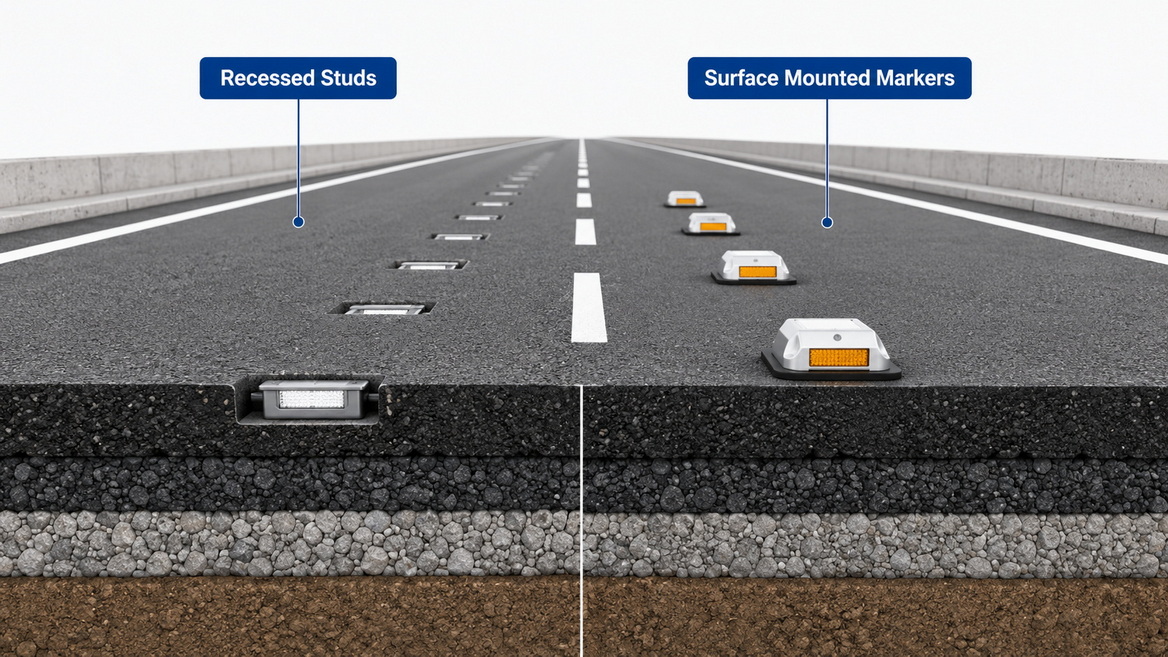
Recessed road studs (also called flush mount markers) are installed into a groove cut into the pavement so that the top of the stud sits slightly below or level with the road surface. This installation method protects the stud from direct wheel impact and makes it suitable for heavy‑duty, long‑term applications.
Key characteristics of recessed studs: - Installed in pre‑cut grooves using cutting equipment and specialist crews.
- Typically sit about 1.6 cm below the road surface for permanent installations. - Designed to endure high traffic volumes, heavy trucks, and snowplows.
- Preferred for major highways, long‑life projects, and harsh climates.
For a Chinese manufacturer like Shenzhen Xingsheng Traffic Facilities Co., Ltd., recessed studs align well with projects requiring high reliability: national highways, expressways, and long tunnel sections where maintenance windows are limited and failure risk must be minimized.
Surface mounted road markers are installed directly onto the pavement using adhesives or a combination of adhesive and mechanical anchoring (such as a shank drilled into the asphalt). They typically sit raised above the surface, creating a tactile feedback when vehicles cross them and enabling fast installation without cutting the pavement.
Key characteristics of surface mounted markers: - Fixed using epoxy, bitumen, or high‑strength road adhesive, often without excavation.
- Can be shankless (fully glued) or shank‑type (mechanically anchored plus adhesive). - Ideal for rapid deployment, temporary lane schemes, and parking lots.
- Easier and faster to install and remove with minimal impact on the pavement.
For Xingsheng, surface mounted markers are a flexible solution for parking facilities, toll plazas, city streets, and temporary traffic control where installation speed and layout changes matter as much as durability.
Recessed studs and surface mounted markers differ in how they handle mechanical stress, weather, and traffic over time.
- Mechanical protection
- Recessed: Protected inside a groove, less exposed to shearing and direct wheel load. - Surface mounted: More exposed; shank‑type models handle shearing better than purely glued studs.
- Traffic and speed environment
- Recessed: Best for high‑speed, high‑volume highways and heavy trucks.
- Surface mounted: Better for low‑ to medium‑speed areas, parking, urban streets, and temporary schemes.
- Maintenance and replacement
- Recessed: Higher upfront installation complexity but lower long‑term replacement frequency. - Surface mounted: Easier to replace or relocate, especially for temporary projects.
| Aspect | Recessed (Flush Mount) Road Studs | Surface Mounted Road Markers |
|---|---|---|
| Installation method | Cut grooves, embed studs, fill with epoxy or bitumennk-roadstud+1 | Bonded to surface with adhesive; sometimes drilled shank anchornokinsolarroadstud+1 |
| Traffic suitability | High‑speed, high‑volume highways; heavy trucks and busesnokinsolarroadstud+1 | Low‑/medium‑speed roads, parking lots, city streets, temporary schemesnokinsolarroadstud+2 |
| Durability | Very high under mechanical stress and snowplows; long service lifenokinsolarroadstud+1 | Medium to high depending on anchor design and adhesive qualitynokinsolarroadstud+1 |
| Installation time | Longer; requires specialized cutting machinery and skilled crewsnk-roadstud | Shorter; minimal or no excavation, rapid deploymentnokinsolarroadstud+1 |
| Maintenance access | More complex; groove work needed for replacementnk-roadstud | Simple; pry off and clean surface, then re‑bond new markernokinsolarroadstud+1 |
| Best applications | Permanent lane delineation on highways, tunnels, long‑term projectsnokinsolarroadstud+1 | Parking bays, toll plazas, work zones, temporary or reconfigurable layoutsnokinsolarroadstud+2 |
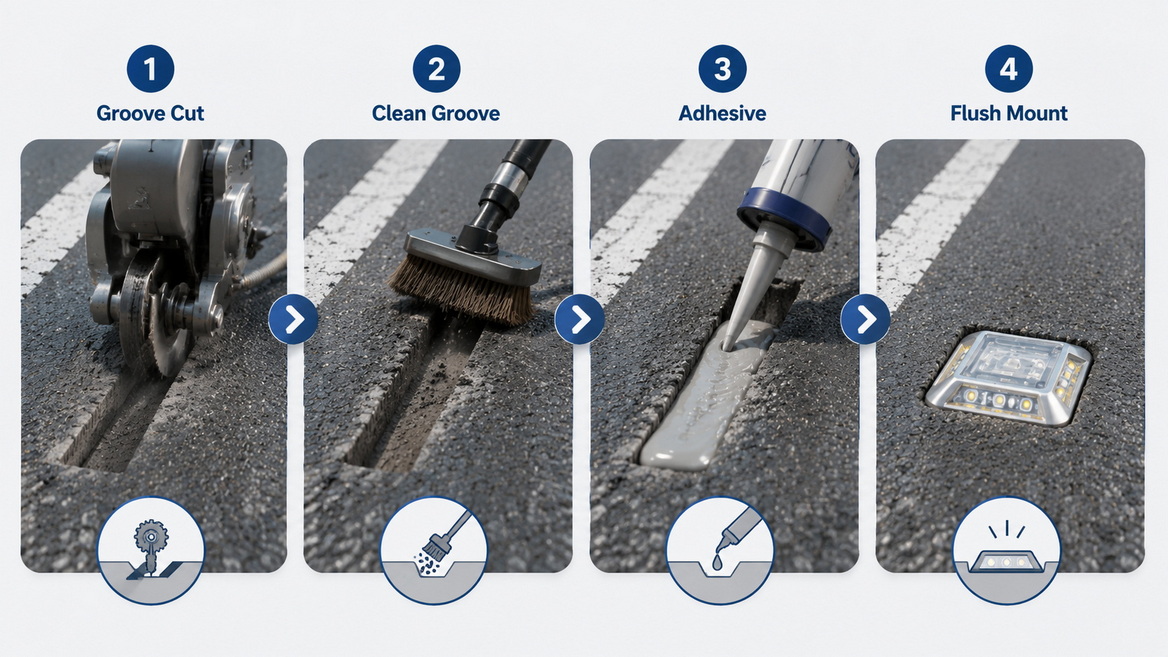
A typical installation process for recessed studs involves:
1. Pavement survey and layout design to position studs according to lane lines and local standards.
2. Groove cutting using road saws at specified length and depth (e. g., around 1.2 m for one‑way markers, 2.1 m for two‑way markers). 3. Cleaning and drying the groove to ensure proper bonding.
4. Applying high‑strength adhesive or bitumen across the groove base. 5. Embedding studs and compacting them to the correct level relative to the road surface.
6. Curing and reopening the lane after adhesive achieves specified strength.
Because the studs sit below the surface, they resist snowplow blades and heavy wheel loads, which significantly extends their service life on busy corridors.
Surface mounted markers follow a faster, more flexible process:
1. Marking positions on the existing pavement without groove cutting.
2. Cleaning and degreasing the surface to ensure strong bonding.
3. Applying a road‑grade adhesive (epoxy, polyurethane, or bitumen). 4. Placing the marker (shank inserted in a pre‑drilled hole when applicable) and pressing into position. 5. Allowing curing and reopening the traffic—often within hours.
This process minimizes dust, noise, and civil construction work, making surface‑mounted markers ideal for night‑time installations and fast upgrades in urban environments or parking facilities.
Both recessed and surface mounted products rely on retroreflective elements (plastic lenses, glass, or ceramic reflectors) to return headlight beams toward drivers and improve night‑time lane recognition.
- Recessed studs can maintain clean reflective faces longer because they are shielded from direct impact, which helps maintain consistent brightness on high‑speed roads. - Raised surface markers often provide stronger tactile and audible feedback when crossed, which can reduce lane drift and support speed management in parking lots and urban traffic calming schemes.
Selecting markers that comply with ASTM, MUTCD, CE, AS/NZS, and RoHS requirements ensures performance, safety, and environmental compliance across different markets.
A manufacturer like Xingsheng can provide project‑specific documentation such as: - Optical performance and retroreflection test reports.
- Load‑bearing and impact resistance data.
- Chemical resistance and adhesion reports for local climatic conditions.
Recessed studs usually carry higher upfront costs due to civil works, cutting equipment, and longer lane closures. However, their long‑term durability in high‑traffic environments produces better total cost of ownership for highways and truck routes.
Surface mounted markers provide cost‑effective flexibility and shorter installation windows, which is valuable for operators managing multiple parking assets, toll plazas, and temporary traffic schemes. While they may need more frequent replacement in heavy traffic, they reduce project risk when lane layouts may change.
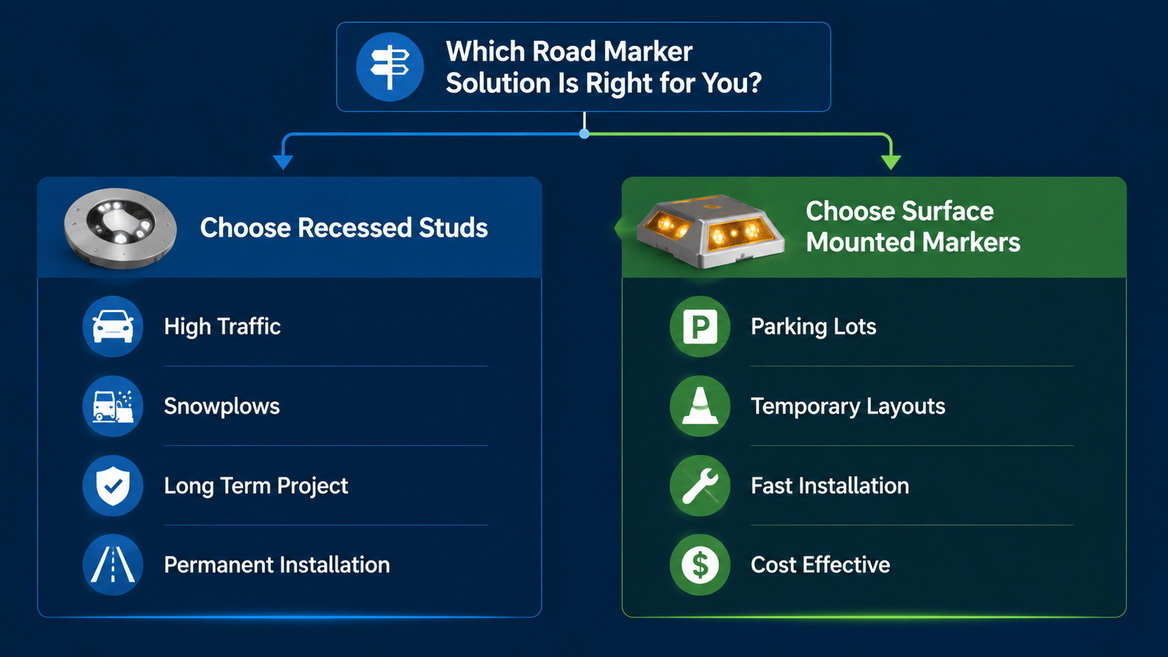
Industry buyer guides emphasize matching product choice to traffic load and pavement type:
- Use recessed studs when:
- Annual average daily traffic is high.
- Heavy trucks and buses dominate the mix.
- Snowplows or aggressive winter maintenance are expected.
- Use surface mounted markers when:
- Layout changes are likely (e. g., redevelopment phases).
- Applications are low‑ to medium‑speed (parking, campus roads).
- Rapid installation and minimal civil work are priorities.
Drawing from Xingsheng's experience as a Chinese OEM/ODM traffic safety manufacturer, successful international projects typically follow three expert principles:
- Design for the worst‑case traffic scenario, not the average. If truck volumes or winter maintenance are rising, future‑proof highways with recessed studs.
- Separate permanent and temporary requirements. Permanent lane lines on expressways deserve flush mount studs; temporary diversion, work zones, and car park re‑striping fit surface mounted markers.
- Integrate markers into a system, not a standalone product. Combine studs with thermoplastic lines, signage, and speed management devices to create a coherent visual guidance system.
For global buyers, working with an OEM/ODM partner like Xingsheng allows you to customize colors, reflectors, base materials, and installation kits to match local standards while controlling costs.
On high‑speed corridors, recessed studs are often deployed: - Along lane lines to support night‑time visibility in rain.
- At dangerous curves and ramps to reinforce visual guidance.
- In tunnels where lighting and reflection must work together.
These projects prioritize long service life and minimized maintenance closures, making flush mount designs the logical choice.
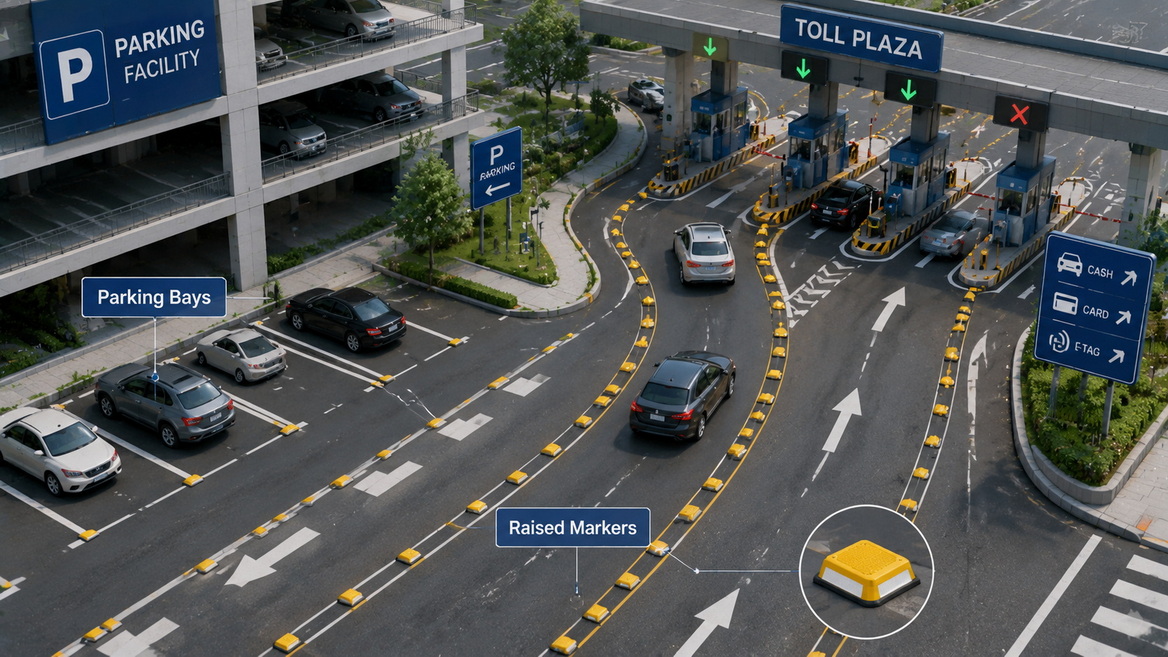
Surface mounted markers excel in toll plazas and parking environments: - Marking individual parking bays and directional arrows.
- Guiding vehicle streams through toll lanes and payment booths.
- Demarcating pedestrian crossings and speed control zones.
Their raised profile provides tactile feedback and strong visual emphasis, which helps drivers navigate complex micro‑environments at lower speeds.
Shenzhen Xingsheng Traffic Facilities Co., Ltd. specializes in road reflectors and related traffic safety products for streets, highways, toll stations, and parking lots, offering OEM and ODM services for international B2B clients.
Typical support includes:- Customized stud dimensions, reflector colors, and materials to match local standards.
- Pre‑packed installation kits (adhesives, bolts, shanks) tailored to project workflows.
- Technical documentation, sample testing, and small batch runs before full deployment.
This combination of manufacturing capacity and customization enables buyers to build project‑specific solutions rather than relying on generic catalog items.
If you're planning a highway, toll station, or parking facility and need guidance on choosing between recessed road studs and surface mounted markers, contact Shenzhen Xingsheng Traffic Facilities Co., Ltd. for OEM/ODM design support, sample testing, and a tailored quotation.
A1: No. Recessed studs offer superior durability for heavy traffic and snowplows, but surface mounted markers are more cost‑effective and flexible for parking areas, toll plazas, and temporary schemes.
A2: Service life depends on traffic volume and climate, but recessed studs designed for highways generally provide multi‑year performance with reduced failure risk compared to raised, surface‑mounted alternatives.
A3: They can, but they are more vulnerable to shearing forces and snowplow damage; many standards recommend recessed designs or mechanically anchored raised studs for high‑speed lanes and heavy trucks.
A4: Common materials include engineered plastics, aluminum, and glass or ceramic lenses; selection depends on traffic load, environment, and budget, with glass and ceramic providing excellent abrasion resistance in high‑wear conditions.
A5: OEM/ODM services allow you to customize reflector colors, body materials, anchoring systems, and packaging to local standards, reducing installation risk and ensuring consistent performance across multiple sites.


