
Please Choose Your Language
Views: 222 Author: XS Traffic Facilities Publish Time: 2026-06-21 Origin: Site


Content Menu
● Why Interstate Signs Matter for Safety and Navigation
● Interstate Sign Colors, Shapes, and What They Tell You
>> Color: Red, White, and Blue
● Understanding Interstate Route Numbers (Two‑Digit)
>> Numbering Direction Across the Map
● Three‑Digit Interstate Signs: Spurs and Beltways
● Where Interstate Signs Are Located (And Why That Matters)
● How Solar Road Markers Enhance Interstate Sign Visibility
● Real‑World Use Cases: Highways, Toll Stations, and Parking Lots
>> 2. Toll Plazas and Weigh Stations
>> 3. Parking Facilities and Interchanges Near Interstates
● Practical Tips for Drivers: Reading Interstate Signs Like a Pro
● How OEM/ODM Traffic Safety Solutions Support Interstate Environments
● When to Upgrade: A Simple Decision Checklist for Operators
● Call to Action: Turn Interstate Signs into Complete Safety Systems
● Recommended Comparison Table: Interstate Signs vs. Supporting Devices
● FAQ
>> 1. What does the Interstate sign actually tell me?
>> 2. How can I tell if an Interstate goes east–west or north–south?
>> 3. What is the difference between a three‑digit Interstate and a two‑digit Interstate?
>> 4. Why are solar road markers important near Interstates?
>> 5. Are solar traffic signs reliable enough for highway use?
Interstate signs are more than colorful shields on a pole – they're a visual code that tells you where you are, where you're going, and how safely you'll get there. As a manufacturer working every day with solar road markers and other traffic safety products, I see firsthand how understanding these signs – and pairing them with the right lighting and markings – can dramatically reduce confusion and crashes on U. S. highways, toll plazas, and parking facilities.
An Interstate sign is the familiar red–white–blue shield that marks roads in the U. S. Interstate Highway System. It shows the route number and often the word "Interstate," helping drivers quickly recognize major, federally supported long‑distance routes. These signs appear along highways that cross at least one state border and are typically placed at key junctions, on ramps, and overhead gantries.
Unlike local street signs, Interstate shields are part of a nationwide standard: once you learn the pattern in one state, you can use it everywhere else in the U. S. For road operators and facility managers, that consistency is a powerful tool for wayfinding and safety.
The main purpose of an interstate sign is to guide drivers safely and efficiently along long‑distance routes. They work together with guide signs, mile markers, and other traffic devices to answer three core questions for every driver:
- What road am I on right now?
- Where does this road go?
- How do I reach my next destination or exit?
When these signs are clear and visible, drivers can make earlier lane changes, choose the right exit, and recover quickly from missed turns. This reduces sudden braking, last‑minute swerving, and rear‑end collisions – especially at complex interchanges and toll plazas. In low‑visibility conditions, enhanced devices such as solar‑powered LED road markers and solar traffic signs keep those guidance cues visible even when headlights or overhead lights are not enough.
Every element of an Interstate sign – from color to shape – has a defined meaning under U. S. roadway standards.
- Blue background: Indicates a guide sign related to the Interstate system, used mainly for route identification and navigation. - Red band at the top: Highlights the word "Interstate" and reinforces that this is part of the federal highway network. - White letters and numbers: Provide maximum contrast day and night, so route numbers remain legible at highway speeds.
In the broader U. S. sign system, green signs are used for exits and directional information, blue for services, white for regulatory signs such as speed limits, yellow for warnings, orange for work zones, and brown for parks or recreation. Interstate shields sit inside this color code as a specific guide sign for numbered freeways.
The shield shape is reserved for route markers, and the Interstate version has its own red‑white‑blue layout. At a glance, drivers can distinguish it from:
- U. S. Highways (black numbers on a white shield)
- State routes (often unique shapes, such as circles or state outlines)
This visual differentiation matters when drivers are scanning multiple signs at once on fast‑moving freeways.
From an engineer's point of view, the Interstate numbering system is a clean and elegant design. Once you know the rules, the shield tells you far more than just a random number.
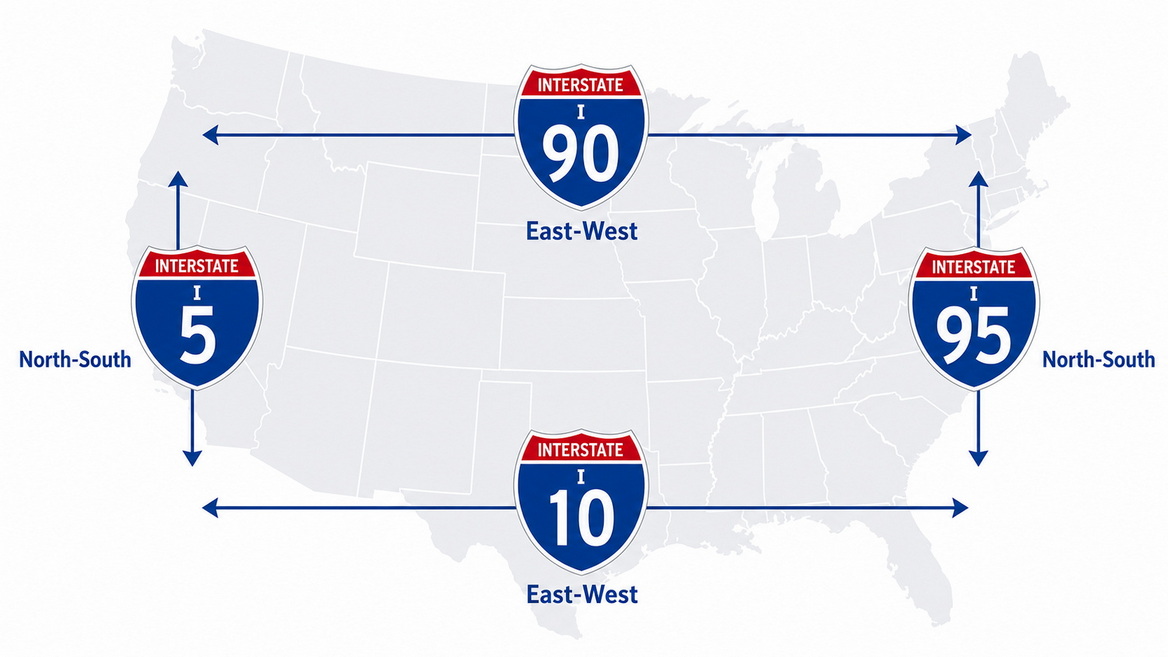
- Even two‑digit Interstates (I‑10, I‑40, I‑90) generally run east–west across the country. - Odd two‑digit Interstates (I‑5, I‑75, I‑95) generally run north–south.
As someone who frequently designs content for logistics and fleet operators, I encourage them to train new drivers on this pattern. A driver who knows that I‑80 is an east–west corridor or that I‑95 is a north–south spine can mentally map their direction of travel even without GPS.
- Lower numbers for east–west routes start in the south (I‑10) and increase as you move north (I‑90). - Lower numbers for north–south routes start in the west (I‑5) and increase as you move east (I‑95).
For example:
- I‑5 runs along the U. S. West Coast.
- I‑95 runs along the East Coast.
- I‑10 roughly parallels the southern border, while I‑90 is far to the north.
For long‑haul drivers, understanding this grid saves time, fuel, and stress – especially when diversions or detours force them off their typical GPS routes.
Three‑digit Interstate numbers are where many drivers get confused, and it's also where I see a clear opportunity for better education and clearer on‑road devices.
The core rule is that these three‑digit routes are auxiliary Interstates that branch off a primary two‑digit route. ### Even First Digit: Beltways and Loops
If the first digit is even (e. g., I‑285, I‑495), the route is typically a loop or beltway around a metro area. These routes often reconnect with the same primary Interstate at two different points. They are designed to:
- Bypass congested downtowns
- Distribute traffic to multiple suburbs or industrial zones
- Connect logistics centers, airports, and ports back to the main freeway
If the first digit is odd (e. g., I‑195, I‑395), the route is usually a spur that branches off a primary Interstate and ends in a city center, port, or other destination. Spurs are critical for: - Feeding traffic into downtown business districts
- Connecting industrial parks, toll facilities, or terminals to the main grid
- Providing redundancy when the main route is under construction
For road owners and developers, understanding where loops and spurs create complex merge areas can guide where solar road markers, LED delineators, and high‑visibility signs deliver the most safety impact.
Interstate shields are strategically placed where drivers most need reassurance or directional confirmation. Typical locations include:
- Approaches to freeway entrances and exits
- Overhead gantries at major junctions
- Key decision points where multiple routes diverge
- Along the route at intervals to confirm you're still on the right Interstate
These signs work together with green guide signs (showing destinations and exit numbers), mile markers (indicating distance and position), and sometimes dynamic message signs displaying real‑time traffic or incident information.
From our field experience on highways and toll plazas, we see the best results when operators pair these standard signs with:
- Solar road markers to outline lanes and exits
- Solar LED signs that flash at critical merges or dangerous curves
- High‑contrast pavement markings for wet‑night visibility
This layered approach ensures drivers are guided by both vertical signs and horizontal lighting cues.
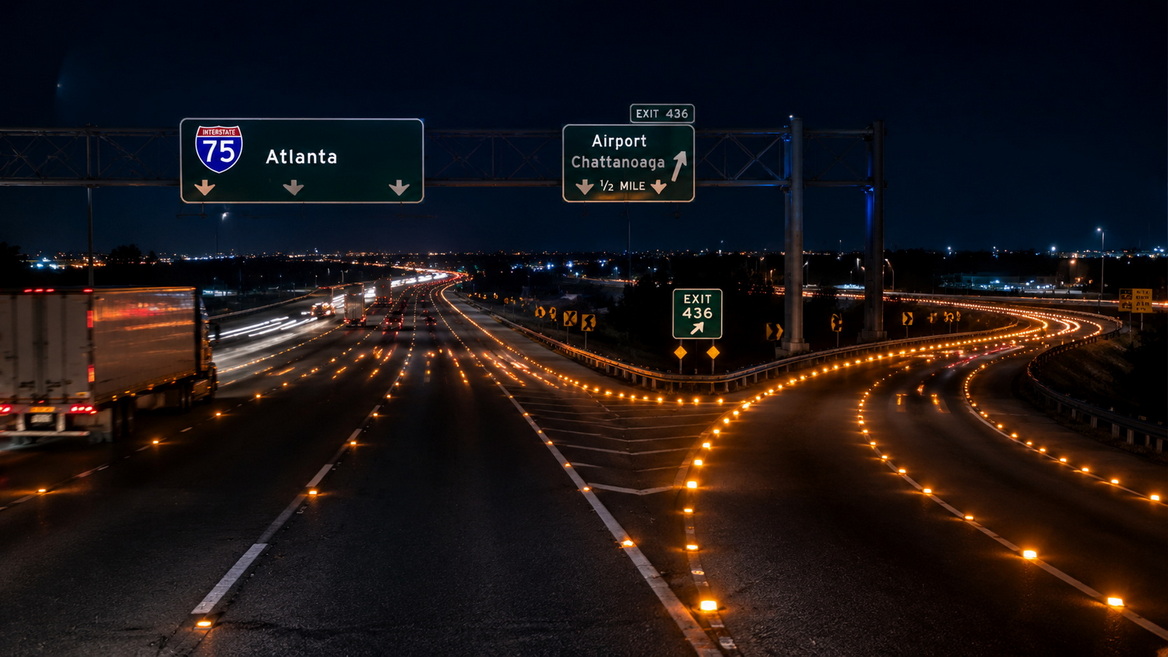
As a manufacturer of solar road markers and LED traffic facilities, we focus heavily on what happens when daylight disappears. A perfectly designed Interstate sign loses its value if drivers can't see how lanes and ramps connect to it at night or in bad weather.
Modern solar‑powered traffic products address exactly this challenge:
- Solar road markers and studs use bright LEDs to outline lane edges, diverging ramps, toll lanes, and speed‑change zones, with visibility distances that can exceed 0.6 miles in darkness. - Solar traffic signs and delineators combine standard MUTCD‑style graphics with internally lit or edge‑lit LEDs, improving conspicuity without relying on the grid. - Energy‑efficient solar systems reduce operating costs and enable lighting at remote or underserved locations where wiring is difficult or expensive.
Globally, the solar traffic sign and solar road marker market is growing at roughly 8–9% CAGR, driven by smart city programs, sustainability targets, and "Vision Zero" road safety goals. For highway agencies and private operators, this trend means two things:
- There is now a mature, competitive supply base for OEM/ODM solar road safety products. - Early adopters can gain both safety and branding benefits by implementing visible, technology‑forward solutions.
From practical projects we've observed and supported, several scenarios highlight how Interstate signs and solar devices work together in the field.
At complex interchanges where multiple Interstates intersect, drivers must make quick lane decisions based on route shields and overhead green signs. Installing solar road markers along lane lines and diverge points helps:
- Emphasize correct lane paths at night
- Reduce late lane changes when drivers finally see an overhead sign
- Support older drivers or foreign visitors who rely more on visual cues
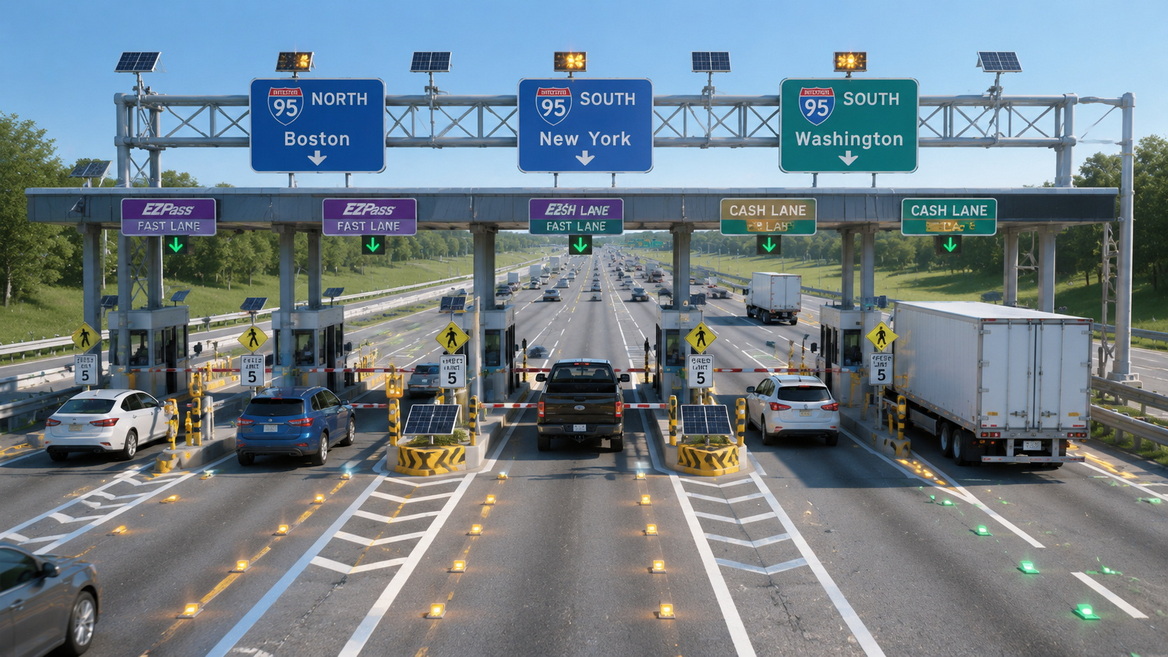
Toll stations and weigh stations often sit directly on or just off Interstate routes. Clear route shields and directional signs (e. g., "I‑95 North – All Lanes") must be supported by:
- Bright lane delineation to distinguish E‑ZPass / electronic toll lanes from cash lanes
- Flashing solar markers at closed or restricted lanes
- LED warning signs for speed reduction and stopping points
These measures help maintain throughput while protecting staff and reducing rear‑end collisions in queues.
At major interchanges, nearby park‑and‑ride lots, logistics hubs, and commercial centers rely on Interstate‑linked traffic flows. Operators increasingly use:
- Solar wheel stops and parking markers to keep vehicles within bays and protect pedestrians - Solar road studs and signage to guide vehicles safely through dark corners and ramps
Here, keeping the route logic consistent with the Interstate signage (clear arrows, route numbers, and color conventions) makes it easier for drivers to transition between freeway speeds and low‑speed facility navigation.
Based on both road‑safety best practices and feedback from drivers, here are simple steps any driver can use to interpret Interstate signs more confidently:
1. Identify the shield
Look for the red‑white‑blue Interstate shield as the backbone of your route. If you see a different shield color or shape, you might be transitioning to a U. S. or state highway.
2. Read the route number
- Even number: you're likely traveling east–west.
- Odd number: you're likely traveling north–south.
3. Check the direction banner
Many signs show "North," "South," "East," or "West" above the shield. Use this to confirm you're heading in the right general direction, not just following a familiar number.
4. Look for three‑digit clues
- Even first digit: loop/beltway, often skirting the city.
- Odd first digit: spur route going into a specific district. 5. Use green guide signs and mile markers
Combine the Interstate shield with green destination signs and mile markers to track distance to exits and cities.
6. At night, follow lighted cues
When visibility is low, rely on reflective markings, solar markers, and illuminated signs to maintain lane discipline near major Interstate junctions and toll points.
For fleets and safety managers, turning these steps into a short driver‑training module can significantly reduce navigation errors and incident risk for new operators.
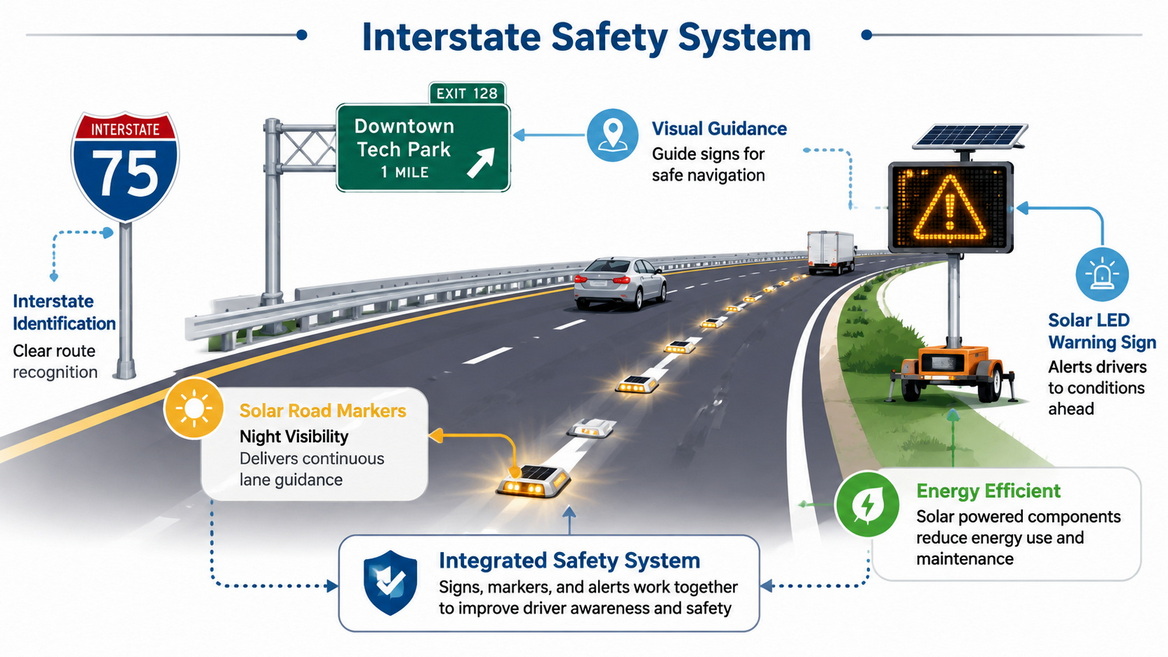
Companies like Shenzhen Xingsheng Traffic Facilities Co., Ltd. are part of a growing ecosystem of specialized manufacturers focused on OEM and ODM solutions for global traffic safety needs. With over a decade of expertise, such factories typically provide:
- Custom‑designed solar road markers, tailored in color, load‑bearing strength, LED pattern, and communication interfaces
- LED traffic signs and warning lights, compatible with regional standards and ready for integration into smart traffic systems
- Parking and low‑speed facility safety products, including bollards, wheel stops, and delineators for toll plazas and logistics yards
From an industry insider's perspective, the most successful highway and parking projects share three characteristics:
- Early collaboration between road owners, designers, and manufacturers
- A system view that combines Interstate signage, lighting, and markings rather than treating them as separate purchases
- A focus on lifecycle performance – not just upfront cost – including durability, maintenance access, and power independence through solar.
If you manage a highway, toll facility, or large parking area connected to an Interstate, use this quick checklist to decide whether it is time to upgrade your signage and lighting:
- Do drivers frequently miss exits or make late lane changes near your site?
- Are there known night‑time or wet‑weather crash hotspots at merges or curves?
- Are you planning or participating in smart city or Vision Zero initiatives that demand better data and lower crash rates? - Are parts of your network far from grid power, making traditional lighting expensive or unreliable? - Is your existing hardware struggling with maintenance issues, corrosion, or outdated reflective performance?
If you answered "yes" to several questions, a combined upgrade of standard Interstate–compliant signage plus solar road markers and solar LED signs is usually a cost‑effective way to improve safety and user experience.
Interstate signs are the backbone of U. S. freeway navigation – but they reach their full potential only when supported by modern, visible, and energy‑efficient road‑safety hardware.
If you operate highways, toll plazas, or large parking facilities and want to:
- Reduce night‑time crashes and confusion near your Interstate connections
- Align with smart city and sustainability goals
- Customize OEM/ODM traffic products for your specific environment
then it is the right time to evaluate a combined solution using solar road markers, LED traffic signs, and high‑performance pavement markings designed around your interstate corridors.
| Item | Primary function | Typical use on/near Interstates | Key benefits |
|---|---|---|---|
| Interstate shield sign | Identify route and direction | Mainline, junctions, exits | Standardized guidance across U.S. |
| Green guide signs | Show cities, exits, distances | Overhead and roadside | Clear route choices and timing |
| Solar road markers | Outline lanes, exits, hazards | Curves, ramps, toll lanes | High night‑time visibility, no grid power needed |
| Solar traffic signs | Highlight warnings and regulations | High‑risk areas, remote sites | Self‑powered, attention‑grabbing alerts |
| Parking/lot safety products | Control low‑speed movements | Interchange hubs, park‑and‑ride | Protect pedestrians and infrastructure |
It tells you that you are on or approaching an Interstate Highway, shows the route number, and usually the travel direction (north, south, east, or west), helping you align your trip with the national freeway grid.
Look at the number on the shield: even two‑digit Interstates typically run east–west, while odd two‑digit Interstates typically run north–south across the country.
Two‑digit Interstates are major cross‑country routes, while three‑digit Interstates are auxiliary routes (loops or spurs) that connect cities, suburbs, or important facilities back to the main route.
They enhance visibility at night and in poor weather, clearly outlining lanes, exits, and hazardous zones without relying on wired power, which reduces long‑term operating costs and improves safety.
Modern solar signs use high‑efficiency panels, advanced batteries, and LED technology, and they are increasingly adopted in highway and smart city projects worldwide due to their durability and energy savings.
1. Business Research Company – *Solar Street Lighting Global Market Report 2026 – Market Size, Trends, And Forecast 2026–2035* (EIN Presswire). https://www.einpresswire.com/article/887265192/industry-analysis-report-on-solar-street-lighting-2026-major-trends-influencing-f
2. Emergen Research – *Solar Road Signs Market Perspectives* (Market size, CAGR, and technology trends). https://www.emergenresearch.com/fr/industry-report/solar-road-signs-market
3. Archive Market Research – *Solar Traffic Signs Market 2025–2033* (Growth drivers and smart feature integration). https://www.archivemarketresearch.com/reports/solar-traffic-signs-119743
4. Accio – *Road Reflector Market Trends 2026: Growth & Innovation* (Solar‑powered studs and smart city demand). https://www.accio.com/business/road-reflector
5. Maryland MVA – *Driver Education Curriculum, Unit 2: Signs, Signals, Markings* (Color coding and Interstate number rules). https://mva.maryland.gov/drivers/Documents/DriverEd_Curriculum_Unit2.pdf
6. Zutobi – *Road Signs & Traffic Signs in the US: The Definitive Guide* (Interstate sign description and function). https://zutobi.com/us/driver-guides/road-signs-explained
7. Sage‑Advices – *What does a blue sign with white letters mean?* (Definition of Interstate directional signs). https://sage-advices.com/what-does-a-blue-sign-with-white-letters-mean/
8. Driving‑Tests. org – *Interstate Sign: What Does it Mean?* (Placement and usage at major intersections). https://driving-tests.org/road-signs/interstate-sign/
9. NY DMV – *Chapter 4: Traffic Control* (Route marker meanings and examples). https://dmv.ny.gov/new-york-state-drivers-manual-and-practice-tests/chapter-4-traffic-control
10. Traffic Safety Warehouse – *Aluminum Solar-Powered Flashing Road Marker* (Performance and applications). https://www.trafficsafetywarehouse.com/Aluminum-Solar-Powered-Flashing-Road-Marker/productinfo/SRS-AL001/
11. CN Patent – *Structure and advantages of solar self‑illuminated road signs. https://patents.google.com/patent/CN102454155B/zh
12. PPG – *Pavement and traffic safety markings for any application* (Use of heavy‑duty products for parking and airports). https://www.ppg.com/en-US/traffic/solutions
13. Speed Humps Australia – *Traffic Calming Products: What to Choose for Your Parking Lot* (Role of wheel stops, rumble strips, etc.). https://www.speedhumpsaustralia.com.au/traffic-calming-products/
14. SafetyCulture – *Traffic Management: Strategies and Solutions* (Dynamic traffic management and warning systems). https://safetyculture.com/topics/traffic-management
15. Traffic Safety Store – *Solar-Powered Road Markers and Studs* (Visibility and application overview). https://www.trafficsafetywarehouse.com/Aluminum-Solar-Powered-Flashing-Road-Marker/productinfo/SRS-AL001/
16. TrafficThing – *Company Profile – XS Traffic Facilities (Shenzhen Xingsheng Traffic Facilities Co., Ltd.)* (Product range and OEM/ODM capabilities). https://www.trafficthing.com/Company-Profile.html
17. TrafficThing – *Customized Solar Road Marker Manufacturer | 10+ Years Expert* (Solar road marker manufacturing and export focus). https://www.trafficthing.com/solar-road-marker.html
18. Shenzhen NOKIN Traffic Facilities – Company and product overview (Solar road safety products portfolio). https://www.made-in-china.com/showroom/candyxue0626/
19. Traffic Safety Blog – *Decoding U. S. Road Signs and Symbols* (Interstate shields and color coding). https://www.trafficsafetystore.com/blog/decoding-u-s-road-signs-and-symbols/
20. Jackwin Safety – *Road Sign Meaning and Types: A Comprehensive Guide* (General road sign purposes and categories). https://jackwinsafety.com/road-sign-meaning-and-types/
21. YouTube – *US Freeways, Highways, Road Signs & Maps Explained* (Color meanings and Interstate sign visuals). https://www.youtube.com/watch?v=sbeYaeiJN3w
22. YouTube – *Interstate Sign in the USA: What does it mean?* (Auxiliary number rules for spurs and loops). https://www.youtube.com/watch?v=TUWzKISUlMY
23. YouTube – *Let's Talk About Road Signs!* (Differences among Interstate, U. S., and State highway signs). https://www.youtube.com/watch?v=P45NzGTjRDk


