
Please Choose Your Language
Views: 222 Author: XS Traffic Facilities Publish Time: 2026-06-16 Origin: Site


Content Menu
● What Are Circular LED Flashing Patterns?
● What Are Sequential Arrow Patterns?
● Safety Performance: Visibility Vs. Directional Guidance
>> When Circular Flashing Patterns Win
>> When Sequential Arrow Patterns Win
● Human Factors: How Drivers Actually React
● Installation Scenarios: Highways, Toll Stations, Streets, Parking
>> Toll Stations And Tunnel Portals
>> Urban Streets And Parking Facilities
● Technical Comparison Table: Circular Vs. Sequential Arrow
● Reliability, Maintenance, And Total Cost Of Ownership
● OEM/ODM Flexibility: Designing For Both Patterns In One Platform
● Latest Industry Trends: From Stand‑Alone To Connected Systems
● Practical Selection Framework: How To Choose For Your Project
>> Step‑By‑Step Decision Checklist
● UX And Design Tips For Clearer LED Traffic Messages
● When To Contact A Manufacturer For Custom Solutions
● Clear CTA: Plan Your LED Pattern Strategy
● FAQ: Circular Vs. Sequential LED Traffic Patterns
>> Q1: Are circular LED flashing patterns enough for highway work zones?
>> Q2: Do sequential arrow patterns consume more power than circular flashers?
>> Q3: Can one LED sign be reprogrammed from circular flashing to sequential arrow mode later?
>> Q4: How do I know which pattern my local regulations allow?
>> Q5: What is the typical lifespan of LEDs in traffic signs?
When I advise road operators and OEM partners on LED traffic sign strategies, the most common debate is whether to deploy circular LED flashing patterns or sequential arrow patterns at critical conflict points such as lane merges, toll plazas, and work zones. From a B2B buyer perspective, this is not just a design preference issue; it is a strategic decision that affects safety KPIs, maintenance budgets, and system integration with ITS platforms.
In this guide, we will compare both patterns from a practical, engineering‑driven angle and share insights based on project experience with highways, urban arterials, and parking applications.

Circular LED flashing patterns use one or multiple circular clusters of LEDs that blink at defined frequencies to attract driver attention. They are common on stop signs, pedestrian crossings, speed limit reminders, and general hazard warning signs.
Key characteristics:
- High conspicuity in low‑visibility conditions (rain, fog, night).
- Simple ON/OFF or alternating flash modes.
- Minimal learning curve for drivers across markets.
From an operations perspective, circular flashers are often the first step when a road authority wants to upgrade a static sign into an "active" sign without redesigning the entire gantry layout.
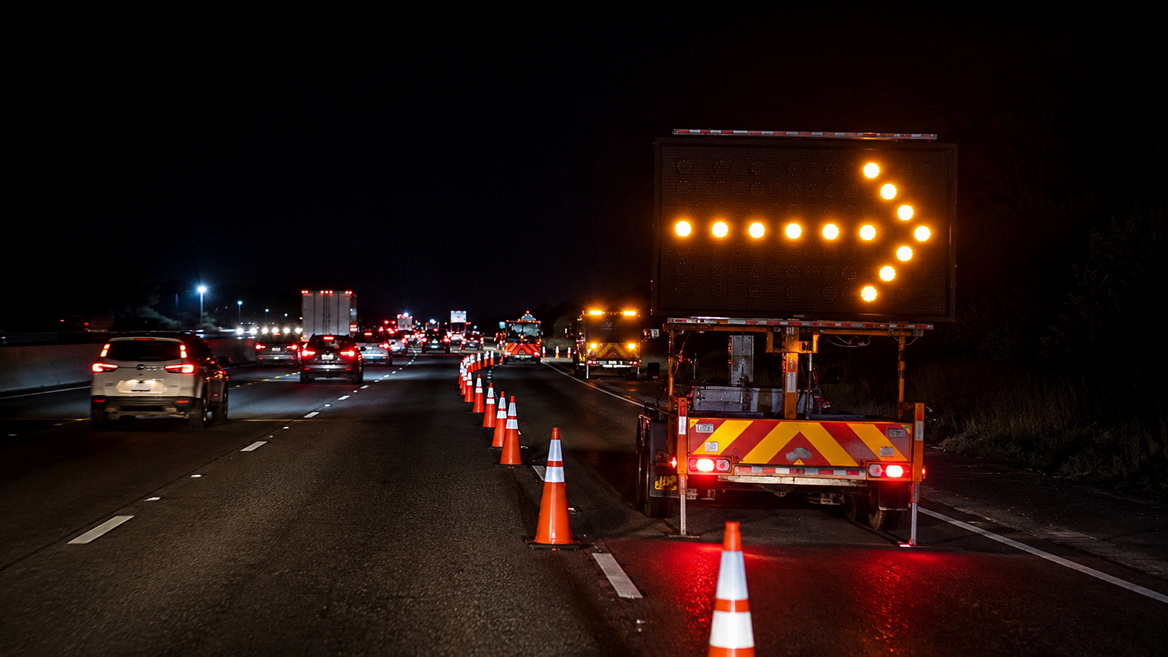
Sequential arrow patterns consist of a series of LED arrow modules that light up in a programmed order, creating a clear sense of *directional movement* (for example, left merge, right lane shift, tapering to a single lane). They are widely used in work zones, lane control systems, and toll station approaches.
Their advantages include:
- Strong directional guidance (where to go, not just "be careful").
- Flexible patterns: merge arrows, chevrons, running light sequences.
- Easy integration with lane control systems, sensors or PLCs.
For complex traffic environments—like multi‑lane toll plazas or dynamic lane management on bridges—sequential arrows often provide a more intuitive message than static or circular flashing signs.
From a safety engineering angle, both patterns aim to improve conspicuity and reduce driver reaction time, but they do so in different ways.
Circular patterns are especially effective when the main objective is "Look here now" rather than detailed instruction.
Typical winning scenarios:
- STOP / YIELD / SCHOOL ZONE enhancement
- Sharp curves and black‑spot locations
- Pedestrian crossings on city streets
- Parking entrances and exits where vehicles and pedestrians mix
Because the human eye is highly sensitive to periodic flashing light sources, circular flashers can significantly improve the chance that a driver notices a sign at the right time, especially under glare or cluttered sign environments.
Sequential arrow patterns excel when drivers must change lane or direction within a short distance.
Best‑fit scenarios:
- Highway lane drops and lane merges
- Work zone tapers and contraflow setups
- Toll station lane control (open/closed lanes, E‑TAG lanes)
- Parking guidance to clearly show available lanes or detours
The moving light effect created by sequential LEDs helps drivers intuitively understand where to go without having to read complex text or symbols, which is critical at highway speeds.
As a content strategist working with engineers, I always advise clients to look beyond catalog specs and consider human factors research.
- Attention capture: Circular flashers are excellent for capturing the first glance, especially in low‑contrast environments.
- Information transfer: Sequential arrows are better at conveying a clear action ("move left now") in a fraction of a second.
- Cognitive load: At high speed, drivers have limited time; simple icons plus motion (as in arrows) reduce cognitive load compared to text‑only signs.
In practice, many successful projects combine both patterns: a circular flashing border to attract attention and a sequential arrow to specify the required maneuver.
Different road sections demand different pattern choices, and this is where your project design brief becomes crucial.
- Circular flashers: Enhance key regulatory signs (speed limits, curve warnings, accident black spots).
- Sequential arrows: Ideal for lane closure boards, incident management, and dynamic lane control.
For OEM/ODM projects, we often configure modular LED panels so the same housing can support either pattern through firmware and layout changes.
Toll plazas and tunnel entrances are high‑risk, high‑density zones.
- Sequential arrows help guide drivers into the correct toll lane and reduce last‑minute lane changes.
- Circular flashers can highlight low‑clearance warnings, speed limits, and emergency stop areas.
Combining both patterns in a carefully coordinated layout usually improves throughput and reduces staff intervention.
In city environments and structured parking:
- Circular patterns are excellent for speed calming, school zones, and pedestrian crossings.
- Sequential arrows are effective inside parking structures, ramps, and tight corners where directional clarity matters more than long‑distance visibility.
For B2B buyers managing mixed assets, a standardized LED platform that can be programmed for both patterns simplifies procurement and maintenance.
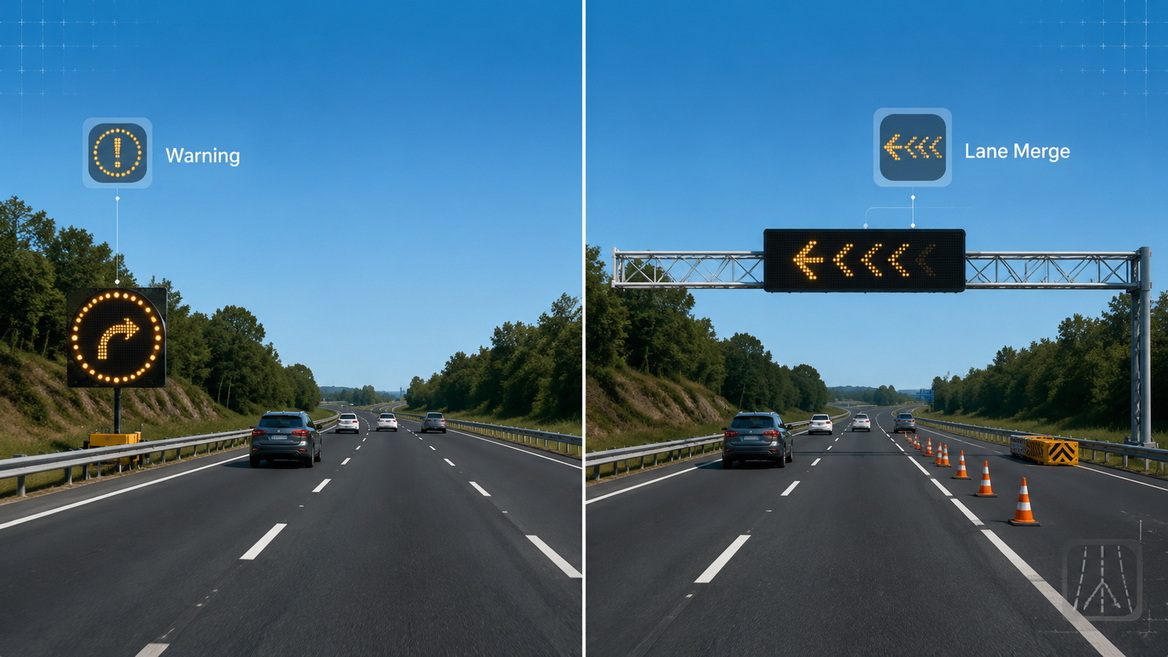
Below is a practical comparison from a traffic engineer and procurement manager's viewpoint.
| Aspect | Circular LED Flashing Patterns | Sequential Arrow Patterns |
|---|---|---|
| Primary function | Attention and hazard warning | Directional lane guidance |
| Typical use | Stop signs, crossings, speed reminders | Lane closures, merges, work zones |
| Visual effect | Static position, flashing circles | Moving arrow sequence, flowing light |
| Driver interpretation | “Danger / Pay attention” | “Change lane / Move this way” |
| Complexity | Simple control logic | More advanced controller required |
| Integration | Easy retrofit to existing signs | Often linked to ITS / sensors |
| Content flexibility | Limited to symbol enhancement | Highly flexible sequences and messages |
| Best for speed range | Low to medium speeds | Medium to high speeds |
| Ideal distance | Short to medium viewing distance | Medium to long viewing distance |
| Typical B2B buyers | Municipalities, parking operators | Highway agencies, EPC contractors |
From a B2B buyer standpoint, lifecycle cost is just as important as initial hardware price.
- Circular flashers usually have fewer control components, which can mean lower failure rates and easier troubleshooting.
- Sequential systems may include more LED modules, drivers, and controllers, but their safety and throughput benefits can justify the extra cost in complex environments.
When evaluating vendors, look for:
- High IP rating (at least IP65) for outdoor applications.
- Wide operating temperature range suitable for local climate.
- Modular design so failed modules can be replaced without removing the whole sign.
As a manufacturer, positioning your product line around long LED lifespan, stable drivers, and robust sealing will strongly appeal to highway and city clients focused on TCO.
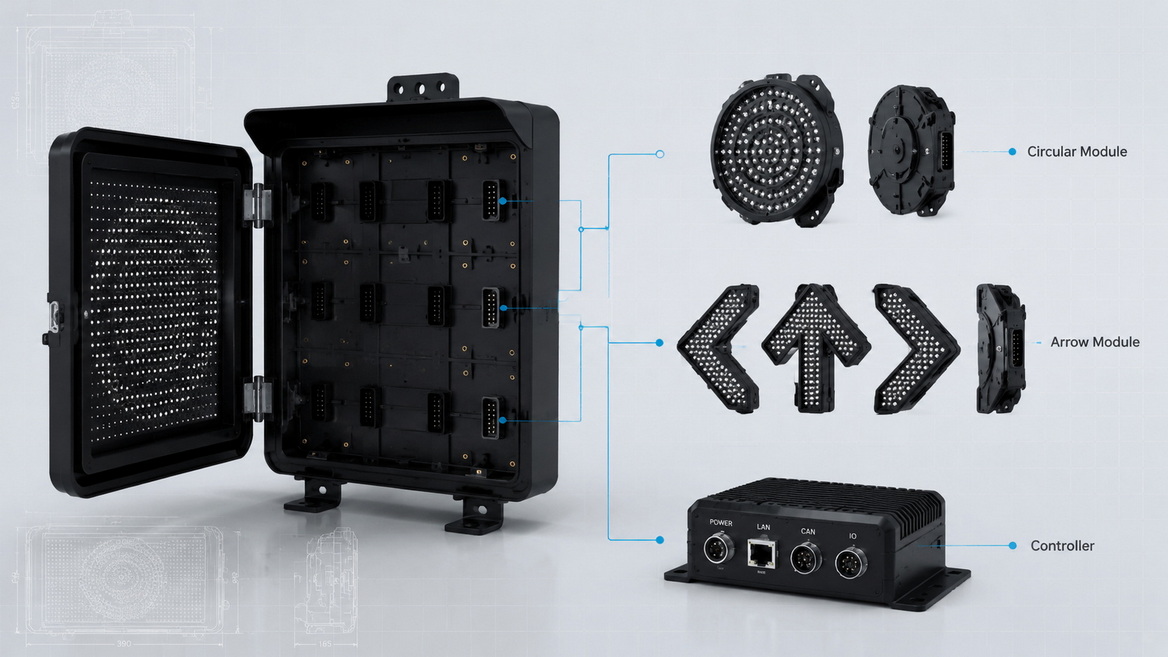
For international distributors and system integrators, flexibility is critical. A smart approach is to design one LED sign platform that can be configured as either a circular flasher or a sequential arrow system through:
- Interchangeable LED modules (circular clusters vs. arrow segments).
- Programmable controllers supporting multiple modes and flash frequencies.
- Standardized housings and mounting systems to reduce SKU complexity.
As a Chinese manufacturer, you can leverage OEM/ODM services to tailor:
- Dimensions and layout for local regulations.
- Controller interface (CAN, RS485, dry contact, TCP/IP).
- Branding, label language and documentation for different markets.
This modular strategy allows overseas partners to cover more project types with fewer core products, improving stock turnover and project responsiveness.
In recent years, LED traffic signs have been moving from stand‑alone flashing devices to connected field equipment integrated with smart city and ITS platforms.
Key trends B2B buyers now care about:
- Remote monitoring of LED status, power consumption, and fault alarms.
- Integration with traffic detectors, CCTV, and incident management systems.
- Use of solar power and high‑efficiency drivers to support off‑grid installations.
Whether you deploy circular or sequential patterns, designing your signs to be "network ready" (with clear communication protocols and interface documentation) can significantly increase project value and win rate in tenders.
When I work with project owners, I often use a simple decision framework that helps them choose between circular and sequential arrow patterns for each location.
1. Define the main objective
- If the primary goal is to make a hazard more visible → start with circular flashers.
- If the goal is to move traffic into a specific lane or path → consider sequential arrows.
2. Assess speed and complexity
- Low‑speed, simple environment (e. g., small intersection, parking entrance) → circular may be enough.
- High‑speed or complex lane layout → sequential arrows add meaningful safety value.
3. Review regulatory requirements
- Confirm local standards for colors, flash rates, and symbol shapes.
- Verify whether certain locations mandate arrow boards or specific warning devices.
4. Evaluate infrastructure and power
- Limited power or solar‑only sites may favor simpler circular systems.
- Sites connected to ITS and AC power are ideal for full arrow systems.
5. Consider OEM/ODM customization needs
- If your clients serve multiple markets, prioritize a modular platform that supports both patterns through configuration, not a complete hardware redesign.
Good hardware is not enough; visual clarity and consistency determine real‑world impact.
Best‑practice UX tips:
- Use high‑contrast colors (typically amber or white on black background) for maximum visibility.
- Keep message density low: one main symbol or arrow per sign whenever possible.
- Ensure synchronization between circular flashers and sequential arrows when both are present, to avoid visual conflict.
- Validate designs with night‑time and bad‑weather simulations before mass deployment.
Thoughtful UX‑driven design helps drivers recognize and react to your LED signs in a predictable way.
If your project involves multiple environments—highways, toll stations, city streets, and parking areas—the optimal solution is rarely "circular only" or "arrow only." It is usually a portfolio approach, tuned to each location.
Working with a manufacturer that offers end‑to‑end OEM/ODM services allows you to:
- Match LED sign patterns to local regulations and design standards.
- Customize mechanical design, optics, control logic, and communication protocols.
- Get engineering support during tender preparation and technical submission.
This partnership approach is often what differentiates successful, long‑term deployments from one‑off device purchases.
If you are planning or upgrading a traffic safety project, now is the right time to map which locations need circular flashers and which require sequential arrow patterns. Preparing a clear pattern strategy early will:
- Improve your safety outcomes and driver compliance.
- Simplify device specifications for tenders and procurement.
- Reduce redesigns and field modifications during installation.
To move forward, prepare a simple list of your key road sections (highways, toll plazas, city intersections, parking facilities) and define the primary objective for each location—then work with your LED traffic sign manufacturer to translate that into hardware and control specifications.
In low‑speed or short work zones, circular flashers may be sufficient to enhance existing static signs. However, for long tapers and high‑speed approaches, sequential arrow boards usually provide better directional guidance and crash risk reduction.
Sequential arrows typically use more LED modules and more complex controllers, so total power draw can be higher, but modern high‑efficiency LEDs and smart drivers allow both solutions to work well with solar or low‑voltage systems when correctly designed.
If the hardware layout and controller are designed with modularity in mind, the same platform can support multiple patterns through firmware or module replacement, which is ideal for OEM/ODM applications serving different markets.
You should always check your national or regional road sign standards and any specific work zone or lane control manuals; many authorities define which symbol types, colors, and flashing behaviors are permitted in different situations.
Quality LED traffic signs, when properly heat‑managed and sealed, can achieve service lives in the range of tens of thousands of hours, with gradual lumen depreciation rather than sudden failure, making them suitable for long‑term deployments on highways and urban networks.
1. LeadLeo, "China Smart Street Light Industry Overview" (in Chinese).
2. Davinci, "What is SEO? How to do SEO? Teach you how to filter SEO companies and ensure they are useful" (UX and content structure best practices). https://www.da-vinci.com.tw/cn/blog/seo-study
3. Blog Garden, "Which Company Will Be the Strongest in the 2026 High-Quality LED Smart Pole Display Market? Here's the Answer" (key evaluation points for LED traffic and smart pole manufacturers).


