
Please Choose Your Language
Views: 222 Author: XS Traffic Facilities Publish Time: 2026-06-17 Origin: Site


Content Menu
● What Is a Raised Pavement Marker?
● How Raised Pavement Markers Work On the Road
● Common Names and Terminology You'll Encounter
● Main Types of Raised Pavement Markers
>> Reflective Raised Pavement Markers
>> Non‑reflective Raised Pavement Markers (NRPMs)
>> Snowplowable Raised Pavement Markers (SRPMs)
>> Temporary Raised Pavement Markers (TRPMs)
>> Solar‑powered Raised Pavement Markers
● Standards and Color Coding (MUTCD and Beyond)
>> Typical Color Conventions for RPMs
● Materials Used for Raised Pavement Markers
● Key Specifications: Dimensions, Spacing, and Placement Rules
>> Spacing and Placement Guidelines
● Mounting Methods and Installation Steps
>> Practical Installation Workflow
● Safety and Operational Benefits of Raised Pavement Markers
● Market Trends and Why RPMs Matter for LED Traffic Sign Projects
● How to Choose the Right Raised Pavement Marker for Your Project
● OEM/ODM Opportunities with Shenzhen Xingsheng Traffic Facilities Co., Ltd.
● Example FAQs About Raised Pavement Markers
>> Q1: How long do raised pavement markers typically last in service?
>> Q2: Can raised pavement markers be used together with LED traffic signs and smart systems?
>> Q3: Are solar raised pavement markers suitable for cold or wet climates?
>> Q4: How often should RPMs be inspected and cleaned?
>> Q5: What information should I provide when requesting an OEM/ODM RPM solution?
Raised pavement markers (RPMs) are one of the quiet "workhorse" technologies behind modern road safety, and when you combine them with LED-based traffic solutions from a specialized OEM/ODM manufacturer, they become a powerful tool to cut crashes and improve driver guidance. Drawing on my experience working with traffic safety manufacturers and what I see on today's highways and toll stations, this guide explains what RPMs are, how they work, how to select and install them, and how Chinese manufacturers like Shenzhen Xingsheng Traffic Facilities Co., Ltd. can support global projects with customized LED traffic safety solutions.

A raised pavement marker (RPM) is a small, durable, often retroreflective device that is bonded or mechanically fixed to the road surface to improve lane guidance and visibility, especially at night and in bad weather. You typically see them along lane lines, centerlines, road edges, ramps, and sharp curves, where they help drivers stay in their lane and receive a tactile warning if they drift.
From a road designer or contractor's perspective, an RPM is a compact safety "signal" that combines visual guidance (reflective or LED light) with physical feedback (vibration and sound) when a vehicle tire runs over it. In practice, that means fewer sideswipe collisions, reduced wrong‑way entries, and better lane discipline on busy urban streets, highways, toll plazas, and parking facilities.
RPMs provide a 2‑in‑1 safety function: enhanced visibility and tactile/audible feedback.
- Enhanced visibility through retroreflection
At night or in heavy rain, painted lines alone often become hard to see. When a vehicle's headlights hit a reflective RPM, its lenses bounce light back toward the driver's eyes, creating a clear, bright pattern that makes lane boundaries stand out. This effect is especially valuable on high‑speed roads, in tunnels, or on rural sections where overhead lighting is limited.
- Tactile and audible warning for drifting vehicles
If a driver drifts across the lane line, the tires strike the raised marker, creating vibration and a distinctive sound inside the vehicle. That instant feedback prompts the driver to correct their position, reducing run‑off‑road and head‑on collision risk without relying only on visual cues.
For agencies and contractors, this combination of visual and tactile cues makes RPMs a cost‑effective layer of redundancy that supports safe driving even when drivers are distracted, tired, or dealing with poor visibility.
Depending on region and design, RPMs are known by several other names. Understanding the terminology helps when you read specifications, standards, or global project tenders.
- Botts' Dots – Traditionally round ceramic or plastic markers used extensively in California.
- Road studs / cat's eyes – Common terms in the UK, Europe, Australia, and New Zealand, often referring to reflective markers with lens units.
- Pavement domes and raised ribs – Dome‑shaped or ribbed markers that emphasize tactile rumble feedback rather than retroreflection.
- Tactile pavement markers – Emphasize vibration and audible feedback for lane departure warning.
- Solar road studs – Raised markers with integrated solar panels and LEDs, used in tunnels, fog‑prone areas, and rural roads with no mains power.
In many international standards and procurement documents, "raised pavement marker" is used as the umbrella term, with detailed sub‑categories defined by material, construction, and optical performance.
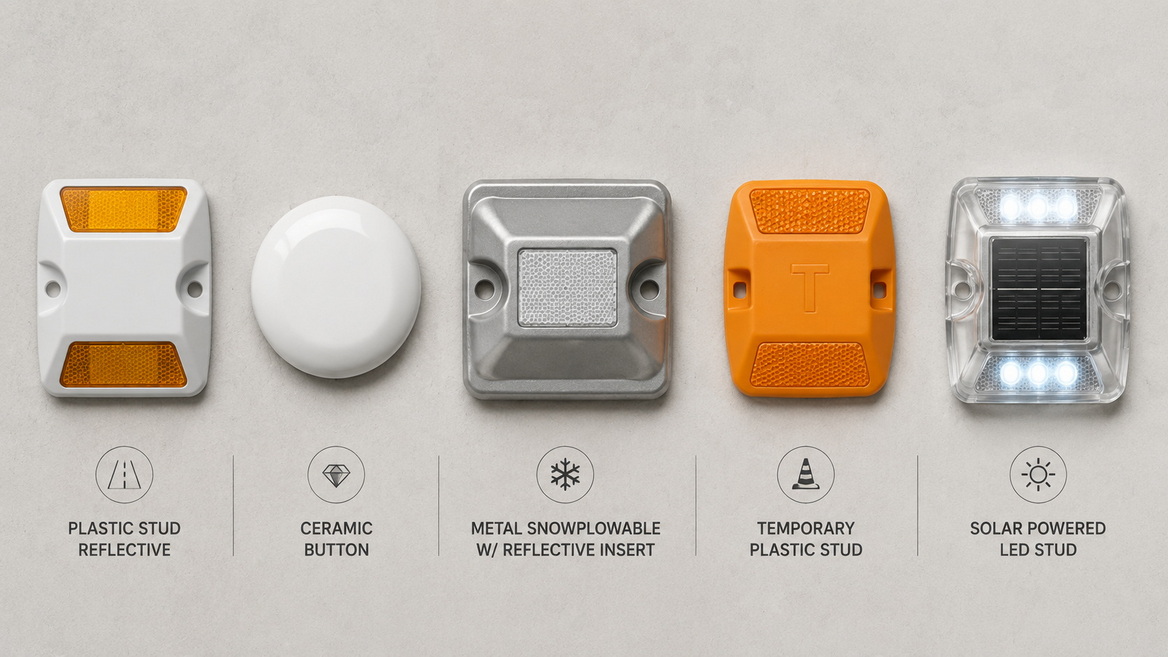
From an engineering and purchasing perspective, you'll usually classify RPMs by how they provide guidance (reflective, tactile, solar, etc.) and by their intended environment. Below are the core types used worldwide.
These are the most widely used RPMs, featuring retroreflective lenses or microprismatic elements built into a plastic, metal, or ceramic body. They are installed wherever night‑time or adverse‑weather visibility is critical, such as multilane highways, tunnels, interchanges, and airport service roads.
Non‑reflective markers rely on their physical profile rather than optical properties. They are typically deployed in well‑lit or low‑speed environments like residential streets, traffic‑calmed areas, and parking lots to provide lane discipline and low‑speed rumble feedback without the added cost of reflectors.
In snow regions, standard surface‑mounted RPMs are quickly scraped off by plows, which led to the development of snowplowable designs. These markers are often recessed into steel or cast‑iron housings anchored in the pavement so that plow blades ride over the housing while the reflective insert stays protected.
TRPMs are lightweight, easy‑to‑install markers used on temporary work zones, resurfacing projects, and detours. They can be reflective or non‑reflective and are designed to be installed and removed without damaging the pavement, making them ideal for short‑term lane shifts and night‑only closures.
Solar RPMs integrate solar panels, battery storage, and LEDs into the marker body, creating an active light source instead of relying solely on retroreflection. They are particularly useful in tunnels, fog‑prone mountain sections, coastal roads, and rural stretches with frequent power outages or no existing lighting infrastructure.
In the United States, RPM use is guided by the Manual on Uniform Traffic Control Devices (MUTCD), which defines where, when, and how different colors and types should be applied. While local regulations vary globally, many markets follow similar logic for color meaning and placement.
By aligning RPM color and placement with MUTCD Section 3B.14 and local standards, agencies achieve consistent "road language" that drivers can understand instantly across jurisdictions.
Choosing the right RPM material is a balance between traffic loading, climate, service life expectations, and budget.
- Plastic – Lightweight, corrosion‑resistant, and economical; ideal for low‑to‑moderate traffic and temporary works, but more prone to cracking under heavy truck loads.
- Ceramic – Hard, impact‑resistant, and stable under UV and temperature changes, offering long life on lanes where strong tactile feedback is desired.
- Glass – High optical performance and excellent wear resistance, often used where maximum retroreflectivity is needed, such as sharp curves or hazard approaches.
- Aluminum – Robust metallic bodies that handle frequent truck traffic and abrasion, suited to busy arteries and industrial routes.
- Stainless steel – Stronger and more corrosion‑resistant than aluminum, recommended for heavy industrial zones, port facilities, and snow‑prone roads, though at higher unit cost.
- Copper or brass – Used more for premium or heritage applications, where aesthetics and corrosion resistance matter more than extreme mechanical strength.
- Solar composite housings – Markers with integrated solar electronics typically use reinforced plastic or metal housings designed for impact resistance and waterproofing.
In practice, many agencies standardize on aluminum or heavy‑duty plastic for high‑volume corridors, complemented by snowplowable or stainless designs in harsh environments.
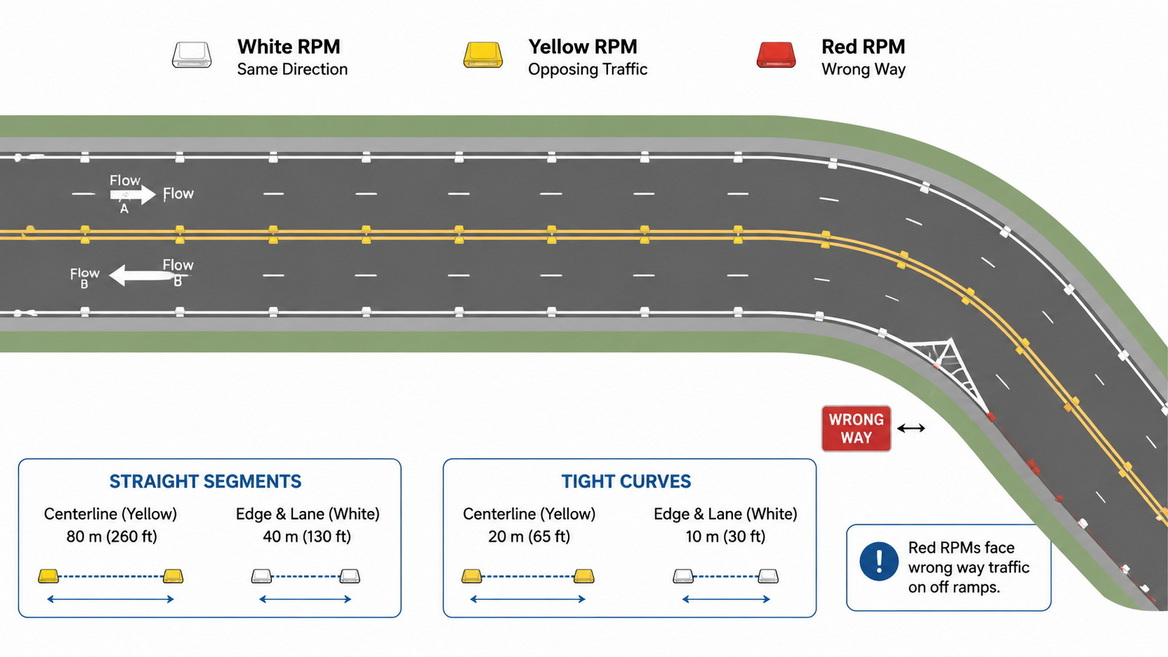
To deliver consistent guidance, RPMs must be sized and spaced correctly for the design speed, alignment, and traffic mix. Specifications vary by country, but the ranges below reflect common practice in North America and other major markets.
Many specifications cap RPM height at 25 mm (1 in) to avoid vehicle damage and ensure snowplow compatibility, while requiring at least 100 mm (4 in) width for adequate visibility. Longer markers (≥200 mm / 8 in) are often selected for higher‑speed routes to create a more continuous visual pattern.
- Straight, normal roads: 80–100 ft between markers on lane or edge lines.
- Sharp curves / hazardous areas: tighter spacing (20–40 ft) to reinforce alignment.
- Urban or low‑speed zones: typically 30–60 ft, especially where there are frequent lane changes.
- Centerlines vs. edge lines: maintain consistent patterns, often tying RPMs to painted skip‑line cycles so reflectors align with each dash.
Color and position should match traffic flow: yellow for opposing flows, white for same‑direction flows and edges, and red for wrong‑way faces or restricted entries. Blue units are reserved for fire/emergency access, and cycling routes should be kept free of abrupt RPM profiles that may destabilize bikes or motorcycles.
From a contractor's standpoint, the mounting method is just as important as the marker spec, because it determines long‑term adhesion and maintenance needs.
- Adhesive mounting – Uses epoxy, bitumen, or other structural adhesives applied to the underside of the RPM before pressing it onto the cleaned pavement; widely used for both reflective and non‑reflective markers.
- Mechanical fastening (bolt‑on) – Bolts or screws anchor the marker to the surface, suitable for high‑impact zones and heavy traffic where adhesive‑only fixation might loosen over time.
- Embedded mounting – The marker sits in a pre‑cut groove or recess and is then bonded and sealed, often used with snowplowable markers in cold climates.
- Surface mounted (nail‑on) – Nails or pins are driven through the marker into the pavement, common for temporary applications and non‑reflective markers in work zones.
- Magnetic mounting – Specialized markers with magnetic bases for very short‑term tests, events, or research projects; they can be removed without surface damage.
1. Transport and staging – Deliver RPMs, adhesives, and tools to site, and stage materials so installation proceeds in a continuous sequence.
2. Traffic control setup – Install cones, barriers, and signs to protect workers and warn drivers of lane closures or shoulder work.
3. Surface preparation – Clean the pavement, removing dust, moisture, oil, and loose material so that adhesives or anchors can bond securely.
4. Layout and marking – Measure and mark RPM positions according to spacing and alignment requirements for the project.
5. Fixing the markers – Apply adhesive or drill and bolt as specified, pressing or fastening each marker to the marked position and holding until initial set.
6. Alignment and quality check – Inspect from a driver's eye height to confirm that markers form a continuous, visible line and meet height requirements.
7. Site reopening and follow‑up – Remove temporary traffic control and schedule post‑installation inspections to detect early failures or misalignment.
Regular inspection, cleaning, and timely replacement of damaged or dim markers keeps the system effective over its design life.
For agencies, contractors, and operators of toll roads and parking facilities, the return on investment for RPMs is driven by measurable safety improvements and operational advantages.
- Improved night‑time and wet‑weather visibility – Reflective markers ensure that lane guidance remains clear even when paint is faded or covered by water film.
- Better lane discipline – Clear visual cues plus tactile feedback help drivers maintain lane position, reducing side‑swipes and run‑off‑road incidents.
- Hazard and wrong‑way alerts – Red and yellow markers reinforce no‑entry zones, gore areas, and sharp curves, providing an additional warning layer.
- Reduced driver fatigue – Drivers can follow a consistent pattern of points of light instead of constantly searching for worn paint, which helps reduce fatigue on long trips.
- Cost‑effective safety upgrade – Compared to full lighting systems or major civil changes, RPMs offer a relatively low‑cost upgrade with significant safety impact when deployed systematically.
These benefits scale further when RPMs are integrated into broader LED‑based traffic safety systems, such as variable message signs, LED speed feedback displays, and illuminated lane‑control signs at toll plazas.
The global market for road marking materials and road markers continues to expand as governments invest in safer, smarter infrastructure. One recent analysis projects the raised pavement markers market to grow significantly in value through the next decade, supported by demand for reflective and high‑visibility road solutions.
At the same time, the broader traffic road marking coatings and materials market is expected to grow steadily, driven by stricter safety regulations, urbanization, and the need to support connected and autonomous vehicles with more consistent, machine‑readable markings. This environment favors manufacturers that can offer integrated solutions: raised pavement markers coordinated with LED traffic signs, speed feedback displays, and lane‑control signals that work as a unified system.
For project owners and EPC contractors, partnering with a specialized Chinese OEM/ODM like Shenzhen Xingsheng Traffic Facilities Co., Ltd. allows you to align RPM selection with LED sign design, power systems, and control logic from the start rather than treating each component in isolation.
From an engineering and procurement standpoint, choosing the "best" RPM is about matching purpose, environment, and budget rather than simply buying the most robust model available.
1. Clarify the safety and operational objective
Decide whether the primary goal is improving night‑time visibility, preventing wrong‑way entries, reinforcing lane discipline in specific zones, or marking emergency infrastructure.
2. Assess road type and traffic load
High‑speed freeways, industrial access roads, and port corridors justify more durable materials such as aluminum or stainless steel, while low‑speed urban streets may perform well with engineered plastics or ceramics.
3. Evaluate environmental conditions
Snow regions may require snowplowable or recessed designs; hot, humid climates demand UV‑ and corrosion‑resistant housings; coastal or chemical‑exposed environments favor stainless steel or treated metals.
4. Choose the working mode
- For maximum visibility in low‑light zones: reflective or solar RPMs.
- For guidance on well‑lit roads: non‑reflective tactile markers may suffice.
- For rural roads with unreliable power: solar studs that operate autonomously through the night.
5. Align color and pattern with standards
Ensure the color coding and placement follow MUTCD or local equivalents to maintain consistency for drivers and legal compliance.
6. Confirm mounting method, maintenance plan, and budget
Balance up‑front cost with service life and replacement cycles. An experienced manufacturer can model total cost of ownership and propose optimized configurations and OEM/ODM customization to your specifications.
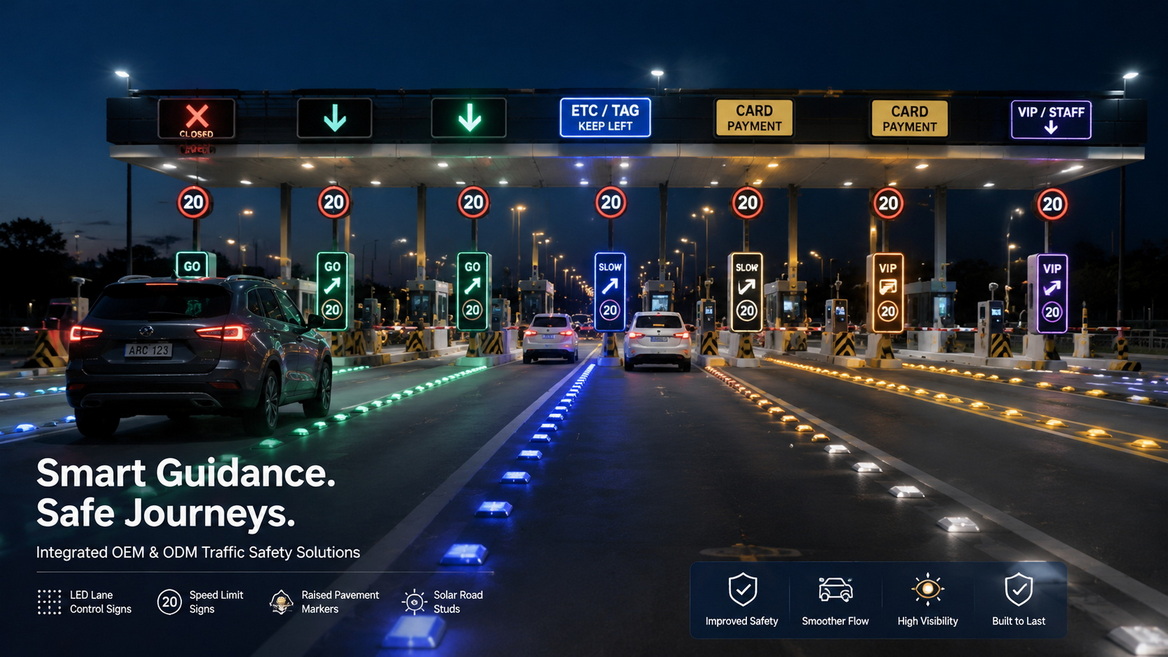
As a China‑based traffic safety manufacturer specializing in LED traffic signs and related products, Shenzhen Xingsheng Traffic Facilities Co., Ltd. is well positioned to support global clients with custom RPM and LED system solutions.
For international road contractors, toll operators, municipal agencies, and parking management companies, this enables:
- Co‑design of LED traffic signs and RPM layouts to ensure consistent visual language from the driver's perspective.
- Customized optics and materials that match regional standards, climate conditions, and asset‑management strategies.
- OEM and ODM services for branded or private‑label RPMs, LED speed signs, lane‑control signs, and parking guidance displays tailored to local market needs.
By consolidating raised pavement markers and LED traffic signs under one integrated supplier, you reduce interface risk, simplify logistics, and create a more coherent safety system on streets, highways, toll gates, and structured parking facilities.
A1: Service life depends on material, traffic load, and climate, but well‑specified RPMs commonly deliver several years of performance on highways, with high‑durability metal and snowplowable designs lasting longer under proper maintenance.
A2: Yes. RPMs are often part of an integrated safety strategy that includes LED speed feedback signs, lane‑control signals, and connected monitoring systems, especially on smart highways and managed lanes.
A3: Modern solar RPMs are designed with sealed housings and temperature‑tolerant batteries, and can perform well in cold, wet climates when correctly specified and installed, though extremely snow‑intensive areas may still rely on snowplowable recessed designs.
A4: Many agencies adopt semi‑annual or annual inspection cycles, checking for damage, loss of retroreflectivity, and adhesion, with cleaning aligned to broader pavement or sign maintenance schedules.
A5: Share details on road type, design speed, traffic volume, climate, applicable standards, preferred colors, and whether integration with LED traffic signs or smart systems is required, so the manufacturer can propose optimized materials, optics, and mounting methods.
1. Jackwin Safety. "What Is a Raised Pavement Marker?" (Common Raised Pavement Marker Guide). https://www.mordorintelligence.com/industry-reports/road-marking-materials-market
2. Market. us. "Raised Pavement Markers Market Size, Share, Forecast 2024–2034." https://market.us/report/raised-pavement-markers-market/
3. Research and Markets. "Road Marking Materials Market Report 2026." https://www.researchandmarkets.com/reports/5741464/road-marking-materials-market-report
4. Signs and LEDs / LEDCraft. "How to Prolong the Life of Your LED Signage: Maintenance Tips." https://www.ledcraftinc.com/how-to-prolong-the-life-of-your-led-signage-maintenance-tips/
5. Signs and LEDs. "Best Outdoor Signage Maintenance Tips for Long Lifespan." https://signsandleds.com/best-outdoor-signage-maintenance-tips/
6. Future Market Insights. "Road Marking Equipment Market: Global Industry Analysis." https://www.futuremarketinsights.com/reports/road-marking-equipment-market
7. Traffic safety manufacturer site (China). "Traffic Safety Products, Road Safety Equipment Manufacturer." https://www.trafficsafetychina.com
8. Made‑in‑China OEM/ODM Solutions Page. "Business Solutions – OEM/ODM Service." https://hangzhousafer.en.made-in-china.com/Solutions/


