
Please Choose Your Language
Views: 222 Author: XS Traffic Facilities Publish Time: 2026-06-14 Origin: Site


Content Menu
● Key Definitions And Use Scenarios
>> What Are Reflective Border LED Signs?
>> What Are Full-face Illuminated LED Signs?
● Visibility And Safety Performance
>> Daytime And Bright Ambient Light
>> Nighttime, Rain, Fog And Tunnels
● Energy Efficiency And Power Architecture
● Installation, Integration And Maintenance
>> Structural And Installation Complexity
>> Maintenance And Life-cycle Cost
● Compliance, Standards And Application Fit
● Technical Design Considerations For Buyers
● Reflective Border Vs. Full-face: Side-by-side Summary
>> Performance Snapshot For Traffic Projects
● Expert Perspective: How Agencies Actually Decide
● OEM/ODM Strategy For Global Buyers (New Value Section)
● Practical Selection Checklist For Project Teams (New Value Section)
● How Shenzhen Xingsheng Can Position Its Solutions
● FAQ
>> 1. Are reflective border LED signs bright enough for high‑speed highways?
>> 2. Can both sign types be powered by solar systems?
>> 3. Which option is better for parking garages and indoor environments?
>> 4. How long do LED traffic signs typically last?
>> 5. Can Shenzhen Xingsheng customize signs to local language and standards?
Reflective border LED signs and full-face illuminated LED signs each have clear strengths, and the best choice depends on application, ambient lighting, driver approach speed, and lifecycle cost targets. For a Chinese OEM/ODM manufacturer like Shenzhen Xingsheng Traffic Facilities Co., Ltd., the most competitive strategy is often to design a mixed portfolio and guide buyers with an application-based decision framework rather than a one‑size‑fits‑all answer.
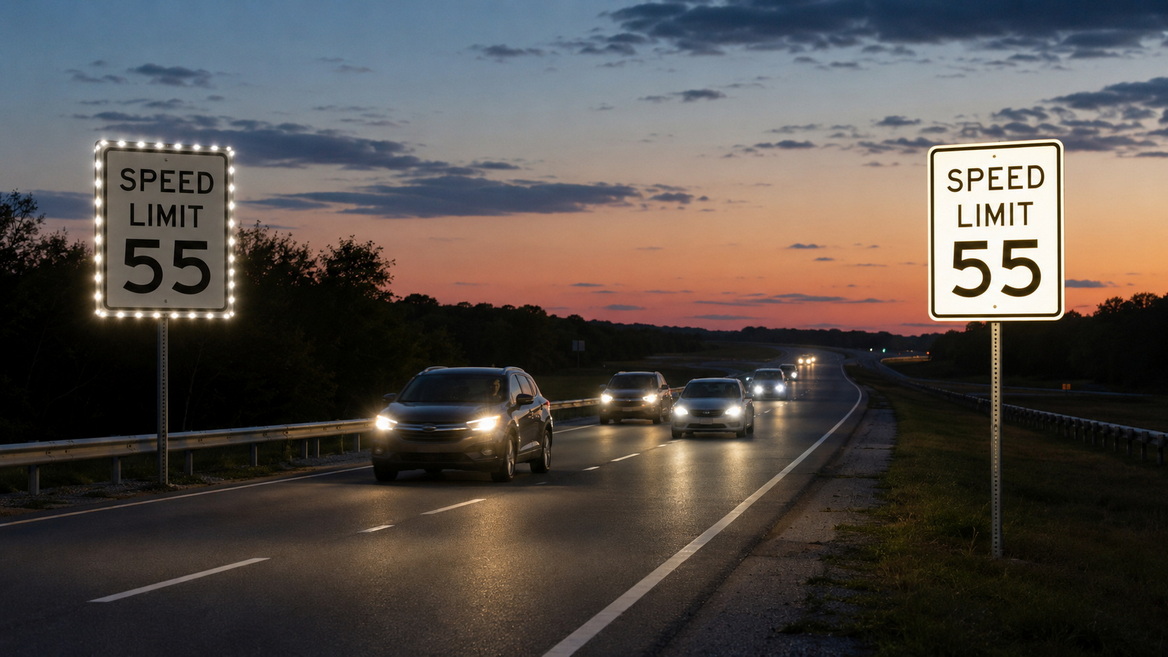
In this article, I will compare Reflective Border LED Signs vs. Full-face Illuminated LED Signs from the perspective of a traffic safety practitioner and a B2B LED traffic sign manufacturer working with street, highway, toll station and parking guidance projects. I will focus on real‑world factors: visibility, compliance, power and control, installation, TCO, and what global OEM/ODM buyers should specify in RFQs.
A reflective border LED sign combines a retroreflective sign face (typically Class I–III reflective sheeting) with an LED-illuminated border or perimeter that flashes or remains steady to attract attention.
- The symbol or legend itself is not backlit; the reflective film returns headlamp light to drivers, while the LED border functions as an active "attention ring."
- This design is widely used for stop, yield, pedestrian crossing and work‑zone warning signs, especially where regulations still favor standard reflective faces.
From a buyer's perspective, reflective border LED signs are often selected when your agency wants to enhance existing sign standards with active conspicuity while keeping energy use very low.
A full-face illuminated LED sign uses LEDs behind or within the entire sign face, so the complete legend and background are actively lit, not only the border.
- They work more like an LED light box or cabinet: an LED matrix or edge‑lit panel spreads light evenly across the full symbol area.
- These signs are common in tunnels, toll lanes, lane‑control signals, parking guidance and critical warning locations, where visibility must be guaranteed regardless of headlamp angle or ambient lighting.
For B2B buyers, full-face illuminated signs are often positioned as the premium, performance‑driven option where safety KPIs and operational uptime justify higher upfront and running costs.
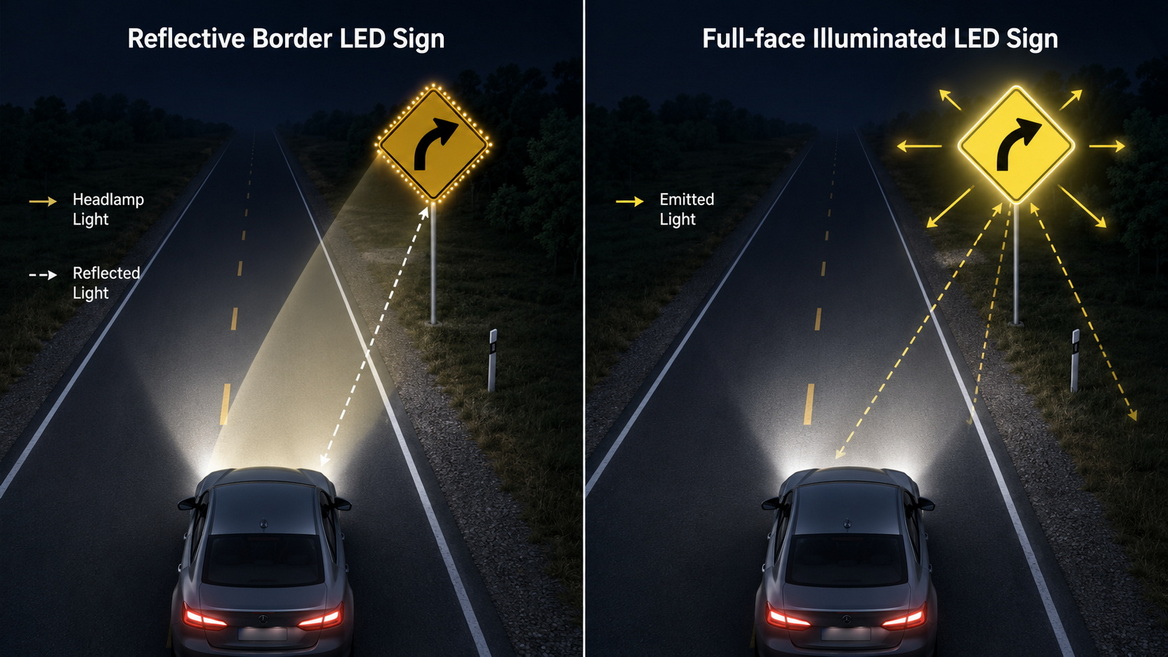
From a traffic engineering point of view, visibility under worst‑case conditions is the first filter before you even look at cost.
- Reflective border LED signs rely mainly on sunlight and driver headlamps for the legend, so daytime visibility is similar to a high‑grade reflective sign, with the LED border acting as an extra attention cue rather than the primary light source.
- Full-face illuminated signs use high‑intensity LEDs, which can exceed typical reflective brightness and deliver strong legibility even in bright daylight or complex backgrounds, provided the system uses adequate lumen output and contrast ratios.
In congested urban or multi‑sign environments, full-face illumination typically outperforms border‑only systems in terms of instant symbol recognition and reading distance.
- In clear night conditions, both technologies perform well, but full-face systems maintain a more uniform and easily readable legend at long distances or wide approach angles.
- Under rain, fog or tunnel environments, full-face signs have a significant advantage, because reflective-only legends can lose contrast when headlamp beams scatter or when vehicles approach from unusual angles; a fully lit face cuts through background clutter and glare more effectively.
For mountainous highways, tunnels and coastal roads with frequent fog, agencies increasingly favor full-face LED traffic signs specifically to stabilize nighttime and bad‑weather visibility.
Both options use LEDs, but their power density and duty cycles differ.
- A reflective border sign typically uses a relatively small number of LEDs in the frame, which means lower wattage and easier solar power integration on poles in remote locations.
- A full-face illuminated sign requires higher LED counts or higher drive currents to produce uniform brightness across the entire face, so the overall power draw is higher, especially for large gantry‑mounted panels.
However, compared with legacy fluorescent or high‑intensity discharge cabinets, full-face LED cabinets still offer 30–70% energy savings, while achieving higher luminance. For Shenzhen Xingsheng as an OEM/ODM vendor, this creates room to design solar‑ready or low‑voltage driver options to support different concession or PPP models.
Reflective border LED signs are structurally similar to standard traffic signs, with additional wiring only for the border modules and control unit.
- They are generally lighter and easier to retrofit on existing poles, which is attractive for municipal upgrade programs.
- For OEM buyers, this typically means simpler mounting hardware and lower shipping volumes per pallet.
Full-face illuminated LED signs usually require deeper enclosures, better heat management and more robust mounting to support the LED array and power electronics. These units are heavier and may require gantry structures or engineered brackets, especially for highway and tolling applications.
Modern LED systems can reach 30,000–50,000 hours of rated life, significantly longer than older fluorescent or neon technology, and with lower service frequencies.
- Reflective border LED systems have fewer active components, so there are fewer failure points; in practice they tend to show lower maintenance hours per sign over a 10‑year period than complex full-face cabinets.
- Full-face illuminated signs concentrate many LEDs and drivers into one assembly; if not well‑designed with modularity, partial failures can lead to patchy brightness or downtime that is more noticeable to drivers.
For B2B buyers managing large networks, this is where Chinese OEMs can differentiate by offering modular LED tiles, plug‑and‑play power modules and remote monitoring, making full-face systems more maintainable and predictable over time.
In many regions, traffic sign design is constrained by national or local standards such as the MUTCD in the United States or equivalent regulations in Europe and Asia.
- Reflective border LED signs usually preserve the standard sign layout and color codes, simply adding a conspicuity enhancement that can often be approved under existing guidelines or experimental provisions.
- Full-face illuminated designs sometimes require explicit approval or type testing, especially if they introduce variable messages, lane‑control arrows or color combinations that differ from static signs.
As an OEM/ODM manufacturer, Shenzhen Xingsheng can add value by pre‑engineering sign types around the dominant standards of the buyer's target market and supporting certification or type‑approval documentation as part of the technical file.
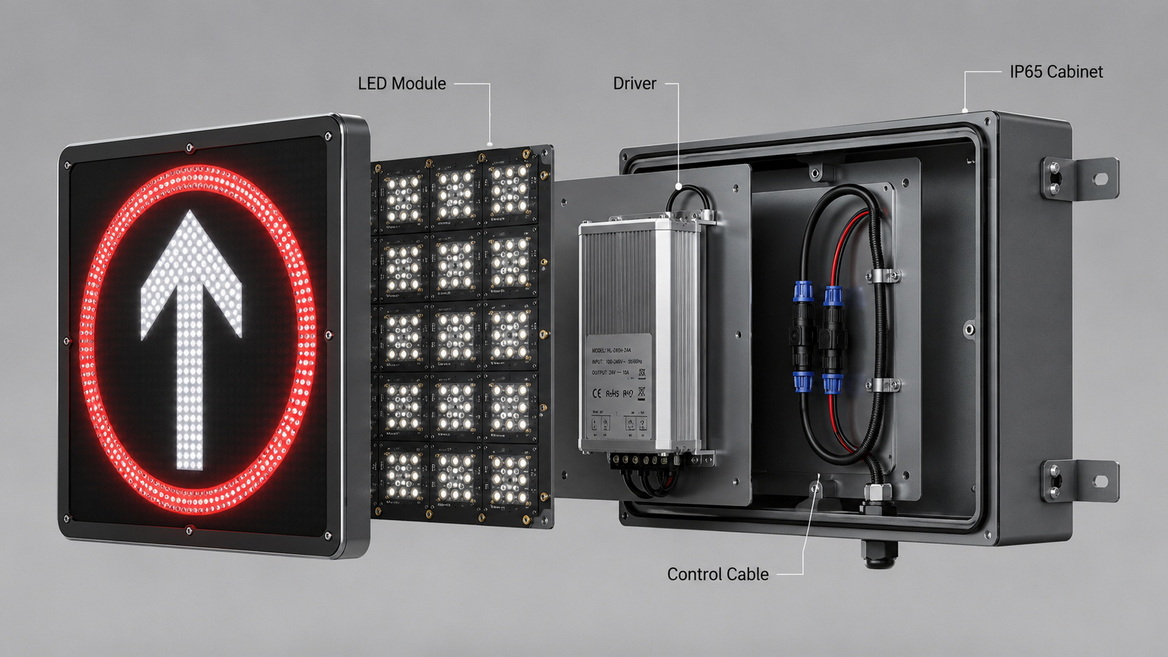
From a procurement and engineering standpoint, buyers should look beyond product names and specify key technical parameters:
- Luminous intensity and luminance levels for both border and face, aligned with the project's design speed and legibility requirements.
- Beam distribution and viewing angles to ensure that drivers in all lanes and heights see consistent brightness.
- Ingress protection ratings (e. g., IP65+), vibration resistance and corrosion protection, especially for coastal or high‑traffic bridges.
- Power input and controller design (AC mains, low‑voltage DC, solar, battery backup, dimming options, and communication interfaces).
Working with a specialized Chinese manufacturer also allows for custom cabinet depths, face materials, anti‑glare treatments and control logic, which can be tuned to concessionaire KPIs like incident reduction or lane throughput at toll plazas.
| Dimension | Reflective Border LED Signs | Full-face Illuminated LED Signs |
|---|---|---|
| Core concept | Retroreflective face with LED border for conspicuity. | Entire sign face illuminated by LEDs. |
| Daytime visibility | Good, similar to high‑grade reflective signs, border adds attention. | Very high, strong symbol contrast in complex environments. |
| Night / fog performance | Strong with headlamps; legend still dependent on reflection. | Excellent; independent of headlamp angle and ambient scatter. |
| Power consumption | Lower; ideal for solar and remote poles. | Higher but still efficient vs. legacy cabinets. |
| Installation | Similar to standard sign plus wiring; lightweight. | Deeper cabinet; more structure and wiring complexity. |
| Maintenance | Fewer active parts; lower service time per sign. | More complex; benefits strongly from modular design. |
| Typical use cases | Stop/yield, pedestrian crossings, school zones, work zones. | Tunnels, toll plazas, lane control, parking guidance, critical warnings. |
| Best fit | Budget‑sensitive upgrades, solar projects, regulatory continuity. | High‑risk segments, 24/7 operations, dense sign environments. |
From observing highway and city projects across different regions, traffic owners rarely choose purely on spec sheets; decisions are shaped by risk profile and budget envelope.
- For standard intersections or mid‑block crossings, many agencies start with retroreflective upgrades and then add LED borders at hotspots with a history of red‑light running or pedestrian incidents.
- For toll collections, managed lanes, tunnels and airport access roads, we see a clear trend toward full-face illuminated LED signs and lane‑control signals because the cost of a single incident far outweighs the incremental hardware cost.
The most effective suppliers are the ones who guide customers through this risk‑based segmentation, instead of pushing the most expensive product by default.
From a B2B manufacturing perspective, the Reflective Border vs. Full-face discussion is also a portfolio strategy question.
1. Tiered product families
- Entry tier: Standard reflective plus LED border, optimized for price, solar compatibility, and simple control, aimed at municipal upgrades.
- Performance tier: Full-face illuminated cabinets with modular LED tiles, smart drivers, and remote monitoring capabilities for concession and PPP projects.
2. Customization paths (ODM)
- Different sign dimensions, pictograms, local languages and colors aligned with country standards, delivered through flexible tooling and digital printing combined with LED integration.
- Electrical customizations like multi‑voltage inputs, specific connector systems and cabinet layouts to match the buyer's existing infrastructure.
3. Data‑backed proposals
International buyers increasingly expect lifetime performance modeling, including energy cost, maintenance frequency and spare‑parts strategy across 10–15 years. A manufacturer that can package reflective border and full-face options into a quantified TCO comparison will typically win more complex tenders.
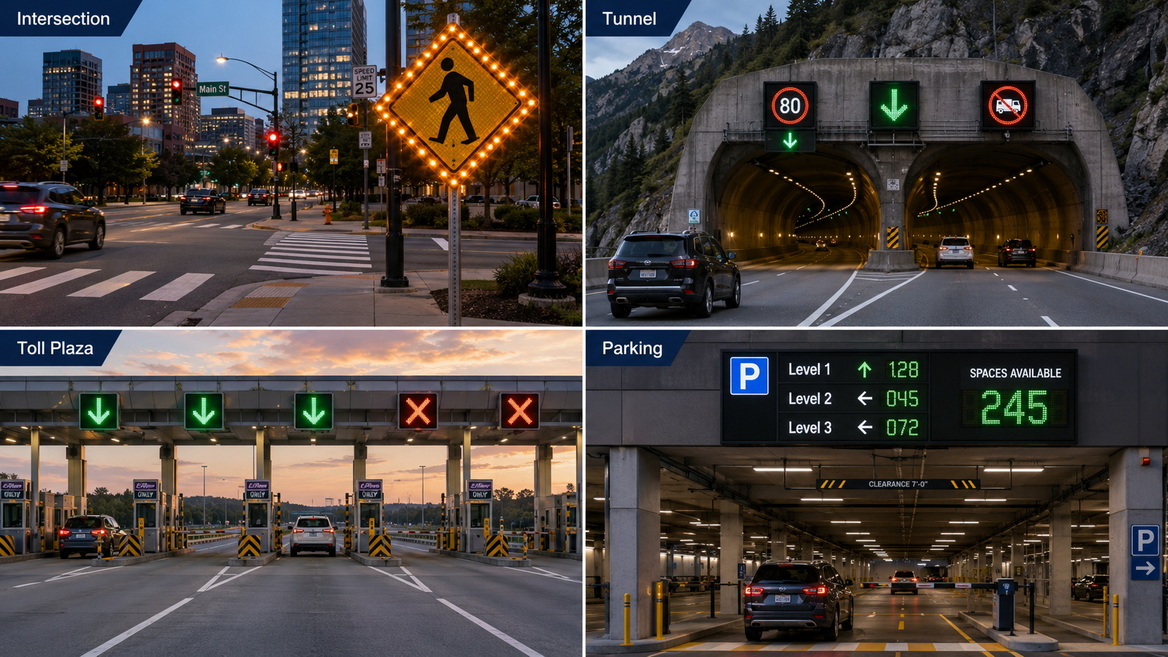
When I help project teams evaluate reflective border LED signs vs. full-face illuminated LED signs, we usually walk through a simple, structured checklist:
1. Define risk and criticality.
- High‑risk: tunnels, sharp curves, complex interchanges, tolling zones → prioritize full-face illuminated signs.
- Moderate to low‑risk: local intersections, mid‑block crossings, school zones → consider reflective border LED signs with selective full-face upgrades.
2. Confirm power and infrastructure.
- Limited or no grid power, or strict energy caps → reflective border with solar and battery systems.
- Robust power and communication backbone (tunnels, expressways) → full-face signs integrated into central ITS or SCADA systems.
3. Check standards and permitting.
- If national standards are conservative, reflective border solutions often pass more smoothly; variable full-face legends may require additional approvals.
4. Model 10‑year TCO.
- Include not only hardware but installation, inspections, cleaning, and replacement of drivers or modules.
This type of structured approach is exactly where an OEM/ODM partner can embed engineering support and documentation into the sales process, increasing win rates and reducing the buyer's design workload.
Given its positioning as a Chinese LED traffic sign manufacturer offering OEM and ODM, Shenzhen Xingsheng can build strong E‑E‑A‑T by:
- Publishing case‑study driven content that shows how reflective border and full-face solutions have reduced incidents or improved lane throughput in real projects.
- Providing transparent technical specifications and application guidelines, demonstrating engineering competence and long‑term support capability.
- Using expert‑level comparison content like this article to help overseas consultants quickly define project‑ready specs instead of generic catalog requests.
A clear call‑to‑action should invite readers to submit project drawings or basic parameters (road type, speed, environment, power conditions) so the engineering team can recommend a mixed package of reflective border and full-face illuminated LED signs tailored to their needs.
If you are planning a new traffic safety project or upgrading existing road signs and need to balance safety performance, energy efficiency and budget, share your drawings, design speeds and site conditions with our engineering team. We will propose a custom mix of reflective border LED signs and full-face illuminated LED signs, optimized for your standards, power system and long‑term maintenance strategy, and support you with OEM/ODM customization from prototype to mass production.
They are suitable for many highway applications, especially as an upgrade to existing signs, but at complex interchanges or tunnels, full-face illuminated LED signs normally deliver more reliable legibility and symbol recognition at high speeds.
Yes, but reflective border LED signs are usually easier to run on small solar and battery kits because of their lower power draw, while full-face signs may require larger panels and storage or stable grid supply.
Full-face illuminated LED signs generally work better in indoor or low‑light environments like parking garages, tunnels or underpasses, where consistent backlighting and clear symbols are crucial.
Commercial LED systems are often rated for 30,000–50,000 hours, which is roughly 2–4 times the lifespan of traditional neon or fluorescent signage when operated under similar conditions.
Chinese OEM/ODM manufacturers commonly provide custom dimensions, legends, languages, power inputs and mounting solutions tailored to national standards and customer specifications, and Shenzhen Xingsheng can follow the same model.
- Federal Highway Administration – United States Road Symbol Signs (MUTCD excerpt). https://mutcd.fhwa.dot.gov/
- New York DMV – Chapter 4: Traffic Control. https://dmv.ny.gov/new-york-state-drivers-manual-and-practice-tests/chapter-4-traffic-control
- CustomSignCenter – Neon vs. LED Signs: What's the Difference — and Which One Is Right? https://customsigncenter.com/blog/neon-vs-led-signs-difference-for-business/
- Ortwein Sign – Pros and Cons of LED Signs. https://ortweinsign.com/blog/pros-and-cons-of-led-signs-and-neon-signs/
- Rapid Color – LED Signs vs Traditional Signage. https://rapidcolor.com/led-signs-vs-traditional-signage-which-is-right-for-your-business/
- Signal-Tech – How Illuminated Traffic Signs Help Traffic Flows in Congested Areas. https://www.signal-tech.com/
- ZGSM – LED Traffic Light Manufacturer. https://www.zgsm-china.com/led-products/led-traffic-light
- LED Traffic Signs Manufacturer (China). https://www.ledvmssigns.com/supplier-2673667-led-traffic-signs
- LeadLeo – China Smart Streetlight Industry Overview (智慧路灯行业概览). http://pdf.dfcfw.com/pdf/H3_AP202007301395266752_1.pdf
- Brite Idea Displays – LED Light Panel vs Light Box Signs. https://briteideadisplays.com/led-light-panel-vs-light-box-signs


