
Please Choose Your Language
Views: 222 Author: XS Traffic Facilities Publish Time: 2026-06-22 Origin: Site


Content Menu
● What Are Active LED Road Studs?
● What Are Passive Reflective Bead Road Studs?
● Active LED vs Passive Beads: Performance Comparison
>> Visibility and Safety Outcomes (Expert Perspective)
>>> Quick Comparison Table: Performance Focus
● Engineering Differences: How Each Technology Works
● Cost, Lifecycle, and Maintenance
● Use‑Case Scenarios: Where Each Option Wins
>> Best Scenarios for Active LED Lighting
>> Best Scenarios for Passive Reflective Beads
● Human Factors: How Drivers Perceive Each System
● Expert Insight: OEM/ODM Design Considerations for B2B Buyers
● Sustainability and Energy Consumption
● Practical Selection Framework for Road Owners
● CTA: Work With a Specialized LED Traffic Safety Manufacturer
● FAQs
>> 1. Are active LED road studs worth the higher price compared to passive reflective studs?
>> 2. How long do solar LED road studs typically last?
>> 3. Can active LED studs be integrated with traffic signals and ITS systems?
>> 4. When should I still choose passive reflective bead studs?
>> 5. What standards should I check before specifying LED road studs?
Active LED road studs provide higher visibility, better safety performance, and more control than passive reflective bead studs, but they come with higher upfront costs and maintenance requirements. From a road safety manufacturer's perspective, the right choice depends on traffic volume, climate, and your long‑term asset management strategy.
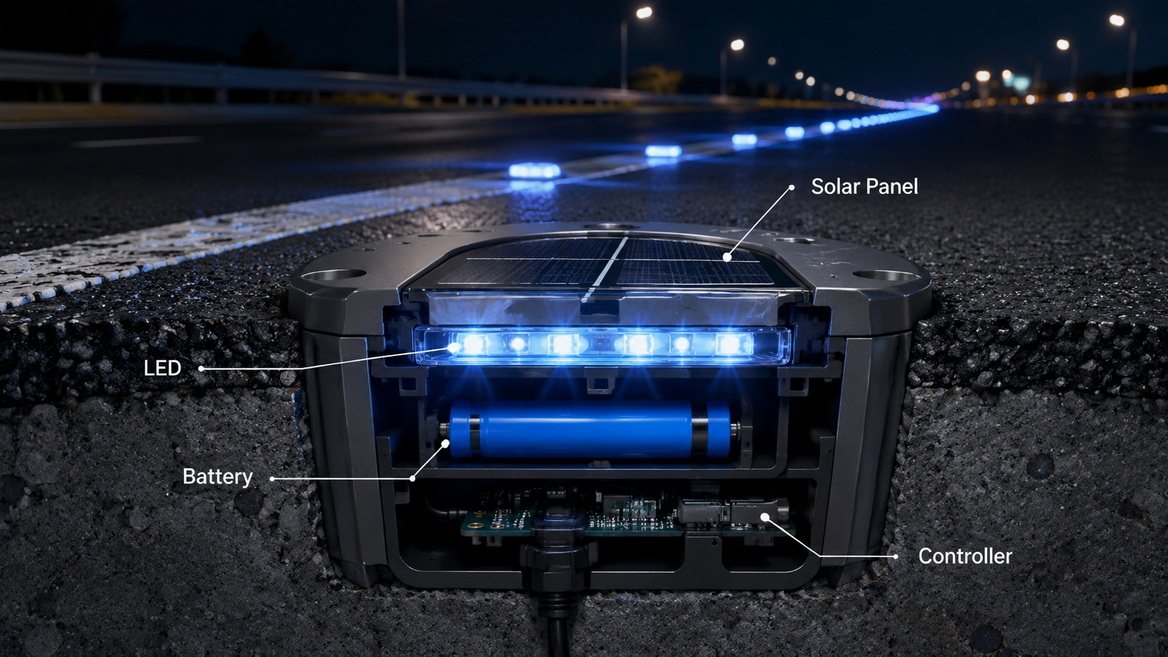
Active LED road studs are self‑illuminating markers that emit light using integrated LEDs, usually powered by mains or solar energy. They are widely deployed on highways, toll stations, pedestrian crossings, tunnels, and complex interchanges where high visibility is critical.
Key characteristics of active LED studs include:
- Built‑in LED light sources (often single or multi‑color)
- Power supply via solar panels, batteries, or wired connection
- IP‑rated housings for outdoor, all‑weather use
- Optional control systems (synchronization, flashing, dimming, IoT integration)
From my experience working with LED traffic warning lights, customers choose active studs when they want the road marking to "speak first" to drivers, not just "answer" incoming headlights.
Passive road studs with reflective beads rely on retro‑reflection: micro glass beads or reflective lenses bounce back the light from vehicle headlights toward the driver's eyes. They do not generate light; instead, they enhance visibility only when illuminated by an external source.
Typical features of passive reflective studs:
- No internal electronics or power supply
- Polycarbonate, aluminum, or steel body with reflective lenses or beads
- Lower unit cost and simpler installation
- Performance highly dependent on headlight angle, road contamination, and weather
These studs are often used in low‑traffic rural roads, parking lots, and budget‑sensitive municipal projects where basic delineation is enough.
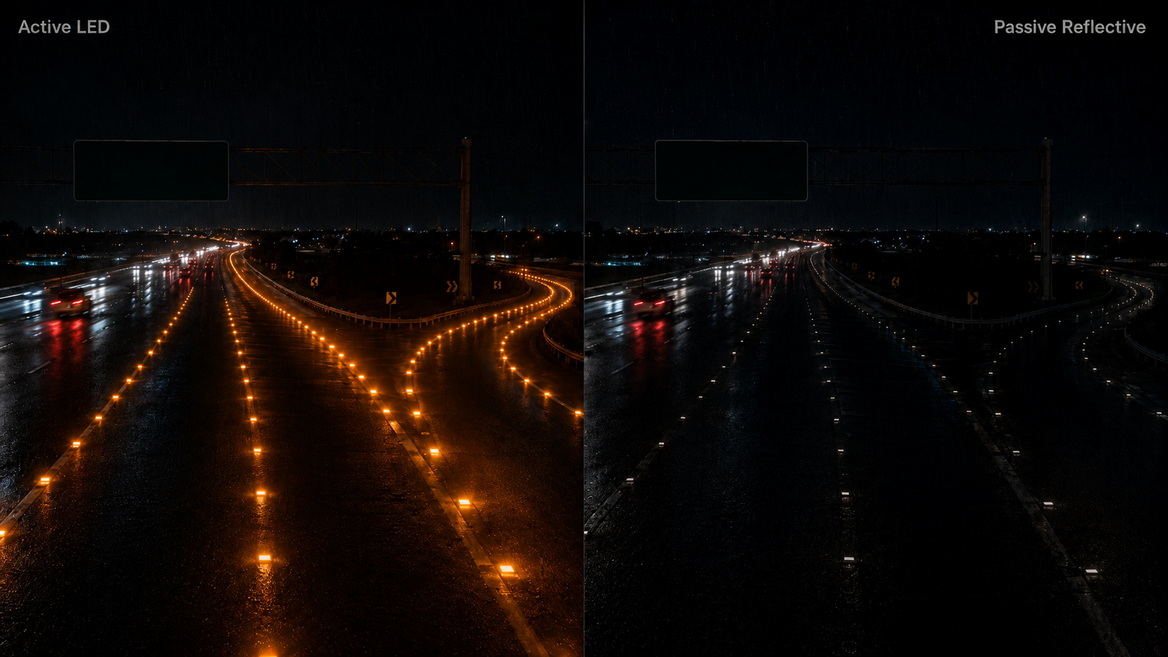
In real roadside projects, visibility window and conspicuity are the two KPIs I always evaluate first.
- Active LED studs provide visible guidance even without headlights, which is crucial at low speeds in urban crossings and in power‑outage scenarios. - Passive studs offer acceptable guidance only when drivers' headlights are correctly aligned and not blocked by rain, fog, or dirt.
A practical example: On multilane toll plazas, projects that upgraded from passive to synchronized LED studs on lane lines reported more stable lane discipline and fewer last‑second lane changes because drivers perceive a continuous light "corridor" instead of scattered reflections.
- Active LED studs emit light directly from LEDs, often using lenses or diffusers to shape the beam pattern (unidirectional, bidirectional, or 360‑degree). - Passive studs use retro‑reflective beads or prismatic optics to send light back toward the source.
Because active systems generate their own light, engineers can design color coding (amber, red, white, green) and dynamic patterns (chasing, flashing, dimming curves) to match local regulations and human‑factors research.
- Active studs:
- Solar panels plus Li‑ion/LiFePO4 battery, or
- Wired to local power with low‑voltage drivers - Optional wireless control for central monitoring and dimming schedules - Passive studs:
- No power, no control electronics
- Life limited mainly by mechanical wear and surface contamination
For a manufacturer like Shenzhen Xingsheng Traffic Facilities Co., Ltd., OEM/ODM LED studs can be engineered to integrate with traffic signal controllers, smart city platforms, and ITS sensors, something passive studs simply cannot offer.
From a procurement and asset‑management angle, the debate is not only CAPEX vs OPEX but lifecycle safety ROI.
In high‑risk sites (tunnels, sharp curves, mountain highways), many road authorities accept higher unit prices for active studs because fewer accidents and smoother traffic flow generate indirect economic returns.
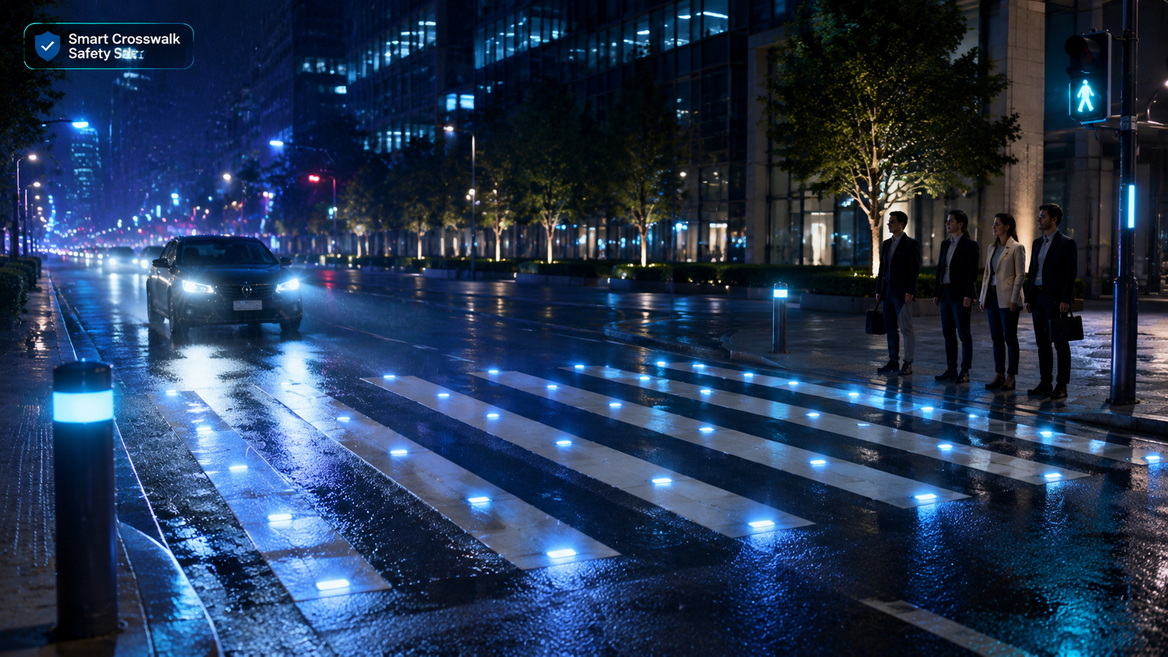
From project experience and industry case studies, active LED studs are preferable when:
- Traffic volume and speed are high (expressways, ring roads, busy arterials) - Night‑time accident rates are above the network average - There is frequent fog, heavy rain, or snow that reduces headlight effectiveness - Pedestrian safety is critical (school zones, zebra crossings, shared spaces) - The client wants integration with traffic signals, ITS, or smart city platforms
Example: At signalized crosswalks, LED studs synchronized with the pedestrian phase can visually "extend" the signal to road level, making distracted drivers and pedestrians more aware of crossing status.
Passive studs remain the practical choice when:
- Budgets are tight and coverage area is large (rural networks, parking areas) - Traffic volumes are low to moderate
- Lighting conditions are acceptable and there are no severe weather extremes
- The goal is mainly lane delineation, not active warning
Many municipalities start with passive studs for wide coverage, then selectively upgrade critical segments to active LED solutions as budgets and safety programs evolve.
From a UX and human‑factors standpoint, road studs are an interface between infrastructure and driver cognition.
- Active LEDs create a continuous, intuitive light path that drivers can follow instinctively, especially at night or in complex geometry. - Passive beads provide intermittent flashes of reflection, which can be less effective in guiding drivers through tight curves or lane drops.
Key human‑factors advantages of active studs:
- Earlier detection distance compared to passive markers in low‑light conditions - Better support for older drivers with reduced night vision
- Ability to indicate temporary conditions (lane closures, reversible lanes, work zones) with color and flashing patterns
From the perspective of a Chinese traffic safety manufacturer offering OEM and ODM services, the design space of active LED studs is far richer than that of passive studs.
For B2B buyers (distributors, system integrators, EPC contractors), key customizable parameters include:
- Optical design: luminous intensity, viewing angle, color combination
- Power design: solar panel size, battery capacity, charging algorithm
- Mechanical design: housing material (aluminum, PC, stainless steel), load rating for heavy trucks, anti‑skid surface
- System integration: RS‑485 / CAN / wireless protocols to interface with controllers
Passive studs, by contrast, are mostly optimized on materials, load capacity, and reflective grade, with limited room for real functional differentiation beyond durability and color.
For Shenzhen Xingsheng Traffic Facilities Co., Ltd., this means:
- Active LED product lines can be tightly aligned with local standards in different regions.
- ODM customers can co‑design unique optical signatures and control logic, building branded smart‑road solutions.
Sustainability is becoming a core decision factor for road authorities and private operators.
- Solar‑powered LED studs consume no grid energy and leverage high‑efficiency LEDs, producing strong visual effects with minimal power. - Passive studs do not consume energy themselves, but may require more overhead lighting or denser installation to achieve equivalent safety levels.
When you compare network‑level energy footprints, a well‑engineered solar LED system can enable road operators to dim or reduce overhead lighting in targeted segments while maintaining or even improving safety performance.
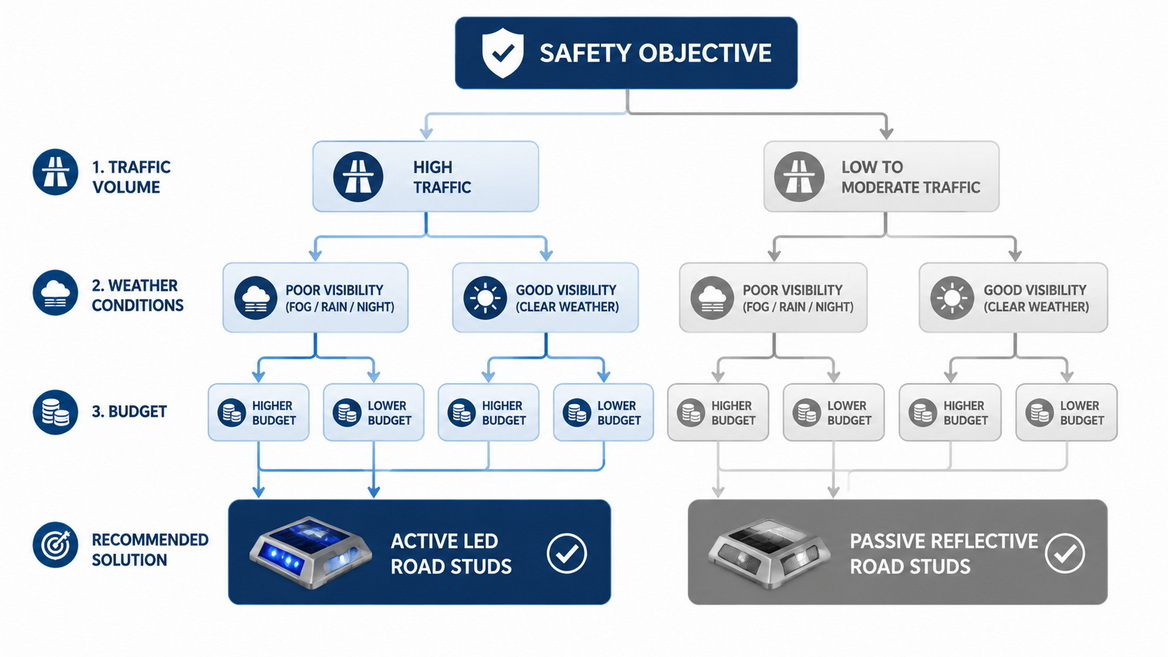
To help B2B buyers make a structured decision between active LED lighting and passive reflective beads in road studs, I recommend a simple 4‑step framework:
1. Define safety objectives
- Reduce night‑time accidents?
- Improve pedestrian protection?
- Support smart‑city or ITS strategy?
2. Assess site conditions
- Traffic speed and volume
- Climate: fog, rain, snow, dust
- Existing lighting and power availability
3. Compare lifecycle economics
- Expected service life
- Maintenance capacity (onsite vs outsourced)
- Accident and downtime costs
4. Align with technology roadmap
- Need for connected infrastructure (IoT, data)
- Compatibility with existing controllers and platforms
- Scalability across multiple corridors or cities
In high‑priority corridors, active LED studs often emerge as the strategic choice, while passive studs remain a cost‑effective baseline for low‑risk sections.
If you are planning a new road safety project or upgrading from passive reflective studs, partnering with a specialized LED traffic warning light manufacturer in China can significantly reduce technical risk and integration cost. By leveraging OEM/ODM capabilities, you can adapt active LED or passive solutions to meet local standards, budget constraints, and long‑term smart‑road strategies.
Active LED studs deliver superior visibility, especially in poor weather and complex road geometry, which can translate into fewer accidents and smoother traffic flow. For high‑risk locations, the safety ROI often justifies the higher upfront cost.
Quality solar LED studs usually offer a service life between 3 and 8 years, depending on component quality, charging cycles, and environmental stress such as heavy truck loads and extreme temperatures.
Yes, many modern active LED studs support wired or wireless communication, enabling synchronization with traffic lights, central control software, and smart‑city platforms for dynamic lane control or pedestrian protection.
Passive studs remain an efficient choice for low‑traffic roads, basic parking layouts, and budget‑constrained projects where the main goal is simple lane delineation rather than dynamic warning or data connectivity.
You should review local road‑marking and traffic‑device standards that define luminance, color, load capacity, ingress protection rating, and retro‑reflectivity criteria, and ensure your supplier can certify compliance for your target market.
- Road safety product selection insights and project examples from recent Chinese urban solar road stud deployments. - Industry analyses and manufacturer datasheets on LED traffic lighting and smart road safety systems. https://finance.sina.com.cn/tjhz/2026-06-11/doc-iniazyeh5470614.shtml


