
Please Choose Your Language
Views: 222 Author: XS Traffic Facilities Publish Time: 2026-06-18 Origin: Site


Content Menu
● Understanding The Two Pattern Types
● Where Each Pattern Is Commonly Used
● Human Factors: How Drivers Perceive Each Pattern
>> Comprehension And Reaction Time
● Technical Design: LED Layout, Optics, And Control
>> Circular LED Flashing Patterns
● Reliability, Maintenance, And Lifecycle Cost
● Standards, Compliance, And Global Best Practices
● Circular Patterns: Best‑Fit Scenarios And Advantages
>> When Circular LED Flashing Patterns Excel
● Sequential Arrow Patterns: Best‑Fit Scenarios And Advantages
>> When Sequential Arrow Patterns Are Ideal
● Expert Insight: Choosing The Right Pattern For Your Network
● OEM / ODM Perspective: How A Chinese Manufacturer Adds Value
● Practical Implementation Steps For Project Teams
>> 1. Define Use Cases And Locations
>> 2. Specify Technical Requirements
>> 3. Align With Local Regulations
>> 4. Evaluate Supplier Capabilities
● Emerging Trends: Smart Integration And Data
● Comparative Summary Table: Circular vs. Sequential
● Call To Action: Plan Your Next LED Sign Upgrade
● FAQ: Circular Vs. Sequential LED Patterns
>> Q1: Are circular LED flashing patterns enough for highway work zones?
>> Q2: Do sequential arrow signs consume more power than circular flashers?
>> Q3: Can one sign support both circular flashing and arrow sequences?
>> Q4: How do I choose flash frequency and pattern?
>> Q5: What documentation should I request from a supplier?
For road operators, choosing between circular LED flashing patterns and sequential arrow patterns is no longer just a design preference; it directly affects driver behavior, safety outcomes, and long‑term lifecycle costs in smart traffic systems. This in‑depth guide compares both pattern types from a practical field perspective and a B2B engineering and procurement perspective, helping you specify the right LED traffic sign solution for highways, toll stations, city streets, and parking facilities.
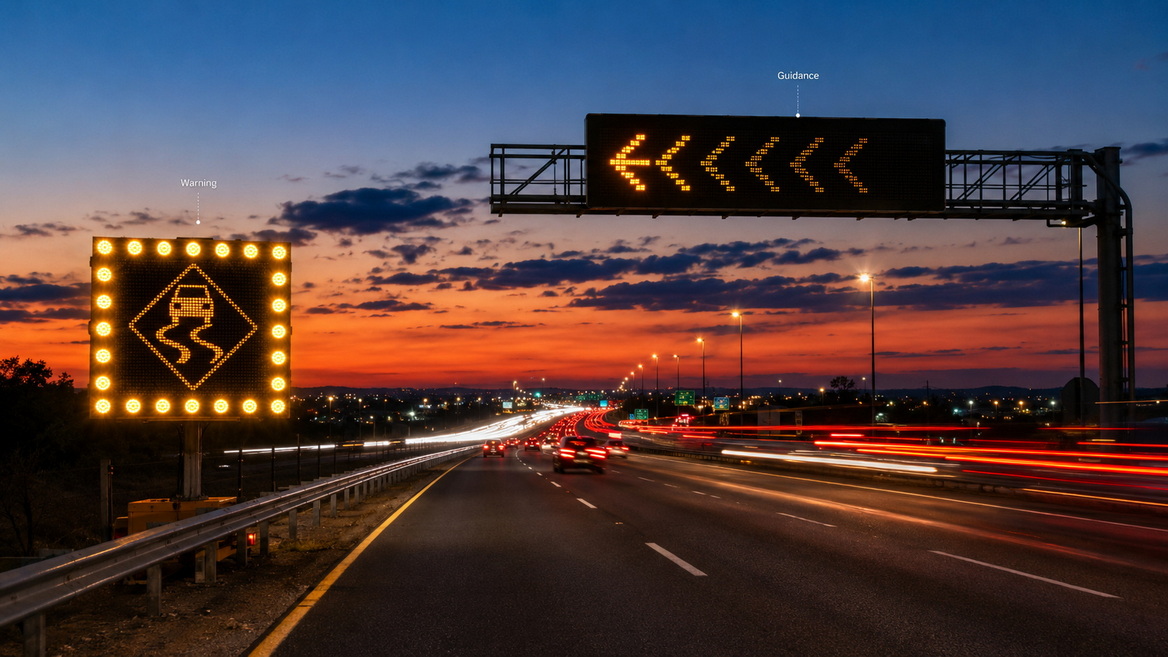
Circular LED flashing patterns use circular arrangements of LEDs that flash at a fixed or variable rate to draw attention to a sign or hazard. By contrast, sequential arrow patterns use multiple LED segments arranged as arrow "chevrons" that light up in sequence to create a clear directional effect.
From a driver's point of view, the circular pattern works like a high‑visibility warning beacon, while the sequential arrow acts like a moving guide, "pulling" the driver in a specific direction. In practice, professional traffic engineers often combine these formats in different locations within the same road network to cover both "warning" and "guidance" functions.
In global practice, you will typically see circular LED flashing patterns in these scenarios:
- School zone warning signs and pedestrian crossings
- Hazard markers at sharp curves or narrow bridges
- Level crossing signs and general caution signs
Meanwhile, sequential arrow patterns are widely used for:
- Lane closure and merge arrows on highways
- Work zone lane transition guidance
- Toll lane status indicators and smart parking guidance
If your network includes highways, toll plazas, and complex parking facilities, it is common to use circular patterns on static warning signs and sequential arrows on dynamic lane control or merging guidance signs.
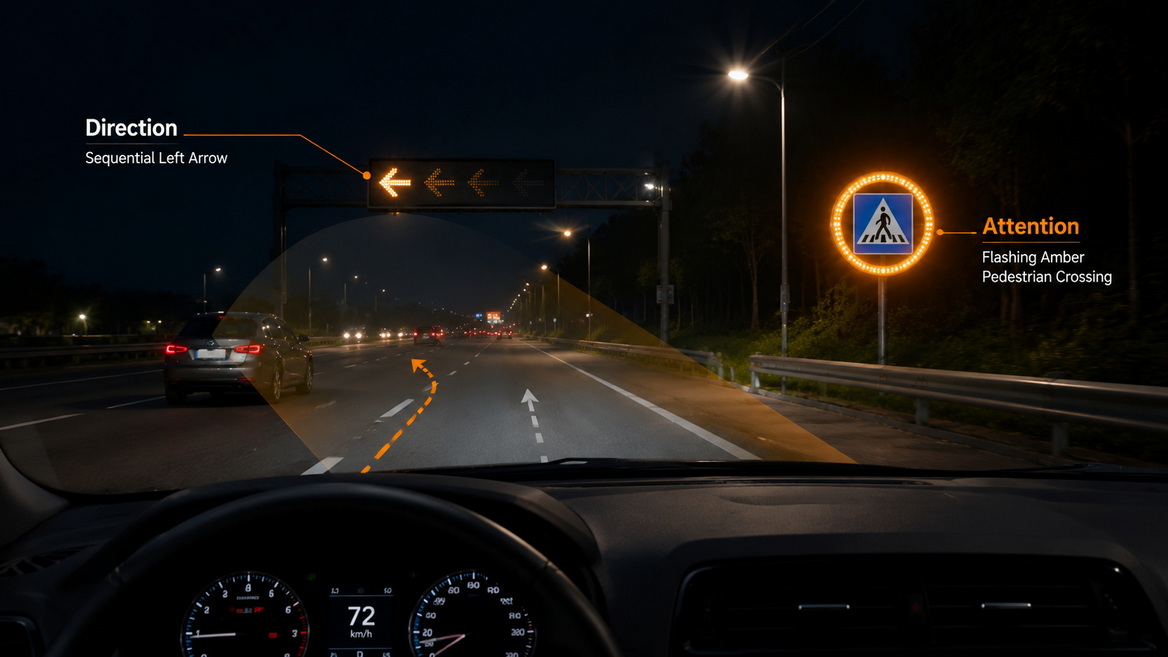
Circular LED flashing patterns are extremely effective at attracting attention due to their symmetry and concentrated luminous intensity. They work particularly well when used as border lights around regulatory or warning signs (e. g., STOP, YIELD), making the message stand out against background clutter.
Sequential arrow patterns, however, encode both visibility and direction in a single animation. Drivers not only see a bright sign; they see a dynamic "flow" showing exactly where to move, which reduces decision time when approaching a lane closure or diversion.
- Circular flashing: Ideal for "Look here, something important". Drivers still need to read the sign legend or understand the symbol.
- Sequential arrow: Ideal for "Move there now". The direction is immediately obvious even if the driver does not read text, which is critical for multi‑language or international routes.
From a UX standpoint, sequential arrows deliver simpler cognitive processing in high‑stress situations, while circular patterns deliver stronger general awareness.
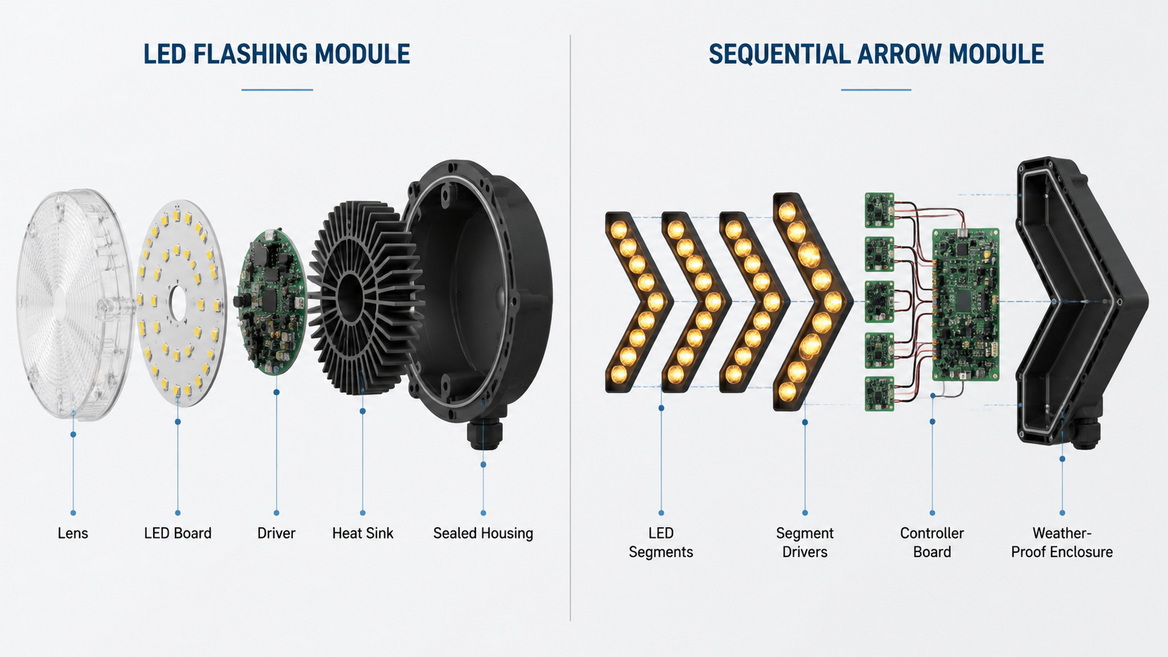
Typical circular LED modules consist of:
- Radial PCB layout with equally spaced diodes
- Integrated optical lenses to expand viewing angle
- Single or dual channel drivers for steady or flashing modes
The control logic can be as simple as a fixed‑frequency flasher, or more advanced with programmable flash rates and duty cycles to comply with local standards. )
Sequential arrow systems usually include:
- Multiple LED "chevrons" or segments arranged in arrow shape
- Addressable drivers for each segment or group
- A controller capable of timed sequence patterns
This architecture requires more complex firmware and synchronization, but it enables advanced patterns like running arrows, alternating arrows, or adaptive patterns that respond to traffic conditions.
From a maintenance engineer's perspective, both designs depend on LED quality, driver robustness, and environmental sealing.
Circular patterns:
- Fewer distinct segments and interconnections
- Simplified driver circuitry
- Lower probability of partial pattern failure
Sequential arrows:
- More segments and more potential failure points
- Requires well‑designed diagnostics (e. g., fault detection per segment
- Offers modularity: damaged arrow modules can be replaced individually
When designed with industrial‑grade LEDs and robust IP‑rated housings, both systems can comfortably reach 50,000–100,000 hours of service life, but sequential arrows demand stricter quality control and better OEM engineering.
Traffic safety authorities in different regions issue guidelines on flashing frequencies, luminous intensity, and pattern usage to avoid driver confusion and visual fatigue. For example, regulations commonly restrict flash frequency to prevent seizure risks, and some standards define where flashing border signs or arrow boards are allowed.
As a B2B buyer or project engineer, you should always verify that your supplier's LED traffic signs comply with local road authority standards, IEC/EN norms, and relevant EMC and environmental tests. This is especially important when importing from overseas manufacturers, as documentation quality varies widely.
Circular LED flashing patterns are typically the better choice when:
- The primary goal is warning, not lane guidance
- Space is limited and sign legends must remain fully visible
- There is a need to upgrade existing static signs with LED borders
Typical applications include school zones, mid‑block pedestrian crossings, dangerous curves, and low‑visibility intersections.
- Strong visual emphasis on existing regulatory or warning signs
- Simple electronics and lower configuration complexity
- Easy retrofit onto existing sign faces
For municipalities and facility owners with limited budgets, retrofit circular flashing kits offer a cost‑effective initial step toward intelligent traffic infrastructure.
Sequential arrow patterns shine in dynamic lane and direction control situations:
- Highway lane closures and contraflow systems
- Work zone lane shifts and shoulder closures
- Toll plazas with changing lane assignments
- Large parking facilities with dynamic wayfinding
In these environments, clarity of direction is more critical than general warning, and the animated arrow offers an immediate intuitive cue.
- Clearly communicates where drivers should move
- Supports multiple operating modes (left, right, merge, close
- Integrates well with ITS controllers and remote monitoring systems
For road operators investing in smart transportation, sequential arrow boards form a key part of lane control and incident management strategies.
Drawing on typical global practice in road safety projects, a mixed strategy often works best:
- Use circular LED flashing patterns around high‑risk static signs to increase compliance (STOP, pedestrian crossing, speed limit reminders).
- Use sequential arrow patterns where traffic flow must be changed or guided dynamically (work zones, reversible lanes, toll lanes).
From an engineering consultant's viewpoint, the decision matrix usually weighs these factors:
- Functional requirement (warning vs guidance
- Regulatory framework
- Site geometry and approach speed
- Budget and maintenance resources
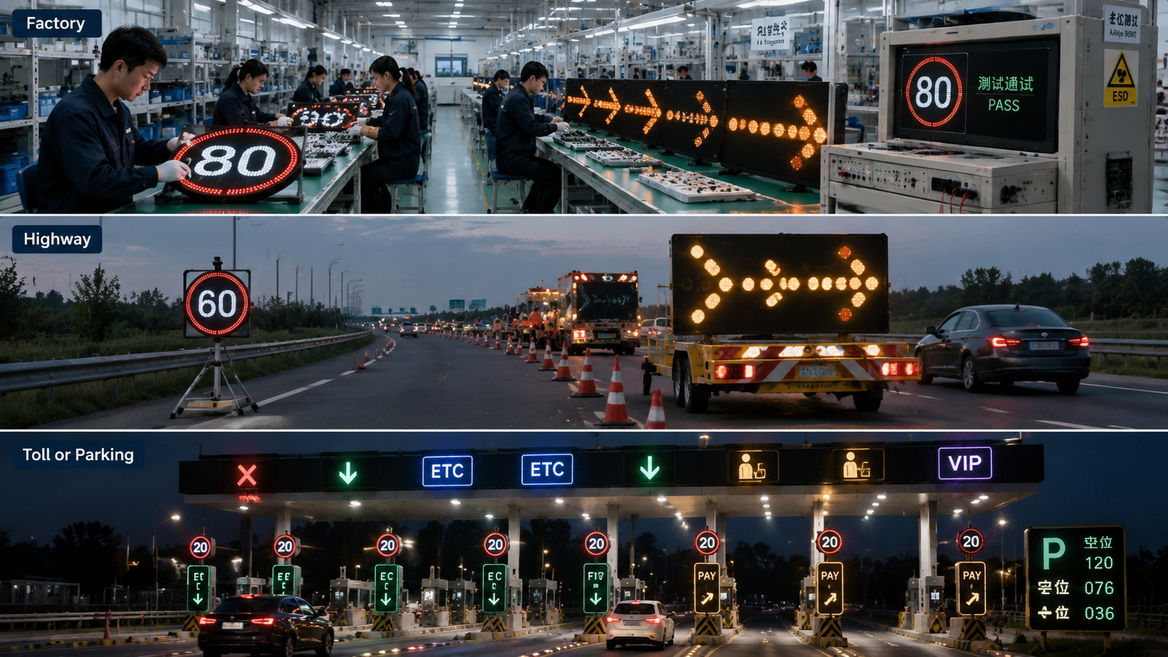
For B2B buyers, especially traffic integrators and distributors, partnering with a specialized Chinese manufacturer of LED traffic signs offers several advantages:
- OEM customization: Branding, language, color schemes, mounting interfaces, and electrical connectors tailored to your market.
- ODM development: Co‑developing new housings, smart controllers, and integrated systems that combine circular and arrow modules in one platform.
An experienced factory can standardize core modules (LED boards, power units, housings), then adapt firmware and mechanical interfaces to meet the requirements of different road authorities, helping clients reduce project risk and time‑to‑market.
- Map out where warning is primary (intersections, school zones, curves) and where guidance is primary (lane closures, toll lanes).
- Decide which locations need hybrid solutions, such as a circular flashing warning sign installed upstream of a sequential arrow board.
- Luminous intensity, beam angle, color (typically amber or white for warning, green/red for guidance).
- Controller type (stand‑alone timer, remote‑controlled, or ITS‑integrated).
- Housing material, IP rating, and vibration resistance for local climate and road conditions.
- Match flashing frequency and duty cycle rules.
- Ensure message types (symbols, legends, arrows) are permitted by the road authority.
- Ask for photometric reports, EMC test reports, and environmental test data.
- Check references for similar highway or toll projects.
- Confirm after‑sales support and spare‑parts availability.
Modern LED traffic signs increasingly integrate with intelligent transportation systems (ITS) and remote monitoring platforms. In this context, both circular and sequential arrow patterns can be enhanced by:
- Remote brightness control based on ambient light sensors
- Automatic fault reporting when LED modules or drivers fail
- Integration with traffic detectors to activate patterns only when vehicles are present
Looking ahead, expect more projects to specify modular signs that can switch between circular flashing and arrow sequences through firmware updates, enabling future‑proof deployments in expanding road networks.
If you are planning a new project or retrofit for highways, toll stations, or parking facilities, now is the right time to upgrade from static signs to LED‑enhanced circular flashers and sequential arrow systems. Collaborating with an OEM/ODM manufacturer specializing in LED traffic signs allows you to standardize hardware, customize patterns, and ensure compliance across different jurisdictions.
In most cases, circular flashers alone are not sufficient for complex highway work zones where drivers must change lanes quickly; combining them with sequential arrow boards provides both warning and clear guidance.
Sequential arrow boards often use more LEDs and more complex controllers, but with modern high‑efficiency LEDs and smart dimming, total power consumption remains manageable and can be supported by solar systems in many sites.
Yes, modular designs can integrate multiple LED zones and programmable controllers, enabling a single sign to operate as a circular flasher in one mode and as a sequential arrow in another, depending on control system inputs.
Always follow local road authority guidelines for flash frequency and duty cycle, and test patterns in a pilot section to ensure they are noticeable but not distracting or fatiguing for drivers.
Request photometric reports, electrical schematics, EMC test certificates, environmental test reports, and reference project lists, especially for large highway or toll implementations.
1. Shopify Help Center – "Adding SEO Keywords To Your Shopify Store" (SEO best practice for keyword placement, headings, meta descriptions).
https://help.shopify.com/zh-CN/manual/promoting-marketing/seo/adding-keywords


