
Please Choose Your Language
Views: 222 Author: XS Traffic Facilities Publish Time: 2026-06-15 Origin: Site


Content Menu
● What Are Road Reflectors on Roads?
● Why Road Reflectors Matter for Modern Road Safety
● How Road Reflectors Work – Retroreflection and Active LED Studs
>> Passive Retroreflective Markers
>> Active Solar‑Powered Road Studs
● Main Types of Road Reflectors (and Where We Recommend Using Them)
>> Glass Cat's Eyes Reflectors
>> Metal Road Reflectors / Heavy‑Duty RPMs
>> Solar‑Powered LED Road Studs
>> Snowplowable or Recessed Reflectors
● Road Reflector Colors and What They Mean
● Where Road Reflectors Are Used – Highways, Streets, Parking, and More
>> Temporary vs Permanent Markers
● Installation and Maintenance – Expert Best Practices
>> Installation Best Practices
● Expert Buying Guide – How to Choose Road Reflectors for Your Project
>> Example Configuration Table
● OEM & ODM Road Reflectors – How Shenzhen Xingsheng Adds Value
>> OEM Manufacturing for Established Brands
>> ODM Co‑Design for New Solutions
● UX and Conversion Tips – Content, Visuals, and CTAs for Road Reflector Pages
>> Q1: What are the reflectors on the road called?
>> Q2: Do road reflectors really reduce accidents?
>> Q3: How long do road reflectors last?
>> Q4: How far apart should road reflectors be installed?
>> Q5: When should I choose solar road studs instead of regular reflectors?
As a traffic safety manufacturer who has spent years walking actual highways, parking lots, and toll plazas with engineers, I can tell you that road reflectors are one of the simplest and most cost‑effective ways to prevent night‑time and bad‑weather accidents. This guide explains how road reflectors work, the main types, current standards and case studies, and how an OEM/ODM partner like Shenzhen Xingsheng Traffic Facilities Co., Ltd. can help you design the right reflector system for your project.

When we talk about "road reflectors," most engineers mean raised pavement markers (RPMs), road studs, or cat's eyes installed on the road surface to give drivers a bright, visible lane and edge reference at night or in poor visibility. They use retroreflective elements or LEDs to return headlight beams back toward the driver, making lanes, curves, shoulders, and hazards easier to see in time to react safely.
From my experience visiting job sites with contractors, the real value of road reflectors is that they work when paint fails—in heavy rain, worn surfaces, glare, and on older drivers who need stronger night‑time guidance. Well‑planned markers often become the difference between a near‑miss and a serious crash.
Search intent for "what are reflectors on roads" is usually informational: buyers, engineers, or safety managers want to understand what they are, how they work, and how to choose them. So we start from the safety fundamentals.
- Enhanced night‑time visibility: Retroreflective markers return headlight beams toward the driver, making lane lines and edges stand out even when paint is faded or wet.
- Better performance in bad weather: In fog, rain, or light snow, reflectors remain visible long after painted lines lose contrast, helping prevent lane departure.
- Earlier hazard awareness: Reflectors at curves, intersections, toll plazas, or ramps give drivers extra seconds to react and slow down.
- Compliance with stricter visibility standards: Agencies in markets like the U. S. now follow minimum retroreflectivity levels for markings and expect similarly high visibility from complementary devices like markers.
One U. S. study under the National Cooperative Highway Research Program found that reflective pavement markers can cut night‑time crashes by up to 30% when used correctly on suitable roads. Another long‑term case in the U. K. showed that active solar studs helped maintain accident reductions over a ten‑year period on high‑risk rural routes.
From an engineering perspective, road reflectors fall into two functional categories: passive retroreflective markers and active LED or solar studs.
Most traditional road studs use glass beads or microprisms sealed inside a durable body (plastic, ceramic, or metal).
- Headlights strike the reflector at a shallow angle.
- Glass beads or prisms bend and bounce the light back toward the source.
- To the driver, the marker appears to glow, even though it uses no power.
This property—retroreflectivity—is the same principle used in reflective signs and high‑visibility garments. It is especially important for older drivers whose night vision has declined, which is one reason regulators introduced minimum retroreflectivity standards for pavement markings.
LED or solar road studs add their own light source on top of the reflective body.
- A small solar panel charges an internal battery during the day.
- At night, embedded LEDs emit a constant or flashing light to highlight lanes, curves, or crossings.
- Because the light is stronger and visible from greater distances, drivers may gain up to 10 times more reaction time compared with paint alone in some installations.
Active studs are particularly effective on:
- Rural curves with high accident history
- Tunnels and bridges
- Unlit country roads and coastal highways
- Work zones where temporary patterns change frequently
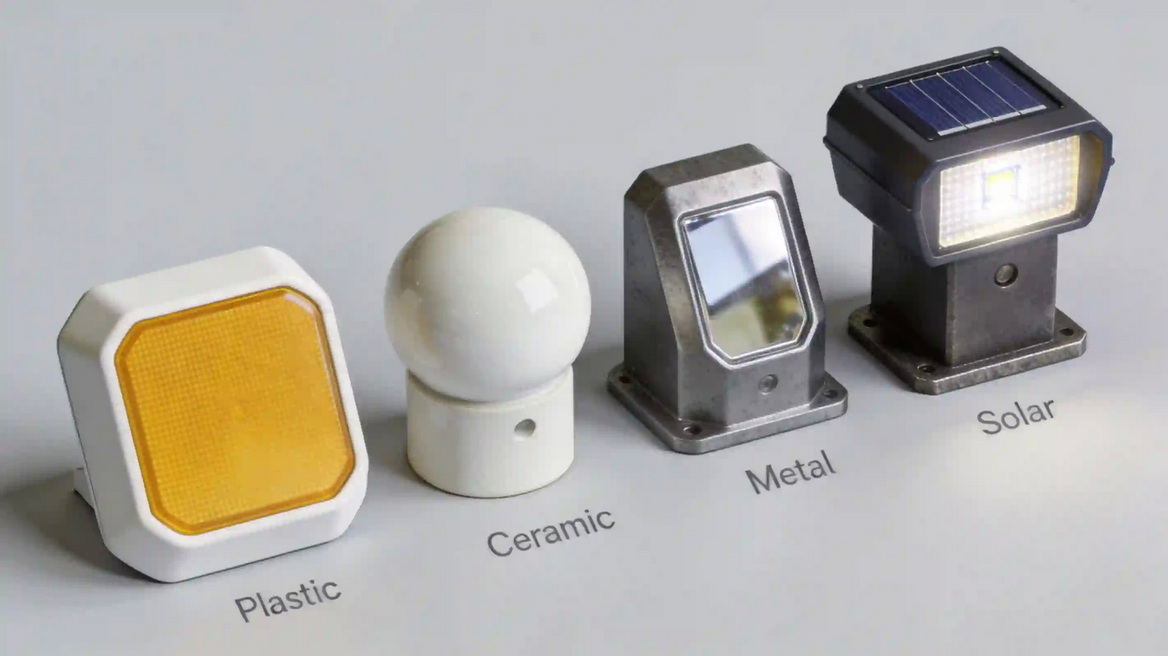
As a manufacturer, we see buyers struggle most with matching product type to application. Here is a practical breakdown.
Plastic markers are lightweight and cost‑effective, often used for temporary lane changes, low‑speed city streets, and parking areas.
- Low unit cost and easy installation with adhesive
- Suitable for short‑term projects or low‑traffic environments
- Not ideal for heavy truck traffic or harsh climates
We typically recommend plastic reflectors for parking lots, temporary lane shifts, and low‑volume roads where budget is a priority and replacement is easy.
Ceramic road studs (often "Bott's Dots" style) are fired at high temperature to produce a hard, smooth, and durable dome.
- Excellent longevity and color stability
- Provide both visual and tactile feedback when tires pass over
- Suited for warm or mild climates with limited snowplow activity
These are common on urban arterials, medians, and lane separation applications where long life and tactile feedback are important.
Classic cat's eyes integrate glass elements in a metal or rubber carrier that self‑cleans as traffic passes, keeping the lenses clear.
- Strong retroreflection in wet and foggy conditions
- Long history on high‑speed roads and fog‑prone regions
- Good fit for centerlines and hazard areas on highways
Because of their self‑cleaning design, cat's eyes often perform well on busy, all‑weather routes where dirt buildup is a concern.
Metal‑bodied reflectors (aluminum or stainless steel) with retroreflective inserts are the workhorses for highways, toll plazas, truck routes, and industrial sites.
- High load‑bearing capacity under heavy trucks
- Excellent impact and abrasion resistance
- Often combined with mechanical anchoring and high‑strength epoxy
Many DOT specifications for raised pavement markers (RPMs) in the U. S. and other markets describe metal types for high‑speed, high‑volume applications.
Solar road studs combine rugged housings with high‑brightness LEDs and are ideal where active lighting is needed but wiring is impractical.
- Provide continuous or flashing illumination
- Improve preview time on curves, ramps, and toll approaches
- Support green, energy‑efficient infrastructure goals
Several case studies report over 70% reductions in night‑time accidents on treated segments when solar studs replace or supplement conventional markings.
In snow regions, snowplowable markers are installed in recessed pockets or steel castings so plow blades do not shear them off.
- Reflector body sits below or within a protective housing
- Designed to survive repeated plow passes and de‑icing chemicals
- Common on mountain passes, bridges, and high‑latitude highways
These are essential when you want durable lane guidance through harsh winters without constant re‑installation.
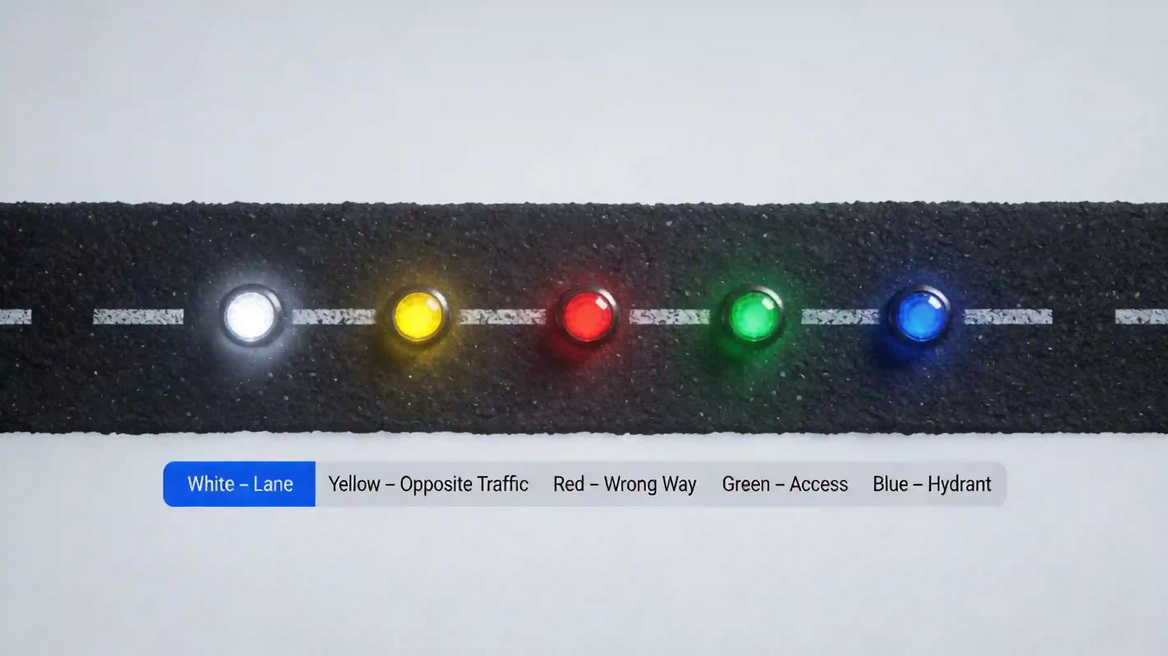
Color conventions vary by country, but most major markets follow similar logic so drivers can quickly understand traffic flow and edge conditions.
- White: Standard lane lines and same‑direction travel lanes.
- Yellow / Amber: Centerlines and opposing traffic, or the left edge on divided highways in some standards.
- Red: Wrong‑way indication or "do not enter" side when viewed from the wrong direction.
- Green: Entries and exits, emergency access points, or special junctions, depending on local rules.
- Blue: Fire hydrant or emergency water locations in some U. S. jurisdictions.
- Special colors (purple, orange): Utility corridors or temporary construction zones.
When we support overseas customers on OEM/ODM projects, we always recommend verifying local standards (such as MUTCD in the U. S. or equivalent national codes) to ensure colors, spacing, and placement comply with law and driver expectations.
As a manufacturer, we see similar usage patterns across markets, but the configuration often changes by speed, volume, and environment.
- Highways and expressways: Lane separation, centerlines, edge lines, ramps, toll plazas, and bridges to maintain clear guidance at high speed.
- Urban and rural roads: Curves, intersections, pedestrian crossings, and village approaches where extra attention is needed.
- Parking lots and commercial sites: Stall boundaries, speed humps, direction arrows, and pedestrian walkways in malls, logistics parks, airports, and campuses.
- Tunnels and underpasses: Continuous guidance where daylight and line‑of‑sight are limited.
- Airports: Taxiways and apron markings with specialized studs to complement paint and lighting systems.
Many projects combine temporary plastic RPMs during construction with permanent ceramic, metal, or solar studs once the final alignment is open.
- Temporary: quick to install and remove, best for short‑term lane shifts or work zones.
- Permanent: more expensive but far more durable, essential for high‑volume or long‑life routes.
The choice should consider traffic volume, project duration, and the cost of lane closures for future replacement.
In our OEM/ODM projects, failures almost always trace back to poor installation, wrong adhesive, or inadequate maintenance, not the marker itself.
Industry guides suggest a structured process:
1. Site assessment and surface preparation
- Ensure asphalt or concrete is clean, dry, and structurally sound.
- Remove dust, oil, and loose particles for better adhesion.
2. Accurate layout and spacing
- Use chalk lines and measuring tools to maintain consistent spacing.
- Typical centerline spacing ranges from about 9–15 m on highways, closer on curves or special hazards.
3. Adhesive and anchoring
- Apply compatible epoxy or road‑grade adhesive with even coverage.
- For heavy‑duty or metal studs, combine adhesive with screws or anchors where specified.
4. Curing and protection
- Respect curing time before reopening traffic—often 1–2 hours or per manufacturer instruction.
- Use cones and signage to prevent vehicles from displacing fresh studs.
5. Night‑time inspection
- Inspect alignment and visibility after dark to confirm that reflectors perform as designed.
Reflective markers are low‑maintenance, but not maintenance‑free.
- Regular cleaning or street‑sweeping to remove dirt films that dull reflectivity.
- Routine night‑time inspections on critical corridors.
- Prompt replacement of damaged or missing studs to avoid "gaps" in guidance.
- For solar studs, battery and panel checks to ensure charging and LED output remain within spec.
Regulators are tightening visibility expectations: in the U. S., for example, longitudinal pavement markings must be maintained at 50–100 mcd/m²/lx retroreflectivity, depending on speed, which indirectly pushes agencies to adopt reflective devices that support these visibility goals.

From working with highway contractors, car park operators, and government agencies, we've found that the best projects start with a simple checklist.
- Road type and speed:
- High‑speed highways and tollways benefit from metal or solar studs for durability and visibility.
- Low‑speed parking lots or internal roads can use plastic or ceramic studs more cost‑effectively.
- Climate and environment:
- Snowplow regions require recessed or snowplowable studs.
- Hot climates need UV‑resistant materials and adhesives that tolerate high surface temperatures.
- Traffic volume and vehicle mix:
- Heavy truck routes and logistics hubs favor heavy‑duty metal housings and high‑bond epoxies.
- Light commercial or residential areas can prioritize cost and aesthetics.
- Visibility requirements and risk level:
- High‑risk curves, bridges, or fog zones justify active solar studs for maximum preview distance.
- Standard corridors can rely on passive retroreflection combined with compliant pavement markings.
- Regulatory standards and certifications:
- Check compliance with local road authority standards (e. g., MUTCD‑based specs for RPM types, colors, and retroreflectivity).
| Application scenario | Recommended type | Key features to prioritize |
|---|---|---|
| High‑speed highway (no snow) | Metal RPM + cat’s eyes | High load, strong retroreflection, compliant colors and spacing |
| Mountain pass with snowplows | Snowplowable recessed studs | Protected housings, abrasion resistance, winter‑grade adhesive |
| Rural curve with high accident rate | Solar‑powered LED road studs | Long‑range visibility, flashing modes, weatherproof design |
| City intersection / pedestrian crossing | Plastic or ceramic + solar at crosswalk | Low‑profile studs, good wet‑night visibility, pedestrian safety focus |
| Shopping mall parking lot | Plastic reflectors + paint | Cost control, easy installation, flexible layout changes |
As a China‑based traffic safety manufacturer, Shenzhen Xingsheng Traffic Facilities Co., Ltd. specializes in OEM and ODM road reflectors and integrated traffic safety solutions for streets, highways, toll stations, and parking facilities.
If you already have a product specification or brand:
- We produce to your drawings and performance targets, including custom retroreflective inserts, colors, and load ratings.
- Products can be labeled, packaged, and certified to match your regional standards and branding strategy.
This model is ideal for importers, distributors, and brands that want reliable, scalable supply without building their own factory.
If you are starting a new product line or adapting to a new standard, we provide:
- Joint product design and tooling based on your road authority requirements.
- Material selection (plastic, ceramic, metal, solar) tailored to climate, traffic, and budget.
- Packaging, instruction sheets, and marketing support optimized for your target market.
Our team works closely with traffic engineers and buyers worldwide to ensure that design, performance, and documentation all support project approval and long‑term safety outcomes.
From an SEO and UX perspective, a strong road reflector page should not only educate but also convert high‑intent visitors like contractors and procurement managers.
If you are planning a highway, toll plaza, or parking project and need OEM or ODM road reflectors, contact Shenzhen Xingsheng Traffic Facilities Co., Ltd. for customized samples, technical drawings, and a detailed quotation.
They are commonly called road reflectors, raised pavement markers (RPMs), road studs, or cat's eyes, depending on the design and region.
Yes. Studies show that reflective pavement markers can reduce night‑time crashes by up to 30% on suitable roads, and active solar studs have achieved even higher reductions in some case studies.
Service life typically ranges from 3–10 years, depending on material, traffic, climate, and maintenance. Ceramic and metal studs usually last longer than plastic ones, especially under heavy trucks.
Spacing depends on road type and geometry, but industry guides suggest around 9–15 m on straight highway centerlines, with closer spacing on curves, ramps, and intersections. Local standards should always be checked.
Choose solar road studs when you need maximum night‑time visibility—such as on sharp curves, unlit rural roads, or high‑risk crossings—and when wiring conventional lighting is too difficult or expensive.
1. Jackwin Safety – *What Are Reflectors on Roads: A Comprehensive Guide* (original reference article, structure, and definitions). https://jackwinsafety.com/what-are-reflectors-on-roads/
2. Transline Inc. – *The Importance of Reflective Pavement Markers for Road Safety* (data on crash reduction and marker functions). https://translineinc.com/the-importance-of-reflective-pavement-markers-for-road-safety/
3. FHWA / OACES – *Minimum Levels for Retroreflective Pavement Markings* (MUTCD‑based retroreflectivity standards). https://or-oaces.org/fhwa-final-rule-minimum-levels-for-retroreflective-pavement-markings/
4. Retrotek – *Mandatory Minimum Pavement Marking Retroreflectivity Standards* (summary of 50–100 mcd/m²/lx thresholds). https://retrotekusa.com/mandatory-minimum-retroreflectivity-standards-for-pavement-markings-on-us-roads/
5. Clearview Intelligence – *SolarLite Active Road Studs Case Studies* (long‑term accident reduction with solar studs). https://www.clearview-intelligence.com/case-studies/maintaining-accident-reductions-ten-years-on-across-buckinghamshire/
6. Solar Road Stud Case Studies – *Solar road studs: proven reduction of night‑time accidents* (technical reference). https://www.idc-online.com/technical_references/pdfs/civil_engineering/Solar_road_studs.pdf)
7. Hi‑Way Services – *Solar‑Powered Road Studs: Our Guide* (benefits and reaction‑time improvements). https://hi-way.co.uk/solar-powered-road-studs-our-guide/
8. Roadsky Safety – *Reflective Road Stud Installation: A Step‑by‑Step Guide* (installation and spacing best practices). https://roadskysafety.com/reflective-road-stud-installation-a-step-by-step-guide
9. FHWA – *Guidelines for the Use of Raised Pavement Markers* (placement and application guidance). https://www.fhwa.dot.gov/publications/research/safety/97152/ch02.cfm
10. Bynder – *12 Tips for Writing SEO‑Optimized Content in 2026* (content structure, headings, and keyword placement). https://www.bynder.com/en/blog/12-tips-for-writing-seo-optimized-content/


