
Please Choose Your Language
Views: 222 Author: XS Traffic Facilities Publish Time: 2026-04-07 Origin: Site


Content Menu
● What Is a Wheel Chock and Why It Matters
● Key Benefits of Using Wheel Chocks
● How to Choose the Right Wheel Chocks (Step‑by‑Step)
>> 1. Size Wheel Chocks by Tire Height
>> 2. Match Chock Rating to Vehicle Weight and Type
>> 3. Choose the Right Material for Your Environment
>> 4. Consider Surface Conditions and Slope
>> 5. Align with OSHA and Local Regulations
● How to Use Wheel Chocks Safely (Best Practices from the Field)
>> Step‑by‑Step Wheel Chock Use
● Building a Wheel Chock Policy for Parking Lots and Fleets
● Wheel Chocks in Modern Parking Lot Safety Strategy (2026 Update)
● Example Wheel Chock Selection Matrix
● Inspection, Maintenance, and Replacement
● Where OEM/ODM Manufacturers Add Value
● Practical Checklist: Before You Buy Wheel Chocks
● Call to Action: Turn Your Wheel Chock Strategy into Real Protection
● Frequently Asked Questions (FAQ)
As a manufacturer working on real parking lots, loading docks, and industrial yards every week, I've seen one small, inexpensive product quietly prevent some of the most serious accidents: the wheel chock. Yet on many sites, chocks are still an afterthought—used inconsistently, sized incorrectly, or ignored completely. In this guide, I'll walk you through how professionals select and use wheel chocks in 2026, with practical steps you can apply today to protect people, vehicles, and property. [ctsi]
A wheel chock is a wedge-shaped block placed against a vehicle tire to keep the vehicle from moving unexpectedly. It works by creating friction and a physical barrier that resists the force of gravity, engine torque, or accidental bumps. [imperialsupplies]
In busy parking lots and logistics yards, low‑speed incidents are common but under‑reported. Studies cited by safety agencies have found that parking lot and driveway crashes can account for 15–25% of pedestrian incidents, especially where visibility is low and vehicles reverse frequently. A properly selected and correctly used wheel chock is one of the simplest controls to reduce these risks, especially when combined with parking brakes and clear procedures. [nhtsa]
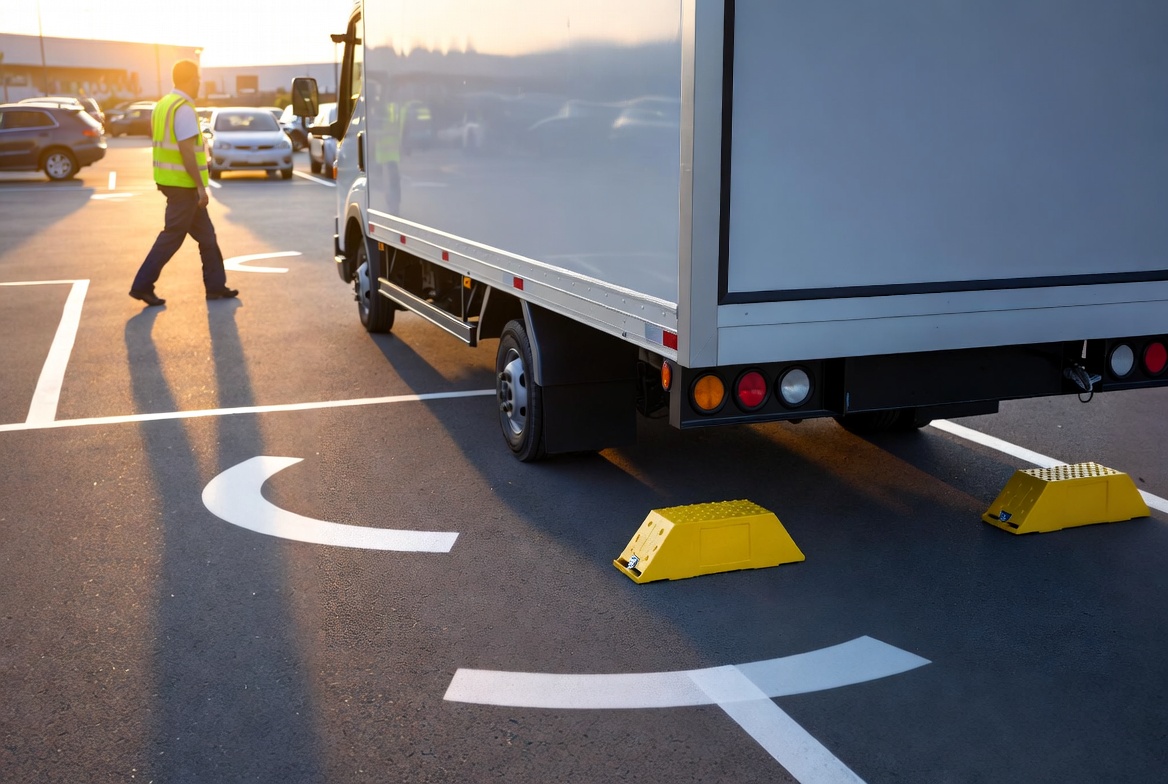
From an operational and safety perspective, consistent wheel chock use delivers several concrete benefits. [durablecorp]
- Prevents unintended vehicle movement during loading, unloading, maintenance, and parking. [durablecorp]
- Reduces risk of roll‑away incidents that can injure pedestrians or damage infrastructure. [ctsi]
- Helps sites align with OSHA and industry best practices, which commonly expect chocks when trucks are boarded by forklifts or parked on grades. [truckinginfo]
- Supports a safety culture: visible, standardized chock use signals that your organization takes risk control seriously. [ctsi]
- Improves asset protection, especially on sloped parking lots, ramps, and near high‑value equipment. [ctsi]
Choosing wheel chocks is not one‑size‑fits‑all. Professional safety teams use a simple framework: tire size, vehicle weight, slope, surface, and regulations. [jackwinsafety]
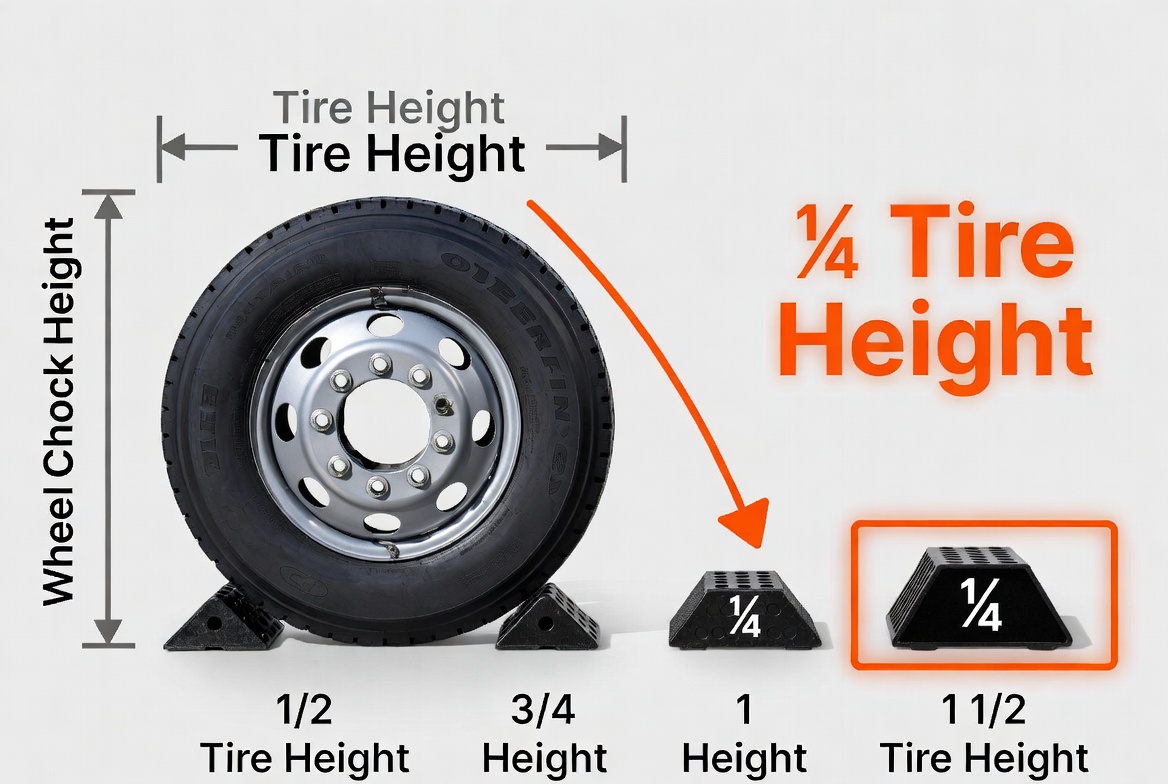
Industry guidance and multiple manufacturers recommend sizing wheel chocks as a proportion of tire height. [trafficsafetywarehouse]
- As a rule of thumb, choose a chock about one‑quarter of the tire height for most standard applications. [trafficsafetywarehouse]
- For light‑duty vehicles on flat or nearly level ground, smaller chocks—around one‑sixth of tire height—may be sufficient, if they meet the weight and usage requirements. [ctsi]
- Heavier vehicles and steeper grades require larger or multiple chocks to resist higher forces. [imperialsupplies]
Example:
If your truck tire is 40 cm high, a chock around 10 cm high (¼ of the tire) is a good starting point, assuming the vehicle weight and slope are within the product's rating. [trafficsafetywarehouse]
Different wheel chocks are designed and tested to handle specific weight ranges. [checkers.justrite]
- Check the gross vehicle weight (GVW) or GVOW of your truck, trailer, or equipment. [imperialsupplies]
- Select chocks with a load rating equal to or greater than that vehicle weight. [imperialsupplies]
- For multi‑axle or articulated vehicles, consider multiple chocks and confirm with the manufacturer's guidelines. [imperialsupplies]
Using under‑rated chocks can create a false sense of security. As an OEM/ODM manufacturer, we routinely work with clients to align chock design with their heaviest operating scenarios, not just average conditions. [checkers.justrite]
The material of a wheel chock determines its durability, grip, and suitability for specific environments. [jackwinsafety]
Common materials:
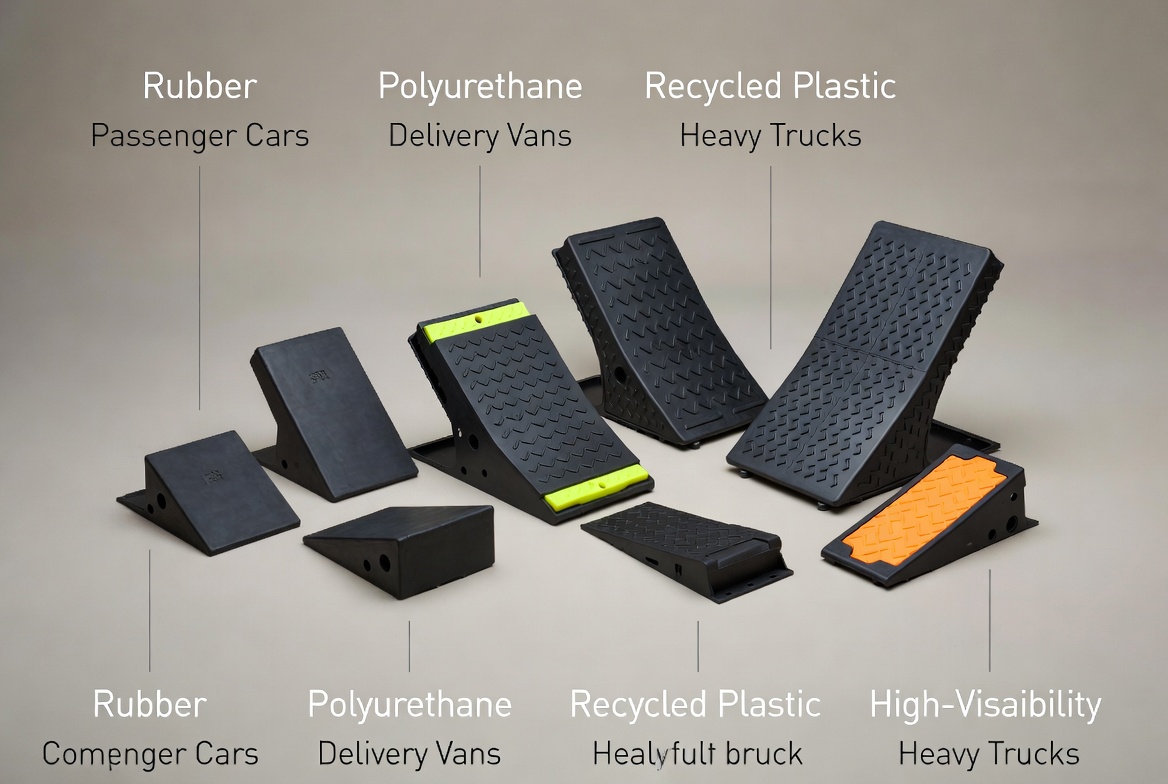
- High‑density rubber: Excellent traction, resistant to slips, ideal for concrete or asphalt parking lots and loading docks. [durablecorp]
- Polyurethane / plastic composites: Lightweight, corrosion‑resistant, often used in aviation and harsh chemical environments. [imperialsupplies]
- Steel or aluminum: Durable for heavy industrial or mining applications, but typically require additional surface treatments and may need non‑slip pads. [durablecorp]
In parking lots and commercial facilities, high‑density rubber wheel chocks with anti‑slip bases are often the most practical choice. [durablecorp]
Where and how you park matters as much as what you park. [jackwinsafety]
- Use chocks on a firm, level surface whenever possible, such as concrete or well‑compacted asphalt. [jackwinsafety]
- Avoid placing chocks on mud, loose gravel, snow, or uneven surfaces where they can shift, sink, or slide. [jackwinsafety]
- On steeper slopes, increase chock size and number, and verify that the chock's base and tread design are suitable for that grade. [ctsi]
If your site includes both indoor garages and outdoor loading areas, consider specifying different chock models for each environment and documenting their proper use in your safety procedures. [advanceglobal.com]
Regulatory agencies treat wheel chocks as part of a broader control system for parked vehicles. [osha]
- OSHA standards for powered industrial trucks state that brakes must be set and wheel chocks used under the rear wheels of highway trucks while they are boarded with forklifts. [truckinginfo]
- Additional OSHA guidance notes that wheel chocks or blocks should be in place when trailers are not coupled to a tractor during loading and unloading. [osha]
- Transport safety rules (such as FMCSA in the U.S.) set specific chocking requirements for certain trailers, including agricultural commodity trailers, pulpwood trailers, and heavy haulers. [uscargocontrol]
Even where enforcement is flexible, most safety professionals treat wheel chocks as a best‑practice control and include them in site rules and training. [uscargocontrol]
Correct selection is only half the equation. The way you use wheel chocks daily determines whether they actually prevent movement. [trafficsafetywarehouse]
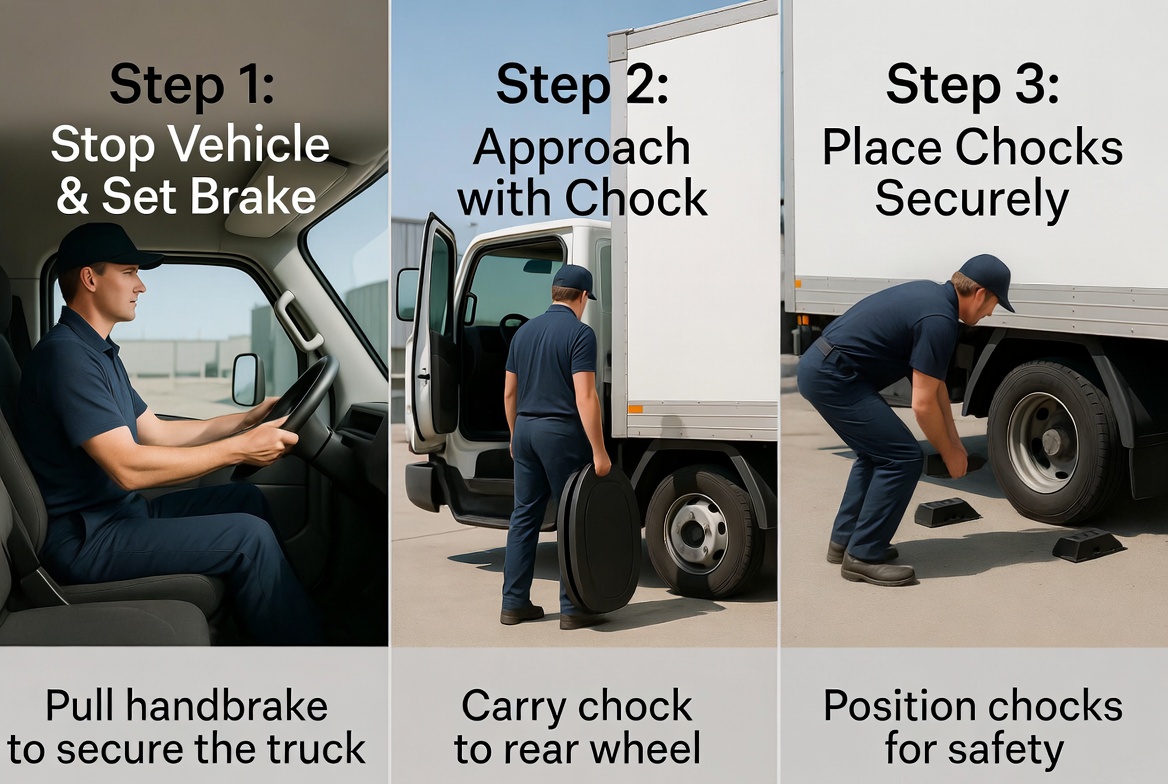
Most manufacturer and safety guidelines recommend the following sequence. [trafficsafetywarehouse]
1. Stop the vehicle and set the parking brake before exiting the cab. [trafficsafetywarehouse]
2. Determine the direction of potential movement (uphill, downhill, or on a slope). [trafficsafetywarehouse]
3. Place chocks squarely against the center of the tire tread, not at an angle. [advanceglobal.com]
4. Always use at least two wheel chocks: one in front and one behind the tire when feasible. [advanceglobal.com]
5. For heavy or multi‑axle vehicles, chock multiple axles as needed, particularly when employees work under or around the vehicle. [ctsi]
6. Confirm that chocks sit firmly on the ground and cannot slide or roll under moderate force. [jackwinsafety]
7. Never drive over wheel chocks; doing so can damage both the chock and tire and reduce future effectiveness. [ctsi]
In parking lots, we often recommend standardizing this into a short checklist posted at exits of loading docks and maintenance bays.
Even experienced drivers sometimes misuse wheel chocks in ways that reduce their protective value. [trafficsafetywarehouse]
- Using only one chock on a slope where vehicle movement could occur in either direction. [advanceglobal.com]
- Placing chocks on soft or uneven surfaces without additional stabilization. [jackwinsafety]
- Choosing a chock that is too small for the tire height and vehicle weight. [trafficsafetywarehouse]
- Leaving chocks in place and then driving over them, causing unseen internal damage. [ctsi]
- Treating chocks as optional, rather than embedding use in formal procedures and training. [ctsi]
To move from ad‑hoc use to a reliable safety control, many organizations create a formal wheel chock policy. [uscargocontrol]
A practical policy typically covers:
- When chocks are required
For example: all trucks at loading docks, any vehicle on a slope above a specified grade, vehicles being serviced, and trailers not coupled to a tractor. [osha]
- Who is responsible
Drivers, dock workers, and supervisors each have defined roles (e.g., driver sets brake and places chocks; dock worker verifies before loading). [ctsi]
- What equipment is approved
Approved chock models, sizes, materials, and minimum load ratings for each vehicle category on site. [checkers.justrite]
- Where chocks are stored
Designated storage locations on vehicles, near dock doors, or at parking lot zones to minimize "I couldn't find one" excuses. [ctsi]
- How compliance is monitored
Spot checks, inclusion in job hazard analyses, safety meetings, and inspection checklists, and periodic replacement of damaged chocks. [ctsi]
As a manufacturer, we often collaborate with safety managers to align chock models, colors, and labeling with these internal policies, making it easier for employees to comply.
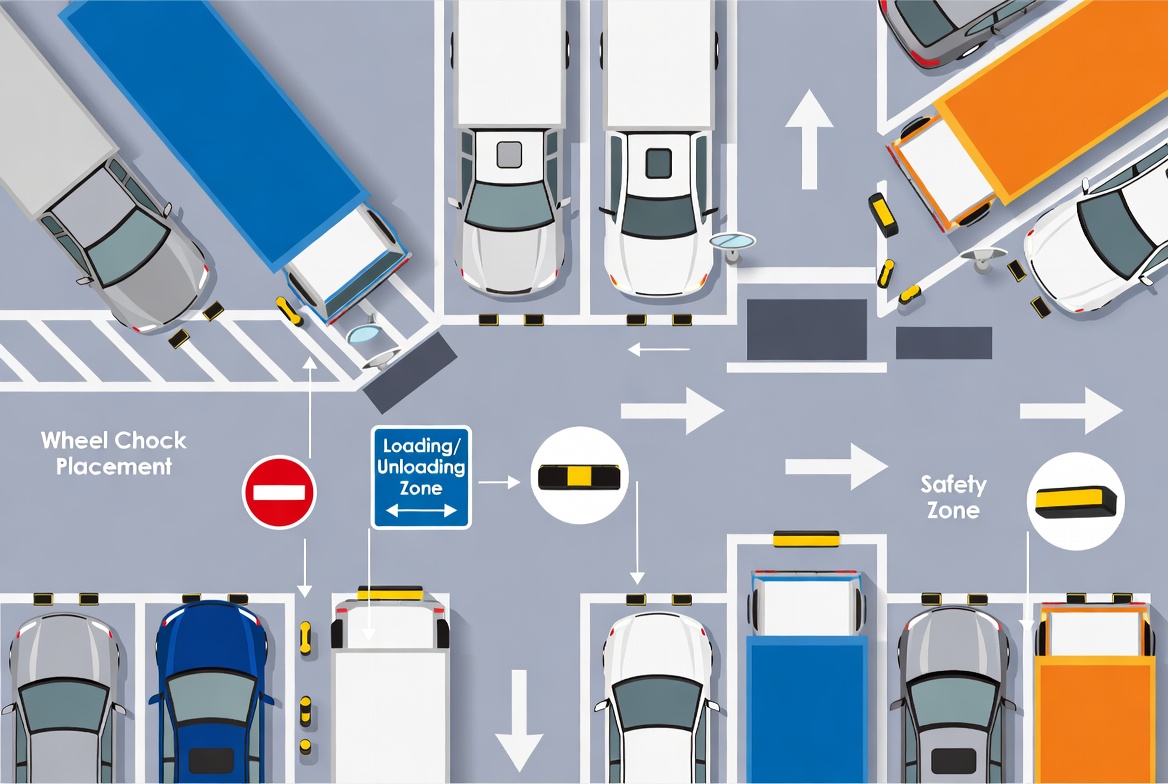
Parking lot risk has evolved with higher vehicle sizes (SUVs, delivery vans) and mixed‑use spaces where drivers share space with pedestrians, cyclists, and micro‑mobility devices. [nhtsa]
In 2026, best‑practice parking lot safety programs typically integrate wheel chocks with:
- Clear pavement markings and signage to guide vehicle positioning and highlight chock zones.
- Speed management using speed humps, rumble strips, and conspicuous signage.
- Lighting and visibility enhancements, including high‑visibility chocks in bright colors for low‑light environments. [ctsi]
- Driver and contractor induction, explaining where and when wheel chocks are mandatory.
- Routine inspections that include chock availability and condition, alongside fire extinguishers and first‑aid equipment. [nhtsa]
Wheel chocks are not a complete parking safety solution—but they are a low‑cost, high‑impact layer within a broader traffic management system. [nhtsa]
Use a simple internal matrix like the one below to guide teams when choosing wheel chocks for different vehicles and locations.
| Vehicle type | Typical tire height | Suggested chock height (min.) | Typical material | Notes on use |
|---|---|---|---|---|
| Passenger car / SUV | 60–75 cm | 10–15 cm (≈1/6–¼ tire) (trafficsafetywarehouse) | Rubber | Use 2 chocks on slopes; ensure firm surface. (ctsi) |
| Light truck / van | 70–90 cm | 15–20 cm (≈¼ tire) (trafficsafetywarehouse) | Rubber / PU | Chock when loading, unloading, or on grades. (ctsi) |
| Heavy truck / trailer | 90–110+ cm | 20–28 cm (≥¼ tire) (trafficsafetywarehouse) | Rubber / metal | Use pairs, chock multiple axles as needed. (ctsi) |
| Forklift / equipment | 40–60 cm | 8–12 cm (≈¼ tire) (ctsi) | Rubber | Use during maintenance or parking on ramps. (ctsi) |
This table should be customized with your specific fleet data, local slopes, and any regulatory requirements.
Even the best wheel chocks lose effectiveness if they are cracked, worn, or contaminated. [ctsi]
- Inspect chocks regularly for cracks, splits, deformation, or missing anti‑slip surfaces. [ctsi]
- Remove from service any chock that shows significant wear, damage, or loss of grip. [ctsi]
- Clean off oil, chemicals, or buildup that could reduce friction on the ground or tire contact surfaces. [jackwinsafety]
- Avoid exposing rubber chocks to unnecessary UV, heat, or chemical exposure that can accelerate aging. [durablecorp]
Modern safety programs often treat chocks like personal protective equipment—tracked, inspected, and replaced according to a documented schedule. [ctsi]
As a dedicated traffic safety manufacturer, our team works directly with parking lot owners, logistics operators, and facility managers to tailor wheel chock solutions to their environment.
Key ways we add value:
- Custom sizing and load ratings aligned with your actual vehicles and slopes.
- Material selection for specific climates (high UV, heavy rain, snow, or chemical exposure). [durablecorp]
- High‑visibility colors and branding to improve compliance and match corporate standards. [ctsi]
- Integration with broader parking lot safety solutions, such as wheel stops, speed bumps, guardrails, and signage.
Use this quick checklist with your purchasing or safety team:
1. List all vehicle types and weights on site (cars, vans, trucks, trailers, forklifts).
2. Measure or obtain tire heights for these vehicles.
3. Map parking and loading areas, including slopes and surface types.
4. Identify regulatory requirements that apply (OSHA, local codes, transport rules). [truckinginfo]
5. Select chock sizes and materials based on tire height, weight, and environment. [trafficsafetywarehouse]
6. Define standard operating procedures for when and how to use wheel chocks. [trafficsafetywarehouse]
7. Plan training and periodic inspections to ensure long‑term compliance. [ctsi]
If you are responsible for parking lot safety, fleet operations, or warehouse management, now is the time to formalize how your organization chooses and uses wheel chocks. Review your current practices, compare them with the best‑practice steps in this guide, and close any gaps you identify. [trafficsafetywarehouse]
As an OEM/ODM traffic safety manufacturer, we can help you:
- Evaluate your current sites and vehicle mix.
- Recommend wheel chock models, sizes, and materials.
- Integrate chocks into a complete parking lot safety solution, including wheel stops, speed bumps, and signage.
If you'd like tailored recommendations for your parking lots or loading areas, contact our team with your vehicle list and site conditions so we can propose a custom wheel chock package that fits your operations.
1. Do I really need wheel chocks if my truck has a strong parking brake?
Yes. Safety agencies and industry guidance treat wheel chocks as a complement to parking brakes, not a replacement. Brakes can fail or be misapplied, while properly sized wheel chocks provide a physical barrier against movement. [truckinginfo]
2. How many wheel chocks should I use per vehicle?
Most guidance recommends using at least two wheel chocks, placed in front of and behind the tire, especially on slopes or when loading and unloading. Larger or heavier vehicles may require additional chocks on multiple axles. [advanceglobal.com]
3. How do I know if my wheel chocks are the right size?
As a rule, chock height should be about one‑quarter of the tire height for most applications. If your chocks look small relative to the tire, or if the vehicle can move the tire onto the chock under moderate force, you likely need larger or additional chocks. [trafficsafetywarehouse]
4. Can I use the same wheel chocks for cars and heavy trucks?
Usually not. Wheel chocks are rated for specific load ranges, and using a car‑sized chock on a loaded semi‑trailer is unsafe. It's better to specify different chocks for light vehicles and heavy equipment and label or color‑code them clearly. [checkers.justrite]
5. How often should wheel chocks be replaced?
There is no universal time limit, but chocks should be replaced whenever they show cracking, deformation, loss of grip, or impact damage, or when they no longer remain stable under load. Many organizations tie replacement to an annual inspection schedule or after any incident or near‑miss involving vehicle movement. [ctsi]
1. Traffic Safety Warehouse – "How to Choose and Use Wheel Chocks" (original resource and guidelines). [trafficsafetywarehouse]
<https://www.trafficsafetywarehouse.com/Resources/how-to-choose-use-wheel-chocks.asp>
2. Traffic Safety Warehouse – "Wheel Chock Guidelines" PDF (size rules, use of two chocks, best practices). [trafficsafetywarehouse]
<https://www.trafficsafetywarehouse.com/pdfs/Wheel-Chock-Guidelines.pdf>
3. CTSI – "Wheel Chock Safety for County Vehicles" (technical update on sizing, placement, inspection). [ctsi]
<https://www.ctsi.org/technical-update-vol-30-no-9-wheel-chock-safety-for-county-vehicles/>
4. Imperial Supplies – "Why It's Essential to Use Wheel Chocks and How to Choose Them" (considerations: wheel size, GVOW, conditions). [imperialsupplies]
<https://www.imperialsupplies.com/shop-talk/how-to-choose-wheel-chocks>
5. OSHA interpretation letters and regulations for chocking trucks and trailers during loading/unloading. [osha]
OSHA 29 CFR 1910.178(k)(1) and related guidance
<http://www.osha.gov/laws-regs/standardinterpretations/2005-09-14>
6. US Cargo Control – "Wheel Chock Regulations – OSHA, FMCSA Requirements" (overview of regulatory expectations). [uscargocontrol]
<https://www.uscargocontrol.com/blogs/blog/wheel-chock-regulations-whats-required-and-whats-just-common-sense>
7. Advance Global – "How to choose the right wheel chocks for your site conditions" (positioning and site‑specific advice). [advanceglobal.com]
<https://www.advanceglobal.com.au/2025/09/how-to-choose-the-right-wheel-chocks-for-your-site-conditions/>
8. Durable Corp – "Wheel Chocks: What They Are and When to Use Them" (OSHA policies, practical application). [durablecorp]
<https://www.durablecorp.com/wheel-chocks-what-they-are-and-when-to-use-them>
9. NHTSA – "Data/Surveillance – Pedestrian Safety" (parking lot and driveway crash share). [nhtsa]
<https://www.nhtsa.gov/book/countermeasures-that-work/pedestrian-safety/data-surveillance>
10. Jackwin Safety – "What Are Wheel Chock? How to Use them With Your Vehicles" (surface conditions and sizing considerations). [jackwinsafety]
<https://jackwinsafety.com/what-are-wheel-chocks/>


