
Please Choose Your Language
Views: 284 Author: XS Traffic Facilities Publish Time: 2026-07-23 Origin: Site


Content Menu
● Common Warning Sign Examples
● Colors and Shapes of Warning Signs
● How to Read a Warning Sign Quickly
● Road Warning Signs vs Work Zone Warning Signs
● LED Traffic Signs in Modern Safety Applications
>> Work Zones
>> Industrial and Logistics Sites
>> Parking Lots
>> Schools and Pedestrian Areas
● What Buyers Should Check Before Ordering
● Why Custom Warning Signs Are Useful
● About Our Traffic Safety Solutions
● Summary
● FAQ
>> 1. What is the main purpose of a warning sign?
>> 2. What color are warning signs?
>> 3. What shape is most common for warning signs?
>> 4. Where are warning signs used?
>> 5. Are LED warning signs better than standard reflective signs?
Warning signs play a critical role in keeping drivers, workers, and pedestrians safe. They alert people to hazards ahead so they can slow down, stay alert, and make better decisions before reaching a dangerous point.
In road systems, warning signs are used for curves, merges, crosswalks, railroad crossings, lane drops, slippery surfaces, and many other situations. In industrial and commercial environments, they are equally important for marking restricted areas, vehicle movement zones, electrical hazards, and other safety concerns.
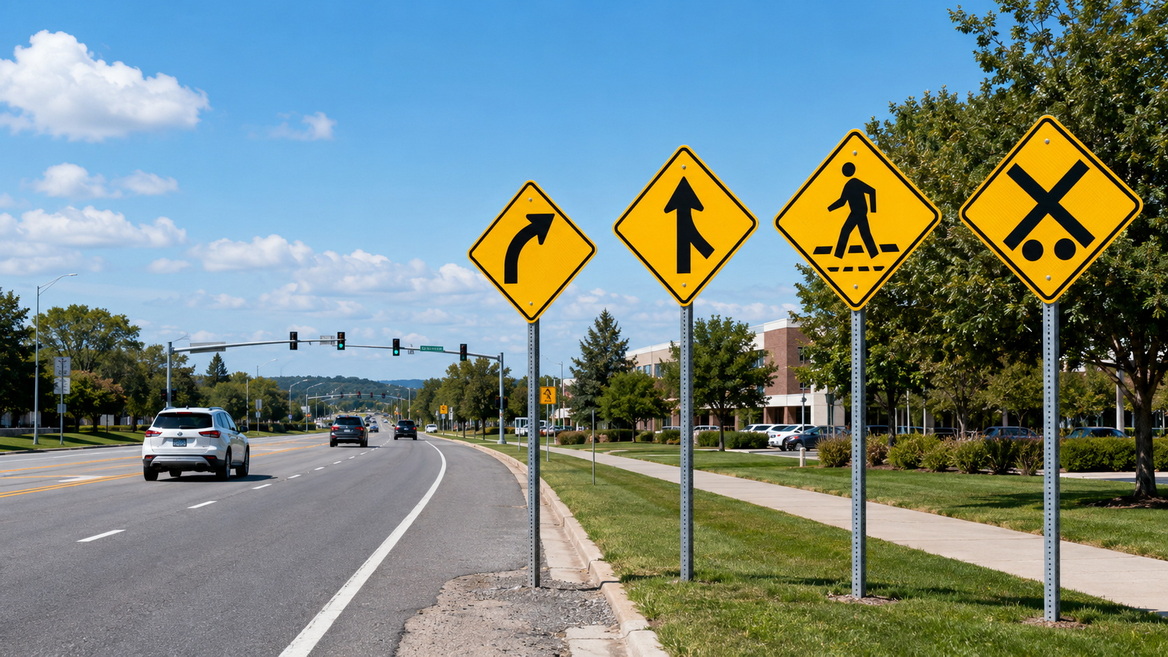
A warning sign is a sign that tells people about a hazard or risky condition ahead. Its purpose is to give advance notice, so the user has time to respond safely.
Unlike regulatory signs that tell people what they must do, warning signs focus on possible danger. They are designed to be noticed quickly and understood in just a few seconds.
Warning signs reduce accidents by improving awareness before people reach a hazard. When a driver sees a warning sign early enough, they can brake, change lanes, or prepare for a road condition ahead.
They are also important in non-road settings. In factories, warehouses, parking lots, and logistics areas, warning signs help organize movement and reduce conflict between vehicles, equipment, and pedestrians.
Here are some of the most common warning sign examples used in traffic and safety environments:
| Warning Sign Example | Meaning | Typical Location |
|---|---|---|
| Curve Ahead | The road bends left or right ahead | Highways, rural roads |
| Stop Ahead | A stop sign is coming soon | Intersections |
| Yield Ahead | A yield condition is approaching | Merge points |
| Road Narrows | The roadway becomes narrower | Bridges, ramps, work zones |
| Slippery When Wet | The surface may lose traction in wet conditions | Curves, bridges, shaded areas |
| Pedestrian Crossing Ahead | Pedestrians may enter the roadway | Schools, commercial streets |
| Railroad Crossing Ahead | Train tracks are ahead | Crossing approaches |
| Merge Ahead | Traffic will join from another lane | Expressways, interchanges |
| Low Clearance | Tall vehicles may not fit ahead | Underpasses, parking structures |
| Truck Crossing | Heavy vehicles may enter or cross | Industrial roads, logistics sites |
These signs help users recognize hazards early and react with less stress and less delay.
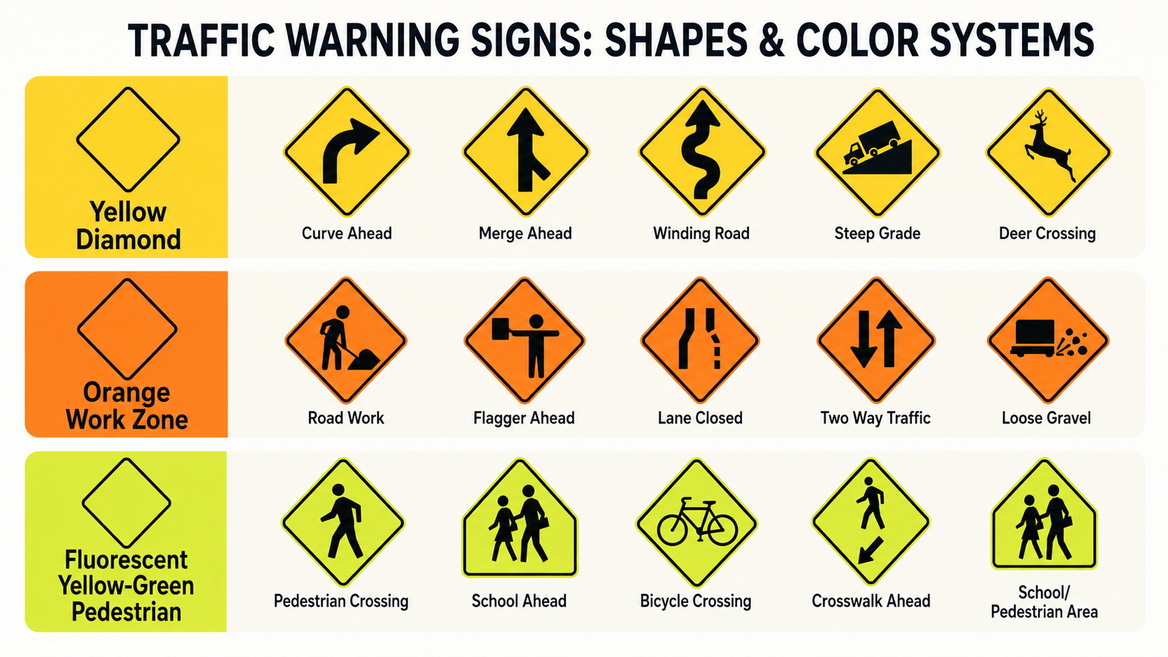
In the U. S. road system, warning signs are usually yellow with black symbols or text. Temporary traffic control warning signs usually use orange instead. Some pedestrian, bicycle, and school-related warnings may use fluorescent yellow-green for added visibility.
The most common warning sign shape is the diamond. This shape is widely recognized and helps drivers immediately identify the sign as a warning rather than a regulatory instruction.
The fastest way to read a warning sign is to look at four things:
1. Shape
The shape gives the first clue about the sign type.
2. Color
Color helps distinguish warning signs from work zone signs and regulatory signs.
3. Symbol or words
The icon or text tells you what hazard is ahead.
4. Distance information
Some signs include plaques that show how far ahead the hazard begins.
This simple reading pattern helps drivers react faster and improves safety in complex traffic environments.
Road warning signs and work zone warning signs serve different purposes. Road warning signs usually describe permanent or long-term conditions such as curves, intersections, and lane changes.
Work zone warning signs are temporary. They often alert drivers to construction, detours, lane closures, workers, and equipment in the roadway. These signs usually use orange backgrounds to show that the hazard is related to a temporary traffic control situation.
Good warning sign placement is just as important as good sign design. If a sign is placed too late, too low, or in a cluttered area, drivers may not have enough time to react.
A well-placed warning sign should be:
- Easy to see from a distance.
- Free from visual obstruction.
- Positioned before the hazard.
- Sized appropriately for the road or facility.
- Made with reflective or illuminated materials when visibility is limited.
In dark, foggy, or rainy conditions, retroreflective signs or illuminated signs become much more effective.
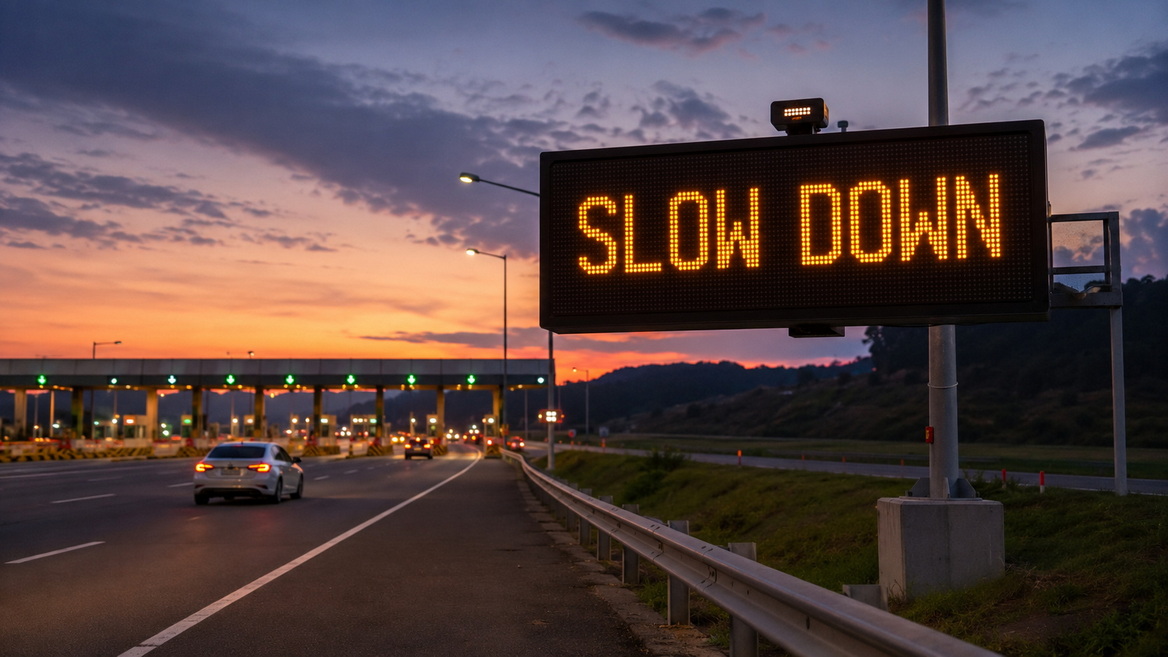
LED traffic signs are becoming more common because they improve visibility and allow flexible messaging. They are especially useful in parking facilities, toll plazas, highways, school zones, logistics yards, and controlled-access sites where conditions may change throughout the day.
Compared with conventional static signs, LED signs can provide:
- Better nighttime visibility.
- Stronger attention in poor weather.
- Dynamic messages for changing traffic conditions.
- Custom options for branded or project-specific needs.
For many customers, LED warning signs are a practical upgrade when standard reflective signs are not enough.
Warning signs are used in many different environments, not just on public roads.
Warning signs help drivers prepare for curves, merges, crossings, slopes, and lane changes.
They inform drivers about temporary hazards such as construction, detours, and lane closures.
They mark forklift traffic, restricted access, high-voltage areas, and equipment movement zones.
They help control vehicle flow, protect pedestrians, and reduce collision risk in low-speed environments.
They warn motorists to slow down and stay alert for children and pedestrians.
If you are selecting warning signs for a project, it is important to check the following:
- The intended environment: road, work zone, factory, or parking area.
- The sign type: permanent, temporary, reflective, or LED.
- The required size and mounting method.
- The visibility distance needed.
- The local standard or project specification.
- The weather resistance and service life of the material.
- The customization options needed for OEM or ODM production.
These points help ensure the final product is suitable for real-world use, not just appearance.
Custom warning signs are often needed when standard products do not fit the project. This may happen when the customer needs a different language, a special message, a unique mounting design, or a specific lighting solution.
For traffic safety projects, customization is especially useful in:
- Export projects.
- Industrial facilities.
- Toll stations.
- Parking systems.
- Municipal road projects.
- Private road and campus applications.
A flexible manufacturing partner can help match the product to the site conditions and user requirements.
Shenzhen Xingsheng Traffic Facilities Co., Ltd. focuses on traffic safety products, including LED traffic signs, warning signs, and custom solutions for streets, highways, toll stations, parking areas, and industrial sites. Our OEM and ODM services support customers who need tailored products for different project requirements.
Whether the need is for standard warning signs or specialized LED signage, the goal is the same: improve safety, improve visibility, and support smoother traffic control.
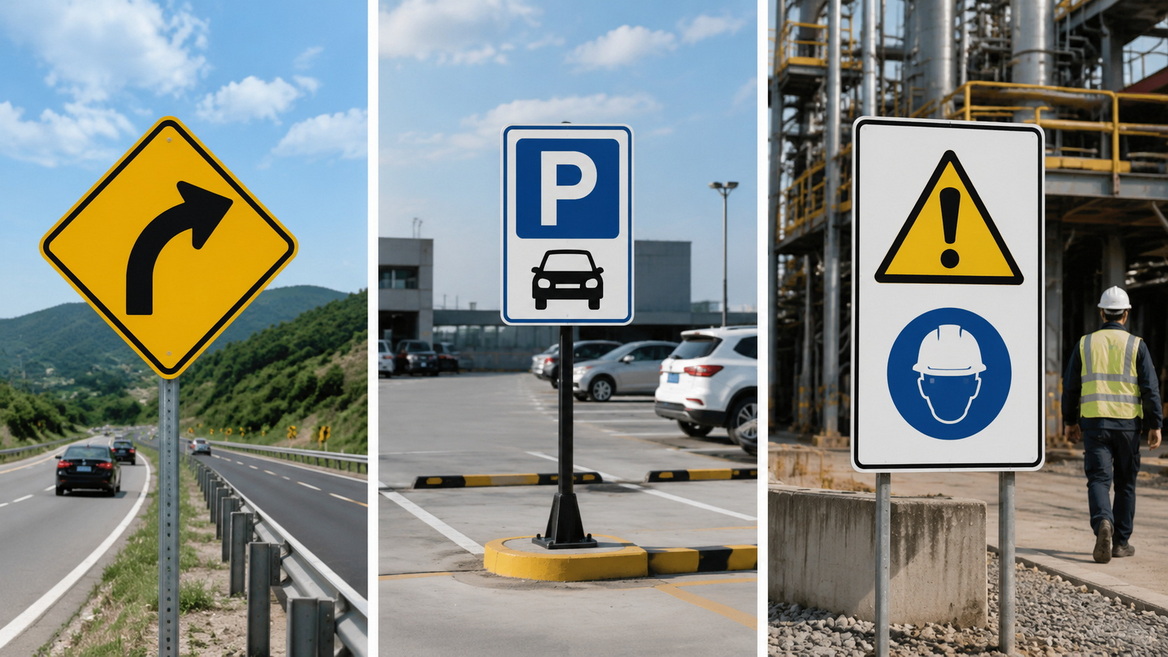
Warning signs are essential safety tools for roads, work zones, and many other environments. Their shape, color, placement, and visibility all affect how quickly people understand the hazard ahead.
LED traffic signs add another layer of value by improving visibility and enabling flexible messaging. For projects that require custom design, OEM/ODM support, or stronger nighttime performance, they are a practical and effective solution.
The main purpose is to alert people to a hazard ahead so they can respond safely and in time.
Most road warning signs are yellow with black symbols or text, while temporary work zone warning signs are usually orange.
The diamond shape is the most common warning sign shape in road traffic systems.
They are used on roads, in work zones, at industrial sites, in parking lots, and in pedestrian safety areas.
LED warning signs can be better when high visibility, dynamic messaging, or nighttime attention is needed, while reflective signs remain effective for many standard road uses.
- FHWA MUTCD Chapter 2C: Warning Signs and Object Markers
https://mutcd.fhwa.dot.gov/htm/2009/part2/part2c.htm
- FHWA MUTCD 11th Edition Chapter 2C PDF
https://mutcd.fhwa.dot.gov/pdfs/11th_Edition/Chapter2c.pdf
- FHWA Warning Signs PDF
https://mutcd.fhwa.dot.gov/SHSm/warning.pdf
- FHWA Figure 2A-2 Long Description
https://mutcd.fhwa.dot.gov/htm/2009/part2/fig2a_02_longdesc.htm
- Manual of Traffic Signs, Standard Sign Colors
https://www.trafficsign.us/signcolor.html
- Mordor Intelligence, LED Display Market Size, Drivers & Opportunities 2026
https://www.mordorintelligence.com/industry-reports/led-display-market
- JACKWIN Safety, 10 Warning Sign Examples and 5 Warning Colors To Know


