
Please Choose Your Language
Views: 229 Author: XS Traffic Facilities Publish Time: 2026-10-06 Origin: Site


Content Menu
● Understanding the Indonesian Market
>> Why Source Through Indonesian Suppliers?
>> How This Shortlist Was Selected
>> 1. Shenzhen Xingsheng Traffic Facilities Co., Ltd.
>>> Core Strengths and Customization Scope
>> 2. PT Safety Sign Indonesia
>>> Core Strengths and Customization Scope
>>> Core Strengths and Customization Scope
>> 4. CV Matrik
>>> Core Strengths and Customization Scope
>> 5. CV Megpro Aneka Sejahtera
>>> Core Strengths and Customization Scope
>>> Core Strengths and Customization Scope
>> Capacity, MOQ, and Certification
>> Define the Complete LED Stop Sign
>> Separate Compliance Requirements
>> Check Waterproofing at Assembly Level
>> Evaluate Solar Autonomy Properly
>> Plan Battery Logistics Early
>> Insider Pitfall: Uncontrolled Substitutions
>> Compare Total Operating Cost
>> Conclusion
>> 1. How Can I Check Whether an ISO Certificate Has Expired?
>> 2. Does CE or RoHS Documentation Establish Indonesian Compliance?
>> 3. How Should I Assess a Seven-Day Solar Autonomy Claim?
>> 4. How Can I Distinguish a Manufacturer From an Integrator?
>> 5. How Can I Prevent Cheaper Materials in Repeat Orders?
Finding a reliable LED stop sign supplier in Indonesia requires more than comparing prices, delivery promises, or product photographs. Professional buyers need to understand who manufactures the equipment, who controls its quality, and who will support it after installation.
Indonesia provides local sourcing options for traffic signs, road equipment, installation, and maintenance. For projects requiring customized electronics, private-label products, or solar-powered systems, buyers may also consider an overseas manufacturer working alongside an Indonesian installation or distribution partner.
This guide examines six supplier candidates, beginning with Shenzhen Xingsheng Traffic Facilities Co., Ltd., a China-based OEM/ODM manufacturer. The remaining companies operate in Indonesia's signage, road-equipment, or safety-product supply sectors.
The shortlist is not an independently audited ranking. Where public information does not establish production capacity, minimum order quantity, certification, or complete LED stop sign manufacturing capability, those limitations are stated clearly.
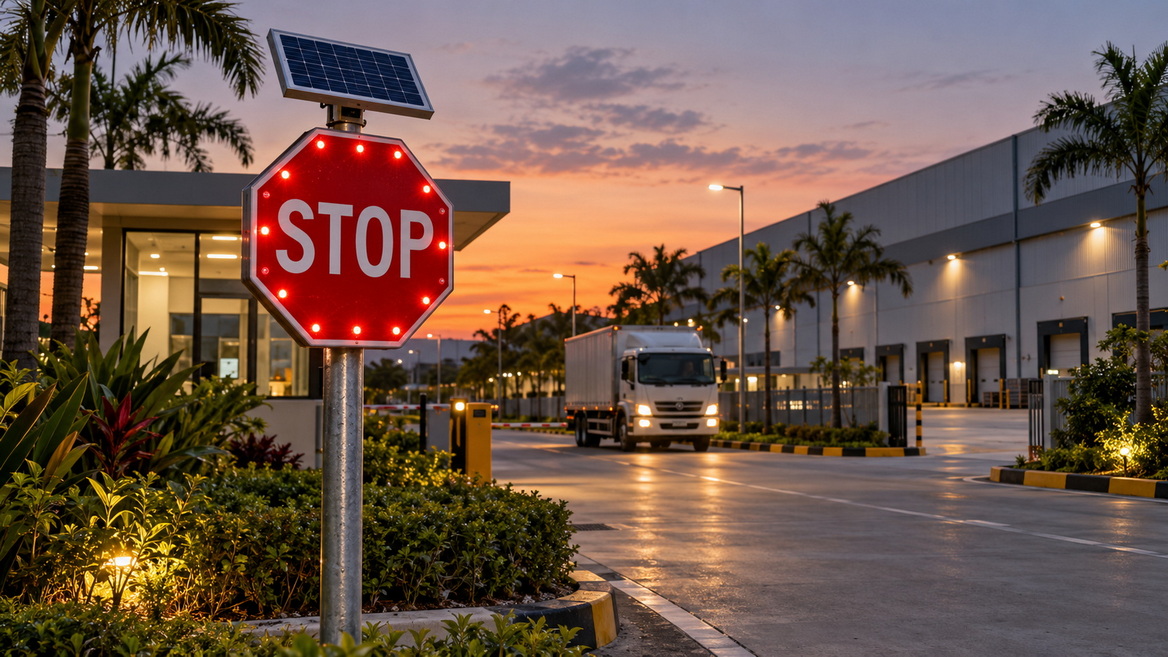
Local suppliers can be valuable when a project requires site visits, installation coordination, supporting structures, or accessible after-sales service.
For streets, industrial access roads, parking facilities, and toll-related projects, the sign itself is only part of the purchasing requirement. Buyers may also need poles, brackets, foundations, electrical connections, commissioning, and maintenance arrangements.
An Indonesian partner can help coordinate those activities. However, buyers should distinguish between three different business models:
- Manufacturers that fabricate signs or produce electronic assemblies.
- Integrators that combine sourced components into a finished system.
- Distributors that sell products manufactured by other companies.
Each model can serve a legitimate purchasing need. The important issue is whether responsibilities are transparent.
A distributor with dependable stock and technical support may suit a small replacement order. A manufacturer with documented engineering and production controls may be more appropriate for a customized, repeat-order program.
Indonesia's broader manufacturing and electronics sectors provide useful context for traffic-equipment procurement.
The International Labour Organization's March 2025 study on Indonesia's electronics manufacturing sector identifies electronics as one of the five priority sectors under the Making Indonesia 4.0 roadmap.
In May 2026, ANTARA reported figures attributed to Indonesia's Industry Ministry indicating that manufacturing grew by 5.30% in 2025, compared with national economic growth of 5.11%.
These figures describe the wider industrial economy. They do not establish the size, growth rate, or export performance of Indonesia's LED stop sign market.
No independently verified 2025 or 2026 Indonesia-specific LED stop sign market-size figure was established for this guide. Buyers should be cautious about articles that apply general lighting-market statistics to specialized traffic safety products.
The companies discussed here illustrate a sourcing network that includes Bandung, Cirebon, and Jakarta.
Their published activities cover safety signage, road equipment, traffic-management products, and distribution. This network can support procurement and project delivery, but it should not be described as a proven, specialized LED stop sign manufacturing cluster.
For procurement managers, the practical advantage is access to complementary services. An overseas electronics manufacturer and an Indonesian installation partner may together provide a more complete solution than either company alone.
That arrangement works only when design responsibility, installation scope, documentation, and warranty obligations are agreed in writing.
The companies were screened for published product relevance and identifiable traffic safety or signage activities.
The selection framework emphasizes five factors:
| Supplier | Identified focus | Published capacity | LED stop sign MOQ | Certification position |
|---|---|---|---|---|
| Shenzhen Xingsheng | Export-oriented LED traffic and safety products | Not verified | Request by configuration | Request current, model-specific documentation |
| PT Safety Sign Indonesia | Customized reflective and safety signage | Not verified | Complete LED scope unverified | Regulatory reference is not product certification |
| CV Trisula Solusindo | Traffic signs and road equipment | Not verified | Complete LED scope unverified | Verify relevant entity and product documents |
| CV Matrik | Road equipment and technology supply | Not verified | Request project quotation | Verify documentation for each supplied model |
| CV Megpro Aneka Sejahtera | Conventional traffic-sign fabrication | Not verified | Complete LED scope unverified | Confirm materials and applicable evidence |
| Karunia Safety | Safety-product distribution | Manufacturing capacity not established | Ask about stock and upstream requirements | Obtain original manufacturer documents |
Public descriptions were used to identify candidates, not to certify their factories.
Before approving any supplier, buyers should also examine payment terms, contract enforceability, sample performance, and the supplier's ability to maintain a consistent specification across repeat orders.
Established: 2014, according to its published company profile.
Location: Shenzhen, Guangdong, China.
Market focus: Export-oriented traffic safety products; a verified country-by-country sales breakdown was not available.
Shenzhen Xingsheng Traffic Facilities Co., Ltd., also presented as XS Traffic Facilities, publishes a product portfolio that includes LED traffic signs, warning lights, solar road markers, reflective products, traffic lights, and parking safety equipment.
Its profile describes an export-oriented business specializing in traffic safety product research and production.
Although it is not an Indonesian manufacturer, Xingsheng is relevant to Indonesian importers, distributors, and project contractors seeking a direct overseas production partner.
Its potential fit is a value-focused sourcing arrangement that combines customized equipment with local installation and service support. Smaller private-label brands may find this model useful when they need product differentiation without establishing their own manufacturing operation.
The company presents itself as an OEM manufacturer, while its supplied business information identifies both OEM and ODM services.
Buyers should explore customization at two levels:
- Branding and artwork changes to an existing product platform.
- Engineering changes to dimensions, mounting, operating modes, or power systems.
A detailed inquiry can cover reflective sheeting, LED operation, solar panel and battery options, brackets, packaging, labeling, and spare parts.
The depth of support should be evaluated through actual deliverables. Ask for an annotated drawing, a configuration-specific quotation, and written responses to unresolved technical questions.
Communication efficiency and flexibility should be measured during the sample process rather than accepted as promotional claims.
The reviewed contact information establishes a Shenzhen address and contact channels. It does not independently substantiate monthly output, MOQ, or current certification for a specific LED stop sign.
Request those details for the exact configuration.
For Indonesian projects, also confirm whether Xingsheng supplies equipment only or can coordinate documentation and technical support with the buyer's local project partner.
Established: Exact incorporation year was not verified. Its August 2025 traffic-sign article states more than 15 years of experience.
Location: Bandung, West Java.
Market focus: Indonesian safety-sign and traffic-sign applications.
PT Safety Sign Indonesia publishes services covering customized traffic-sign text, designs, languages, and dimensions.
Its materials discuss reflective surfaces, aluminum plates, and pole arrangements, including single-pole and gantry structures. The company also references Indonesia's Ministry of Transportation Regulation PM 13 of 2014.
Its demonstrated relevance lies in local sign design and fabrication services.
Buyers sourcing traffic signs alongside workplace or industrial safety signage may find that combined scope useful. Published customization supports artwork and sign-format adaptation.
However, the reviewed evidence did not establish original LED stop sign electronics development.
Ask whether the company supplies a complete powered sign, integrates third-party electronics, or provides only the reflective panel and supporting structure.
If electronics come from another manufacturer, request the original product documentation and a clear statement of warranty responsibility.
The buyer should know who handles failures involving the LED assembly, controller, battery, and installation.
Established: 2004, according to its published website description.
Location: Indonesia; confirm registered and manufacturing addresses during qualification.
Market focus: Traffic signs and road-equipment projects.
CV Trisula Solusindo operates through the Produsen Rambu website. Its public description identifies it as part of DAIVA Group and states that the business dates to 2004.
Its associated catalog includes warning, directional, and prohibition signs.
The company is a relevant candidate for conventional traffic-sign fabrication and supporting road-equipment procurement.
Buyers can investigate project-specific dimensions, artwork, panel construction, mounting arrangements, and delivery scope.
The reviewed public information did not establish a proprietary LED stop sign platform or original solar-controller development.
Treat the company as a potential local signage partner until complete powered-sign capability is demonstrated.
Request a construction drawing showing the substrate, frame, fasteners, electronics enclosure, and maintenance access.
For an LED stop sign proposal, require a complete bill of supply rather than a general catalog description.
Established: Not verified from the reviewed company page.
Location: Cirebon, West Java.
Market focus: Indonesian road equipment and technology applications.
CV Matrik describes products and services involving traffic lights, road markings, traffic signs, variable-message signs or videotrons, CCTV, and IP cameras.
This portfolio makes it worth investigating when an LED stop sign forms part of a larger traffic-management or site-safety project.
Its potential purchasing value lies in coordinating multiple road-equipment and technology requirements.
Project adaptation and system integration should be discussed directly. Published information does not establish original LED stop sign manufacturing or standard private-label production terms.
Ask which products are manufactured internally and which are sourced.
Clarify responsibility for electrical interfaces, commissioning, maintenance, and coordination with other contractors.
For a combined project, require a responsibility matrix identifying who supplies, installs, tests, and warrants each item.
Established: 2009, according to an Indonesian supplier-directory listing.
Location: Indonesia; verify the registered and operating addresses.
Market focus: Conventional traffic-sign fabrication for domestic applications.
An Indonetwork listing describes CV Megpro Aneka Sejahtera as a traffic-sign producer using aluminum composite panel, commonly abbreviated as ACP.
Because this information comes from a supplier directory, buyers should confirm the current legal entity and manufacturing activities directly.
The company's identified relevance is conventional sign fabrication.
Ask about custom artwork, panel dimensions, structural supports, edge treatment, and mounting hardware. Original LED stop sign electronics and complete solar-powered assemblies were not verified.
Pay particular attention to material construction.
ACP and solid aluminum sheet are not interchangeable descriptions. A supplier should not substitute one for the other without written approval against the project specification.
For ACP, request total panel thickness, aluminum skin thickness, core material, and the proposed support structure. For solid sheet, specify alloy, thickness, finish, and tolerances.
Established: Not verified from the reviewed website.
Location: West Jakarta.
Market focus: Indonesian safety-product distribution.
Karunia Safety identifies itself as a distributor and supplier of safety equipment. Its catalog includes LED solar road studs.
That listing establishes an adjacent solar road-safety product offering. It does not prove complete LED stop sign manufacturing.
Karunia Safety may be relevant for consolidated safety-product purchasing or locally supplied related equipment.
No original LED stop sign design or manufacturing capability was verified. Buyers should ask whether custom requirements are handled internally or through an upstream manufacturer.
Request the original manufacturer's identity, product documentation, warranty terms, and replacement process.
A local sales channel can be useful, but local invoicing does not automatically mean local technical repair capability.
Confirm stock availability separately from factory production lead time.
The following table avoids unsupported figures. "Not verified" means the reviewed information did not establish the detail; it does not mean the supplier lacks the capability.
| Supplier | Identified focus | Published capacity | LED stop sign MOQ | Certification position |
|---|---|---|---|---|
| Shenzhen Xingsheng | Export-oriented LED traffic and safety products | Not verified | Request by configuration | Request current, model-specific documentation |
| PT Safety Sign Indonesia | Customized reflective and safety signage | Not verified | Complete LED scope unverified | Regulatory reference is not product certification |
| CV Trisula Solusindo | Traffic signs and road equipment | Not verified | Complete LED scope unverified | Verify relevant entity and product documents |
| CV Matrik | Road equipment and technology supply | Not verified | Request project quotation | Verify documentation for each supplied model |
| CV Megpro Aneka Sejahtera | Conventional traffic-sign fabrication | Not verified | Complete LED scope unverified | Confirm materials and applicable evidence |
| Karunia Safety | Safety-product distribution | Manufacturing capacity not established | Ask about stock and upstream requirements | Obtain original manufacturer documents |
When comparing capacity, ask about available output for your configuration during the required production window.
A general factory output claim does not establish the availability of approved batteries, controllers, reflective film, or final inspection resources.
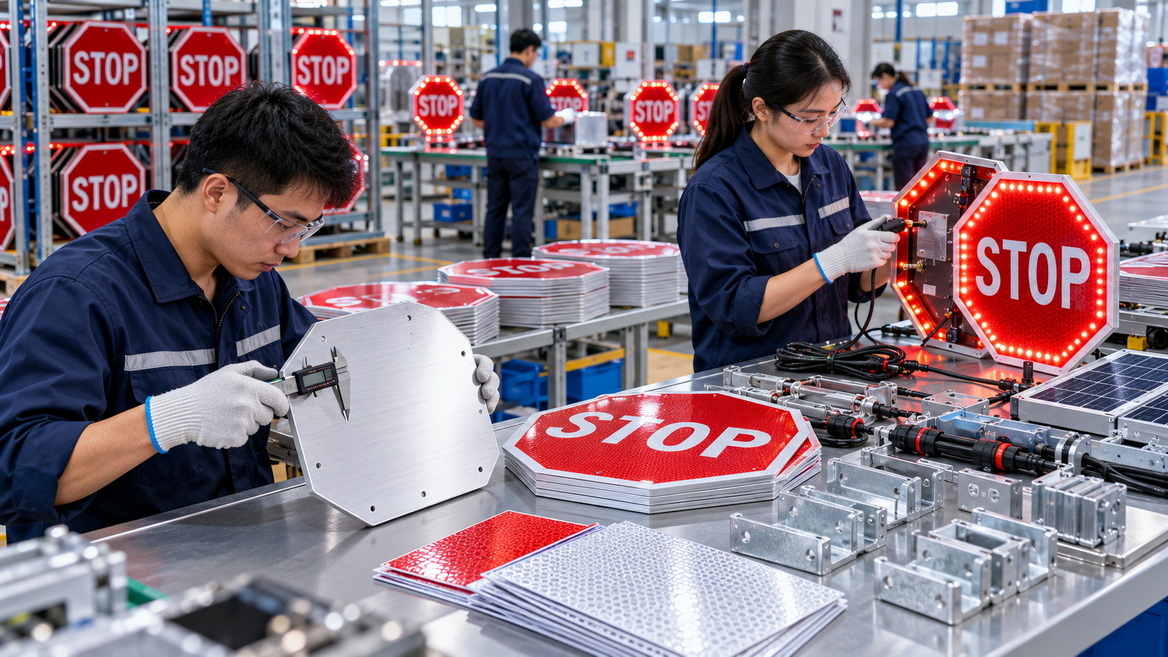
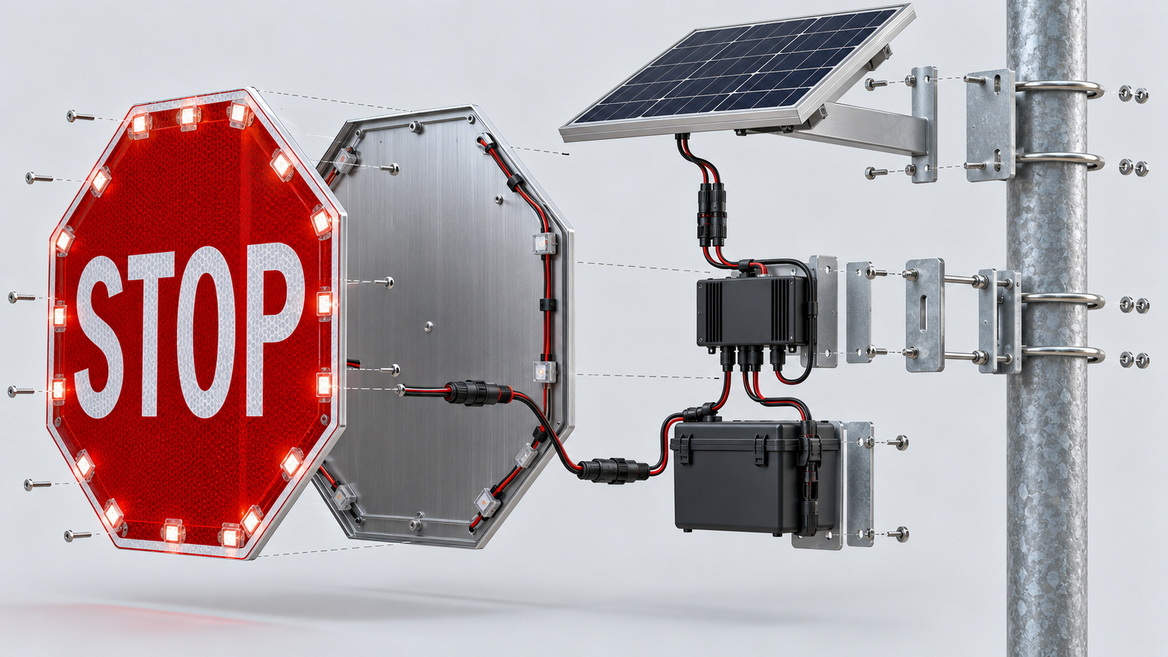
An LED stop sign is an assembled system. Its performance depends on more than the number of LEDs fitted around the sign face.
The purchasing specification should identify:
- Sign dimensions, artwork, and intended application.
- Substrate material, thickness, and finish.
- Reflective sheeting requirements.
- LED arrangement and operating mode.
- Controller settings and power consumption.
- Battery and solar panel specifications, where applicable.
- Enclosure construction and mounting hardware.
- Inspection, maintenance, and spare-part requirements.
Avoid relying on phrases such as "premium aluminum" or "high-intensity reflective material" without measurable specifications.
The finished sign should also remain recognizable when the LEDs are off. Powered illumination should not compensate for an unsuitable reflective face.
Indonesia's Ministry of Transportation Regulation PM 13 of 2014 addresses traffic signs, including design and installation provisions.
Buyers should review the regulation alongside the project specification and obtain confirmation from the responsible authority before approving an LED-enhanced layout.
Do not assume that a foreign sign design or flashing mode will be accepted simply because it is sold internationally.
CE marking concerns conformity with applicable European requirements. It is not Indonesian road-authority approval.
RoHS addresses restrictions on hazardous substances in electrical and electronic equipment. It does not establish outdoor durability, visibility, or battery runtime.
Similarly, an ISO 9001 certificate concerns a management system. It should not be presented as proof that a particular sign model meets all project performance requirements.
IEC 60529 defines ingress-protection classifications and associated testing.
A supplier's IP claim should be supported by evidence identifying the enclosure or assembly tested. Review whether the report covers production-equivalent seals, connectors, cable glands, and mounting conditions.
A waterproof LED module does not establish that the controller box or battery compartment is waterproof.
Also address corrosion, heat exposure, cable strain, and service access separately. Those issues should not disappear behind a general "weatherproof" claim.
Battery capacity alone cannot establish operating duration.
Runtime depends on usable battery energy, LED consumption, controller demand, flashing duty cycle, dimming settings, and operating conditions.
For example, two similar-looking signs may have different autonomy because one reduces brightness at night while the other maintains a higher output.
Require the supplier to explain whether its claim applies to continuous operation, dusk-to-dawn use, or a reduced-duty mode.
For projects requiring extended operation without charging, agree on a no-charge acceptance test using the approved production settings.
Use a staged process rather than moving directly from a photograph to a large order.
1. Issue a requirement sheet covering the site, application, dimensions, operating mode, and power expectations.
2. Approve the drawings and proposed bill of materials.
3. Test a sample for visibility, operation, mounting, and maintenance access.
4. Record the approved component identities and controller settings.
5. Place a pilot order to evaluate batch consistency.
6. Release repeat orders against the controlled specification.
Separate production lead time from shipping, customs clearance, and installation.
The quotation should explain when the production period begins: after payment, artwork approval, sample approval, or confirmation of the final configuration.
For lithium-powered products, request the relevant UN 38.3 documentation before booking freight.
Provide the forwarder with the actual battery type and shipment configuration. Installed batteries and separately packed batteries may require different handling arrangements.
Have the forwarder confirm packaging, labeling, documentation, and carrier acceptance.
The commercial agreement should also identify the Incoterm, named place, import-clearance responsibility, local transport, unloading, and installation scope.
An important sourcing risk is approving a high-quality sample without freezing the production specification.
Later batches may contain different reflective film, batteries, controllers, or LED modules described as "equivalent." Those changes can be difficult to identify from photographs.
This is a risk-control issue, not an allegation against any company in this guide.
Protect the order through traceability:
- Attach the approved bill of materials to the purchase agreement.
- Require written approval before substitutions.
- Record battery and reflective-material identification.
- Retain an approved reference sample.
- Inspect randomly selected production units.
- Recheck operating settings and runtime during batch inspection.
Another practical check is to inspect the sign with its LEDs switched off. Flashing lights can distract evaluators from weak reflective performance or poor panel construction.
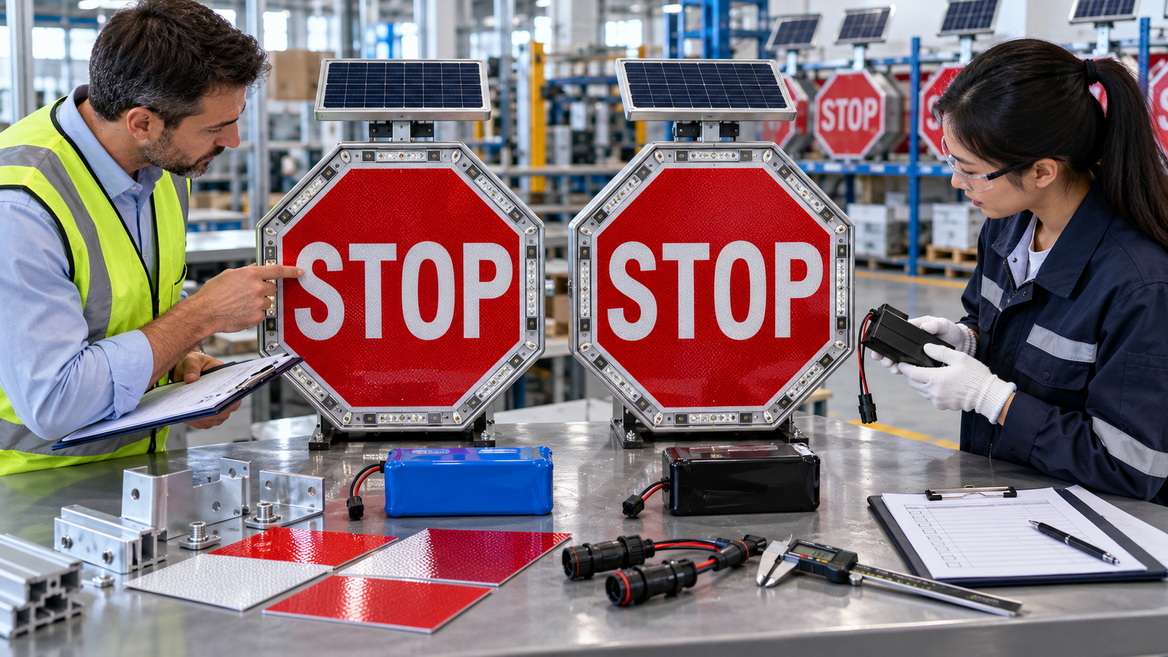
The lowest quoted unit price may exclude mounting hardware, poles, spare batteries, inspection, documentation, or replacement shipping.
Compare complete scope rather than headline price.
Include landed cost, installation, maintenance access, replacement parts, and warranty handling. Obtain prices and availability commitments for major replaceable components before ordering.
A dependable supplier arrangement is one that can maintain the approved specification and support the equipment—not simply one that offers the shortest quotation.
Indonesia offers useful local partners for signage, project coordination, and safety-product distribution. However, buyers should verify complete LED stop sign capability rather than assuming that conventional sign fabrication establishes electronics expertise.
For customized products, an overseas manufacturer such as Shenzhen Xingsheng Traffic Facilities Co., Ltd. may be considered alongside an Indonesian installation or service partner.
Before committing to a long-term agreement, approve the design, verify the documentation, test production-representative samples, and define responsibility for installation and warranty support.
Send Shenzhen Xingsheng your sign layout, installation environment, order quantity, power requirements, and delivery destination. Request a configuration-specific quotation, technical drawings, sample plan, and documentation list to compare its proposal fairly with local supply options.
Check the exact legal entity, certificate number, certified site, scope, standard, and current status.
IAF CertSearch supports certificate verification using company or certificate details. Review whether the record is active, suspended, withdrawn, or expired.
If the information cannot be resolved, contact the issuing certification body directly.
Do not rely only on a downloaded certificate. Confirm that its scope and location cover the activity relevant to your purchase.
No. These documents address different requirements.
CE relates to applicable European conformity obligations, while RoHS concerns restricted substances in electrical and electronic equipment.
Neither automatically establishes acceptance under Indonesian traffic-sign requirements or a specific project approval process.
Request separate evidence for sign design, electrical construction, materials, and local acceptance. Ensure the documents identify the supplied configuration.
Ask the supplier to define the starting charge, brightness, operating schedule, flashing duty cycle, dimming settings, temperature, and battery condition.
Then agree on an acceptance test using the settings intended for the project.
Distinguish new-battery runtime from any commitment about performance after extended service.
An autonomy statement without test conditions is not a sound basis for comparing suppliers.
Ask which processes occur at the supplier's facility and which are outsourced.
Request a live walkthrough covering fabrication, wiring, assembly, inspection, and packing. Review representative production records and component traceability.
An integrator can still be a suitable partner. The essential requirement is transparent responsibility for engineering, quality control, documentation, installation, and warranty service.
Avoid rejecting a supplier solely because it sources components. Focus on whether it controls the finished system effectively.
Freeze the approved drawings, bill of materials, operating settings, and inspection requirements.
Require written approval for substitutions and define which changes trigger retesting.
Match inspection records to production batches and reserve the right to inspect finished units independently.
Specify remedies for unauthorized substitutions in the contract. "Same quality" is less enforceable than a documented specification with identifiable components.
Company websites provide self-published information and should not be treated as independent factory audits. Directory information requires direct verification before supplier approval.
- [Shenzhen Xingsheng Traffic Facilities Co., Ltd. — Company Profile]: Published establishment year, export orientation, and traffic safety product portfolio. [trafficthing]
- [XS Traffic Facilities — Official Website]: Published OEM positioning and product categories. [trafficthing]
- [Shenzhen Xingsheng — Contact Information]: Shenzhen location and contact channels. [trafficthing]
- [PT Safety Sign Indonesia — Traffic Sign Overview]: Published customization, materials, pole options, and experience statement. [safetysign.co]
- [PT Safety Sign Indonesia — Official Website]: Service portfolio and Bandung location. [safetysign.co]
- [Produsen Rambu — CV Trisula Solusindo]: Published business history and road-sign positioning. [produsenrambu]
- [CV Matrik — Official Website]: Road-equipment and technology portfolio, with Cirebon contact information. [cvmatrik]
- [Indonetwork — Traffic Sign Supplier Directory]: Directory information concerning CV Megpro Aneka Sejahtera. [indonetwork.co]
- [Karunia Safety — Official Website]: Published distributor positioning and Jakarta location. [karuniasafety]
- [Karunia Safety — LED Solar Road Stud]: Adjacent solar road-safety product listing. [karuniasafety]
- [Indonesia Ministry of Transportation — Legal Database]: Official listing of PM 13 of 2014 on traffic signs. [jdih.dephub.go]
- [International Labour Organization — Indonesia Electronics Manufacturing Study]: March 2025 sector study and industrial-policy context. [ilo]
- [ANTARA — Indonesia Manufacturing Sector Report]: May 2026 reporting of manufacturing figures attributed to the Industry Ministry. [en.antaranews]
- [IAF CertSearch — Certificate Verification]: Accredited management-system certification verification. [iafcertsearch]
- [European Commission — CE Marking]: Conformity assessment and manufacturer responsibilities. [single-market-economy.ec.europa]
- [European Commission — RoHS Directive]: Restrictions on hazardous substances in electrical and electronic equipment. [environment.ec.europa]
- [International Electrotechnical Commission — IP Ratings]: Ingress-protection classifications and IEC 60529 testing context. [iec]
- [TÜV SÜD — UN 38.3 Lithium Battery Transportation Testing]: Lithium battery transport-testing guidance. [tuvsud]


