
Please Choose Your Language
Views: 222 Author: XS Traffic Facilities Publish Time: 2026-04-16 Origin: Site


LED traffic warning lights are one of the simplest but most powerful ways to reduce night‑time and low‑visibility accidents on streets, highways, toll stations and parking lots. Drawing on my experience working with traffic engineers, safety managers and overseas buyers, this guide explains how to select and deploy LED barricade and warning lights that actually perform in the field. [pdmautomotive]
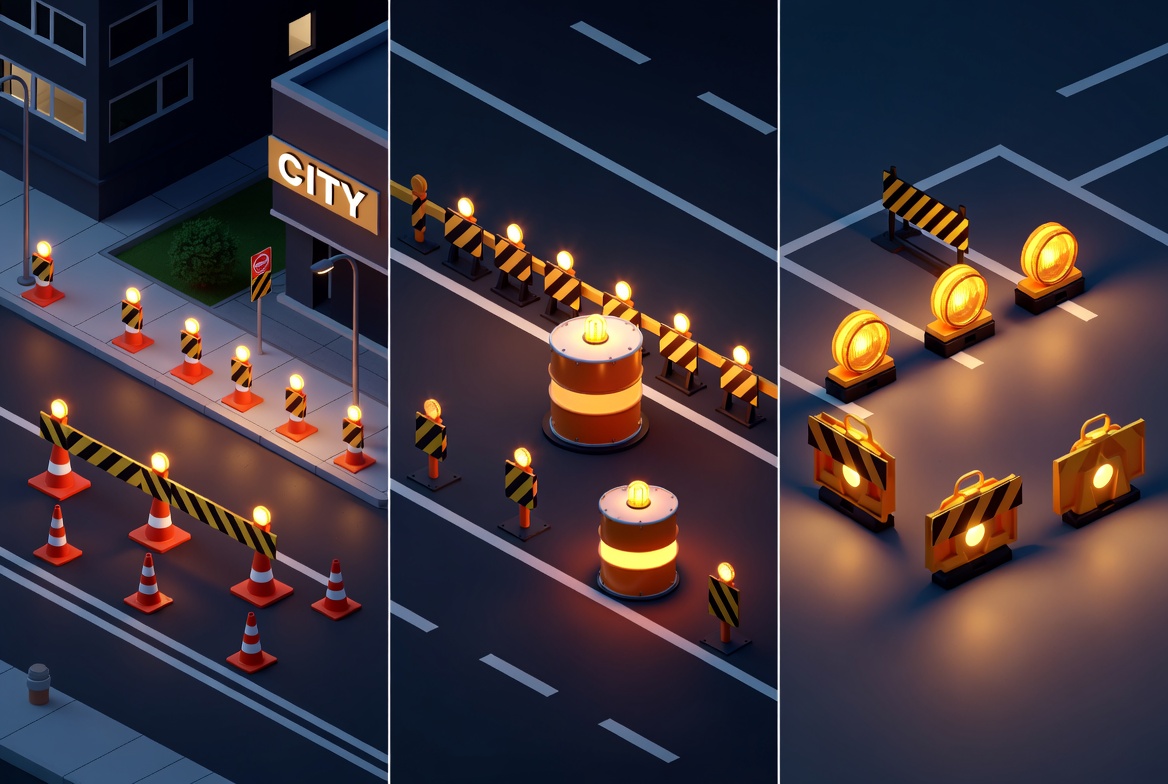
LED barricade and traffic warning lights are high‑visibility signal lights mounted on cones, drums, barriers, barricades and parking lot devices to alert drivers and pedestrians to hazards, lane changes or restricted areas. [pdmautomotive]
These lights are widely used on road construction zones, highway maintenance sites, toll booths, airport perimeters and commercial parking structures. When correctly specified, they significantly improve night‑time visibility and extend the effective life and usefulness of your safety devices. [jarvislighting]
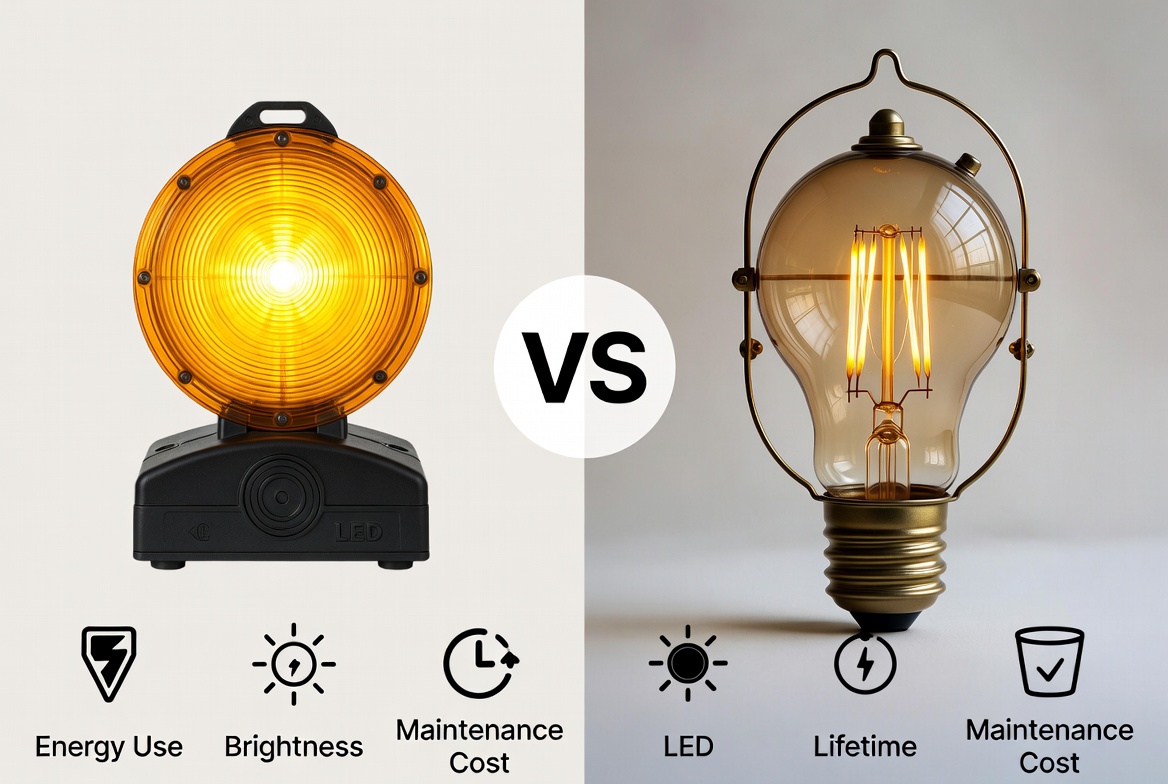
From an engineering and lifecycle‑cost perspective, LED has almost entirely replaced incandescent barricade lights in professional applications. [jarvislighting]
Key technical advantages of LED vs incandescent:
- Far lower power consumption for the same light output, which means much longer run‑time per battery set. [pdmautomotive]
- Ability to deliver higher intensity without overheating, improving visibility in rain, fog and through dirty lenses. [pdmautomotive]
- Longer component life, reducing lamp replacement and maintenance truck rolls. [jarvislighting]
- Less waste and lower environmental impact over the product life, an increasing requirement in public tenders. [publisherdesk]
In real projects, I have seen LED barricade lights run reliably for entire multi‑month highway resurfacing seasons where incandescent units required constant bulb and battery changes. This is why most DOT‑grade specifications now either explicitly call for LED or de‑facto expect it. [toprankmarketing]
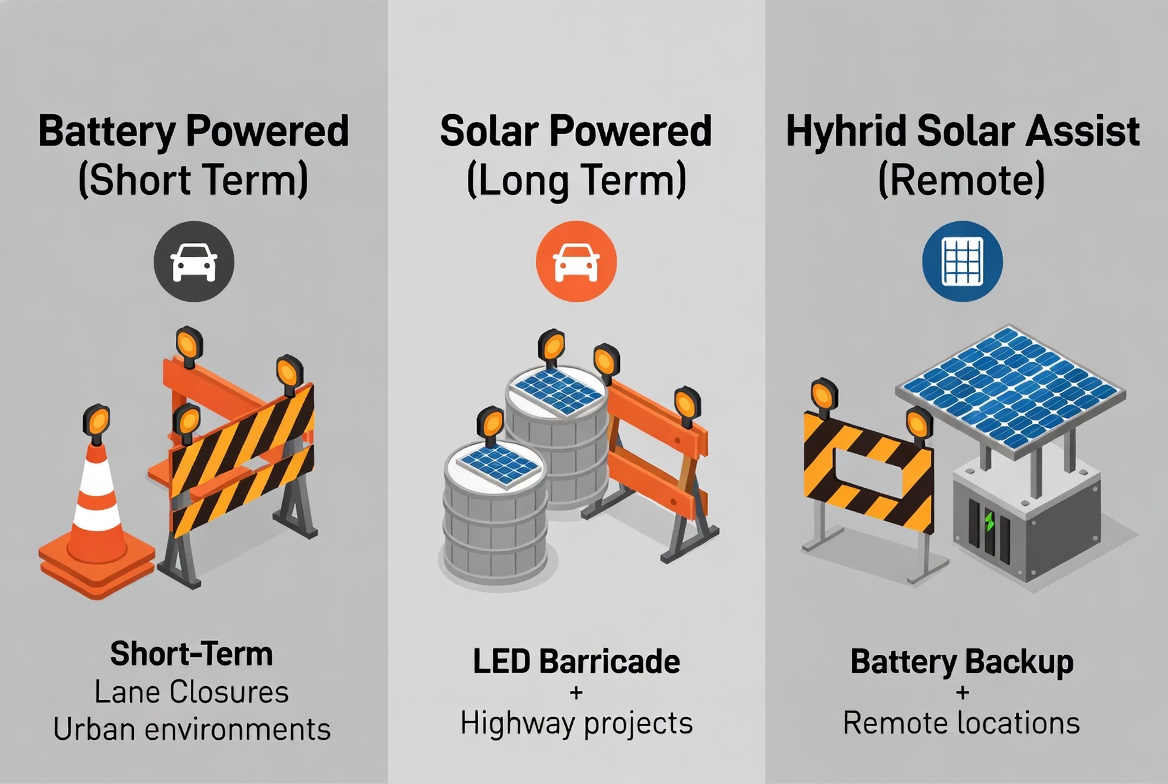
Choosing the right power system is a critical part of your barricade light specification. [pdmautomotive]
Many LED warning lights use lantern or cell batteries, including NiMH, alkaline, lithium‑ion or other rechargeable chemistries. [pdmautomotive]
They are suitable when:
- Your projects are short‑term or seasonal.
- You have established maintenance rounds for battery replacement.
- Storage conditions are controlled to avoid battery leakage or deep discharge.
For export buyers, we typically recommend lithium‑based or high‑quality alkaline packs for colder climates and NiMH rechargeables for warm, high‑utilization environments, where regular charging is easy to schedule. [jarvislighting]
Solar barricade lights integrate panels that either fully recharge the battery or provide solar‑assist trickle charging to extend battery life. [pdmautomotive]
They are ideal for:
- Long‑term work zones and permanent parking‑lot or toll‑plaza installations.
- Remote or hard‑to‑reach locations where frequent battery changes are costly.
- Sustainability‑focused projects seeking to reduce lifetime energy use.
Although the initial unit price is higher, actual total cost of ownership often drops over multi‑year deployments due to reduced battery purchases and labor. [publisherdesk]
Selecting the correct color and intensity is not just a cosmetic decision; it is about safety, compliance and driver behavior. [pdmautomotive]
Typical practices include:
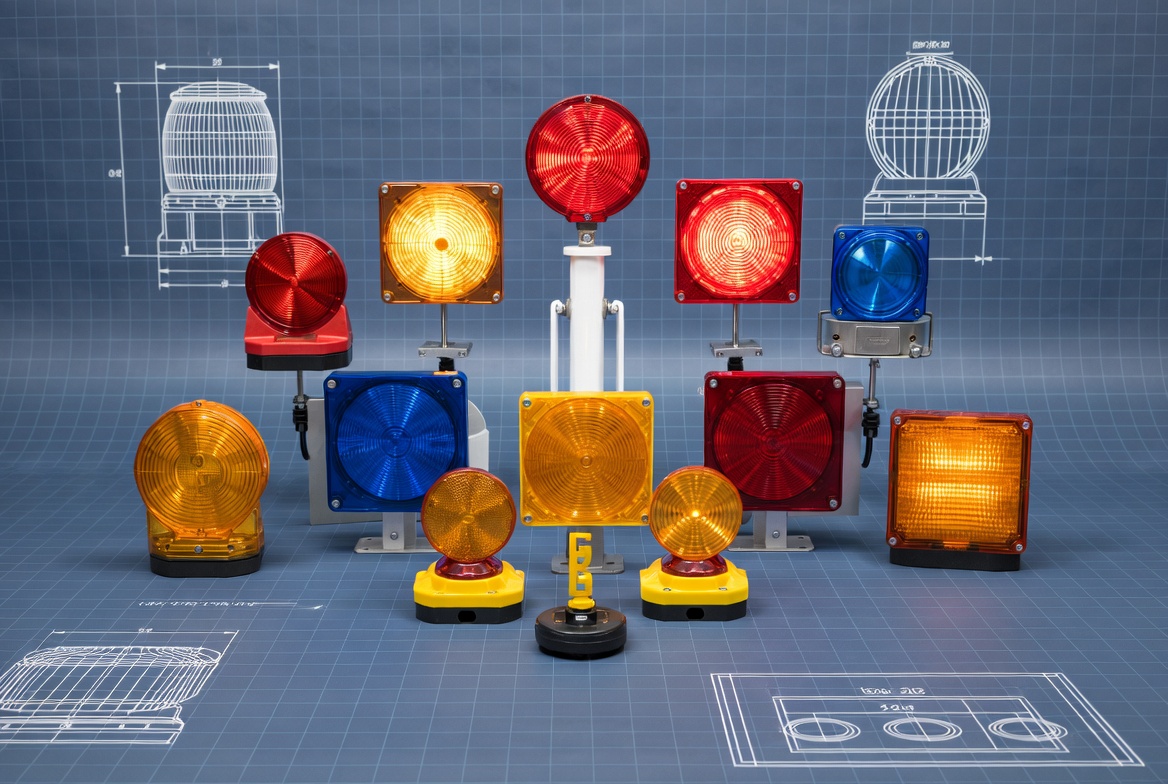
- Amber: Standard for traffic devices such as cones, drums, barricades and parking lot delineators. [pdmautomotive]
- Red / Blue: Higher‑intensity lights often used in airports, near railroads or in restricted zones where a stronger "do not enter" signal is required. [pdmautomotive]
- Custom colors (white, green, etc.): Used in specialized industrial sites or wayfinding projects, usually in combination with clear signage. [jarvislighting]
High‑intensity modes are particularly useful for high‑speed highways and complex urban interchanges, while lower‑intensity steady‑burn modes can be better for close‑range parking structures where glare is a concern. [jarvislighting]
Every state or country maintains its own traffic code and minimum standards for lighting on safety devices. [servicetrade]
As an overseas manufacturer working closely with importers, we typically see requirements addressing:
- Whether certain devices (e.g., Type II barricades, drums) must be equipped with lights.
- Minimum luminous intensity and visibility distance.
- Flash patterns (e.g., single flash vs steady burn).
- Mounting height and orientation relative to traffic flow.
If your local code does not explicitly require barricade lights, risk‑based reasoning still applies. In poorly lit, complex or high‑speed areas, adding compliant LED lights often becomes the difference between a near‑miss and a serious accident. [servicetrade]
From a buyer's perspective, barricade lights can be grouped into several practical types. [jarvislighting]
- Steady‑burn lights provide continuous illumination, enhancing object recognition (shape of the barricade or drum).
- Flashing lights draw attention to a specific hazard or decision point, such as lane merges or closed ramps.
Many modern units combine both functions, allowing mode selection per project. Professionals often use flashing lights on advance warning devices and steady‑burn on channelizing devices inside the work zone. [jarvislighting]
- Directional lights focus light in a forward beam toward oncoming traffic.
- 360‑degree lights distribute light around the full circle, suitable for islands, toll plazas and parking structures where vehicles approach from multiple directions. [jarvislighting]
Selecting between these depends on traffic approach patterns and whether the device sits in a lane, shoulder or central island.
Based on field feedback from contractors and facility managers, LED warning lights bring disproportionate value in these scenarios: [jarvislighting]
- Night‑time highway construction and bridge repairs.
- Temporary detours around utilities or emergency excavations.
- Parking structures with tight turning radii and poor line‑of‑sight.
- Toll stations and barrier gates with mixed car‑truck traffic.
- Industrial plants with forklifts and heavy equipment operating near pedestrians.
In parking lots specifically, pairing LED warning lights with speed bumps, wheel stops and bollards gives drivers a much clearer visual structure, reducing wrong‑way entries and low‑speed collisions.
Over the years, I have found that the most successful purchasers follow a simple but rigorous selection process. [servicetrade]
1. Define your primary risk scenario
- High‑speed highway vs low‑speed parking lot.
- Short‑term nighttime work vs 24/7 long‑term site.
2. Map local regulatory requirements
- Identify any mandatory light usage and performance standards.
- Confirm acceptable colors and flash patterns.
3. Choose the optical and power configuration
- LED (mandatory in most cases), battery‑only vs solar or solar‑assist.
- Steady‑burn, flashing or dual‑mode; directional vs 360‑degree.
4. Evaluate lifecycle cost, not just unit price
- Battery replacement frequency and labor cost.
- Expected LED service life and environmental factors.
5. Confirm compatibility with your existing devices
- Mounting options for drums, cones, barricades, barriers and parking fixtures.
- Weather‑proofing and impact resistance ratings.
This structured approach aligns with what search engines and safety auditors both care about: clear decision logic supported by professional reasoning. [toprankmarketing]
As a Chinese manufacturer focused on LED traffic warning lights and parking lot safety facilities, Shenzhen Xingsheng Traffic Facilities Co., Ltd. works with OEM and ODM customers who often have very specific project needs. [szslr]
Typical customization requests include:
- Tailored optics to meet a particular country's intensity profile.
- Integrated mounting brackets for proprietary barriers or toll‑gate arms.
- Custom flash patterns synchronized with existing ITS systems.
- Housing colors and branding to match municipal or corporate identity.
For global B2B buyers, partnering directly with an OEM/ODM supplier allows you to align product design with local regulations and brand positioning, while controlling total project cost.
To illustrate how these principles come together, consider a multi‑level commercial parking garage with frequent minor collisions and complaints about poor lighting.
A practical upgrade plan might include:
1. Installing LED barricade or warning lights at all entry/exit ramps, speed bumps and tight turns, using amber steady‑burn units to define lane paths.
2. Adding higher‑intensity, possibly flashing, LED units at pedestrian crossings and payment kiosks to slow drivers and draw attention.
3. Choosing solar‑assist models for the roof level where sun exposure is highest, and battery‑powered units on lower levels where access is easy.
4. Integrating reflective signage and pavement markings to work together with the lighting system.
In projects like this, facility managers typically report better driver compliance and fewer incidents within the first operational quarter.
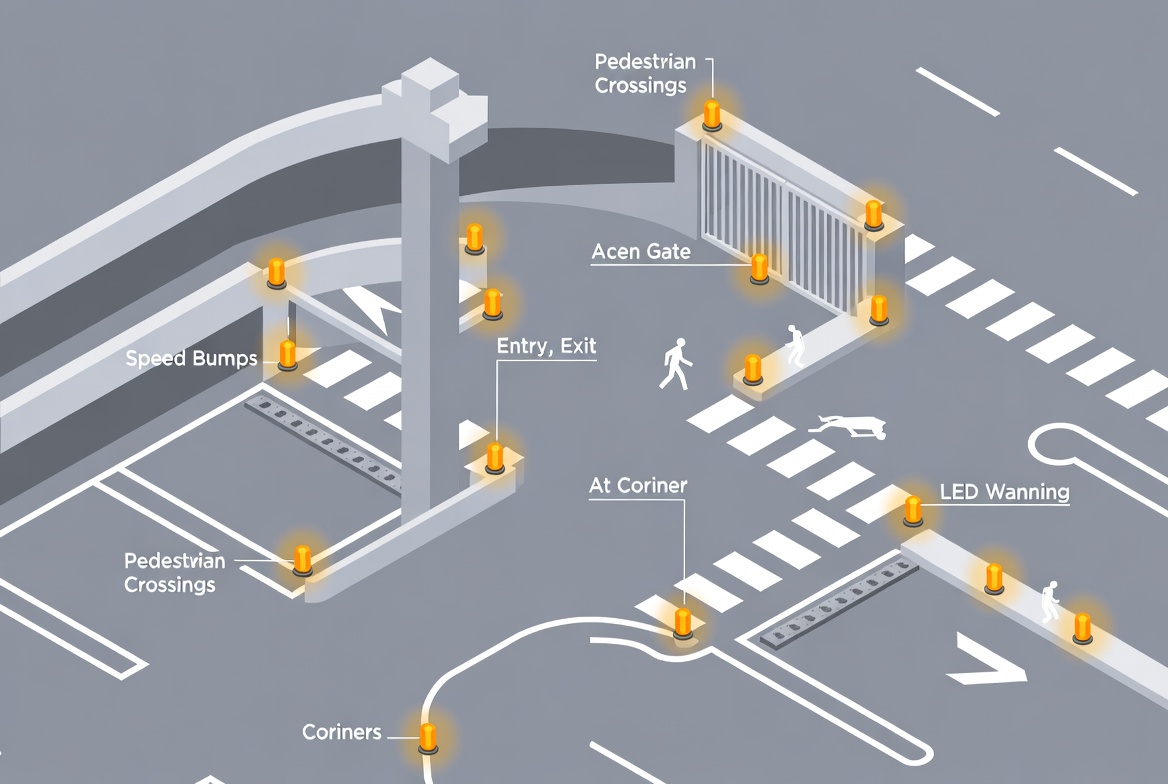
Even the best light fails if poorly installed or neglected.
Recommended practices from the field include:
- Ensure correct mounting height and orientation facing oncoming traffic, with no obstruction from sign panels or guardrails. [jarvislighting]
- Use anti‑theft hardware or tamper‑resistant screws in high‑theft areas.
- Implement regular inspection rounds, especially after storms or major traffic events, to check alignment, lens cleanliness and functioning.
- Standardize batteries, tools and checklists across your fleet to simplify logistics.
For OEM buyers, designing maintenance friendliness (quick‑release housings, standardized screws, easy battery access) into your spec at the start pays off for years.
| Decision area | Main options | When to choose |
|---|---|---|
| Light source | LED vs legacy incandescent (pdmautomotive) | LED for almost all modern projects due to efficiency and lifetime (pdmautomotive) |
| Power | Battery, solar, solar‑assist (pdmautomotive) | Battery for short term, solar/assist for long‑term or remote sites (pdmautomotive) |
| Mode | Steady‑burn, flashing, dual | Steady for channelizing, flashing for warning and attention points (jarvislighting) |
| Optics | Directional vs 360‑degree (jarvislighting) | Directional for one‑way approaches, 360‑degree for islands and plazas |
| Color | Amber, red/blue, others (pdmautomotive) | Amber for general traffic, red/blue for restricted or special zones (pdmautomotive) |
If you are planning a new street, highway, toll station or parking lot project, now is the right time to define a clear, LED‑first barricade lighting strategy.
Work with a specialist manufacturer like Shenzhen Xingsheng Traffic Facilities Co., Ltd. to:
- Review your local standards and project drawings.
- Choose the optimal mix of LED, power systems, colors and mounting solutions.
- Customize OEM/ODM designs where needed for brand and regulatory alignment.
Taking this step early in the design process prevents costly rework and ensures that your traffic safety devices deliver the visibility and protection your road users deserve.
Q1. Do I really need LED barricade lights if my state does not require them?
Even where not mandated, LED barricade lights significantly increase visibility and reduce risk in low‑light, high‑speed or complex environments, making them a best practice rather than an optional luxury. [servicetrade]
Q2. How long do LED barricade lights typically last?
LED modules can last tens of thousands of hours, and with efficient power management many work zones use the same light bodies for multiple seasons, changing only batteries as needed. [pdmautomotive]
Q3. Are solar barricade lights worth the higher upfront cost?
For long‑term or remote installations, solar or solar‑assist lights often deliver lower total cost over time by reducing battery purchases and maintenance visits. [pdmautomotive]
Q4. Which color should I choose for a parking garage project?
Amber is usually sufficient and compliant for delineating lanes, hazards and pedestrian areas in parking structures, while red is reserved for stop or no‑entry conditions based on local codes. [pdmautomotive]
Q5. What information should I prepare before requesting OEM/ODM customization?
Provide detailed application descriptions, local standards, desired color/flash modes, power preference (battery or solar), expected climate and any special mounting or branding requirements. This allows engineers to design a solution that fits your project without over‑specifying or under‑performing.
1. Traffic Safety Warehouse – "Barricade Light Types and Requirements"
https://www.trafficsafetywarehouse.com/Resources/barricade-lights.asp
2. The Publisher Desk – "10 Essential E‑E‑A‑T Best Practices to Boost Your Website's Credibility"
https://www.publisherdesk.com/google-e-e-a-t-best-practices/
3. Jarvis Lighting – "Commercial LED Lighting: The Complete Technical Guide"
https://www.jarvislighting.com/blogs/jarvis-lighting-insights/commercial-led-lighting-guide
4. PageOptimizer Pro – "Effective Strategies for E‑E‑A‑T Implementation on Websites"
https://www.pageoptimizer.pro/blog/effective-strategies-for-e-e-a-t-implementation-on-websites
5. TopRank Marketing – "E‑E‑A‑T and SEO: Optimizing for Google's Guidelines"
6. ServiceTrade – "5 SEO Strategies Every Fire Protection Service Provider Should Know"
https://servicetrade.com/resources/guides/fire-protection-seo/
7. NAV43 – "SEO Content Marketing for Ecommerce: Driving Discovery, Traffic, Trust"
https://nav43.com/blog/seo-content-marketing-for-ecommerce-driving-discovery-traffic-trust/


