
Please Choose Your Language
Views: 274 Author: XS Traffic Facilities Publish Time: 2026-10-05 Origin: Site


Content Menu
● Why Traffic Sign Maintenance Is Important
● What Makes a Traffic Sign Effective?
● The Difference Between Cleaning and Restoring Visibility
● Create a Traffic Sign Inspection Schedule
● Step-by-Step Traffic Sign Maintenance Checklist
>> Inspect the Sign Face for Damage
>> Remove Vegetation and Sightline Obstructions
>> Inspect Posts, Brackets, and Fasteners
>> Check Sign Position and Orientation
● Nighttime Visibility and Retroreflectivity
>> Nighttime Visual Inspection
>> Measured Retroreflectivity Testing
● When to Repair or Replace a Traffic Sign
● Where LED Traffic Signs Can Improve Visibility
● A 30-Day Traffic Sign Maintenance Plan
>> Week 1: Identify High-Priority Locations
>> Week 2: Complete Daytime Inspections
>> Week 3: Conduct Nighttime Reviews
>> Week 4: Assign Maintenance Actions
● Summary
>> How often should traffic signs be inspected?
>> Can traffic signs be cleaned with a pressure washer?
>> What is retroreflectivity in traffic signs?
>> Can cleaning restore a faded traffic sign?
>> What is the difference between a reflective traffic sign and an LED traffic sign?
Traffic sign maintenance is not just a cleaning task. It is an essential part of managing safer streets, highways, toll stations, parking areas, industrial sites, and pedestrian environments.
A sign may still be standing, but that does not mean it is working properly. Dirt, fading, damaged reflective sheeting, loose hardware, vegetation, poor mounting angles, and nighttime visibility problems can all reduce the time drivers have to recognize and react to important information.
For road authorities, contractors, facility managers, parking operators, and private-property owners, a reliable traffic sign maintenance program should include regular inspections, gentle cleaning, obstruction removal, structural checks, nighttime visibility reviews, and timely replacement. In higher-risk locations, LED traffic signs can provide an additional layer of visibility and driver awareness.

Traffic signs help drivers make safe decisions in limited time. They regulate traffic movement, provide warnings, direct vehicles, protect pedestrians, identify parking restrictions, and guide drivers through complex road environments.
When signs are not properly maintained, road users may receive important information too late. This can increase confusion, sudden braking, unsafe lane changes, missed turns, parking conflicts, and other avoidable risks.
Poorly maintained signs are especially problematic in locations such as:
- High-speed roads and highway ramps
- Toll plazas and lane-control areas
- Curves, roundabouts, and intersection approaches
- School zones and pedestrian crossings
- Temporary work zones
- Parking garages and parking-lot entrances
- Industrial parks and logistics facilities
- Roads with limited street lighting
- Areas exposed to heavy rain, fog, dust, snow, or salt
A well-maintained traffic sign should be easy to notice, easy to understand, correctly positioned, securely mounted, and visible in the conditions where drivers need it.
An effective traffic sign does more than display a message. It gives drivers enough time to see, understand, and respond to that message safely.
Several factors affect sign performance:
- Sign color and contrast
- Letter size and symbol clarity
- Reflective sheeting condition
- Daytime and nighttime visibility
- Mounting height and orientation
- Distance from approaching traffic
- Obstructions such as branches, parked vehicles, or advertising boards
- Dirt, dust, graffiti, and road residue
- Sign placement among other visual information
- Weather conditions and available lighting
A faded warning sign may still be visible during the day, but it can become difficult to read at night. A parking sign may be clean but mounted at the wrong height. A pedestrian-crossing sign may be reflective but hidden behind overgrown tree branches.
This is why a complete maintenance program should examine the entire sign system rather than only the sign face.
Cleaning can improve the appearance of a traffic sign, but it cannot repair a sign that has lost its reflective performance.
Dust, road salt, mud, insect residue, exhaust particles, algae, and pollution can reduce visibility. Regular cleaning can remove these surface contaminants and help drivers see the sign more clearly.
However, signs should be replaced when they show signs of material failure, including:
- Faded colors
- Cracked reflective sheeting
- Peeling film
- Delamination
- Severe scratches
- Broken borders or symbols
- Corrosion around mounting holes
- Moisture under the sign face
- Bending or deformation
- Reduced nighttime brightness
A clean sign is not always a reliable sign. If a traffic sign no longer provides adequate visibility at night, replacement is usually the better long-term solution.
Waiting for someone to report a damaged sign is not an effective maintenance strategy. A planned inspection schedule helps identify issues before they create a safety problem.
Inspection frequency should depend on traffic speed, road type, weather exposure, sign importance, and the consequences of failure.
| Location or Sign Type | Recommended Daytime Inspection | Recommended Nighttime Review |
|---|---|---|
| Highways and major roads | Monthly or quarterly | Regular planned review |
| Toll plazas and lane-control areas | Weekly or monthly | Frequent operational checks |
| Urban intersections | Quarterly | Periodic review |
| School zones and pedestrian crossings | Monthly during active periods | Seasonal or risk-based checks |
| Parking lots and garages | Monthly | At least seasonally |
| Work zones and temporary signs | Before installation and daily during use | Night checks when relevant |
| Industrial facilities and logistics parks | Monthly or quarterly | Periodic review in low-light areas |
Additional inspections should be completed after severe storms, flooding, vehicle collisions, vandalism, road construction, landscaping work, or repeated complaints from drivers and residents.
A traffic sign inventory helps maintenance teams track the condition, age, location, and repair history of every sign.
For each sign, record:
- Sign identification number
- Exact location or GPS coordinates
- Sign type and message
- Sign dimensions
- Installation date
- Material and reflective sheeting type
- Mounting method
- Direction of approaching traffic
- Daytime inspection condition
- Nighttime inspection condition
- Maintenance history
- Cleaning date
- Repair date
- Replacement date
- Photos of the sign face and mounting structure
- Priority level for future action
A complete inventory makes it easier to plan budgets, prioritize replacements, organize field teams, and identify repeating issues at certain locations.
Start with a close visual inspection of the sign panel. Review both the sign face and its edges.
Look for:
- Faded red, yellow, blue, green, white, or black colors
- Scratches and abrasion
- Cracks in the sign substrate
- Peeling or bubbling reflective film
- Delamination
- Graffiti and sticker residue
- Missing letters, arrows, or symbols
- Bent corners and damaged edges
- Impact damage
- Rust or corrosion
- Bullet holes, punctures, or vandalism
- Water trapped beneath the reflective film
Pay close attention to regulatory signs, warning signs, school-zone signs, pedestrian signs, directional signs, speed-limit signs, and lane-control signs. These signs often communicate information that drivers must understand quickly.
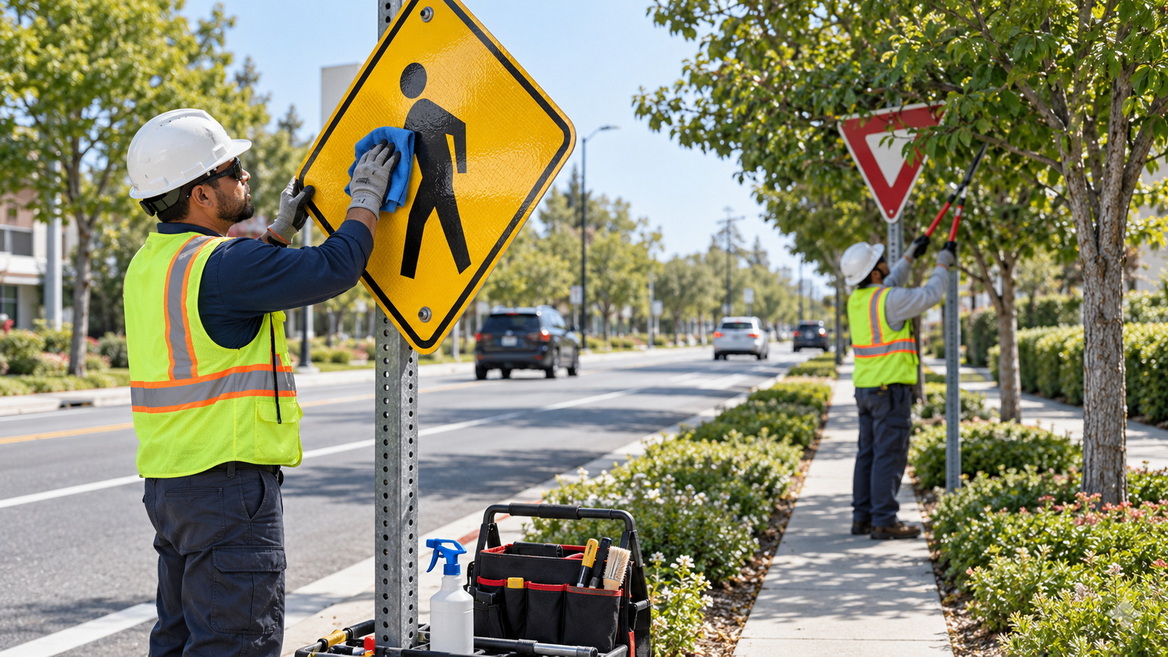
Regular cleaning can help preserve a professional appearance and improve daytime visibility. However, the wrong cleaning method can damage reflective sheeting.
Use a gentle cleaning process:
1. Remove loose dirt with clean water where possible.
2. Use a mild, non-abrasive cleaner.
3. Apply the cleaner with a soft cloth, sponge, or soft-bristle brush.
4. Avoid excessive pressure when wiping the sign face.
5. Rinse the surface thoroughly.
6. Allow the sign to dry.
7. Reinspect the sign after cleaning.
Avoid abrasive pads, sharp tools, harsh solvents, strong chemical cleaners, and high-pressure washing at close range. These methods can scratch reflective surfaces, damage sign edges, weaken seals, or reduce the service life of the sign.
A traffic sign must remain visible from the driver's normal approach direction. Vegetation often creates gradual visibility problems because trees, branches, shrubs, grass, and vines can grow over time.
During inspections, check whether signs are blocked by:
- Tree branches
- Shrubs and hedges
- Tall grass
- Construction barriers
- Utility boxes
- Temporary advertising boards
- Parked trucks or trailers
- Other traffic signs
- Decorative landscaping
- Snow accumulation
- Roadside debris
When trimming vegetation, consider the driver's approach distance. A sign may appear clear when standing beside it, yet remain difficult to see from a moving vehicle several hundred feet away.
This is especially important near curves, intersections, highway exits, pedestrian crossings, toll roads, parking entrances, and narrow internal roads.
A sign face may be in good condition while its support system is failing. Every inspection should include a review of the post, brackets, fasteners, and foundation.
Check for:
- Leaning or damaged posts
- Loose clamps and brackets
- Missing bolts, nuts, or washers
- Rusted hardware
- Cracked base plates
- Vehicle-impact damage
- Soil erosion around the post
- Loose concrete foundations
- Improper sign angle
- Excessive vibration
- Signs mounted too low or too high
- Sharp exposed edges
Signs in areas with frequent vandalism or theft should use durable mounting systems and tamper-resistant fasteners where appropriate. Even with anti-theft hardware, regular inspections remain necessary.
A sign must face approaching traffic at the correct angle. If it is twisted, tilted, or rotated away from the driver, its visibility and reflective performance may be reduced.
Review:
- Whether the sign faces the correct travel lane
- Whether it is visible from the expected driver approach
- Whether it is blocked by another sign
- Whether it has shifted due to wind, impact, or vibration
- Whether the sign is installed at an appropriate height
- Whether the sign is positioned far enough in advance of the decision point
- Whether a new building, tree, billboard, or road modification has affected visibility
Even a small change in sign angle can influence nighttime performance. This is particularly important for reflective warning signs and directional signs on high-speed roads.
Daytime inspections are important, but they are not enough. Many sign problems become more serious after dark.
A traffic sign may appear bright and readable in sunlight but become difficult to recognize under headlights at night. Nighttime visibility is influenced by retroreflectivity, vehicle-headlight angle, ambient lighting, sign orientation, weather conditions, and the visual clutter around the roadway.
Retroreflectivity is the ability of a sign surface to return light from vehicle headlights back toward the driver. It is a key reason why reflective traffic signs are visible at night.
Two useful evaluation methods are nighttime visual inspection and measured retroreflectivity testing.
A trained inspector reviews signs after dark from the perspective of an approaching vehicle. This helps identify signs that are difficult to detect, read, or understand in real driving conditions.
During a nighttime inspection, look for:
- Signs that appear dim compared with nearby signs
- Faded reflective surfaces
- Poor visibility in rain or fog
- Inadequate sign brightness in areas with streetlights
- Signs that are blocked by branches or parked vehicles
- Confusing clusters of signs at intersections
- Signs facing the wrong direction
- Glare from commercial lighting, LED screens, or vehicle headlights
- Difficulty reading legends, arrows, or symbols at normal travel speeds
Nighttime visual inspection is particularly useful for highways, toll stations, pedestrian crossings, parking garages, work zones, and industrial facilities with limited lighting.
A retroreflectometer is a device used to measure the reflective performance of traffic sign sheeting. It provides objective data that can help teams identify signs that should be replaced.
This type of testing is useful when managing large inventories of traffic signs, planning budgets, documenting asset condition, or comparing the performance of signs installed at different times.
Measured data can support better decisions about which signs should be cleaned, monitored, repaired, or replaced.
Not every damaged sign needs complete replacement. The right action depends on the severity of the problem, sign location, sign function, and safety risk.
| Sign Condition | Recommended Action |
|---|---|
| Light dust or road grime | Clean and reinspect |
| Small amount of vegetation blocking the sign | Trim vegetation and verify visibility |
| Loose bracket or bolt | Tighten or replace hardware |
| Minor graffiti that can be removed safely | Clean and inspect the sign face |
| Bent panel or distorted sign message | Replace the sign panel |
| Faded colors or reduced contrast | Replace the sign |
| Peeling, cracked, or delaminated reflective film | Replace the sign |
| Poor nighttime visibility | Inspect further and replace when needed |
| Repeated theft or vandalism | Upgrade mounting hardware and consider more secure installation |
| High-risk location with low visibility | Consider an LED traffic sign solution |
A simple rule can guide maintenance decisions: if drivers cannot quickly see, understand, and respond to the sign in real operating conditions, the sign should not remain in service without corrective action.
Traditional retroreflective signs rely on vehicle headlights. In many locations, reflective sheeting provides effective visibility. However, some environments require greater attention, stronger visual contrast, or active warning capability.
LED traffic signs can provide enhanced visibility in locations where drivers need earlier warning or where passive reflective signs may be difficult to notice.
Common LED traffic sign applications include:
- Pedestrian crossings
- School-zone warnings
- Speed-warning areas
- Dangerous curves
- Sharp turns and ramp approaches
- Toll plazas
- Lane-control areas
- Highway merging zones
- Work zones
- Emergency diversion routes
- Parking entrances and exits
- Parking guidance systems
- Industrial facilities
- Logistics parks
- Low-light rural roads
Solar-powered LED traffic signs can be especially useful when grid electricity is difficult, expensive, or impractical to install. Solar systems can support flexible deployment in remote roads, parking areas, temporary locations, and construction projects.
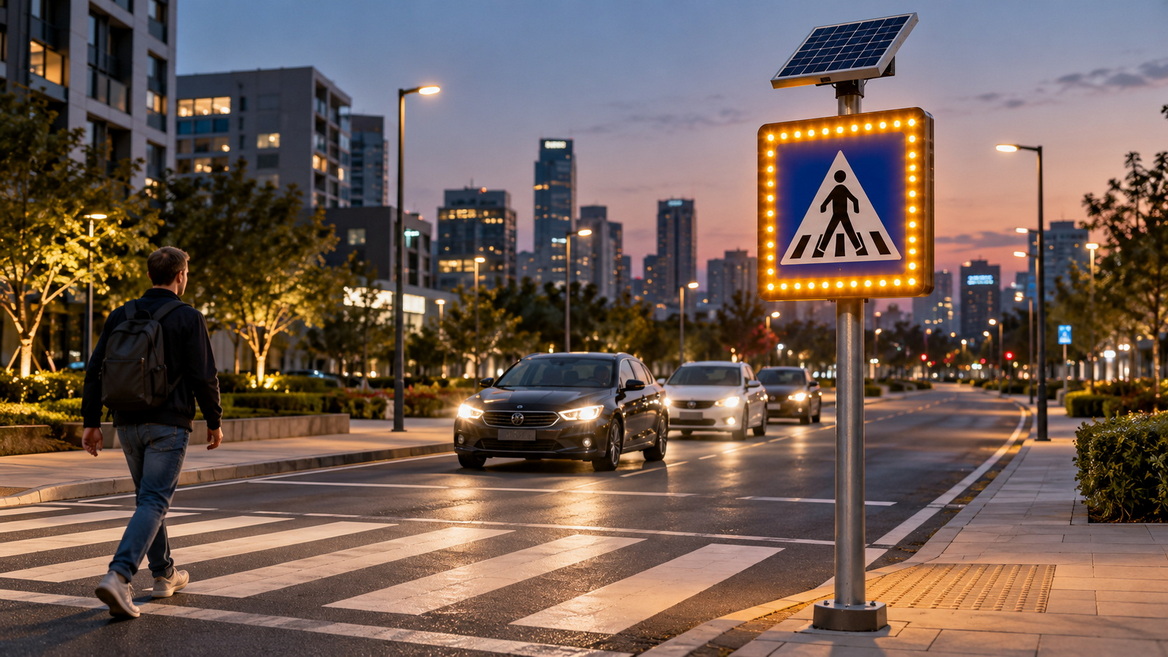
When maintaining LED traffic signs, inspect:
- LED brightness and flashing operation
- Solar-panel cleanliness
- Battery performance
- Controller settings
- Waterproof sealing
- Cable protection
- Mounting stability
- Sign-panel condition
- Visibility during daylight and nighttime hours
Shenzhen Xingsheng Traffic Facilities Co., Ltd. manufactures traffic safety products for streets, highways, toll stations, parking lots, and other traffic-management environments. The company provides OEM and ODM services for LED traffic signs, solar traffic signs, warning signs, pedestrian-crossing signs, parking guidance signs, and customized road-safety solutions.
Available customization options may include:
- Sign size and shape
- LED color and brightness
- Flashing pattern
- Solar-panel configuration
- Battery capacity
- Sign message and symbol
- Reflective sheeting grade
- Aluminum panel thickness
- Mounting bracket design
- Waterproof enclosure level
- Private labeling and branding
- Packaging requirements
Organizations without a formal traffic sign maintenance system can begin with a practical 30-day plan.
Focus first on locations where sign failure could create the greatest risk:
- High-speed roads
- Pedestrian crossings
- School zones
- Toll stations
- Road curves
- Highway exits
- Parking-lot entrances
- Dimly lit facilities
- Busy intersections
- Construction areas
Review sign faces, posts, brackets, mounting angles, vegetation, dirt, fading, graffiti, and physical damage. Take photographs from the driver's approach direction rather than only from beside the sign.
Inspect priority signs after dark. Identify signs that are difficult to see, difficult to read, hidden by vegetation, affected by glare, or insufficiently visible in rain and low-light conditions.
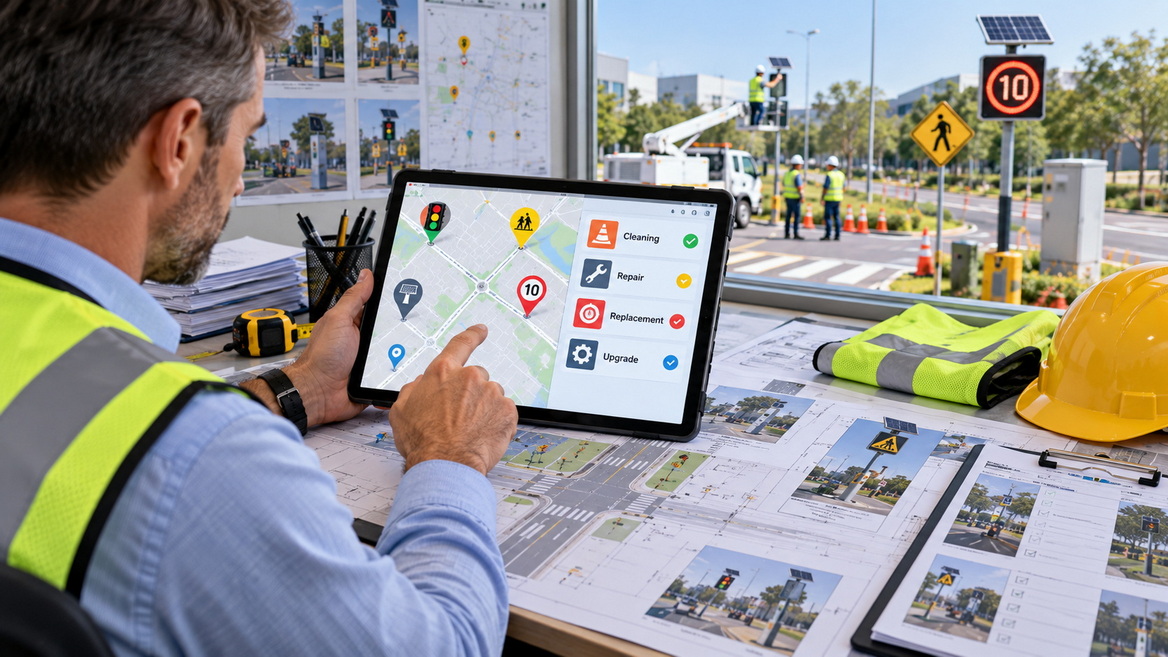
Classify every finding into one of four categories:
- Clean
- Repair
- Replace
- Upgrade
This process provides a clear overview of the current sign condition and helps create a realistic maintenance budget for the next quarter or year.
Traffic sign maintenance should be preventive rather than reactive. Regular inspections, safe cleaning methods, vegetation control, secure mounting, nighttime visibility reviews, and timely replacement can help maintain safer and more reliable traffic environments.
The most effective maintenance programs evaluate signs from the driver's perspective. A sign should not only be present—it should be clear, visible, readable, stable, and easy to understand in daylight, darkness, rain, fog, and real traffic conditions.
For streets, highways, toll stations, parking facilities, industrial parks, and specialized safety projects, Shenzhen Xingsheng Traffic Facilities Co., Ltd. provides customized traffic safety products, including LED traffic signs and solar-powered warning systems. OEM and ODM manufacturing options can be developed according to project specifications, traffic conditions, product dimensions, visibility requirements, and branding needs.
Traffic sign inspection frequency depends on traffic volume, road speed, weather conditions, sign importance, and location risk. High-priority signs on major roads, toll stations, school zones, and pedestrian crossings may require monthly or quarterly inspections, while all signs should be reviewed after storms, collisions, vandalism, or construction activity.
Pressure washing should be used carefully. High-pressure water applied too closely can damage reflective film, sign edges, seals, and mounting hardware. A mild cleaner, clean water, and a soft cloth or soft-bristle brush are safer for routine cleaning.
Retroreflectivity is the ability of a traffic sign surface to return vehicle-headlight light toward the driver. This makes signs more visible at night and helps drivers read warnings, instructions, symbols, and directional information in low-light conditions.
No. Cleaning removes dirt and surface contamination, but it cannot restore reflective performance lost because of fading, cracking, peeling, aging, or material damage. A sign with serious fading or reduced nighttime visibility should be replaced.
A reflective traffic sign uses retroreflective sheeting to return light from vehicle headlights back to the driver. An LED traffic sign uses active LEDs to produce stronger visual attention, flashing warnings, or illuminated messages. LED signs are particularly useful at pedestrian crossings, school zones, toll plazas, dangerous curves, parking facilities, and low-light areas.
1. Traffic Safety Warehouse. [How To Maintain Your Traffic Signs]
2. Federal Highway Administration. [Methods for Maintaining Traffic Sign Retroreflectivity]
3. Federal Highway Administration. [Chapter 2: Retroreflectivity Maintenance Methods]
4. Federal Highway Administration. [Maintaining Traffic Sign Retroreflectivity: Impacts on State and Local Agencies]
5. Federal Highway Administration. [Manual on Uniform Traffic Control Devices for Streets and Highways, 11th Edition]
6. American Traffic Safety Services Association. [Manuals and Guidelines]


