
Please Choose Your Language
Views: 222 Author: XS Traffic Facilities Publish Time: 2026-04-12 Origin: Site


Content Menu
● Why Visibility Is the Real Currency of Crosswalk Safety
>> The Limits of Markings and Beacons Alone
>> How Light Changes Driver Behavior
● What RRFBs Already Achieve—and Where Lighting Closes the Gap
>> Proven Impact of RRFBs on Yielding and Crashes
● How Crosswalk Illumination Enhances RRFB Performance
>> Bringing Beacons and Lighting Into One System
>> Key Lighting Principles from Current Guidance
● A Solar‑First Approach to Crosswalk and Traffic Signal Safety
>> Why Solar RRFBs and Solar Traffic Lights Have Become Standard
>> Our Field Experience as a Solar Manufacturer
● Design Blueprint: How to Plan a High‑Performing Illuminated RRFB Crosswalk
>> Step‑by‑Step Design Process
● Latest Research Insights: What the Data Says About Light + RRFB
>> Nighttime Yielding and Speed Reduction
>> Long‑Term Performance and Cost‑Effectiveness
● OEM/ODM Opportunities for Agencies and Integrators
>> Customization for Regional Standards
>> Building a Scalable Safety Platform
● Quick Reference – RRFB and Crosswalk Illumination Highlights
● User‑Centric Benefits: What Pedestrians and Drivers Actually Experience
>> Driver Clarity and Reduced Stress
● How We Can Help You Upgrade Crosswalk Safety
● FAQ: Crosswalk Illumination, RRFBs, and Solar Traffic Lights
Crosswalk safety after dark is no longer just a design question—it is a visibility question. Crosswalk illumination combined with solar RRFB systems and solar traffic lights has become one of the most cost‑effective ways cities can protect people at the street edge. As a manufacturer working with transportation agencies around the world, I have seen how the right combination of solar‑powered beacons, overhead lighting, and pavement‑level guidance can transform a risky mid‑block crossing into a predictable, highly visible decision point for drivers. [carmanah]
At unsignalized crosswalks, drivers make split‑second decisions based on what they can see, not what is painted on the road. Research shows RRFBs can raise driver yielding rates from under 20% at basic marked crosswalks to above 90%, but performance is strongly influenced by nighttime lighting conditions. When crosswalk illumination is designed to work with the RRFB—rather than as a separate system—agencies see higher compliance, earlier braking, and fewer near misses. [highways.dot]
Traditional painted crosswalks rely on contrast and driver goodwill. At night, in rain or glare, that contrast disappears. FHWA findings indicate that even with RRFBs, yielding rates can vary widely—from as low as 19% in some locations to as high as 98% in others—depending on speed, geometry, and visibility. This variability is exactly where targeted crosswalk illumination makes the difference between "visible enough" and "unmissable." [codot]
Recent research on nighttime crossings confirms that better lighting does not just make pedestrians easier to see; it changes how drivers behave upstream of the crosswalk. Studies of RRFB sites with supplemental crosswalk illuminators show that drivers slow earlier, reduce speeds more, and yield more frequently when lighting is triggered along with the beacon. In some naturalistic driving studies, drivers approaching active RRFBs decelerated from 50–120 m away and began braking about 20 m earlier when pedestrians were present compared to unlit conditions. [sciencedirect]
RRFBs have moved from "innovative" to "proven countermeasure" in just over a decade. FHWA research and follow‑up case studies show that RRFBs can increase driver yielding rates to around 90–96% and reduce pedestrian crashes by up to 47% at treated crosswalks. They have also been recognized in FHWA's Safe Transportation for Every Pedestrian program as one of the top seven safety treatments for pedestrian crossings. [availedtechnologies]
From an operations perspective, agencies often highlight that RRFBs deliver these safety gains at roughly one‑third of the cost of traditional overhead flashers, while achieving very similar levels of driver compliance. [tac-atc]
Even at high‑performing RRFB sites, night presents a recurring challenge. Where existing street lighting is sparse or poorly aimed, drivers may see the beacon but struggle to visually locate the pedestrian, which can delay decision‑making and reduce the effective safety margin. Field work in North America and Europe shows that crosswalks with RRFBs but inadequate lighting tend to have lower nighttime yielding, more hard braking, and more late lane changes—classic precursors to collisions. [carmanah]
This is the gap crosswalk illumination is designed to close: not replacing RRFBs, but making their warnings actionable by revealing the pedestrian and the entire conflict area clearly.
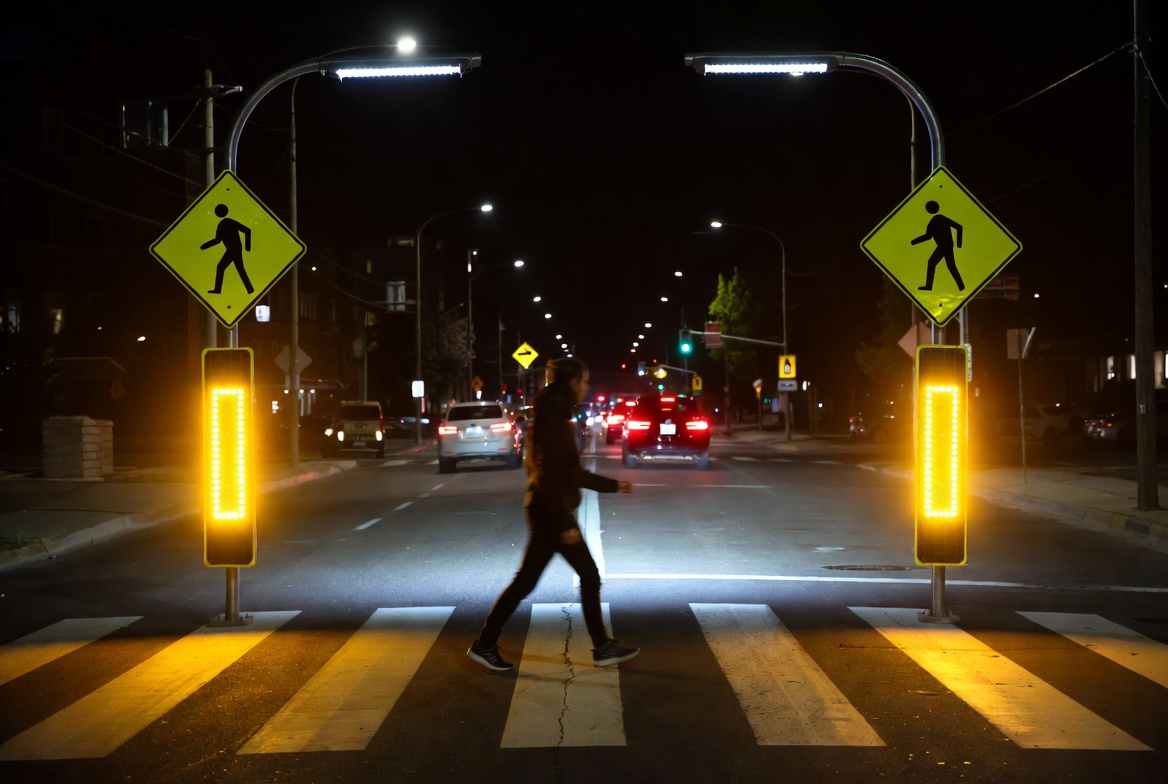
In our projects, the most effective installations treat RRFBs, crosswalk lighting, and solar traffic lights as one integrated system rather than three separate devices. When LED crosswalk illuminators are triggered in sync with RRFB activation, drivers receive both a dynamic warning and a clear, lit‑up target zone, which has been shown to improve yielding and speed reduction compared to RRFBs alone. [michigan]
Well‑designed overhead or side‑mounted luminaires direct light across the full width of the crosswalk and approach area while minimizing glare. Combined with high‑intensity RRFB flashes and reflective signs, drivers perceive a consistent, high‑contrast corridor of safety, even at rural highways and complex multilane approaches. [carmanah]
Recent guidance from bodies such as FHWA and IES emphasizes several principles for effective crosswalk illumination at RRFB sites:
- Targeted illumination of the conflict area rather than uniform roadway lighting alone. [carmanah]
- Avoiding backlighting that leaves pedestrians in silhouette; instead, lighting them from the driver's viewing direction. [michigan]
- Maintaining consistent vertical and horizontal illuminance across the crosswalk so that pedestrians are visible from various heights and angles. [carmanah]
- Coordinating light levels with surrounding street lighting to avoid extreme contrast that can cause adaptation issues for drivers. [michigan]
Agencies that apply these principles report not only higher compliance, but also fewer complaints and better perceived safety from local communities. [codot]
The article that inspired this discussion focuses on performance, but in practice, agencies also worry about procurement, installation, and life‑cycle cost. Solar‑powered RRFBs and solar traffic lights dramatically cut trenching, wiring, and traffic control needs, which is one reason many DOTs and municipalities have shifted to solar for crosswalk safety. FHWA case summaries highlight quick deployment and minimal disruption as recurring themes at successful RRFB projects. [carmanah]
For agencies managing long rural roadways, toll plazas, or distributed parking facilities, off‑grid systems offer additional resilience: power outages do not compromise crosswalk or lane‑control visibility. [carmanah]
As Shenzhen Xingsheng Traffic Facilities Co., Ltd., we manufacture solar traffic lights, solar RRFB systems, LED‑enhanced signs, and parking guidance solutions tailored to diverse regional standards and climates. Through OEM and ODM partnerships, we work with engineering firms and integrators who must balance:
- Strict compliance with local regulations and MUTCD‑style guidance
- Tight capital and maintenance budgets
- Challenging sites with long cable runs or unstable grid power
In these contexts, we have repeatedly seen that a well‑specified solar RRFB with integrated crosswalk illumination outperforms "piecemeal" upgrades—like markings alone or beacon‑only treatments—especially at night and on higher speed roadways. [carmanah]
From an engineer's perspective, two crosswalks with the same devices can perform very differently. Below is a practical design sequence we use when supporting customers.
1. Assess the site and risk profile
- Traffic volume, speeds, lane count, and sight distance. [walkable]
- Pedestrian demand patterns (schools, transit, parking, trail heads). [highways.dot]
2. Decide whether RRFBs are appropriate
- Mid‑block or uncontrolled crossings on roads under typical threshold speeds are strong candidates. [walkable]
- Consider alternatives (full signals, HAWK, grade separation) at very high‑risk or high‑speed locations. [highways.dot]
3. Define the lighting strategy
- Identify existing lighting gaps and glare issues. [carmanah]
- Choose between overhead poles, side‑mounted fixtures, or in‑pavement options. [carmanah]
4. Specify solar and power requirements
- Evaluate solar insolation, shading, and seasonal variations at the site. [carmanah]
- Size the solar panels and batteries to support RRFBs plus illuminators with sufficient autonomy. [carmanah]
5. Plan for maintenance and monitoring
- Define inspection intervals and cleaning schedules for PV panels and lenses. [carmanah]
- Consider remote monitoring to track activation rates and energy status where feasible. [carmanah]
6. Engage the community and iterate
- Collect user feedback post‑installation, especially from vulnerable groups like school children and seniors. [legacy.trafficalm]
- Adjust flash patterns, lighting angles, or sign placement as needed based on observed behavior. [sciencedirect]

To move beyond intuition, it is useful to look at recent findings from agencies and researchers.
- Triggering crosswalk illuminators in concert with RRFBs has been shown to increase the likelihood that drivers both slow down and yield compared to using either treatment on its own. [codot]
- Studies report that drivers reduce speed more, and from farther upstream, when the crossing is clearly lit, reducing the risk of last‑second braking and rear‑end conflicts. [sciencedirect]
- In naturalistic driving studies, drivers approaching active RRFBs often slow even when no pedestrians are visible, indicating a strong learned association between the beacon, illuminated crosswalk, and potential pedestrian presence. [sciencedirect]
Longitudinal evaluations suggest that the safety benefits of RRFBs do not "fade" with time. Motorist yielding remains high years after installation, especially when crosswalk visibility is maintained through good lighting and sign maintenance. From a cost‑benefit standpoint, the combination of RRFBs and targeted crosswalk lighting consistently ranks among the most cost‑effective pedestrian treatments because it provides large safety gains at moderate investment levels. [tac-atc]
Not every jurisdiction uses the same beacon patterns, pole configurations, or sign legends. As an OEM/ODM partner, we help:
- Adapt RRFB flash patterns, sign legends, and housing colors to local regulations
- Configure solar traffic lights and lane control signals that align with existing ITS and tolling infrastructure
- Integrate crosswalk illumination into combined masts, reducing pole clutter and installation cost
This customization matters because a system that fits seamlessly into local driver expectations typically achieves higher real‑world compliance than a "generic" import. [legacy.trafficalm]
Many of our clients treat their first illuminated RRFB installation as a pilot. Once performance data and community feedback come in, they expand to:
- School zones and safe routes to school corridors
- Transit stop crossings and park‑and‑ride access points
- Parking lot and toll plaza pedestrian paths
By standardizing on a solar‑based, modular platform, agencies can replicate a proven configuration quickly across multiple sites, reducing design time and training needs for maintenance teams. [tac-atc]

| Safety element | Typical impact or guidance |
|---|---|
| RRFB alone | Yielding can reach 90–96% at many sites. (highways.dot) |
| RRFB + crosswalk illuminators | Higher nighttime yielding and greater speed reductions vs. either alone. (codot) |
| Crash reduction potential | Pedestrian crashes cut by up to about 47% at treated crosswalks. (carmanah) |
| Cost vs. overhead flashers | Approx. one‑third the installation cost with similar compliance. (tac-atc) |
| Solar‑powered systems | Fast installation, minimal trenching, resilient to grid outages. (carmanah) |
From feedback gathered at various projects, pedestrians often describe an illuminated RRFB crosswalk as "finally feeling safe enough to use at night." When the crosswalk, pedestrian figure, and surrounding area are clearly lit, people are more willing to choose the marked crossing instead of unsafe mid‑block shortcuts. This behavioral shift is crucial in school zones, university districts, and busy commercial streets. [walkable]
Drivers, especially in suburban and rural areas, frequently report that they appreciate having a predictable, consistent signal that a pedestrian might be present. The combination of RRFB flashes, reflective signs, and targeted lighting reduces ambiguity and last‑second surprises, lowering stress and the likelihood of harsh braking or evasive maneuvers. [codot]

If you are responsible for improving pedestrian safety at crosswalks, toll plazas, or parking facilities, you do not have to start from scratch. At Shenzhen Xingsheng Traffic Facilities Co., Ltd., we:
- Provide solar traffic lights, solar RRFB systems, and LED crosswalk illumination designed for international markets
- Offer OEM and ODM services so you can deploy solutions under your own brand or tailored to your standard details
- Support you with layout recommendations, component selection, and performance optimization based on current research and best practices
Call to action:
If you are planning to upgrade existing RRFB crosswalks or design new illuminated crossings, contact our team to discuss a solar‑powered solution that integrates RRFBs, crosswalk lighting, and traffic signals into a single, high‑performance system. We can help you translate the latest research into a practical design that fits your budget, standards, and long‑term safety goals.
Q1: Do I need crosswalk illumination if I already have RRFBs?
Even high‑performing RRFB sites can see lower nighttime yielding where lighting is poor. Adding targeted crosswalk illumination helps drivers see pedestrians earlier and respond more consistently after dark. [carmanah]
Q2: Are solar RRFBs reliable in low‑sunlight regions?
Modern solar RRFB systems are typically sized for local solar conditions with adequate battery autonomy. When properly specified, they can provide reliable operation through low‑sun periods without relying on grid power. [carmanah]
Q3: How do illuminated RRFB crosswalks compare to full traffic signals?
Full signals can be appropriate at very high‑volume or high‑speed locations, but they are significantly more expensive. RRFBs with crosswalk lighting offer substantial safety benefits at a fraction of the cost for many mid‑block and minor crossing locations. [highways.dot]
Q4: Will crosswalk lighting cause glare for drivers or nearby homes?
When luminaires are correctly aimed and designed according to current guidance, crosswalk illumination should improve pedestrian visibility while minimizing glare and light spill into adjacent properties. [michigan]
Q5: Can we integrate RRFB and crosswalk lighting control into our existing ITS?
Yes. Many modern systems allow activation by pushbutton, passive detection, or remote control, and can interface with broader ITS or central management platforms where required. Solar‑powered systems can incorporate communication modules without needing wired data connections. [carmanah]
1. Carmanah Technologies – "Lighting the Way: How Crosswalk Illumination Enhances RRFB Performance" (webinar and article). [carmanah]
2. FHWA – Rectangular Rapid Flashing Beacons (RRFB) Proven Safety Countermeasure. [highways.dot]
3. Colorado DOT – "Effects of crosswalk illuminators and rapid rectangular flashing beacons on speed reductions and yielding to pedestrians at night." [codot]
4. Avail(ed) Technologies – Case studies on effectiveness of LED‑enhanced traffic signs and RRFBs. [availedtechnologies]
5. City of Calgary – "Lessons Learned from Calgary's RRFB Pilot." [tac-atc]
6. Carmanah – "Overhead Lighting for Crosswalks" technical brief. [carmanah]
7. Carmanah – "Overview of RRFB Cost and Effectiveness" and related resources. [carmanah]
8. ScienceDirect – "Driving behavior at midblock crosswalks with Rectangular Rapid Flashing Beacons." [sciencedirect]
9. Carmanah – "Building Crosswalks for Walkable Communities" video and supporting materials. [carmanah]
10. Walkable.org – RRFB technical sheet from FHWA STEP program. [walkable]
11. Carmanah – Crosswalks/RRFBs application resources and installation tips. [carmanah]
12. Trafficalm – "Assessing the Impact of Pedestrian‑Activated Crossing Systems: A Focus on RRFBs." [legacy.trafficalm]
13. Michigan DOT – "Examination of Lighting Practices at Crosswalks." [michigan]


