
Please Choose Your Language
Views: 266 Author: XS Traffic Facilities Publish Time: 2026-10-03 Origin: Site


Content Menu
● What Does the Corrosive Symbol Mean?
>> Why Corrosive Hazard Signs Matter
● Understanding the GHS Corrosion Pictogram
>> Hazards Identified by the Corrosion Pictogram
>> What Else Appears on a Chemical Label?
● Class 8 Corrosive Labels in Transport
>> GHS Corrosion Pictogram vs. Class 8 Label
● Common Chemicals That May Be Corrosive
>> Corrosive Materials in Traffic and Facility Operations
● Where Should Corrosive Warning Signs Be Installed?
>> Chemical Storage Rooms and Cabinets
>> Laboratories and Manufacturing Areas
>> Warehouses, Loading Areas, and Transport Routes
● How to Handle Corrosive Chemicals Safely
>> Five Steps Before Handling a Corrosive Product
>> Important PPE Considerations
● What to Do During a Corrosive Chemical Spill
>> Immediate Spill-Response Priorities
● Safe Storage of Corrosive Materials
>> Corrosive Storage Best Practices
>> Why Chemical Compatibility Matters
● Choosing Corrosive Safety Signs for Industrial Locations
● Practical Signage Recommendations for Facilities
>> Use Consistent Sign Designs
>> Combine Symbols With Action Messages
>> Make Signs Visible in Real Conditions
● Summary
>> What does the corrosive symbol mean?
>> Is the corrosive pictogram the same as a Class 8 transport label?
>> Which chemicals may display the corrosive symbol?
>> Where should corrosive warning signs be installed?
>> What PPE is required for corrosive chemicals?
The corrosive symbol warns that a chemical can cause severe skin burns, permanent eye damage, or damage to metals. It is one of the most important hazard symbols used in factories, laboratories, warehouses, maintenance rooms, chemical-storage areas, transport operations, parking facilities, and public-infrastructure sites.
For facility managers, safety officers, chemical handlers, and procurement teams, recognizing the corrosive symbol is only the first step. Effective protection depends on clear labeling, durable warning signs, proper storage, suitable personal protective equipment, Safety Data Sheet access, staff training, and emergency preparation.
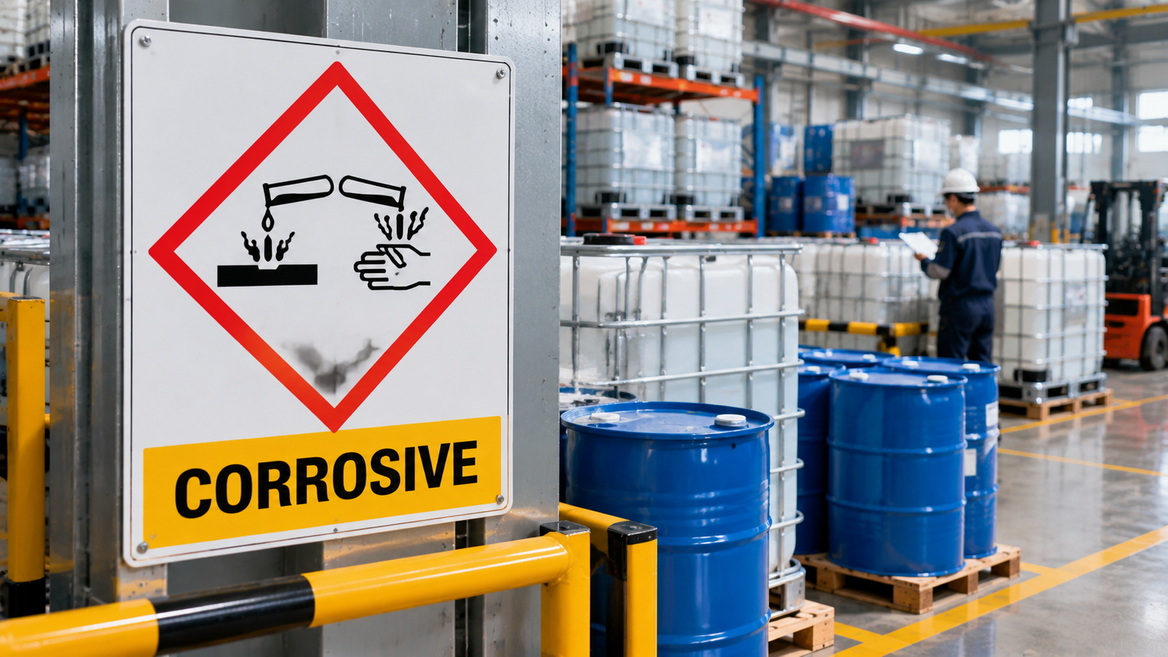
The corrosive symbol identifies substances that can chemically attack human tissue or materials when they come into contact with them. The standard image usually shows two test tubes pouring liquid onto a hand and a metal surface.
This image communicates two major hazards:
- Health hazard: The chemical may burn the skin or cause permanent eye injury.
- Material hazard: The chemical may corrode metal containers, equipment, tools, pipes, shelving, or vehicle components.
A corrosive sign is not simply a reminder to "be careful." It is a serious warning that workers must identify the chemical, understand its risks, use the correct protective equipment, and follow established workplace procedures before handling it.
Corrosive chemicals are used in a wide range of workplaces. Many are essential for cleaning, water treatment, metal processing, manufacturing, vehicle maintenance, laboratory testing, battery servicing, and construction work.
However, even a routine maintenance task can become dangerous if a corrosive product is incorrectly stored, transferred into an unlabelled container, mixed with an incompatible material, or handled without the right protection.
Clear warning signs help people recognize a hazard before entering an area, opening a container, transferring a liquid, or beginning a maintenance task. They are especially important for visitors, contractors, temporary workers, drivers, and employees who may not work with chemicals every day.
The GHS corrosion pictogram is commonly displayed as a black symbol inside a red diamond with a white background. It is used on chemical containers and related workplace labels to communicate serious health and material hazards.
The pictogram may appear on:
- Chemical containers and drums
- Industrial cleaning products
- Laboratory reagent bottles
- Chemical storage cabinets
- Safety posters and training materials
- Maintenance-room signs
- Workplace hazard labels
- Safety Data Sheets
The corrosive pictogram can indicate one or more serious hazards.
| Hazard Type | Meaning | Possible Result |
|---|---|---|
| Skin corrosion | The substance may cause irreversible damage to skin tissue | Severe burns, tissue damage, scars |
| Serious eye damage | The substance may cause permanent eye injury | Loss of vision, chemical burns, long-term eye damage |
| Corrosive to metals | The substance may attack or weaken metal surfaces | Leaks, damaged containers, equipment failure |
A substance does not need to look dangerous to create a serious risk. Some corrosive chemicals are clear liquids, colorless powders, or ordinary-looking cleaning products. Workers should always check the label, container condition, and handling instructions before use.
The corrosive symbol is only one part of a complete chemical label. A properly marked product may also include:
- Product name or identifier
- Signal word, such as "Danger"
- Hazard statements
- Precautionary statements
- Supplier or manufacturer information
- Emergency contact details
- Storage instructions
- Disposal guidance
- Supplementary safety information
For example, a chemical label may include a message such as:
> Causes severe skin burns and eye damage.
> Wear protective gloves, protective clothing, eye protection, and face protection.
Safety signs placed near storage areas or workstations should reinforce the label information. They should not replace the container label or the workplace chemical-safety procedure.
The Class 8 corrosive label is used for transporting dangerous goods. It is similar to the corrosive pictogram because it also shows liquid damaging a hand and a metal surface. However, its main purpose is to identify corrosive materials during road, rail, sea, or air transportation.
The Class 8 label is often placed on:
- Chemical drums
- IBC containers
- Bulk tanks
- Shipping packages
- Freight containers
- Cargo vehicles
- Tank trucks
- Transport documentation
The label usually includes the number 8 at the bottom of the diamond shape. This identifies the shipment as a corrosive dangerous good.
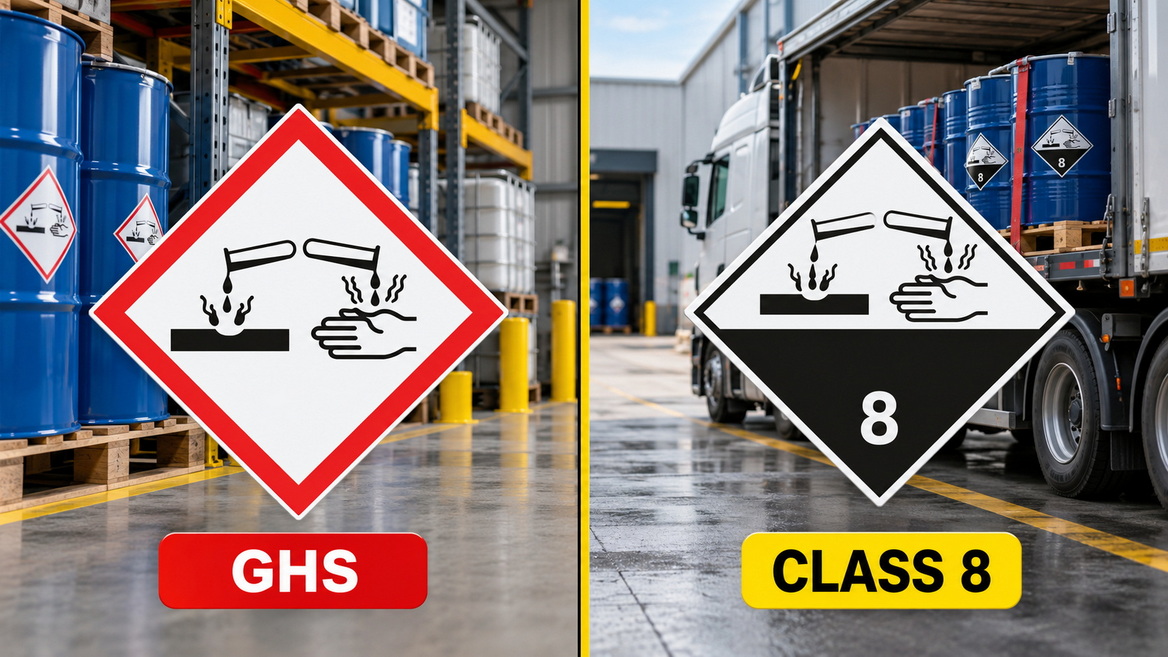
| Feature | GHS Corrosion Pictogram | Class 8 Corrosive Label |
|---|---|---|
| Main purpose | Communicates hazards during storage and workplace use | Identifies corrosive dangerous goods in transport |
| Typical location | Chemical containers, work areas, storage rooms | Packages, tanks, vehicles, freight units |
| Design | Red diamond border with a black symbol | Black-and-white transport label with number 8 |
| Primary focus | Skin burns, eye damage, and metal corrosion | Transport safety for corrosive substances |
| Supporting information | Product name, hazard statements, precautionary instructions | UN number, shipping name, package information, transport documents |
A facility should not rely on one type of marking for every situation. Workplace storage, routine handling, emergency response, and transport operations may require different labels, signs, procedures, and documentation.
Corrosive substances include strong acids, strong alkalis, industrial cleaners, treatment chemicals, and specialized manufacturing products.
Acids can cause severe burns and may damage metals, concrete surfaces, equipment, and storage containers.
Common examples include:
- Hydrochloric acid
- Sulfuric acid
- Nitric acid
- Hydrofluoric acid
- Phosphoric acid
- Glacial acetic acid
- Chromic acid
- Perchloric acid
These materials may be used for metal cleaning, surface preparation, battery maintenance, chemical processing, industrial cleaning, laboratory work, water treatment, and manufacturing.
Alkalis, also called bases, can be equally dangerous. They may penetrate deeply into tissue and cause severe damage before the full extent of the injury is visible.
Common examples include:
- Sodium hydroxide
- Potassium hydroxide
- Calcium hydroxide
- Ammonia solutions
- Sodium hypochlorite solutions
- Industrial degreasers
- Drain-cleaning products
Workers should never assume that a product is safe because it is marketed as a cleaner or maintenance product. Concentrated cleaning chemicals may be highly corrosive.
Traffic-management sites, toll stations, parking facilities, warehouses, and public-infrastructure projects may use or store corrosive materials in several forms.
Examples include:
- Battery electrolyte in backup-power systems
- Chemicals used for road or facility cleaning
- Products used for concrete cleaning
- Water-treatment chemicals
- Metal-cleaning agents
- Drain-maintenance chemicals
- Maintenance chemicals for generators and vehicles
- Industrial coatings and surface-preparation products
At these locations, safety signs should remain easy to read despite moisture, dust, sunlight, vehicle movement, vibration, and frequent cleaning.
Corrosive warning signs should be installed wherever a person may encounter the material before entering, handling, moving, storing, or disposing of it.
The sign should be visible before a worker reaches the hazard area.
Install corrosive hazard signs at:
- Entrances to chemical storage rooms
- Acid storage cabinets
- Alkali storage cabinets
- Bulk-liquid storage areas
- Chemical drum-storage zones
- IBC storage locations
- Secondary-containment areas
- Chemical dispensing stations
- Waste-chemical collection areas
Signs should remain visible when doors are open, pallets are moved, or equipment is placed near the storage area.
Use corrosive warning signs near:
- Laboratory workbenches
- Fume hoods
- Chemical reagent cabinets
- Process tanks
- Mixing systems
- Wash stations
- Chemical piping
- Production equipment
- Waste containers
- Neutralization systems
In high-risk areas, combine the corrosive symbol with direct protective instructions.
For example:
> CORROSIVE CHEMICALS
> Wear chemical-resistant gloves, goggles, and face protection.
> Keep containers closed when not in use.
> Know the location of the nearest eyewash station.
Warning communication is especially important in busy logistics environments because workers may move products using forklifts, pallet jacks, hand trucks, or vehicles.
Install visible signs in:
- Dangerous-goods storage zones
- Loading docks
- Container-stuffing areas
- Chemical transfer points
- Vehicle maintenance areas
- Freight inspection zones
- Spill-response equipment locations
- Emergency shower and eyewash routes
- Restricted-access chemical areas
In large facilities, use layered hazard communication. The corrosive hazard should be visible at the entrance, on storage racks, near the product, and in the relevant operating instructions.
A corrosive symbol should trigger a consistent safety process. Workers should never handle unfamiliar products without understanding the required precautions.
1. Identify the chemical clearly.
Check the product name, hazard symbols, signal word, hazard statements, and container condition. Never use a chemical that is unlabelled or stored in an unidentified container.
2. Read the Safety Data Sheet.
Review the chemical hazards, handling requirements, storage conditions, required personal protective equipment, first-aid guidance, spill-response procedures, and incompatibility information.
3. Wear appropriate personal protective equipment.
The required protection depends on the product and task. It may include chemical-resistant gloves, splash goggles, a face shield, protective clothing, chemical-resistant footwear, and respiratory protection.
4. Check the work area before starting.
Confirm that ventilation is adequate, emergency eyewash equipment is accessible, spill-control materials are available, and incompatible products are not nearby.
5. Follow approved workplace procedures.
Use the correct containers, tools, transfer methods, and disposal process. Report damaged packaging, missing labels, leaks, or unsafe storage conditions immediately.
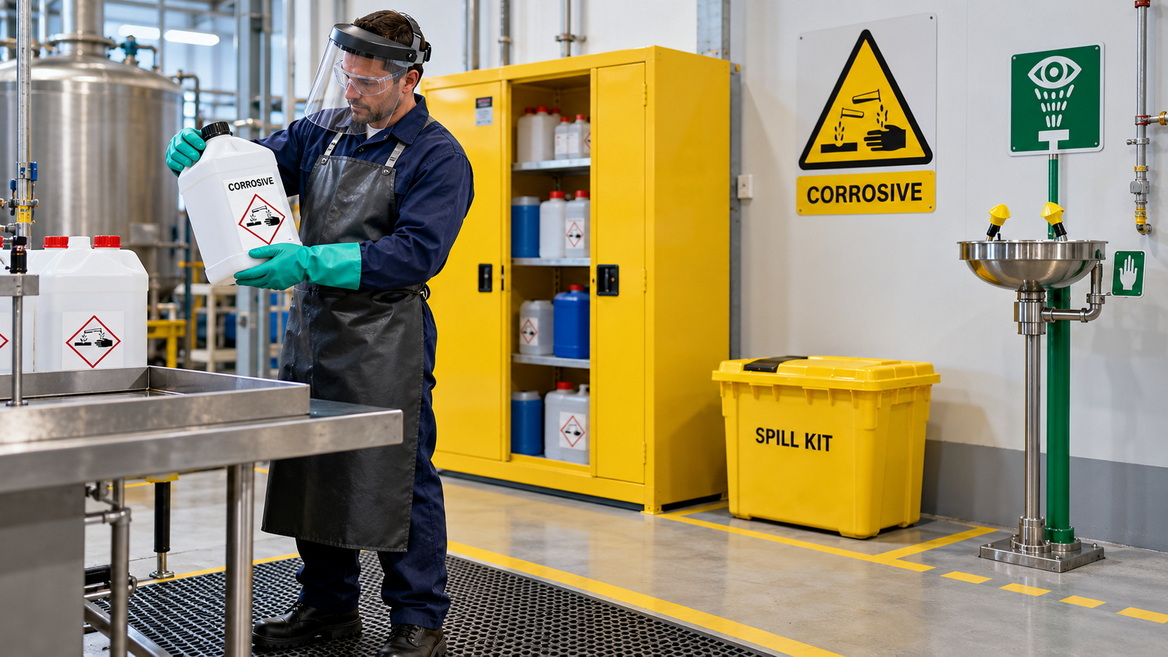
The correct PPE depends on the specific chemical, its concentration, the amount being handled, the likelihood of splashing, the duration of exposure, and the working environment.
Common PPE may include:
- Chemical-resistant gloves
- Safety goggles
- Face shields
- Chemical-resistant aprons
- Protective coveralls
- Chemical-resistant boots
- Respiratory protection when required
- Sleeves or arm guards for splash-prone tasks
Gloves should be selected based on chemical compatibility. A glove that protects against one corrosive product may fail quickly when exposed to another.
A spill involving corrosive chemicals can create immediate risks to people, equipment, drains, vehicles, and surrounding materials. The correct response depends on the product, the quantity, the location, and the level of worker training.
- Keep people away from the spill area.
- Avoid touching the chemical or walking through contaminated liquid.
- Alert a supervisor, safety officer, or trained emergency-response team.
- Check the product label and Safety Data Sheet.
- Use spill-control materials only if trained and authorized.
- Prevent the chemical from reaching drains, soil, waterways, or incompatible materials.
- Isolate the area until it is safe to re-enter.
- Report the incident and document the corrective action.
Do not attempt to clean up a large, unknown, or highly hazardous chemical spill without the correct training, protective equipment, and response plan.
Chemical exposure to the skin or eyes requires immediate action. Follow the product's emergency instructions and workplace procedures.
General emergency priorities include:
- Begin flushing affected skin or eyes immediately.
- Use an emergency eyewash station or safety shower where available.
- Remove contaminated clothing carefully if it can be done safely.
- Inform the responsible supervisor or emergency contact.
- Obtain medical evaluation when required by the chemical hazard and workplace procedure.
Do not delay emergency flushing while searching for additional information. Fast action can reduce injury severity.
[Suggested video: A short instructional video demonstrating emergency eyewash use, safety-shower operation, and proper reporting of a chemical exposure.]
Safe storage prevents leaks, chemical reactions, damaged containers, injuries, and expensive facility damage.
All corrosive products should be stored according to their product instructions and workplace chemical-management procedures.
- Store chemicals in clearly labelled, compatible containers.
- Keep containers tightly closed when not in use.
- Use secondary containment where appropriate.
- Separate acids from alkalis when required.
- Keep corrosive chemicals away from incompatible products.
- Protect chemicals from heat, sunlight, moisture, and physical damage.
- Store heavy containers at a safe height to reduce the risk of falling or splashing.
- Keep emergency equipment accessible.
- Inspect containers regularly for leaks, corrosion, swelling, cracks, or damaged labels.
- Restrict access to trained personnel.
Not every corrosive chemical can be stored together. Some acids, bases, oxidizers, organic materials, metals, cyanides, sulfides, and water-reactive products may create serious reactions when mixed.
For example, mixing an acid with an incompatible product can release heat, toxic gases, or hazardous splashes. A damaged metal shelf may also fail when exposed to a corrosive liquid over time.
Storage decisions should be based on the individual product's safety information, not only on whether the product carries a corrosive symbol.
A corrosive safety sign must match the environment where it will be used. A lightweight indoor label may not perform well in a humid warehouse, outdoor loading zone, traffic-maintenance site, chemical processing area, or parking facility.
When selecting signs, consider the expected operating conditions, viewing distance, mounting surface, and local safety requirements.
| Selection Factor | What to Consider |
|---|---|
| Sign material | PVC, aluminum, rigid plastic, reflective sheeting, or other durable material |
| Weather resistance | UV resistance, water resistance, temperature tolerance, and corrosion resistance |
| Chemical resistance | Ability to remain legible when exposed to cleaning products, humidity, dust, and industrial conditions |
| Visibility | Clear colors, strong contrast, large symbols, readable text, and reflective options |
| Sign size | Viewing distance, speed of passing traffic, room size, and installation location |
| Mounting method | Adhesive backing, screw holes, brackets, posts, magnetic mounting, or custom hardware |
| Language | English-only, bilingual, multilingual, or symbol-based communication |
| Customization | PPE reminders, directional arrows, company logo, emergency information, or site-specific instructions |
Durable hazard signs are especially important for streets, highways, toll stations, parking areas, industrial facilities, warehouse zones, and maintenance environments. Signs should remain legible and securely mounted throughout their intended service life.
A clear sign system can reduce confusion and support safer daily operations.
Use the same pictogram style, color system, wording format, and sign placement rules across the facility. Consistency helps workers recognize hazards faster.
A symbol identifies a risk, but a short instruction tells people what to do.
Useful messages include:
- Wear protective gloves and eye protection
- Authorized personnel only
- Keep container closed
- Do not mix with other chemicals
- Emergency eyewash nearby
- Use chemical-resistant equipment
- Report leaks immediately
A sign must remain visible during actual operations, not only during installation. Consider:
- Forklift movement
- Stacked pallets
- Open doors
- Night work
- Low-light areas
- Outdoor weather
- Dust and dirt
- Equipment vibration
- Long viewing distances
For outdoor or roadside environments, reflective and weather-resistant materials may improve visibility and service life.
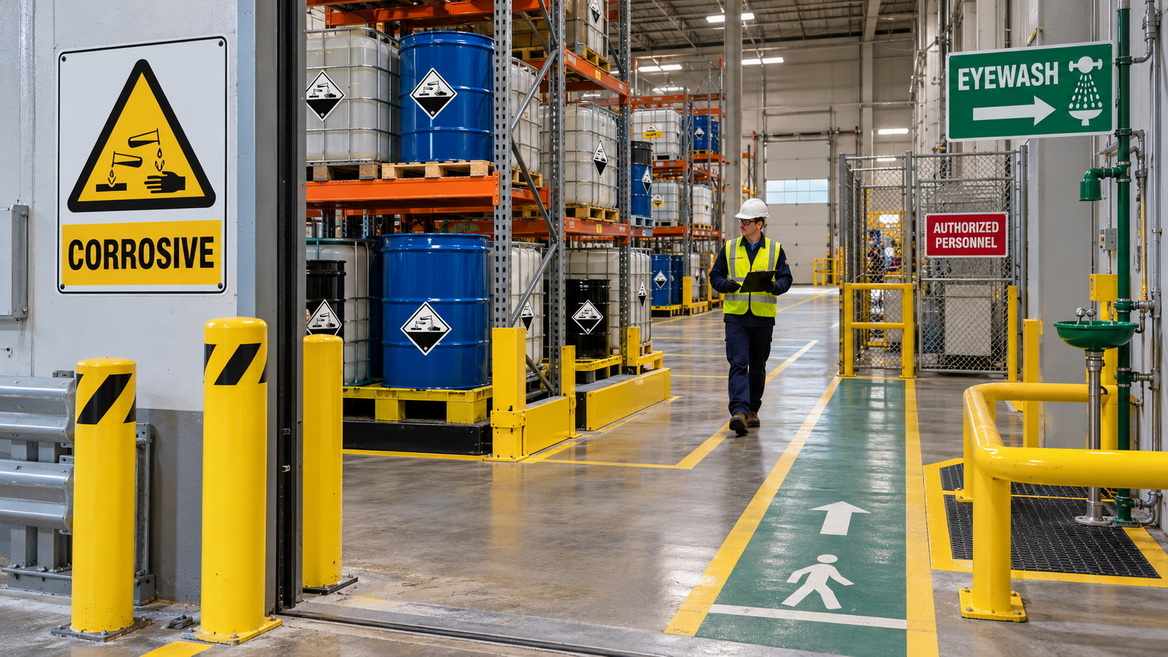
The corrosive symbol is a critical warning for chemicals that can burn skin, damage eyes, or corrode metals. It may appear on workplace labels, chemical containers, storage areas, transport packages, industrial equipment, and safety signs.
Safe corrosive-chemical management requires more than placing a symbol on a door or container. It requires clear labeling, appropriate PPE, reliable storage practices, access to Safety Data Sheets, trained workers, emergency equipment, and durable warning signs installed where people need to see them.
For industrial sites, traffic facilities, toll stations, parking areas, warehouses, manufacturing plants, and public-infrastructure projects, strong visual hazard communication supports safer operations and helps reduce preventable chemical incidents.
Shenzhen Xingsheng Traffic Facilities Co., Ltd. provides traffic-safety and facility-safety signage solutions for streets, highways, toll stations, parking areas, warehouses, industrial facilities, and related projects. OEM and ODM options can be developed according to project requirements, including sign dimensions, materials, languages, reflective grades, mounting methods, hazard symbols, and customized safety messages.
The corrosive symbol warns that a chemical may cause severe skin burns, permanent eye damage, or corrosion of metal surfaces. It usually shows liquid from two test tubes damaging a hand and a metal object.
No. The corrosive pictogram is commonly used for workplace chemical hazard communication, while the Class 8 label identifies corrosive dangerous goods during transportation. They have similar images but different applications.
Common examples include hydrochloric acid, sulfuric acid, nitric acid, hydrofluoric acid, sodium hydroxide, potassium hydroxide, concentrated ammonia solutions, industrial degreasers, and some drain-cleaning products.
Install corrosive warning signs at chemical-storage room entrances, chemical cabinets, laboratories, process areas, drum-storage zones, loading docks, transfer stations, waste-collection points, vehicle-maintenance areas, and emergency-equipment locations.
The required PPE depends on the chemical and the task. It may include chemical-resistant gloves, safety goggles, a face shield, protective clothing, chemical-resistant footwear, and respiratory protection.
1. [Occupational Safety and Health Administration: Hazard Communication Standard Pictogram QuickCard]
2. [Occupational Safety and Health Administration: Appendix A to 29 CFR 1910.1200—Health Hazard Criteria]
3. [United Nations Economic Commission for Europe: ADR Class 8 Corrosive Substances Criteria]
4. [United Nations Economic Commission for Europe: ADR 2025 Files]
5. [U.S. Environmental Protection Agency: Hazardous Chemical Inventory Reporting]
6. [Original Topic Reference: Corrosive Symbol Meaning—Important Examples & Locations]


