
Please Choose Your Language
Views: 267 Author: XS Traffic Facilities Publish Time: 2026-07-29 Origin: Site


Content Menu
● Why Arrow Boards Matter in Traffic Safety
● MUTCD and EN12352 Compliance
● How to Choose the Right Arrow Board
>> 1. Define the traffic scenario
>> 2. Match the mounting style
>> 3. Check visibility requirements
>> 5. Confirm customization needs
● Expert Insight: What Buyers Often Miss
● Why Work With an OEM/ODM Manufacturer
>> What is the main purpose of an arrow board?
>> What is the difference between an arrow board and a message board?
>> Are arrow boards required for every work zone?
>> Can arrow boards be solar powered?
>> What standards should I check before buying?
When traffic must be redirected quickly and safely, arrow boards are one of the most reliable visual warning devices available. In work zones, lane closures, highway maintenance, parking areas, and emergency operations, LED arrow boards help drivers understand where to move and how to pass through a hazard safely.
For buyers looking for a manufacturer that supports OEM and ODM customization, this guide explains how arrow boards work, what standards matter, how to choose the right model, and how to use them more effectively in real-world traffic safety projects.

An arrow board is an electronic traffic control device that uses bright LED lights to display directional arrows, chevrons, or alternating flash patterns. Its main purpose is simple: guide road users away from danger and toward the correct lane or path.
Unlike a static traffic sign, an arrow board is active and highly visible. That makes it especially useful in temporary and high-risk environments where traffic patterns change fast, such as roadwork, lane shifts, roadside maintenance, and emergency response operations.
Arrow boards improve driver decision-making at the exact moment it matters most. They reduce confusion, give advance visual guidance, and help traffic move in an orderly way through hazardous areas.
They are especially valuable when:
- Visibility is limited at night or in bad weather.
- Drivers need to merge quickly.
- Work zones create sudden lane restrictions.
- Temporary traffic control must be understood at a glance.
For contractors and road authorities, this is not just a convenience feature. It is a core part of safe work-zone communication.
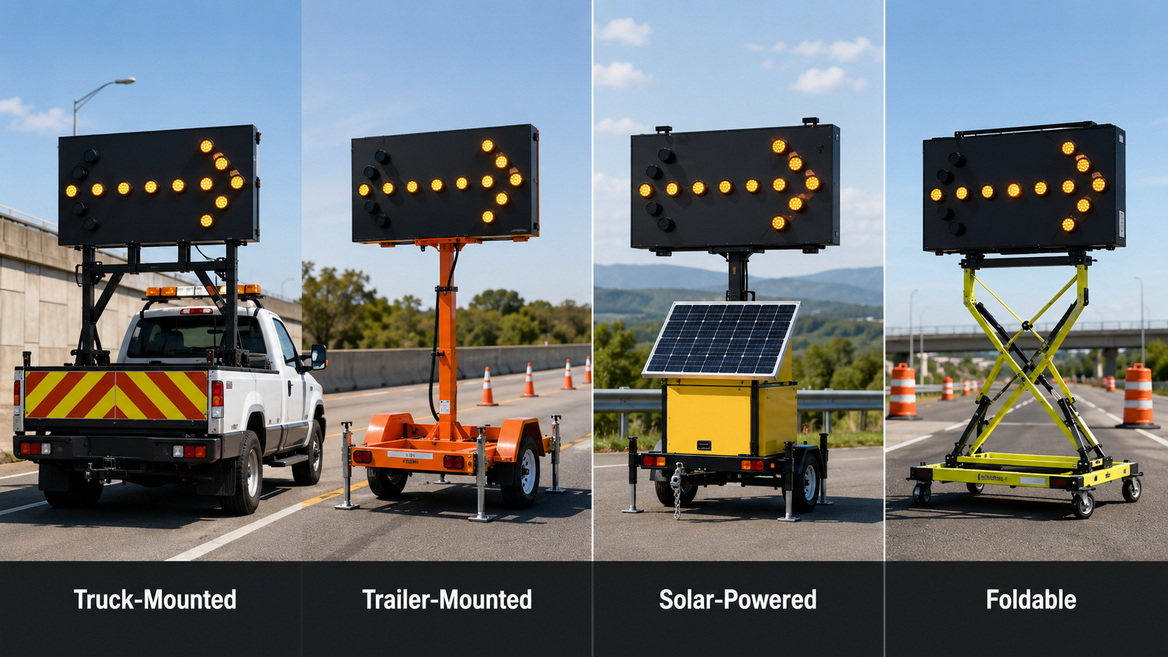
Different projects require different board sizes, mounting methods, and power systems. A well-structured product page should not only list models, but also help users compare them by use case.
| Arrow board type | Typical use case | Key benefit |
|---|---|---|
| Truck-mounted arrow board | Mobile roadwork, lane closures, utility work | Easy deployment and high mobility |
| Trailer-mounted arrow board | Highway maintenance, long-duration projects | Stable, visible, and highly portable |
| Solar LED arrow board | Remote sites, energy-saving projects | Lower operating cost |
| Foldable arrow board | Temporary maintenance and quick transport | Space-saving and convenient |
| Smart arrow board | Advanced traffic control and special applications | Flexible functions and customization |
This comparison makes it easier for buyers to match the product to the project instead of choosing only by price.
Compliance is one of the strongest trust signals in this category. In the United States, the MUTCD is the central reference for traffic control devices, and its current official edition is the 11th Edition with Revision 1.
The MUTCD guidance for arrow boards includes requirements related to size, legibility distance, dimming, and placement, including the need for nighttime dimming and the use of appropriate board types for different situations.
For European projects, EN12352 is the relevant standard for warning lights and traffic control lighting devices, covering performance and test requirements for road-user warning applications.
Why this matters to buyers: compliance helps buyers reduce risk, improve project acceptance, and choose boards that can be deployed more confidently in regulated environments.

When comparing arrow boards, buyers should look beyond LED count alone. A stronger product listing should explain the full value of the board in operational terms.
Important features include:
- High-brightness LEDs for day and night visibility.
- Multiple flash patterns for different traffic conditions.
- Weather resistance for outdoor use.
- Power options such as AC, DC, or solar.
- Portable mounting methods for trucks, trailers, and fixed installations.
- Control system flexibility for custom sequences and modes.
If you are a manufacturer, these are also the right keywords to emphasize naturally in on-page copy because they reflect what industrial buyers actually search for.
Choosing the right board depends on the project, the road environment, and the operating time. A simple decision framework helps users move from product browsing to action.
Ask whether the board will be used for lane closure, merging, detour guidance, roadside maintenance, or emergency support.
Choose vehicle-mounted units for mobile work, trailer-mounted units for larger fixed operations, and portable or foldable units when frequent transport is required.
The board should be readable from an appropriate distance and remain effective in daytime glare, nighttime work, and adverse weather conditions.
Solar power is useful for remote or low-maintenance sites, while wired or battery-powered models may suit other operating patterns better.
If your project requires OEM/ODM support, ask about panel size, controller logic, LED layout, voltage, and branding options.
Arrow boards are not limited to highway projects. They support a wide range of temporary traffic safety applications where clear visual guidance is essential.
Typical uses include:
- Temporary lane closures.
- Work zone safety management.
- Construction site traffic redirection.
- Road maintenance and utility operations.
- Emergency incident response.
- Public events and temporary access control.
This broad application range is one reason arrow boards are often purchased by contractors, municipalities, traffic control companies, and industrial site managers.
Many buyers focus on panel size and LED quantity, but the real performance difference often comes from visibility logic, placement, and controller quality. A board that looks strong in a catalog may still underperform if the flash pattern is hard to interpret, the mounting is unstable, or the brightness is not suited to the road environment.
From a buyer's perspective, the best purchase is the one that balances compliance, clarity, and durability. From a manufacturer's perspective, that means product content should explain not only what the board is, but when and why it should be used.
Correct deployment improves both safety and effectiveness. Even a high-quality board can underperform if it is positioned poorly or used without a clear traffic control plan.
Use this practical checklist:
1. Place the board where drivers can see it early enough to react.
2. Keep it stable and secure against wind and vibration.
3. Match the board mode to the actual traffic movement.
4. Inspect the LEDs, controller, and power source before deployment.
5. Re-check visibility after placement, especially at night.

Long-term reliability depends on maintenance. Buyers should ask about replacement controllers, LEDs, control boxes, and batteries before placing a bulk order.
A manufacturer-friendly page can strengthen trust by explaining that spare parts reduce downtime, simplify service, and extend the life of the board. This is especially important for customers managing multiple work zones or fleet-based operations.
For B2B buyers, the right supplier is often the one that can support customization at scale. OEM and ODM capability matters because traffic safety projects often vary by country, road standard, voltage, mounting format, and branding requirement.
A strong OEM/ODM partner should offer:
- Custom dimensions and panel layouts.
- Logo and branding options.
- Controller and PCB customization.
- Multiple mounting and power configurations.
- Support for export-oriented compliance needs.
This section helps turn the page from a generic product description into a conversion-focused manufacturing solution page.
Arrow boards are a practical, high-impact traffic safety solution for work zones, construction sites, road maintenance, and emergency traffic management. When chosen correctly, they improve visibility, reduce confusion, and help drivers respond safely and quickly.
If you are sourcing for OEM or ODM production, the most effective next step is to compare compliance needs, mounting style, power system, and customization requirements before requesting a quote.
An arrow board provides directional guidance to drivers in temporary traffic situations, especially lane closures, work zones, and road maintenance areas.
An arrow board shows directional light patterns, while a message board displays text messages and more detailed instructions.
Not every work zone needs one, but they are commonly used where traffic must merge, shift, or bypass a lane closure, especially in higher-risk and high-speed settings.
Yes. Solar-powered arrow boards are widely used for temporary traffic control because they reduce dependence on external power and support remote deployment.
For the U. S. market, check MUTCD-related requirements. For Europe, check EN12352 compliance. The correct standard depends on the target market and project location.
1. JACKWIN Safety, "Premium Arrow Board Manufacturer in China - JACKWIN-Traffic" — https://jackwinsafety.com/arrow-boards/
2. FHWA MUTCD, "2009 Edition Chapter 6F. Temporary Traffic Control Zone Devices" — https://mutcd.fhwa.dot.gov/htm/2009/part6/part6f.htm
3. FHWA MUTCD, "Manual on Uniform Traffic Control Devices (MUTCD)" — https://mutcd.fhwa.dot.gov/
4. FHWA MUTCD, "2009 Edition Part 6 Figure 6F-6. Advance Warning Arrow Board..." — https://mutcd.fhwa.dot.gov/htm/2009/part6/fig6f_06_longdesc.htm
5. Safety Sign, "Traffic and Road Safety Signage: A Complete Guide to Choosing MUTCD-Compliant Signs" — https://blog.safetysign.com/traffic-and-road-safety-signage-a-complete-guide-to-choosing-mutcd-compliant-signs?hs_amp=true
6. TRALERT, "Safety standardisation EN12352" — https://www.tralert.com/en/lighting-terms/safety-standard-en12352/
7. SIST-EN-12352-2006 PDF sample — https://cdn.standards.iteh.ai/samples/10683/9d30b8ca20b146c5845dd5e6b754a04f/SIST-EN-12352-2006.pdf
8. Capitol Barricade, "Changeable Message Board vs. Arrow Board" — https://www.capitolbarricade.com/changeable-message-board-vs-arrow-board-which-one-does-your-work-zone-need/
9. Work Zone Safety, "Guidelines on Ensuring Positive Guidance in Work Zones" — https://workzonesafety-media.s3.amazonaws.com/workzonesafety/files/documents/training/courses_programs/rsa_program/RSP_Guidance_...


