
Please Choose Your Language
Views: 238 Author: XS Traffic Facilities Publish Time: 2026-07-08 Origin: Site


Content Menu
● What Are Solar Studs and Why They Matter on Sharp Curves?
● Static Vs. Flashing Solar Studs: Core Working Principles
>> How Static Solar Studs Work on Curves
>> How Flashing Solar Studs Work on Curves
● Performance Comparison: Static Vs. Flashing Solar Studs on Sharp Curves
>> Key Safety and Performance Metrics
● When Static Solar Studs Are the Better Choice
>> Design Scenarios Where Static Mode Shines
>> Practical Layout Tips from Field Projects
● When Flashing Solar Studs Deliver Superior Safety
>> High‑Risk Curves and "Black Spots"
>> Energy Efficiency and Maintenance Benefits
● Mixed Strategies: Combining Static and Flashing Studs Along One Curve
>> Hybrid Layouts for Maximum Impact
>> Practical OEM/ODM Design Considerations
● Engineering Factors That Should Drive Your Choice
>> Key Criteria for Selecting Static or Flashing Studs
>> A Simple Three‑Step Selection Framework
● Case‑Style Overview: How Road Owners Use Each Type
>> Typical Deployment Scenarios From Industry Practice
● How Shenzhen Xingsheng Can Support Your Sharp Curve Projects
>> OEM/ODM Solar Road Markers Tailored for Sharp Curves
● Practical Implementation Checklist for Sharp Curve Warnings
>> Step‑by‑Step Approach for Road Authorities and Contractors
● Conclusion: How to Decide Between Static and Flashing Solar Studs
● FAQs About Static Vs. Flashing Solar Studs for Sharp Curves
>> 1. Are flashing solar studs always safer than static ones on sharp curves?
>> 2. Do flashing solar studs consume more energy than static studs?
>> 3. Can I mix static and flashing solar studs on the same curve?
>> 4. How do solar studs perform in heavy rain and fog compared with reflective studs?
>> 5. What technical specifications should I check before buying solar studs for sharp curves?
As a traffic safety manufacturer working with road authorities every week, I see one question coming up repeatedly: should you choose static (steady-on) or flashing solar studs for sharp curve warnings? The right answer is rarely "one-size-fits-all" — it depends on risk level, driver behavior, and your long‑term maintenance and safety goals.

Solar road studs (also called solar road markers or solar cat eyes) use built‑in solar panels and batteries to power high‑brightness LEDs at night without external wiring. Unlike traditional reflective studs that depend on vehicle headlights, solar studs actively emit light, so drivers can see the curve outline much earlier and more clearly, especially in rain, fog, and total darkness.
On sharp curves with limited sight distance, this early visual guidance is not a "nice to have" – it directly influences driver reaction time, lane discipline, and accident rates. Many field projects report accident reductions of up to 70% after upgrading to solar studs on high‑risk areas such as curves and intersections.
Static (steady‑on) solar studs emit a constant beam of light throughout the night after charging during the day. They create a smooth, continuous light corridor that guides drivers through the entire curve without visual interruption.
From the driver's perspective, static studs feel similar to a mini‑LED lane lighting system: calm, predictable, and easy on the eyes, especially on long night drives. This makes them particularly suitable for high‑speed roads where you want drivers to stay relaxed yet alert, not startled.
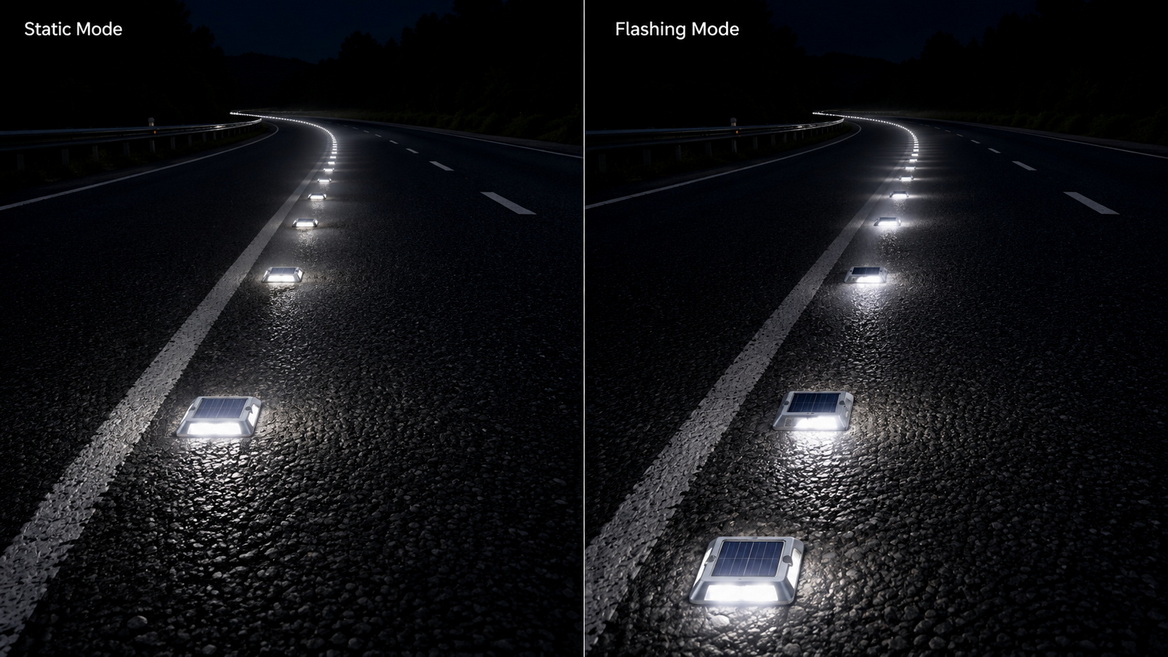
Flashing solar studs use the same solar panel and LED structure but drive the LED in blinking mode (for example, around 200 flashes per minute in common highway‑grade products). The human eye is wired to lock onto moving or blinking stimuli, so flashing studs instantly grab attention, especially when drivers are tired or distracted.
This is why many engineering guidelines recommend flashing mode in zones that require immediate hazard awareness: sharp curves, tunnel entrances, steep descents, and work zones. In practice, flashing studs act like a built‑in warning sign embedded directly into the road surface, right where the danger actually is.
The table below summarizes how static and flashing solar studs perform on sharp curves across real‑world criteria that matter to road designers and operators.
| Factor | Static (Steady‑On) Solar Studs wistronchina+2 | Flashing Solar Studs wistronchina+2 |
|---|---|---|
| Driver attention on sharp curves | Provides continuous guidance; good for lane tracking at medium to high speeds | Strong attention‑grabbing effect; ideal for high‑risk or unexpected sharp curves |
| Reaction time | Improves visibility vs reflective studs; reaction improved but less “urgent” | Faster driver response due to blinking stimulus, especially at night and in fatigue conditions |
| Driver comfort | More comfortable for long stretches and continuous curves | Can cause visual fatigue if used over‑long sections or at very high flashing rates |
| Visibility in rain/fog | Bright continuous light line; LEDs remain visible when headlights are scattered by rain | Flashing points punch through rain/fog and stand out even more than static studs |
| Power consumption | Higher overall energy use per night (LEDs always on) | Often lower power use because duty cycle is reduced in flashing mode |
| Typical use cases | Long curves, highway alignments, airport taxiways, general lane guidance | Dangerous sharp curves, tunnel portals, intersections, toll plazas, mountain roads, work zones |
Modern solar road studs typically use high‑brightness LEDs (often equivalent to 2000 MCD or more), giving a recognition distance from tens to several hundred meters, depending on layout and viewing angle. On sharp curves, this extra distance can be the difference between a controlled steering correction and a loss‑of‑control crash.
Static (steady) solar studs tend to perform best in these scenarios:
- Long curves with consistent geometry where you want a calm, continuous guidance line rather than a "warning light" effect.
- Highways and expressways with high design speeds and relatively stable traffic flow, where driver comfort and reduced distraction matter.
- Airport taxiways, parking areas, and multi‑lane toll plazas where static studs help define complex lane patterns clearly and continuously.
In these environments, over‑using flashing mode can lead to driver fatigue or "alarm saturation," where drivers begin to ignore perpetual warnings because everything seems critical. A well‑designed static layout, with correct spacing and color coding, often achieves a safer balance.
From manufacturer experience on sharp curves and interchanges, the following static layout practices are commonly adopted:
1. Tighten spacing on the apex of the curve to visually emphasize the sharpest section.
2. Use consistent color (for example, amber or white) to maintain intuitive lane guidance.
3. Combine static studs with retroreflective road markings and warning signs to reinforce the message.
For black spot curves — locations with a history of crashes or near‑misses — flashing solar studs often provide the most cost‑effective "step change" in safety performance.
Typical scenarios include:
- Mountain roads and rural sharp bends where drivers frequently underestimate curve radius at night.
- Tunnel entrances/exits with sudden lighting transitions that can temporarily blind drivers.
- Approaches to toll plazas, checkpoints, and downhill curves where speed reduction is essential.
- Temporary construction diversions where the road geometry changes unexpectedly.
In such environments, field feedback shows that flashing studs significantly improve driver awareness and lane discipline. A blinking signal effectively says: "This is not just a normal curve — slow down now."
Because the LEDs are not on 100% of the time, flashing modes can reduce energy consumption, extending battery backup times beyond 200 hours on some products after a full charge. This can be particularly valuable in regions with long rainy seasons or frequent overcast conditions, where charging time is limited.
Less energy stress on the battery also contributes to longer overall service life, reducing site visits and total cost of ownership for road agencies. For OEM/ODM manufacturers, this creates room to optimize battery capacity, LED current, and housing size for different project requirements.
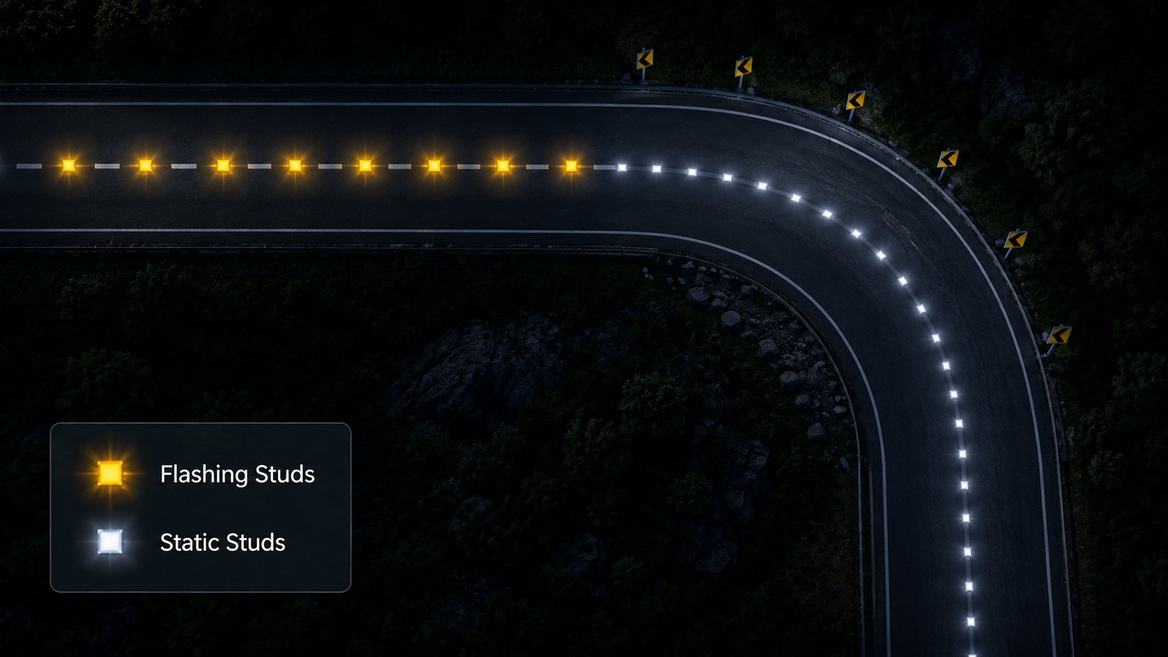
Advanced projects now rarely rely on just one mode. Many highway and city authorities are adopting hybrid layouts, using flashing and static solar studs in different sections of the same alignment. A typical design strategy:
- Use flashing solar studs at the approach zone to the sharp curve (for example, 100–300 m before the curve starts), signaling "danger ahead."
- Switch to static solar studs through the inside of the curve and exit, providing stable lane guidance.
This approach takes advantage of both modes: warning first, guiding second. For smart road stud systems, wireless synchronization can coordinate flash frequency and pattern to avoid driver confusion and ensure a smooth visual transition.
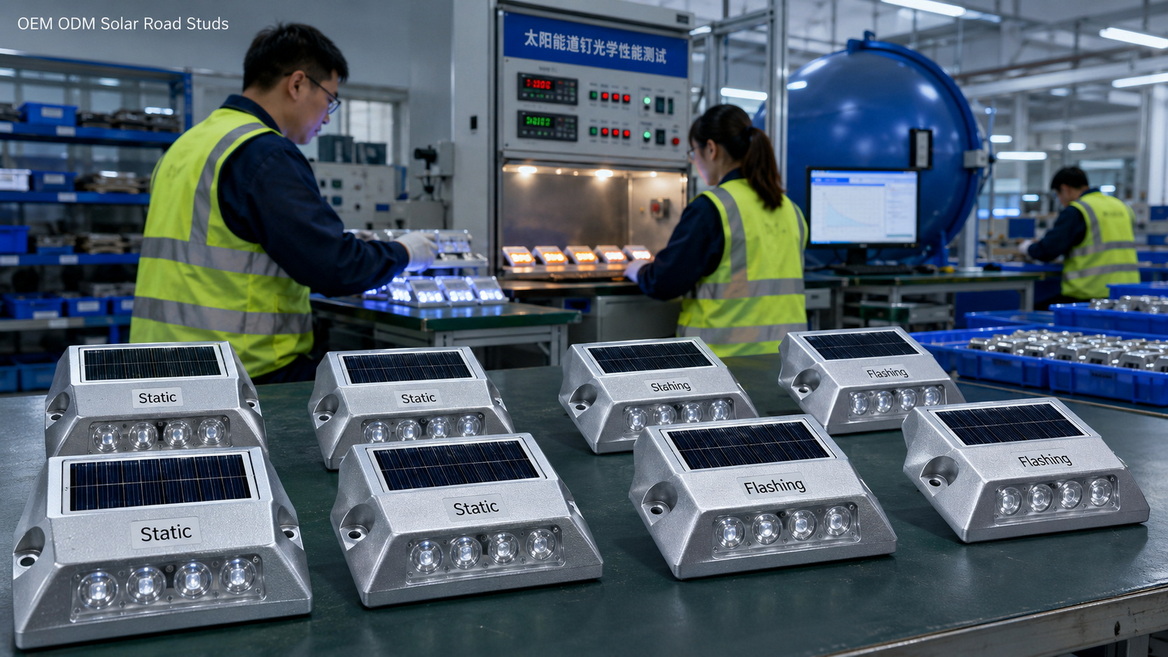
As a Chinese manufacturer like Shenzhen Xingsheng Traffic Facilities Co., Ltd., offering both static and flashing options in one platform gives clients flexibility without changing the core mechanical structure. In practice, that often means:
- One housing design, with configurable LED driving modes.
- Customizable flash frequency, color, and synchronization according to local regulations.
- Different lens designs (unidirectional, bidirectional, omnidirectional) tailored to curve geometry and lane arrangement.
When working with road engineers and safety managers, we typically evaluate at least these factors before deciding on static or flashing studs for a specific sharp curve:
- Accident history
- If the location is a known black spot with previous collisions, flashing mode is usually prioritized.
- Design speed and traffic volume
- Higher speeds and high volumes often benefit from static studs along the curve plus flashing on the approach, balancing comfort and urgency.
- Ambient lighting and weather
- On unlit rural roads with fog or heavy rain, both static and flashing modes outperform reflective studs, but flashing may give better detection at longer distance.
- Driver workload and environment complexity
- In highly complex interchanges with signage overload, a carefully placed line of flashing studs can cut through visual noise and direct focus to the most critical hazard.
- Maintenance access and budget
- If maintenance resources are limited, selecting robust IP68 aluminum housings and energy‑efficient flashing modes can extend service intervals.
From a practical OEM/ODM consulting perspective, you can use this simple framework when advising clients:
1. Classify the curve risk level
- Normal curve → usually static studs.
- High‑risk / black spot → flashing or hybrid.
2. Check operating environment
- Good lighting and low speeds → static commonly sufficient.
- Dark, rainy, mountain, or tunnel environment → flashing or mixed design.
3. Confirm policy and standards
- Align colors, flash rates, and spacing with national or regional road standards to ensure compliance and easy project approval.
Based on published engineering articles and manufacturer case summaries, the following patterns are common worldwide:
- National highways with multiple sharp curves
- Flashing studs installed at the three most dangerous bends, static studs on the rest, reducing run‑off‑road crashes while controlling investment.
- Tunnel approach roads
- Flashing studs used to "pull" driver attention into the zone where lighting changes, often synchronized with warning signs and speed control measures.
- Rural mountain roads with tourism traffic
- Static studs along most curves for general guidance; flashing studs at hairpin bends where sightseeing drivers often misjudge speed.
- Urban exit ramps and toll plazas
- Flashing studs at the ramp or plaza entrance; static studs along the diverging lanes to help drivers choose the correct lane early.
For a manufacturer like your company, packaging these learnings into clear design recommendations and layout drawings can greatly improve client trust and speed up project decisions.
As a Chinese manufacturer specializing in solar road markers and traffic safety solutions for streets, highways, toll stations, and parking areas, you are well‑positioned to provide project‑specific static and flashing configurations.
From an overseas buyer's perspective, the most valuable OEM/ODM capabilities for sharp curve applications include:
- Dual‑mode stud platforms
- One product family supporting both static and flashing modes, selectable via firmware, DIP switch, or remote configuration.
- Custom optics and colors
- Tailored lens angles for different curve radii and lane layouts, plus white, amber, red, or bi‑color LEDs that align with local standards.
- Engineering support
- Curve layout suggestions, spacing guidelines, and sample CAD drawings showing mixed static/flashing deployment for sharp curves.
- High‑durability designs
- IP68 aluminum housings, high load capacity, and low‑maintenance solar/battery configurations suitable for heavy trucks and harsh climates.
Suggested visual:
Close‑up 3D render of a heavy‑duty aluminum solar road stud with dual‑mode labeling (Static / Flashing), installed on an asphalt curve with visible lane markings.
To move from concept to a successful sharp‑curve solar stud project, decision makers can follow this practical checklist, which we frequently see in high‑performing projects:
1. Collect data
- Curve radius, design speed, crash history, traffic volume, lighting conditions, and weather profile.
2. Define safety objective
- For example: reduce run‑off‑road crashes by 40% over three years.
3. Choose stud mode strategy
- Static, flashing, or hybrid, based on risk level and environment, using the framework described above.
4. Design layout
- Determine stud spacing, color sequence, start/end points, and any transition zones between flashing and static.
5. Confirm specifications with OEM/ODM partner
- Verify load capacity, IP rating, luminous intensity, view angle, battery backup hours, and expected lifespan.
6. Pilot installation and monitoring
- Install on one or two curves first, collect feedback from drivers and maintenance teams, and adjust the layout if needed.
7. Scale up deployment
- After validation, replicate the design on similar curves in the network for consistent safety performance.
For normal curves and long guidance sections, static solar studs usually offer the best balance of comfort, visibility, and simplicity. For high‑risk sharp curves, black spots, and sudden geometry changes, flashing studs significantly improve driver attention and reaction time, especially in poor weather and dark environments. In many projects, the optimal solution is a hybrid layout that uses flashing studs on the approach and static studs through the curve to combine warning and guidance.
As a manufacturer like Shenzhen Xingsheng, your competitive edge lies in delivering flexible, high‑reliability dual‑mode solar road markers, plus engineering support that helps authorities select the right mode for each curve rather than forcing a single default option.
Not always. Flashing studs offer better attention and faster reaction, but if used on every curve they can cause visual fatigue and reduce their warning value. The safest designs usually reserve flashing mode for genuinely high‑risk curves and use static studs elsewhere.
In many designs, flashing mode actually consumes less energy, because the LED is off part of the time, extending battery backup beyond 200 hours after full charge in some models. Static studs remain on continuously, so their nightly energy use is higher.
Yes. Many modern projects use flashing studs on the approach to the curve and static studs along the curve itself. This hybrid approach sends a strong warning before the hazard and then guides drivers smoothly through it.
Solar studs provide active LED lighting that remains visible even when rain and fog scatter headlight beams, while reflective studs lose effectiveness under the same conditions. This makes solar studs particularly valuable on dark, wet mountain curves and coastal roads.
Key parameters include LED brightness, viewing angle, battery capacity and backup hours, IP rating (often IP68), load capacity for heavy trucks, operating temperature range, and choice of static/flashing or dual‑mode operation. For OEM/ODM projects, also confirm customization options for color, flash frequency, and housing material.
1. JINXIN – *Benefits of Solar Road Studs for Highway Safety and Sustainability* – discussion of solar stud visibility, durability, and highway use cases. https://www.chinaroadstud.com/news/benefits-of-solar-road-studs-for-highway-safety-and-sustainability.html
2. Wistron – *Should Solar Road Studs Flashing or Not? A Look at G105 Solar Road Stud* – comparison of flashing vs steady modes, suggested application scenarios, and energy performance. https://www.wistronchina.com/should-solar-road-studs-flashing-or-not-a-look-at-g105-solar-road-stud/)
3. HAROAD – *How to Choose Solar Road Studs for Pathway to Ensure Visibility and Safety* – mode selection guidance for steady vs flashing operation in different environments. https://www.haroadstud.com/blog/how-to-choose-solar-road-studs-for-pathway-to-ensure-visibility-and-safety.html)
4. UKEN Industry – *Solar Road Studs vs. Reflective Road Studs* – comparative data on visibility, environmental adaptability, and durability. https://www.uken-industry.com/solar-road-studs-vs-reflective-road-studs/)
5. Wistron – *Solar LED Road Studs vs Reflective Road Studs: Which One Performs Better?* – engineering‑focused analysis on visibility, maintenance, and accident reduction. https://www.wistronchina.com/solar-led-road-studs-vs-reflective-road-studs-which-one-performs-better/)
6. TraffiClair – *ClairSRS Smart Road Studs* – overview of smart, solar and wired road stud platforms and configuration flexibility. https://www.trafficlair.com/ClairSRS/)


