
Please Choose Your Language
Views: 271 Author: XS Traffic Facilities Publish Time: 2026-09-23 Origin: Site


Content Menu
● Why Road Sign Visibility Is Important
● How Retroreflective Road Signs Improve Nighttime Safety
>> Common Types of Reflective Sheeting
● Why Signs Alone Are Not Enough
>> The Role of Solar Road Markers
● How Solar Road Markers Support Different Applications
>> Highways and Curved Road Sections
>> Toll Stations and Toll Plaza Approaches
>> Parking Lots and Parking Structures
● A Practical Road Visibility Assessment Process
>> Step 1: Identify High-Risk Locations
>> Step 2: Inspect the Site at Night
>> Step 3: Select Products Based on the Problem
>> Step 4: Plan for Maintenance
● What to Consider When Sourcing Solar Road Markers
>> Important Product Specifications
● Best Practices for Better Roadway Guidance
>> What is the difference between retroreflective road signs and solar road markers?
>> Are solar road markers suitable for highways?
>> Can solar road markers be used in parking lots?
>> Which reflective sheeting is suitable for high-speed roads?
>> How can road sign visibility be improved at night?
Road sign visibility is more than a matter of installing a sign beside the road. For a driver, especially at night or in poor weather, every sign must be seen, understood, and acted upon within a limited amount of time.
On a highway curve, a driver may need to slow down before entering the bend. At a toll plaza, they may need to identify the correct lane quickly. In a parking area, they may need to follow a safe route while watching for pedestrians, parked vehicles, and delivery traffic. In each situation, poor visibility can create hesitation, sudden braking, lane confusion, or unsafe movement.
A reliable traffic safety system combines multiple elements, including retroreflective road signs, pavement markings, road delineators, chevrons, channelizers, and solar road markers. Each product plays a different role. Together, they create clearer visual guidance for drivers during the day, at night, and in challenging weather conditions.
Shenzhen Xingsheng Traffic Facilities Co., Ltd. provides solar road markers and traffic safety products for streets, highways, toll stations, parking lots, industrial facilities, and customized road safety projects. With OEM and ODM capabilities, the company supports buyers who need customized product designs, lighting configurations, branding, packaging, and application-specific solutions.

Drivers rely on visual information to make fast decisions. They need to know where to go, what hazards are ahead, which lane to use, and when they need to slow down or stop.
During daylight hours, signs are usually easy to identify. At night, however, visibility changes significantly. Headlights become the main source of illumination for many roads, especially in rural areas, industrial zones, private facilities, and low-light parking areas.
Rain, fog, snow, dust, glare, faded sign faces, worn pavement markings, and roadside obstacles can make traffic-control devices more difficult to see. A sign may be installed in the correct location but still fail to provide enough warning if its reflective surface is damaged, dirty, poorly positioned, or hidden by vegetation.
For this reason, effective traffic visibility requires more than one product. A road user should receive information in a clear sequence:
1. Advance warning before reaching a hazard or decision point
2. Clear instruction at the location where action is required
3. Continuous guidance while travelling through the area
4. Confirmation that the driver is following the correct path
This principle is useful for nearly every traffic environment, from high-speed roads to low-speed parking facilities.
Retroreflectivity is the ability of a material to return light toward its source. On a road sign, the source is usually a vehicle's headlights.
When headlights shine onto a retroreflective sign, the surface sends light back toward the approaching driver. This makes the sign easier to see and read at night. Unlike a standard painted surface, retroreflective sheeting is engineered to provide stronger visibility from the direction of approaching traffic.
Road signs with effective reflective sheeting can help drivers recognize important information earlier, including:
- Speed limits
- Stop and yield instructions
- Curve warnings
- Lane-use guidance
- Exit and destination information
- Toll-lane directions
- Work-zone warnings
- Parking and pedestrian instructions
- Restricted-access notices
- Hazard identification
The correct level of reflectivity depends on the road environment. A low-speed private parking area may require different sign materials than a high-speed highway interchange or a dangerous mountain curve.
Several categories of reflective sheeting are commonly used for traffic signs. Each option has a different level of brightness, durability, and cost.
| Reflective Sheeting Type | Typical Visibility Level | Common Applications |
|---|---|---|
| Engineer Grade | Basic | Parking signs, private-property signs, low-speed wayfinding |
| High-Intensity Prismatic | High | Streets, intersections, construction zones, warning signs |
| Diamond Grade or Full-Cube Prismatic | Very high | High-speed roads, stop signs, school zones, toll areas, critical warnings |
Engineer Grade sheeting is often suitable for basic information signs, temporary signage, and lower-risk areas. It can be used in locations where vehicle speeds are low and drivers have more time to react.
High-Intensity Prismatic sheeting provides stronger brightness and is widely used for permanent traffic signs, construction zones, regulatory signs, warning signs, and urban roadway applications.
Diamond Grade or Full-Cube Prismatic sheeting is generally selected for demanding applications. It is often used at major intersections, high-speed roads, school zones, toll stations, sharp curves, and locations where earlier sign recognition is especially important.
The strongest sheeting is not always necessary for every project. The best choice depends on vehicle speed, road design, weather exposure, local lighting, driver workload, and the consequences of a missed message.
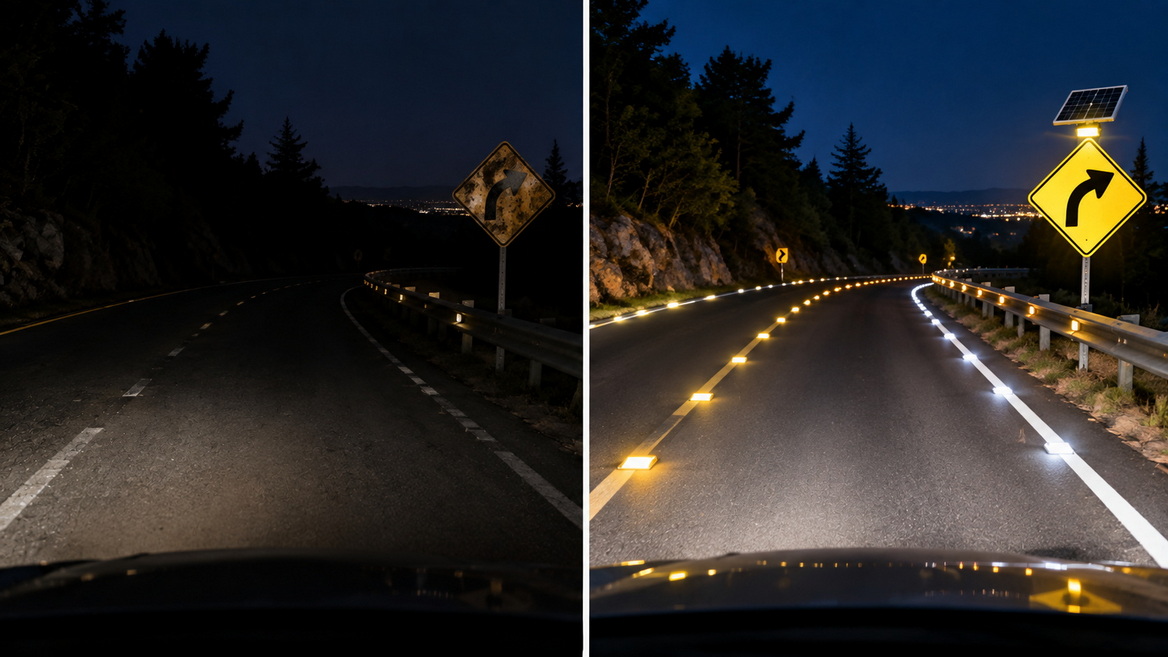
A traffic sign can alert drivers to a condition ahead, but it may not provide continuous guidance after the driver passes it.
For example, a curve warning sign tells drivers that a bend is approaching. Once a vehicle enters the curve, the driver still needs to see the road edge, lane boundaries, and direction of travel. If road markings are faded or the roadway is dark, drivers may struggle to maintain safe alignment.
The same issue can occur in other locations:
- Toll station approaches with multiple payment lanes
- Parking lots with unclear traffic circulation
- Highway ramps and lane merges
- Industrial facilities with heavy trucks and forklifts
- Rural roads without street lighting
- Roundabouts and channelized intersections
- Construction zones with temporary lane shifts
- Pedestrian crossings near commercial areas
- Port terminals and logistics yards
A complete visibility system should include signs for communication and guidance devices for path definition.
Solar road markers are active traffic safety devices that use solar energy to generate light at night. During the day, the integrated solar panel captures energy. After dark, the stored energy powers LEDs that can provide steady or flashing illumination.
Unlike passive reflectors, which depend on vehicle headlights, solar road markers can remain visible before a driver's headlights reach them. This can improve early route recognition in dark conditions.
Solar road markers are particularly useful for improving the visibility of:
- Lane dividers
- Road edges
- Curves and bends
- Highway ramps
- Toll booth approaches
- Traffic islands
- Median separators
- Pedestrian crossing approaches
- Parking-lot drive aisles
- Roundabout boundaries
- Industrial access roads
- Low-light private roads
Solar road markers should be used as part of a wider traffic safety plan. They can support signs, pavement markings, delineators, and other traffic-control products by making the road path easier to follow at night.
Different traffic environments create different visibility challenges. The same solar road marker configuration may not be suitable for every location.
A high-speed road may require high load resistance, long visible distance, strong waterproof performance, and carefully planned spacing. A parking lot may place greater emphasis on color coding, low-speed guidance, ease of installation, and visual organization.
Urban streets often include parked vehicles, pedestrians, bicycles, intersections, storefront lighting, and frequent lane changes. These elements can make it difficult for drivers to identify roadway boundaries.
Solar road markers can be installed along lane divisions, medians, curves, pedestrian approaches, and traffic islands. They can help create a more visible travel path when street lighting is limited or when rain reduces the visibility of painted lines.
Highway drivers travel at higher speeds and need more time to understand road conditions. Curves, ramps, lane transitions, and exits require especially clear guidance.
Solar road markers can support highway visibility by helping drivers identify:
- Lane alignment
- Outer road edges
- Median boundaries
- Curve direction
- Ramp entrances
- Exit lanes
- Channelized areas
- Hazard zones
For curved road sections, road signs may provide early warning, while solar road markers and pavement markings guide the vehicle through the curve. This creates a more complete visual sequence for drivers.
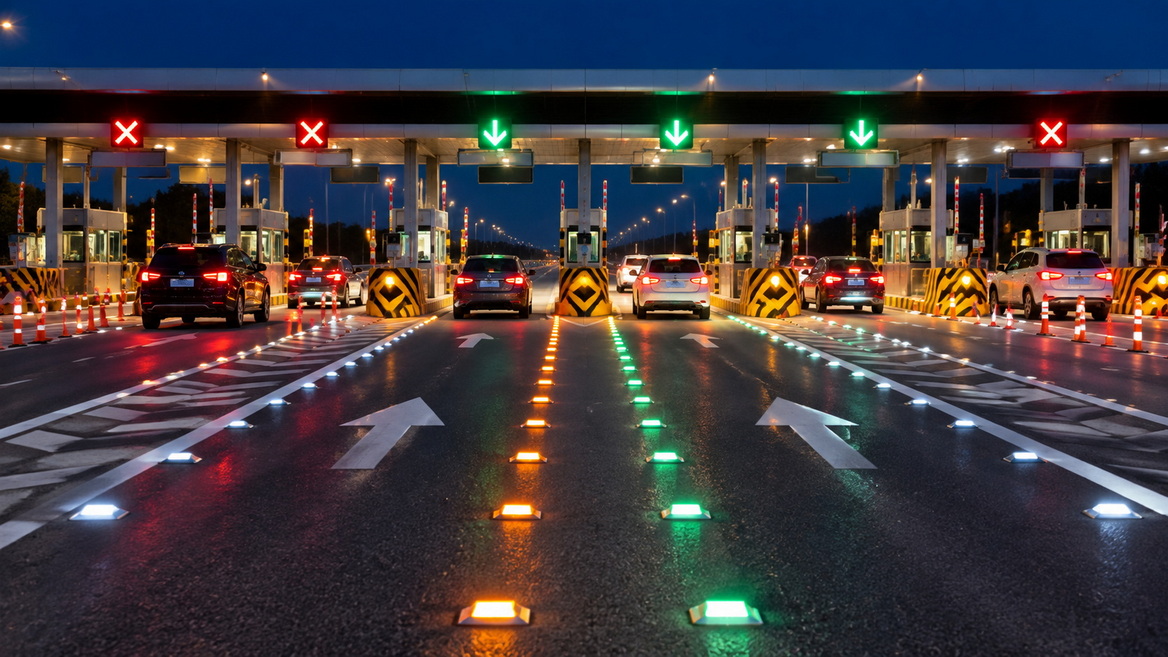
Toll plazas are high-information traffic environments. Drivers often need to select a lane, identify payment methods, reduce speed, follow arrows, and avoid barriers or channelizers.
Solar road markers can help define approach lanes and improve lane separation. They can also be used to guide vehicles toward designated payment lanes, electronic toll lanes, truck lanes, or restricted-access lanes.
A clear toll-plaza visibility plan may include:
- Overhead lane signs
- Directional arrows
- Pavement markings
- Channelizers
- Reflective barriers
- Solar road markers
- Warning signs
- Speed-control signs
- Lane-use messages
The goal is to reduce confusion before vehicles reach the toll booths.
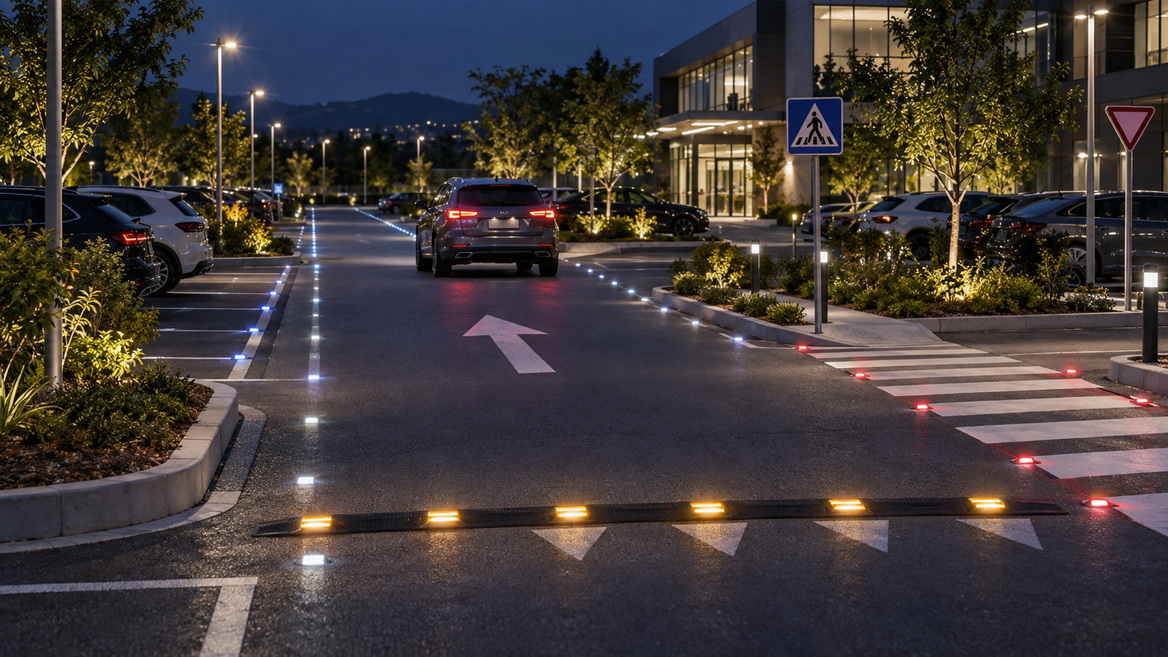
Parking areas may have lower vehicle speeds, but they often include a high number of potential conflicts. Drivers need to watch for pedestrians, reversing vehicles, shopping carts, delivery trucks, bicycles, columns, ramps, and parked cars.
Solar road markers can improve traffic organization by highlighting:
- Entry and exit routes
- One-way lanes
- Pedestrian crossings
- Parking bay edges
- Speed humps
- Turn points
- Restricted zones
- Emergency access routes
- Loading areas
- Underground parking ramps
In parking garages and outdoor parking facilities, solar markers can provide additional guidance in areas where ordinary road paint is difficult to see.
Before selecting signs, reflective materials, or solar road markers, project owners should evaluate the actual conditions of the site.
A practical assessment process can help identify the locations where visibility improvements are most valuable.
Begin by identifying points where drivers must make quick decisions or change their driving behavior.
Common high-risk locations include:
- Sharp curves
- Stop-controlled intersections
- Highway exits
- Toll-lane approaches
- Lane merges
- Roundabouts
- Pedestrian crossings
- School zones
- Work-zone transitions
- Parking-lot exits
- Truck entrances
- Industrial yards
- Poorly lit access roads
The key question is simple: Can an unfamiliar driver understand what to do in time?
A daytime inspection is useful, but it does not show the full visibility challenge. Nighttime inspections are essential for identifying issues that may not be obvious during the day.
During the inspection, check the following:
- Are signs readable from the expected approach distance?
- Are lane lines, road edges, and curves easy to identify?
- Is there glare from headlights, streetlights, storefronts, or billboards?
- Are trees, parked vehicles, poles, or structures blocking signs?
- Are signs dirty, faded, damaged, or incorrectly positioned?
- Are pavement markings worn or difficult to see in wet conditions?
- Do drivers receive enough advance warning before a turn, curve, or lane split?
- Is the roadway path visible after the driver passes the warning sign?
This process can reveal gaps between the information a road user receives and the guidance they actually need.
The best traffic safety product depends on the visibility problem being solved.
| Traffic Condition | Main Visibility Challenge | Recommended Products |
|---|---|---|
| High-speed curve | Early warning and route alignment | Warning signs, chevrons, road edge markings, solar road markers |
| Toll plaza | Lane selection and controlled traffic flow | Lane signs, directional arrows, channelizers, solar road markers |
| Rural road | Limited lighting and unclear road edges | High-visibility signs, delineators, pavement markings, solar markers |
| Parking lot | Low-speed circulation and pedestrian conflict | Wayfinding signs, speed signs, reflective markings, solar road studs |
| Industrial facility | Truck movement and restricted-access zones | Direction signs, reflective barriers, lane markings, warning markers |
| Work zone | Temporary lane changes and hazard alerts | Temporary signs, cones, barriers, reflective devices, warning lights |
Traffic visibility products should be maintained throughout their service life. Dirt, water, UV exposure, snow, salt, vehicle impact, vibration, and surface wear can reduce performance over time.
A practical maintenance plan should include:
- Routine nighttime inspections
- Cleaning of sign faces and solar panels
- Replacement of damaged or faded products
- Inspection after severe weather events
- Checks after resurfacing or road repairs
- Review of battery and LED performance
- Replacement planning for high-traffic locations
- Installation records by product type and location
A product that is visible on the first day but poorly maintained may not provide the same long-term safety value.
For contractors, distributors, project owners, and traffic safety buyers, product selection should be based on application requirements rather than appearance alone.
Before placing an order, define the technical and commercial requirements clearly.
Consider the following factors when sourcing solar road markers:
- Application environment
- Installation location
- Traffic volume
- Vehicle loading requirement
- Required light color
- Lighting direction
- Flashing or steady-light mode
- Solar panel performance
- Battery capacity
- Charging time
- Working time after charging
- Waterproof performance
- Dust resistance
- Housing material
- LED quantity and brightness
- Operating temperature range
- Installation method
- Product dimensions
- Packaging requirements
- Logo and branding requirements
- Required testing documents
For example, a highway project may require heavy-duty aluminum solar road markers with strong pressure resistance and long working hours. A parking project may require smaller products with customized colors, easy installation, and private-label packaging.
Shenzhen Xingsheng Traffic Facilities Co., Ltd. can support customized solar road marker projects through OEM and ODM services. Customization options may include product housing, LED color, lighting mode, logo marking, packaging design, instruction materials, labeling, and selected product configurations.
The most effective traffic safety projects use multiple layers of visibility rather than relying on one product alone.
Consider the following practical principles:
- Use signs to provide warnings, instructions, and regulations
- Use pavement markings to define lanes and travel paths
- Use delineators and chevrons to improve route recognition
- Use solar road markers where active nighttime guidance can add value
- Prioritize high-risk locations such as curves, ramps, toll areas, and pedestrian crossings
- Inspect projects after dark before final acceptance
- Consider rain, fog, dust, snow, glare, and surface drainage
- Select products according to traffic speed and loading conditions
- Establish a maintenance schedule before installation
- Follow local traffic rules, engineering requirements, and project specifications
A strong traffic guidance system does not simply place a bright sign before a hazard. It provides drivers with a clear visual path from the moment they receive a warning until they have safely passed through the area.
Road sign visibility is a critical part of traffic safety planning. Signs must be easy to see, easy to understand, and supported by clear roadway guidance. Retroreflective sheeting improves sign recognition at night, while pavement markings, delineators, chevrons, and solar road markers help drivers follow the intended path.
For streets, highways, toll plazas, parking areas, industrial facilities, and private roads, an integrated visibility strategy can improve driver confidence and reduce confusion in challenging conditions.
Shenzhen Xingsheng Traffic Facilities Co., Ltd. provides solar road markers and related traffic safety products for a wide range of transportation applications. Through OEM and ODM services, the company supports customized product solutions for distributors, contractors, road projects, and commercial traffic safety buyers.
Retroreflective road signs return light from vehicle headlights toward the driver. Solar road markers use solar energy to power LEDs and create active illumination at night. Signs communicate warnings and instructions, while solar markers support lane guidance, road boundaries, curves, and traffic flow.
Yes. Solar road markers can be used on highways, ramps, curves, medians, lane separations, and other areas where improved nighttime guidance is needed. The selected product should match the traffic load, installation surface, weather conditions, and project requirements.
Yes. Solar road markers are well suited for parking lots, parking structures, commercial facilities, hospitals, campuses, industrial zones, and private roads. They can help guide vehicles around turns, lanes, crossings, speed humps, loading areas, and restricted zones.
High-Intensity Prismatic and Diamond Grade reflective sheeting are commonly selected for demanding road environments. The final choice should be based on road speed, sign type, local lighting, weather exposure, and the importance of early sign recognition.
Road sign visibility can be improved by selecting suitable reflective sheeting, placing signs correctly, removing obstructions, maintaining clean sign faces, upgrading faded products, improving pavement markings, adding delineators, and using solar road markers in areas that require stronger nighttime guidance.
1. Traffic Safety Warehouse. "Enhancing Safety with Reflective Sheeting: A Guide to Sign Visibility."
[https://www.trafficsafetywarehouse.com/Resources/guide-to-sign-visibility.asp]
2. Federal Highway Administration. "Manual on Uniform Traffic Control Devices."
[https://mutcd.fhwa.dot.gov/index.htm]
3. Federal Highway Administration. "Minimum Sign Retroreflectivity Requirements."
[https://highways.dot.gov/safety/other/visibility/minimum-sign-retroreflectivity-requirements]
4. Federal Highway Administration. "Nighttime Visibility: Sign Retroreflectivity Frequently Asked Questions."
5. Federal Highway Administration. "Proven Safety Countermeasures."
[https://highways.dot.gov/safety/proven-safety-countermeasures]
6. Federal Highway Administration. "Pavement Marking Safety Studies: Benefits of Pavement Markings."


